The concrete truck has just left, the chute is still dripping, and your foreman is holding a rental agreement he signed beside the washout pan. The vendor's dispatcher says pickup is scheduled for tomorrow. The contract says rent continues until written off-hire confirmation, cleaning is billed separately, and any slurry release is the renter's responsibility. Nobody on the crew can say exactly when the rental period started, when it ends, or who pays if the pan comes back damaged.
That confusion is common because concrete washout containment rentals have a different risk profile from ordinary equipment rentals. A ladder, generator, or mini-excavator is usually evaluated by condition and operating performance. A washout pan is also a temporary environmental-control system. It receives cement slurry, holds contaminated wash water, depends on proper placement, and eventually requires collection, cleaning, disposal, or replacement.
The contract matters most when the site is under pressure. The driver arrives, the pour is moving, and the project manager may not be present. Crews skim the paperwork, sign for delivery, and assume the remaining language is boilerplate. That assumption is expensive. Rental agreement terms decide who controls delivery timing, disposal decisions, damage exposure, notice requirements, and the point at which rent stops.
Why Washout Rental Contracts Catch Crews Off Guard
A foreman watches the concrete truck pull away and then notices a line in the washout agreement about cleanup. The vendor interprets the clause as authorization to charge a substantial cleanup surcharge after the pan is returned with hardened material. The foreman remembers discussing a clean pickup with the dispatcher, but the signed document says something else.
That moment catches crews off guard because a washout rental combines several transactions that ordinary equipment agreements often keep separate:
- Containment: The renter receives a pan or container intended to hold concrete slurry and wash water.
- Site logistics: Delivery, placement, access, pickup, and off-hire notice control the usable rental period.
- Environmental handling: The contract may assign responsibility for runoff prevention, disposal coordination, and compliance with project requirements.
- Condition and cleaning: The renter may owe charges for damage, excessive residue, hardened concrete, or a failed return inspection.

The clock starts before the crew is ready
Washout rentals often run on delivery-driven schedules. The pan may arrive before the pour, remain on site through several concrete placements, and need rapid removal when access changes. A contract that measures the term from delivery can charge rent while the pan is present but not yet usable. A contract that requires written off-hire confirmation can keep rent running after the crew believes it has requested pickup.
The equipment rental agreement template identifies this start-and-stop problem as an underserved issue in short-term construction rentals. Its discussion also points to a recent commercial dispute statistic, with 2025 dispute-mediation filings reported at 4,726, up 17% year over year and 66% over three years. That statistic doesn't prove every dispute involves washout containers, but it reinforces the operational lesson: unclear term boundaries and notice mechanics create real commercial friction.
Environmental language changes the risk
A washout pan isn't just a box left beside a mixer. The crew must place it where slurry won't escape, keep wash water inside the containment area, monitor capacity, and follow the project's stormwater plan. The agreement may refer to NPDES requirements, EPA rules, state permits, municipal restrictions, or the site-specific SWPPP without explaining how those obligations interact with the vendor's service.
Field rule: Never let the delivery driver be the first person who explains the rental term, disposal process, or environmental responsibility. Review those points before the truck arrives.
The rest of the contract deserves the same attention. You need to know what was delivered, what you're paying for, what condition is acceptable at return, what notice ends rent, and whether the vendor's broad indemnity language transfers risks your insurance wasn't designed to absorb.
The Core Building Blocks of a Rental Agreement
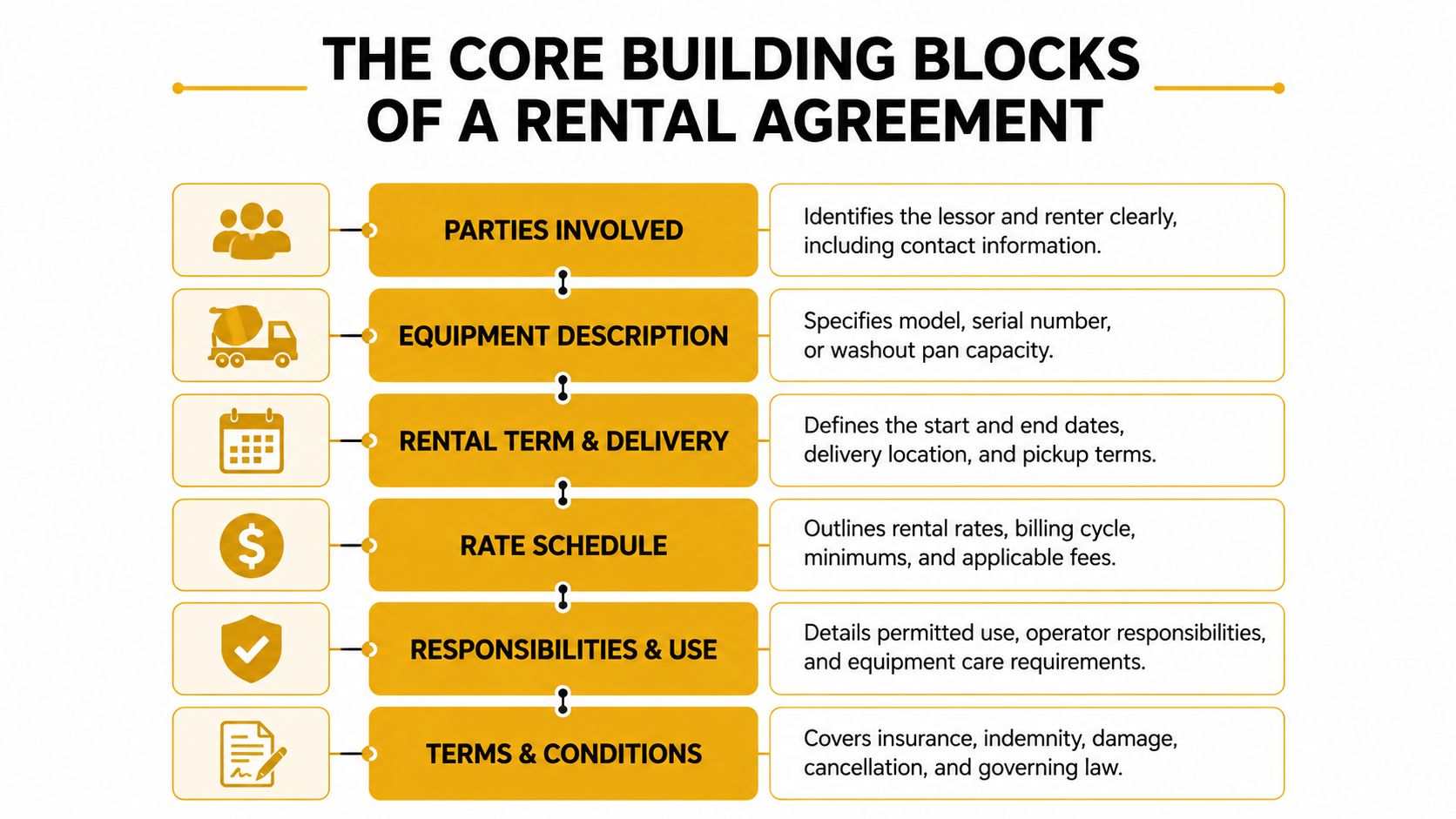
A rental agreement becomes easier to control when you read it as a set of building blocks rather than a wall of legal text. Start at the top and verify each block against the physical washout setup.
Identify the parties and the equipment
The parties block should name the actual renter, the vendor, and any approved project entity. If the general contractor signs the agreement but a concrete subcontractor operates the pan, the contract should clarify who has operating, inspection, and return duties.
The equipment description needs more than “washout pan.” Record the pan size, container type, accessories, condition, and any serial or asset number. Match the document to the item on the ground. If the agreement identifies a different pan, the vendor may later argue that the wrong equipment was returned or that a different condition standard applies.
Define delivery, term, and pricing
The rental term should answer four questions plainly:
- Does rent begin at dispatch, delivery, placement, signing, or first use?
- What happens if the truck arrives outside the agreed delivery window?
- Does rent stop when the renter requests pickup or only after written off-hire confirmation?
- What charges continue during a pickup delay?
The rate schedule should separate base rent from delivery, collection, cleaning, disposal, rough-access, express-order, and damage charges. A daily rate that looks reasonable can become difficult to budget if the agreement leaves add-ons open-ended.
Separate duties from remedies
The renter obligations should cover placement, use, inspection, access, prohibited materials, spill response, and return condition. The vendor obligations should cover delivery, pickup, equipment suitability, damage reporting, and disposal services if the vendor provides them.
Insurance and indemnity are separate concepts. Insurance describes coverage. Indemnity describes who must protect the other party from claims, costs, or losses. Default and termination explain what happens after nonpayment, misuse, delayed pickup, or another breach. The signature block confirms which people accepted the terms and whether an addendum or purchase order modifies them.
Every later dispute sits inside these building blocks. If the parties, pan, term, pricing, duties, and remedies are vague, the detailed clauses won't rescue the deal.
Key Clauses That Shape Every Washout Rental
A crew schedules a washout pan for a short concrete pour. Delivery arrives late, pickup is delayed, and the pan contains hardened slurry at collection. The dispute rarely turns on the daily rate. It turns on whether the agreement defined delivery, off-hire, condition, environmental duties, and proof.
| Clause Category | What It Controls | Washout Rental Risk |
|---|---|---|
| Delivery and pickup | Arrival windows, access, collection, waiting time | Rent may begin before usable placement or continue during a delayed pickup |
| Daily rates and surcharges | Base rent and added charges | Environmental, fuel, access, idle-day, or service fees may appear after delivery |
| Damage and condition | Repair, replacement, cleaning, and wear standards | A cracked pan or hardened slurry may trigger broad recovery costs |
| Insurance | Required policies, limits, certificates, and additional insured status | The renter may discover that its policy doesn't match the contract |
| Indemnity | Responsibility for third-party claims and legal costs | A slurry release can become the renter's obligation even when fault is disputed |
| Environmental compliance | Stormwater, disposal, wash-water, and site rules | The crew may accept duties it can't perform without vendor support |
| Extensions and termination | Renewal, early return, notice, and minimum charges | Rent can continue because the correct notice wasn't delivered |
| Security deposits | Holdback and release conditions | The vendor may retain funds for undefined cleaning or disposal issues |
| Invoicing | Billing date, supporting documents, late fees, and recipient | Charges may reach the wrong entity or arrive without inspection evidence |
| Dispute resolution | Venue, arbitration, governing law, and attorney fees | A local site dispute may have to proceed in a distant forum |
Delivery and pickup set the billable term
Require a defined delivery window, a named site contact, and written placement evidence. The contract should identify the event that starts rent. It might be arrival at the site, placement in the designated washout area, or renter acceptance after inspection. Those events produce different risks, especially when the pan reaches the gate but cannot be positioned safely.
Pickup requires the same precision. The agreement should require the vendor to acknowledge a pickup request and state the condition that ends rent. If the pan is ready but the vendor cannot access the site, the contract must say whether charges continue. Push for a clear cutoff and a process for documenting a vendor-caused delay.
Rates, damage, and liability need boundaries
A vendor can charge for transport, cleaning, and disposal. Reject undefined additions such as “special handling,” “excessive contamination,” or “all costs.” Ask for a rate schedule, a condition standard, and supporting records for every extra charge. The schedule should distinguish expected cement residue from hardened buildup, prohibited material, structural damage, and disposal that requires special treatment.
The Crowley equipment lease terms illustrate a useful default structure. Nonpayment when due can trigger default, while another uncured breach may receive a written cure period of 15 days before repossession and termination. A washout agreement should separate immediate payment failures from correctable administrative problems, such as missing inspection photographs or delayed paperwork.
Insurance, indemnity, and environmental duties must match
Require the vendor to specify certificate requirements, additional insured wording, and exclusions involving slurry, wash water, pollution, and vehicle access. Confirm that the coverage your project carries responds to the duties assigned in the agreement.
Indemnity deserves separate review. Do not accept language that makes the renter responsible for every claim connected with possession or use, regardless of the vendor's negligence, defective equipment, delivery conduct, or disposal decisions. Assign each party responsibility for the acts it controls, and require the vendor to stand behind its own services.
Environmental language must identify who controls placement, stormwater protection, wash-water handling, slurry containment, and disposal records. A clause that assigns compliance to the crew without giving it control over pickup or disposal creates an avoidable liability gap. Require prompt notice of any release and a defined response process.
Extensions, deposits, invoices, and disputes finish the deal
An extension clause should state the notice method, renewal mechanics, and pricing after the original term. Do not let an automatic renewal or minimum charge continue because a superintendent used the wrong communication channel. Identify the people authorized to extend or end the rental.
A deposit clause should set the inspection deadline, permitted deductions, and refund timing. Invoicing should require an itemized bill covering delivery, pickup, cleaning, disposal, and damage, with photographs, weight records, or other supporting evidence where relevant. The vendor should send invoices to the contracting entity and identify the rental period covered.
Dispute resolution decides whether the parties use negotiation, court, or arbitration, and where the process occurs. For a short rental, a distant venue or mandatory arbitration can cost more to challenge than the disputed charge. Ask for written notice, a prompt opportunity to inspect disputed damage, and a practical forum near the project or contracting parties.
Treat these clauses as an operating plan, not boilerplate. The agreement should show who acts, what evidence proves completion, when charges stop, and which party carries each environmental and slurry-handling risk.
Red Flags Hidden in Standard Rental Agreement Terms
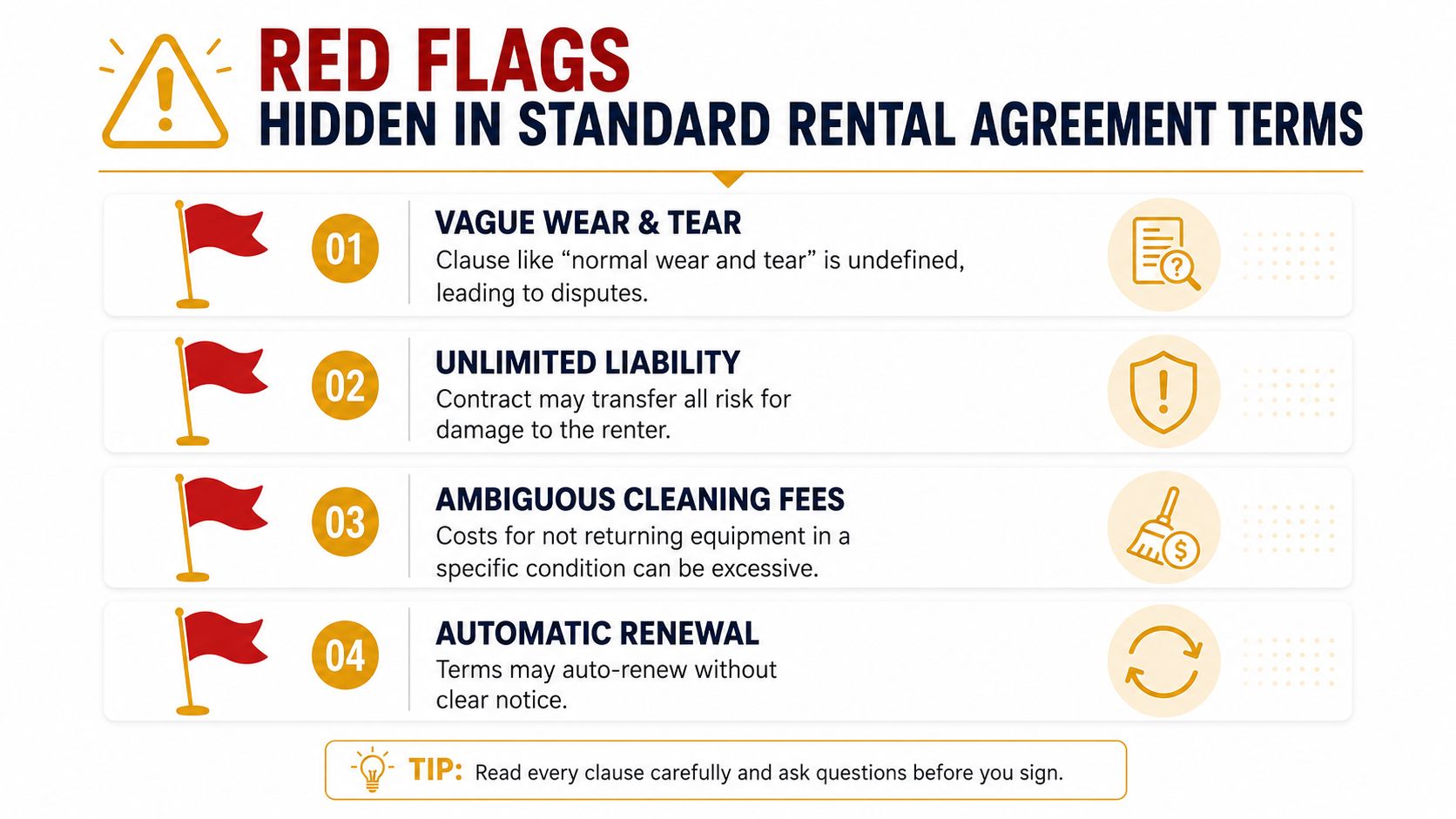
A washout pan can arrive on schedule and still create contract trouble. Crews sign standard terms quickly, then discover that environmental exposure, cured slurry, pickup timing, and disposal decisions all sit under vague language. Repeated wording does not make a clause fair.
Reject undefined condition standards
“Return equipment in good condition, normal wear and tear excepted” sounds reasonable until someone must decide whether cured concrete inside a washout container is normal use. The container is meant to receive cementitious material. The agreement must separate expected residue from prohibited accumulation, structural cracking, physical damage, and contamination requiring special handling.
Require a written inspection standard, supported by photographs where useful. State who inspects, when the renter receives notice, and whether the renter can correct a condition before the vendor orders repair, cleaning, or disposal. Without those details, the vendor controls both the finding and the charge.
Limit exposure to risks the renter controls
A clause stating that the renter is responsible for “all damages, losses, claims, fines, cleanup, and remediation arising from use” transfers risks beyond the crew's control. It could apply when a pan arrives defective, a delivery vehicle damages the site, or the vendor selects a disposal method the renter did not approve.
One-sided indemnity language deserves the same pushback. For a washout project, require carve-outs for the vendor's negligence, defective equipment, failure to follow agreed instructions, and misconduct. Environmental responsibility should follow the cause of the release, not just the party that ordered the container.
Find renewal and fee triggers before delivery
Automatic renewal can keep rent running after the pour sequence ends and the pan is ready for pickup. The worst terms renew unless the renter uses a specific notice channel within a narrow window, while allowing the vendor to change rates or add service charges.
Check these warning signs:
- “At vendor's discretion” fees: The contract gives no objective test for cleaning, disposal, access, or environmental charges.
- Coverage-undermining waivers: The renter assumes pollution exposure or waives claims without confirming that its insurance responds.
- Broad remediation language: The renter pays for every release, including one caused by vendor transport or equipment failure.
- No cure opportunity: A fixable notice or access problem becomes an immediate default.
- Verbal modification limits: A dispatcher promises a pickup date, but the contract recognizes only a signed amendment.
Do not negotiate only the price. Define the facts that determine whether the price stays the price.
A red flag does not always require rejecting the vendor. Add a precise definition, a liability cap, a notice requirement, or a mutual carve-out. If the vendor refuses every reasonable boundary, treat that refusal as useful commercial information before placing the order.
Effective Negotiation Tactics for Washout Rentals
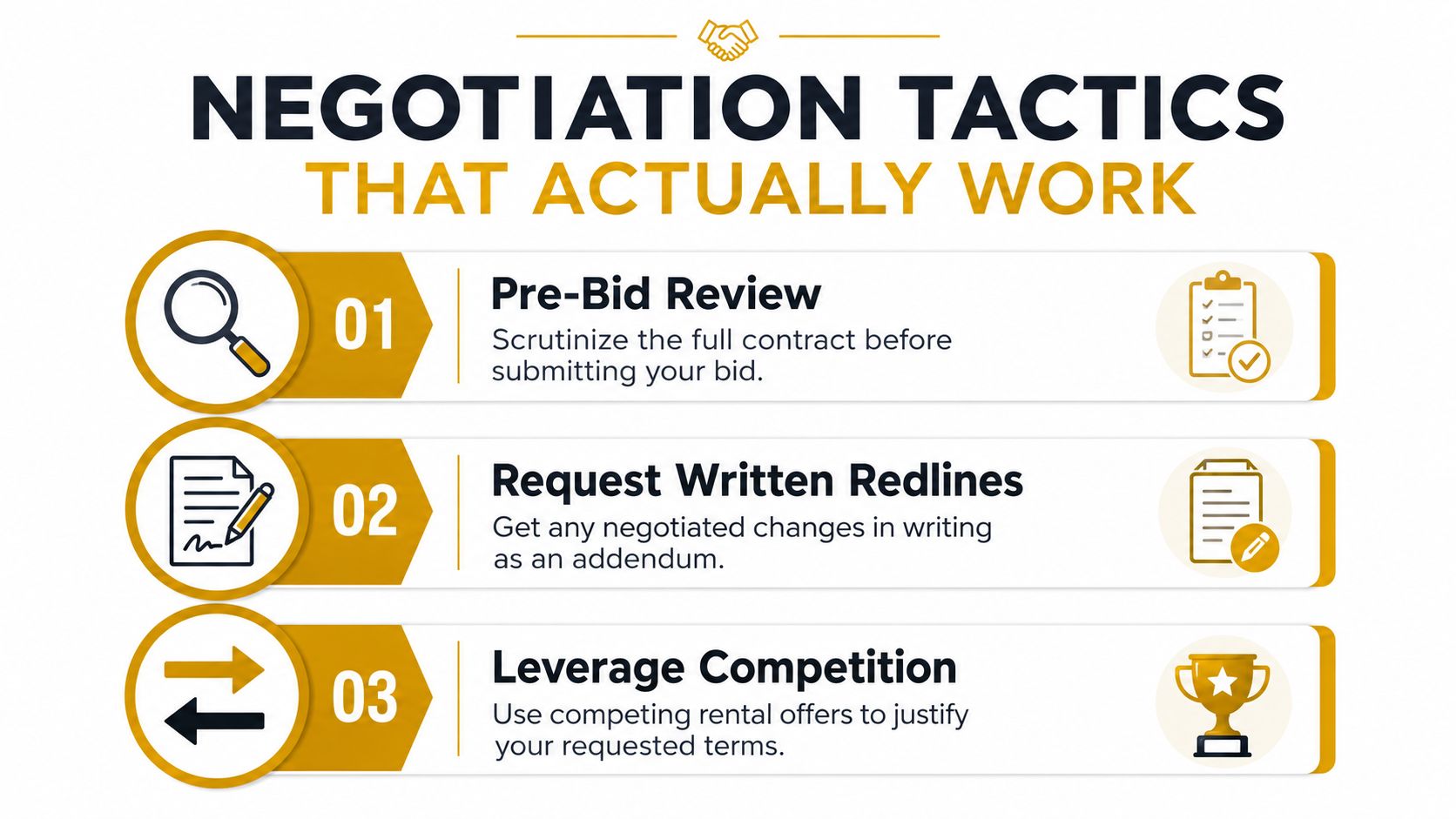
Concrete washout rentals are easiest to negotiate before a pour is scheduled. Once the truck is waiting and slurry containment is required, the vendor has more control. Set the commercial terms during procurement, not at the gate.
Review before the order becomes urgent
Request the complete agreement, fee schedule, insurance requirements, and service terms before approving delivery. Compare them with the project's SWPPP, access plan, pour sequence, pickup timing, and slurry disposal process. This review confirms that the proposed pan, delivery method, and service scope fit the site before anyone signs a delivery ticket.
Mark every open-ended clause. Flag phrases such as “all costs,” “excessive,” “as determined by lessor,” “at any time,” and “without limitation.” These phrases are not automatically invalid, but they give the vendor room to decide what you owe after delivery.
Put every change in writing
A dispatcher's text or driver's assurance does not protect the project if the signed contract says something else. Send a written redline or addendum listing each agreed change. Specify which document controls if the purchase order, delivery ticket, website terms, and master agreement conflict.
Use direct replacements:
- Open-ended indemnity: Replace “renter shall indemnify against all claims” with “each party shall indemnify the other for third-party claims to the extent caused by its negligence, willful misconduct, or breach.”
- Unbounded damage recovery: Replace “renter is responsible for all damages” with “renter is responsible for direct physical damage caused by its negligent handling, subject to the agreed liability cap.”
- Unclear pickup delay: Add a written acknowledgment requirement and a cure period for pickup failures, including a 24-hour cure period if that timing fits the project's operational needs.
- Undefined environmental responsibility: State which party handles slurry disposal, which party provides disposal documentation, and which party responds to a release caused by its own conduct.
Use alternatives without bluffing
Competing quotes help only when they compare contract terms as well as daily rates. Ask another supplier whether its terms include defined pickup windows, itemized cleaning charges, documented inspections, and mutual indemnity. Return to the preferred vendor with a specific request based on that comparison.
A vendor may reject a liability cap but accept a narrower damage definition. It may reject a broad environmental warranty but agree to provide disposal records and coordinate with the project's stormwater contact. Secure the operational protection your crew needs, even if the final wording differs from your first proposal.
Practical rule: If a negotiated promise is not in the signed agreement, treat it as unresolved.
Assign one person to maintain the contract record. Keep the signed agreement, delivery photos, pickup requests, inspection records, invoices, and disposal documentation together. That file gives the project evidence when a vendor disputes responsibility, timing, or charges.
Sample Language for Fair Rental Agreement Terms
The language below is a negotiation starting point, not a substitute for legal review under the law governing your project. The useful test is whether the clause identifies a measurable event, assigns responsibility to the party controlling it, and limits recovery to a reasonable category of loss.
| Clause Category | Problematic Language Before | Fair Rewritten Language After |
|---|---|---|
| Delivery and pickup | “Term begins upon delivery and ends when returned to lessor.” | “Term begins when the equipment is placed in the agreed location and accepted by the renter. Rent stops when the renter gives written pickup notice, the equipment is reasonably accessible, and the lessor acknowledges the notice. If the lessor cannot collect after an agreed pickup appointment, no additional rent accrues for the delay.” |
| Daily rate and surcharges | “Additional charges may apply for cleaning, fuel, access, or special handling.” | “The daily rate and each permitted surcharge are listed in the order. No additional charge applies unless the agreement identifies the triggering condition and the lessor provides an itemized explanation.” |
| Damage and liability | “Renter is responsible for all damage.” | “Renter is responsible for direct physical damage caused by its negligent handling, excluding ordinary use consistent with the equipment's intended washout function and excluding pre-existing defects.” |
| Insurance and indemnity | “Renter shall maintain insurance and indemnify lessor from all claims.” | “Each party shall maintain commercially reasonable insurance for its responsibilities. Each party shall indemnify the other for third-party claims to the extent caused by its negligence, willful misconduct, or breach.” |
| Environmental compliance | “Renter assumes all environmental liability.” | “Renter is responsible for placement and site operation in accordance with the project's written requirements. Lessor is responsible for its transport, collection, disposal services, and regulatory duties arising from its own operations.” |
| Extension and termination | “Rental renews automatically until equipment is returned.” | “Any extension requires written approval. Either party may terminate on written notice, subject to documented charges for the period through pickup and any agreed minimum term.” |
| Security deposit | “Deposit may be applied to any amount owed.” | “The deposit may be applied only to documented unpaid rent, direct damage, or agreed service charges. Lessor shall provide an itemized statement and return any undisputed balance after inspection.” |
| Invoicing and late fees | “Invoices are due immediately and late fees may apply.” | “Lessor shall issue an itemized invoice identifying the rental period and each surcharge. Payment is due under the agreed purchase-order terms. Late fees apply only to undisputed overdue amounts.” |
| Dispute resolution | “All disputes shall be resolved in lessor's chosen forum.” | “The parties shall first exchange written notice and meet through project representatives. If unresolved, the dispute proceeds in the agreed local court or mutually selected arbitration venue under the stated governing law.” |
The fair versions don't eliminate accountability. They make accountability traceable. That distinction matters when a pan returns with residue, a pickup is delayed, or a stormwater issue raises questions about who controlled the relevant action.
Your Washout Rental Contract Checklist
Use this list before the delivery truck arrives, during the rental, and on return day.
Before signing
- Parties and equipment: Confirm the renter, vendor, site, pan type, dimensions, asset identification, accessories, and starting condition.
- Delivery window: Record the delivery appointment, placement location, access assumptions, and responsibility for waiting time.
- Rental clock: Confirm whether rent starts at placement or delivery, and what event ends the term.
- Rates: Separate base rent from delivery, pickup, cleaning, disposal, rough-terrain, express, idle-day, and damage charges.
- Damage standard: Define ordinary use, prohibited damage, excessive residue, hardened material, and inspection evidence.
- Insurance: Check required policies, certificates, additional insured wording, exclusions, and notice obligations.
- Indemnity: Require mutual responsibility tied to each party's negligence, breach, or misconduct.
- Environmental duties: Assign placement, stormwater protection, slurry handling, disposal, documentation, and release response.
- Extensions and termination: Set notice methods, renewal rules, early-return treatment, and any minimum term.
- Deposit and billing: Define permitted deductions, itemized invoices, refund conditions, payment timing, and late-fee limits.
- Disputes: Confirm governing law, venue, escalation steps, arbitration terms, and attorney-fee rules.
On site and at return
- Photograph delivery: Capture the pan, surrounding ground, access route, and any existing damage.
- Monitor containment: Document placement, leaks, overflow risk, access changes, and corrective actions.
- Request pickup in writing: Keep the message, timestamp, vendor acknowledgment, and requested collection window.
- Record condition: Photograph the empty or returned pan and ask for written confirmation of inspection and off-hire.
- Challenge unsupported charges: Request the contract provision, inspection evidence, labor description, disposal record, and calculation.
One reminder belongs on every job-site copy: the signed contract supersedes a verbal promise made by the dispatcher unless the written agreement says otherwise.
Reborn Rentals provides specialized concrete washout containment rentals with clear daily pricing, defined equipment options, delivery coordination, and practical support for crews managing slurry responsibly. Before your next pour, review the terms with the same care you give the site logistics, then visit Reborn Rentals to arrange dependable washout containment for your project.