You've just ordered a 30-yard roll-off for a demolition or renovation job. The delivery date is confirmed, but one practical question remains: will the container fit behind the fence, clear the driveway approach, and sit safely beneath the overhead lines? The advertised size tells you the volume. It doesn't tell you whether the actual box from that hauler will work on your site.
The standard dimensions of a 30 yard roll off are commonly listed at about 22 feet long, 8 feet wide, and 5 to 6 feet high, but fleets vary. Published units can be closer to 21 feet 11 inches by 7 feet by 5 feet 2 inches, while others are approximately 22 feet by 8 feet by 6 feet. Waste Management's 30-yard specifications and industry capacity guidance from Waste Connections both reinforce the same planning lesson: verify the actual container, not just the nominal yard size.
Why the 30 Yard Roll Off Keeps Showing Up on Job Sites
A 30-yard container earns its place on construction sites because it handles substantial debris without the taller profile of the largest common roll-off. It sits between the tighter 20-yard option and the bulkier 40-yard unit, giving crews useful volume for bulky, mixed material while remaining manageable in many driveways and staging areas.
Its rated capacity is 30 cubic yards, or about 810 cubic feet, and industry guides commonly translate that into roughly 9 pickup-truck loads or approximately 170 to 190 standard 33-gallon trash bags. Waste Connections' dumpster size guide provides those field-friendly benchmarks. The number matters because foremen rarely estimate debris by cubic yards while standing in a dusty room. They think in truckloads, roof sections, pallets, wall bays, and trailer runs.
Typical applications include:
- Major renovations: Interior gut-outs, additions, framing cleanup, drywall removal, and mixed construction debris.
- Whole-property cleanouts: Furnished homes, commercial suites, retail spaces, and inherited-property cleanups.
- Roofing work: Shingles, underlayment, damaged decking, and related tear-off debris, subject to the hauler's weight rules.
- Commercial strip-outs: Office partitions, flooring, ceiling materials, fixtures, and packaging from a mid-scale remodel.
- Controlled heavy-material work: Concrete, brick, block, soil, and similar debris only when the load stays within the operator's payload limit.
Practical rule: Treat the 30-yard order as four separate checks, footprint fit, weight headroom, truck access, and permit status.
Volume alone doesn't make the container suitable. A bin can have empty space above a dense load and still be too heavy to transport legally. Likewise, a container that fits within the property line can remain undeliverable if the truck can't approach, tilt, or retrieve it safely.
Standard External Dimensions Explained
A tight driveway, gate, or sidewalk can turn a routine delivery into a failed placement. Start with the container's outside envelope, then verify the hauler's actual unit before booking. Published specifications commonly place a 30-yard roll-off near 22 feet long, 8 feet wide, and 5 to 6 feet high, but fleet and manufacturer differences affect site fit.
| Dimension | Typical Range | Site-planning decision |
|---|---|---|
| Overall length | About 21 feet 11 inches to 23 feet | Measure the full box, including rear hardware and door geometry, before checking a tight placement area. |
| Overall width | About 7 to 8 feet | Use the outside rail width for driveway, gate, and fixed-obstruction clearance. |
| Overall height | About 5 feet 2 inches to 6 feet | Check hand-loading reach, visibility, and the practical loading risk for dense debris. |
| Rated capacity | 30 cubic yards, about 810 cubic feet | Treat this as volume only. Material weight still controls whether the load can be hauled. |
Measure overall length against fence gaps, property-line setbacks, and the usable part of the driveway. A few extra inches can put the rear door into a sidewalk, curb return, parked vehicle, or active work zone. Include the door end in the measurement, not just the straight container body.
Width requires a second check. An outside width near 8 feet leaves little room in a narrow gate or between masonry and posts. Measure the clear opening, then allow for the truck's approach, placement tolerance, and alignment during set-down. A container that fits the opening on paper may still be impractical if the driver cannot position it without scraping an obstruction.
Height affects loading and delivery separately. The sidewall determines how easily workers can load by hand. The truck's lifting motion and approach determine overhead clearance. Check trees, service drops, canopies, temporary scaffolding, and garage overhangs along the entire route, not only above the final resting spot.
Confirm the rear-door design before delivery. Haulers may provide swinging barn doors or another configuration, and the opening can need clear space beyond the stated container length. Ask how the door opens and whether the driver expects that end facing the street or the work area. Waste Management's 30-yard roll-off information is useful for initial planning, but the hauler's delivery unit and field measurements should control the final layout.
How Much Published Measurements Vary
Two containers can both be sold as 30-yard roll-offs and still occupy noticeably different space on a job site. One published footprint measures approximately 21 feet 11 inches long, 7 feet wide, and 5 feet 2 inches high. Another measures about 22 feet long, 8 feet wide, and 6 feet high. The capacity rating matches, but the outside envelope does not.
| Measurement | Footprint A, Tapered | Footprint B, Rectangular |
|---|---|---|
| Length | About 21 feet 11 inches | About 22 feet |
| Width | About 7 feet | About 8 feet |
| Height | About 5 feet 2 inches | About 6 feet |
| Rated volume | 30 cubic yards, about 810 cubic feet | 30 cubic yards, about 810 cubic feet |
Manufacturer design explains much of the difference. A tapered front wall, sloped sides, or a lower rail can reduce the exterior footprint. A rectangular body may give crews a taller or wider loading area. That extra apparent room does not increase the amount of dense debris the hauler will accept.
The sidewall height is the swing variable crews notice first. A taller box handles bulky, lightweight debris efficiently because workers can load more material before reaching the rim. Heavy debris reaches the truck's payload limit sooner, so the container may be far from visually full. A lower or tapered body can look smaller while carrying the same rated volume through its length and width.
Published dimensions therefore work as a planning range, not a universal template. Use the larger footprint when clearance is tight, then request the assigned unit's measurements before scheduling delivery. Confirm the rear door, wheel or rail protrusions, and delivery orientation. If the dispatcher has no specification sheet, provide a measured site photo and ask the rental coordinator or driver to approve the placement.
Translating 30 Cubic Yards Into Crew-Friendly Equivalents
The cubic-yard rating is useful for comparing containers, but it's not how most crews judge progress. A 30-yard roll-off holds about 810 cubic feet, according to the capacity information summarized by Dumpster Comparison's roll-off dumpster guide. That figure gives you a reliable reference for estimating how quickly a demolition area will consume available space.
| Material or Container | Approximate Equivalent |
|---|---|
| Pickup-truck loads | About 9 loads |
| Standard 33-gallon trash bags | About 170 to 190 bags |
| Enclosed volume | About 810 cubic feet |
| Nominal container rating | 30 cubic yards |
Pickup loads are the most practical field comparison, but the material type changes the result. A truck loaded with broken cabinets and flattened cardboard occupies volume quickly without approaching the weight limit. A truck carrying concrete chunks, wet soil, or brick reaches the payload ceiling much sooner, even if the debris sits well below the top rail.
Trash bags provide another quick visual reference for cleanouts. They work best for household contents, packaging, light fixtures, and small loose debris. They're less useful for dimensional lumber, long metal sections, masonry, and irregular demolition pieces, where stacking method and void space control the actual fill rate.
The crew should also separate volume estimation from loading discipline. Break down cabinets and furniture where safe, flatten sheet goods, and place long pieces so they don't create unstable protrusions. Don't use the nominal bag count as permission to heap material above the sidewalls. The container still needs to be transportable, covered when required, and within the hauler's loading rules.
Weight Limits and Why Payload Beats Volume
Order the container only after the hauler confirms how the project will be classified. Published allowances are useful for initial planning, but they do not replace the pickup company's approval for your specific debris, truck, and route. Waste Connections' capacity guidance is a reference point, not a universal loading authorization.
Give the hauler a clear material description before delivery. Say whether the load includes clean concrete, excavated soil, brick, block, roofing, wet organic waste, or mixed construction debris. Ask which category applies, what weight allowance is included, and whether excess weight is billed or refused. Get those terms in writing when dense debris is involved.
Use this confirmation sequence:
- Describe the load accurately. Do not call a masonry-heavy load “general debris” because lighter waste is mixed in.
- Confirm the approved container and service. The hauler may recommend partial loading, a smaller box, or a separate inert-material service.
- Ask about loading restrictions. Confirm whether doors, covers, fill lines, or material separation rules apply to your order.
- Set a stop point for the crew. The foreman should know who can authorize additional loading after the confirmed limit is reached.
- Document the agreement. Keep the quote, email, or dispatch notes with the site records so the driver and office receive the same instructions.
The practical decision is often service selection, not container height. A dedicated heavy-material box can prevent a mixed load from becoming difficult to collect, while partial loading may protect the truck and the site from an avoidable surcharge.
Confirm the payload terms before the first shovel goes in. The hauler's written approval is more dependable than estimating from remaining space.
If the material description changes during demolition, stop and call the hauler before continuing. A revised order is easier to manage than a rejected pickup or a loaded container that cannot be safely transported.
Placement and Truck Access Requirements
A good drop zone is more than an open rectangle. The container needs a firm, reasonably level surface, and the truck needs a safe approach that allows the operator to place and retrieve the box without contacting buildings, utility lines, landscaping, or parked equipment.
Check these conditions before the delivery date:
- Ground condition: Use a firm pad rather than soft lawn, loose fill, an open trench, or questionable asphalt. A loaded container can settle, tilt, or leave deep ruts.
- Level placement: Keep the resting surface as close to level as practical. A slope can shift debris, complicate door operation, and concentrate load on one end.
- Overhead path: Inspect the entire approach for branches, service drops, awnings, temporary lighting, and scaffolding. The truck's lifting action needs more clearance than the container's resting height suggests.
- Rear-door zone: Leave clear space at the door end for loading and opening. A fence or stored equipment directly behind the box can make the container unusable even when the box itself fits.
- Approach geometry: Confirm that the truck can align with the drop area without a sharp turn, blocked lane, or unstable shoulder.
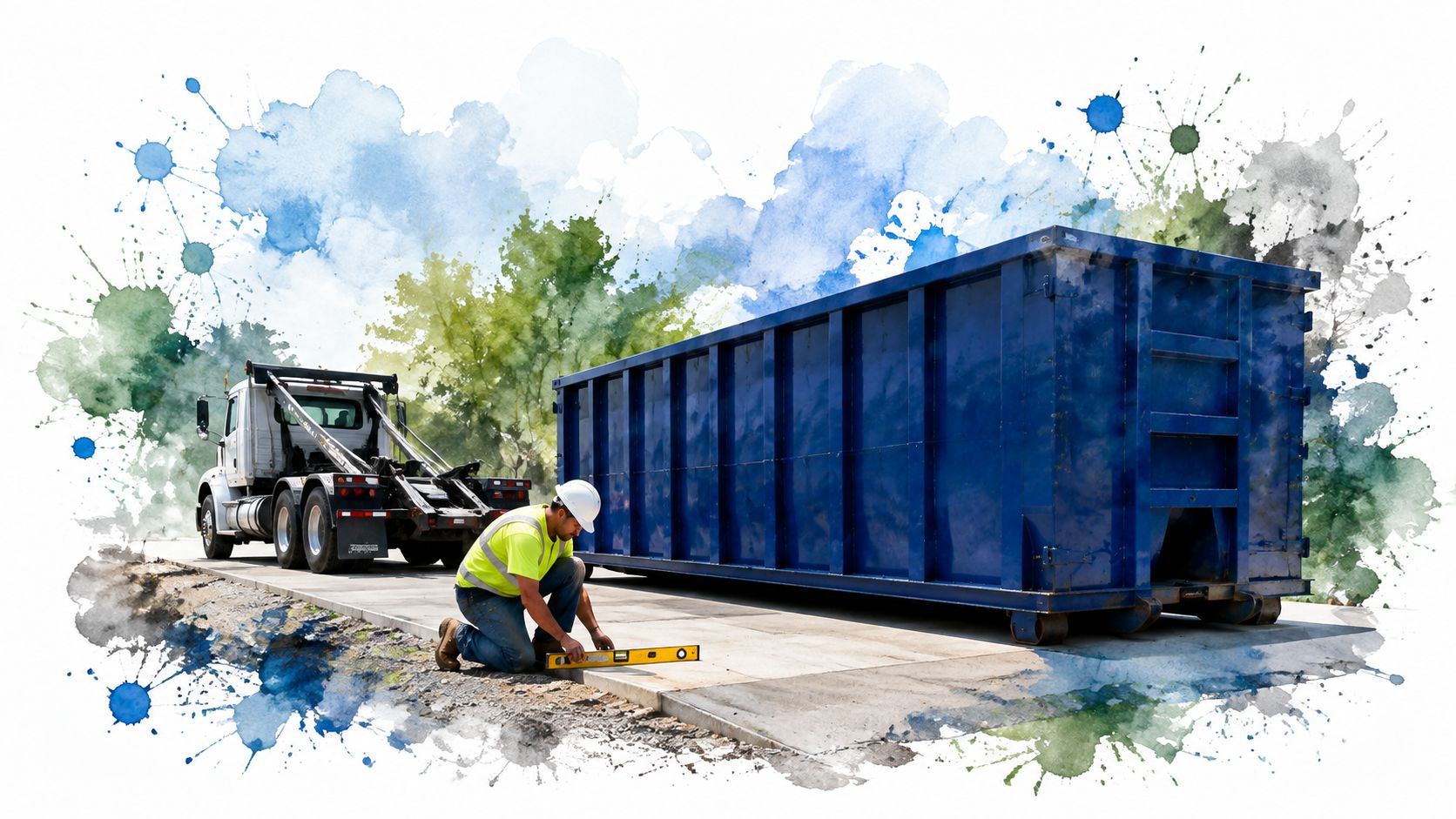
A site sketch helps more than a verbal description. Mark the container's long axis, the door end, the truck approach, fixed obstructions, overhead hazards, and the route workers will use to carry debris. Send that sketch or a marked-up photograph to the hauler before the truck is dispatched.
Don't place the bin where the crew must carry heavy material through an active vehicle lane or around a blind corner. A technically possible placement can still be a poor logistics choice if it creates repeated handling, blocks emergency access, or forces workers to lift debris over a tall sidewall.
Permits, Codes, and Site Compliance Considerations
The container's footprint, loaded weight, and contents can trigger different requirements. Treat them as separate checks instead of assuming a private property placement is automatically exempt.
A container placed in a street, sidewalk area, curb lane, or other public right-of-way may require a temporary occupancy or encroachment approval. The approximately 22-foot length can determine whether the box stays inside the property boundary or extends into public space. Measure from the actual property line, not from the edge of the driveway pavement.
Weight creates another compliance question. Dense material can exceed the hauler's allowance before the container looks full, and a heavy box can stress pavement, buried utilities, trench backfill, or a weak driveway edge. Ask the local authority and the hauler whether protective boards, a load review, or a site-specific approval is required for the planned placement.
Contents matter as well. Roofing debris, soil, concrete, and mixed demolition waste may have different containment, covering, transport, or stormwater controls. A project subject to a stormwater pollution prevention plan, often called SWPPP, may require the team to prevent sediment and loose debris from leaving the work area.
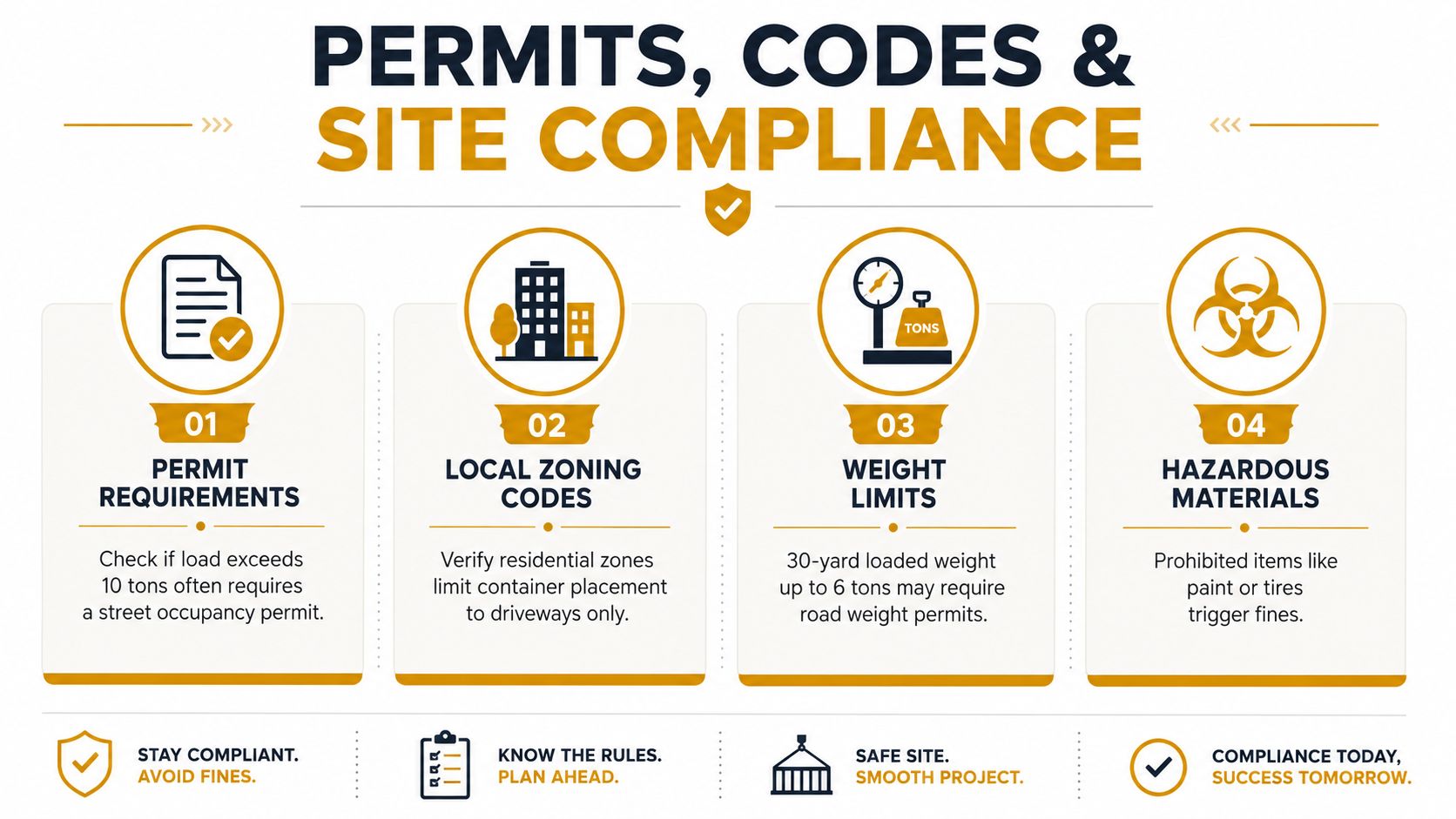
Before booking, confirm three items with the relevant local department or project compliance lead:
- Placement authority: Whether the container sits entirely on private property or enters a public right-of-way.
- Structural and roadway conditions: Whether the surface, curb, trench, bridge, or access route needs protection or approval.
- Material controls: Whether the load needs a cover, sediment protection, separation, or a specialized disposal route.
Also review prohibited materials with the rental company. Paint, chemicals, batteries, tires, and other regulated items may require separate handling. Don't let a crew discover those restrictions after the container is full.
How the 30 Yard Compares to the 20 and 40 Yard Sizes
The 30-yard roll-off is a middle-ground choice, but “middle” doesn't mean automatically correct. The right size depends on the combination of debris volume, material density, available space, and loading method.
| Spec | 20 Yard | 30 Yard | 40 Yard |
|---|---|---|---|
| Typical role | Smaller renovation and cleanout work | Major renovation and mixed construction cleanup | Large-volume, mostly light debris |
| Main advantage | Lower profile and easier access | Balanced volume and height | More room for bulky, light material |
| Main limitation | Fills sooner | Still needs a long, clear placement area | Taller walls and greater space demands |
| Heavy debris suitability | Depends on hauler rules | Payload remains the governing factor | Never assume extra volume means extra weight capacity |
A 20-yard unit can make sense when the driveway, gate, or loading area is tight, or when workers need a lower sidewall for hand loading. It also may be preferable for a heavy-material job where the crew plans to load only a controlled amount.
A 40-yard unit is better suited to bulky, relatively light debris that would consume volume quickly. Its taller profile can complicate loading and visibility, and it won't solve a weight problem involving soil, concrete, or saturated material.
The 30-yard option works when the project has enough space for the longer container and the debris mix is too large for a smaller bin but not so light and bulky that the taller largest option is necessary. Make the final choice after confirming the actual fleet dimensions and weight policy, not from the yard number alone.
Pre-Delivery Measurement Checklist for Site Teams
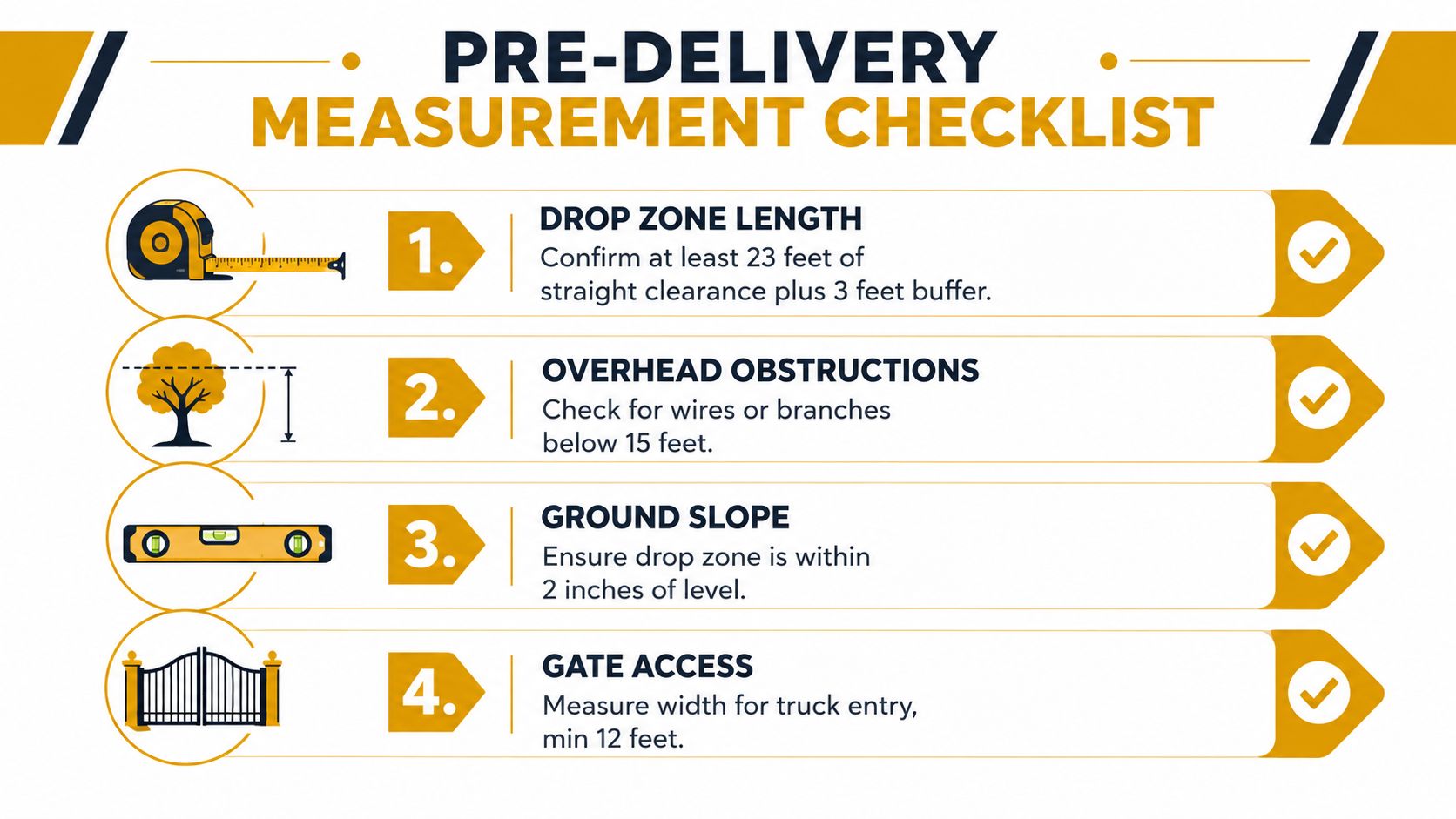
Run the site check during planning, not when the driver is already at the gate. Use a tape measure, level, camera, and a quick sketch.
- Measure the drop zone. Confirm the full container length and leave working clearance at the door end.
- Measure the width route. Check the gate, driveway, fixed posts, parked equipment, and the truck's approach, not just the open pad.
- Inspect overhead obstructions. Trace the delivery path beneath branches, wires, awnings, and temporary structures.
- Check the surface. Look for soft asphalt, loose fill, low spots, trench edges, and slopes that could worsen under load.
- Confirm the haul path. Make sure the driver can approach, align, set the box down, and return without backing into an unsafe turn.
- Mark the intended position. Use cones or paint, then photograph the site from the street and send the images to the hauler.
Ask the rental coordinator to confirm the actual length, width, height, door arrangement, and placement orientation for the assigned unit. That final confirmation prevents a common failure: measuring for a generic 30-yard container while the fleet sends a different body style.
Common Questions About 30 Yard Roll Off Sizing
Will a 30-yard roll-off fit through a standard driveway gate? It may, but verify the clear opening and the truck's approach. A container listed at about 8 feet wide leaves little room for posts, mirrors, and alignment error.
Is the inside width also 8 feet? Usually not. The exterior rail may be about 8 feet wide, while the usable interior is narrower because of the sidewalls and hardware.
Which way does the rear door open? Door style and opening direction vary by hauler. Specify the door end and loading direction when you place the order.
Can it sit on grass or soft ground? It can rut or settle once loaded. Use a firm pad and ask the hauler whether surface protection is needed.
Reborn Rentals helps construction teams coordinate dependable, ready-to-deploy containment equipment for concrete washout and renovation logistics. Visit Reborn Rentals to review available options, confirm delivery details, and arrange the right site solution before your next pour or cleanup.