The call usually comes when the crew is already moving concrete. An inspector is on the way, a neighbor has complained about runoff, or the project team needs proof that yesterday's stormwater controls were checked. The superintendent starts looking for the washout pan, the latest SWPPP entry, the inspection photos, and the person who can explain what happened after the last rain event.
That scramble exposes the weakness of a binder-based system. A signed form can show that someone intended to inspect a control, but it may not prove that the containment was in place, intact, correctly positioned, and usable during the pour. Construction site compliance now depends on field evidence, not documentation separated from field conditions.
Why Construction Site Compliance Matters More Than Ever
A site can look orderly from the trailer and still have a compliance problem at the curb. A concrete truck may wash out beside an inlet, dust may drift beyond the fence, or waste may collect where a public footpath makes it highly visible. These failures often begin as small housekeeping decisions, but they can create a much larger response when an inspector, client, or neighbor sees them first.
The pressure is not limited to avoiding a fine. A failed control can force corrective work, interrupt a pour, delay access, and damage the trust that keeps a project moving. The practical cost comes from lost production and uncertainty. Crews wait while someone relocates a pan, cleans slurry, updates a SWPPP record, or explains why the control was missing.
Field lesson: If the crew can't show what was checked and fixed, the project team may have to argue from memory.
Enforcement data shows how much attention large construction programs can place on field performance. New York City's Department of Buildings reported more than 20,000 unannounced proactive inspections at over 10,000 large construction sites in 2019, followed by more than 15,500 unannounced inspections at over 9,500 sites in 2020. The same report recorded construction incidents involving injuries and fatalities falling from 565 in 2019 to 485 in 2020, a 14% drop. The data doesn't prove that inspections alone caused the change, but it shows how repeated inspection presence and measurable outcomes operate together in a major city. New York City's construction safety reporting makes that enforcement model visible.
The public sees environmental failures first
Safety controls often sit behind barriers or inside work zones. Dust, overflowing washout, scattered waste, and dirty runoff are different. They cross the boundary between the project and its neighbors, making them easy to notice and report.
Municipal enforcement can therefore become complaint-driven. Dubai municipal reporting recorded 11,215 site visits, 1,523 violations, and 632 public reports in a single month, illustrating how site visits and public complaints can form part of the enforcement system in a major growth market. The Dubai municipal reporting covered by Gulf News is a useful reminder that nuisance and environmental controls deserve the same operational discipline as formal safety checks.

The superintendent who stays ahead of inspections doesn't just keep paperwork current. They make the site easy to verify. The washout area is visible, signed, intact, and accessible. The digital log connects the inspection to photos, corrective actions, and follow-up evidence. That approach protects the schedule because it reduces the number of questions that must be answered under pressure.
Understanding the Regulatory Landscape for Concrete Washout
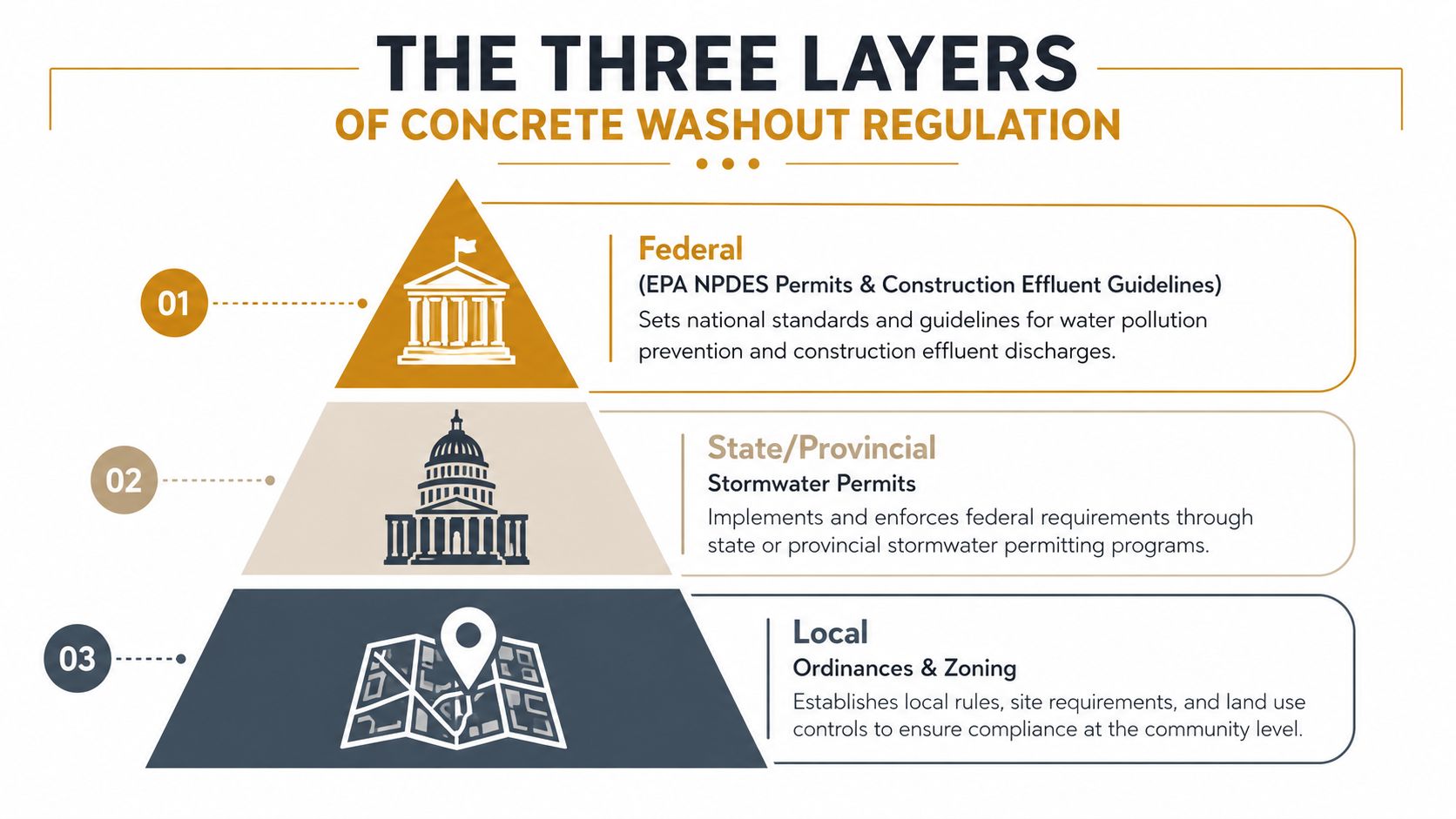
Concrete washout rules become easier to manage when you separate them into three layers. The federal layer establishes broad pollution-prevention requirements, the state or provincial layer administers stormwater programs and may add conditions, and the local layer controls site details such as placement, access, signage, and nuisance impacts.
Start with the federal baseline
For projects covered by construction stormwater permitting, the EPA's construction effluent guidelines require erosion and sediment controls, soil stabilization, dewatering management, buffers around surface waters, and controls for prohibited discharges, including concrete washout. The EPA construction and development effluent guidelines provide the federal framework.
The wash water itself is the critical issue. EPA guidance describes concrete wash water as highly polluted and says it must not be discharged to storm drains, surface waters, sanitary sewers without permission, or allowed to infiltrate into the ground. A designated washout area must be contained, appropriately signed, adequately sized, and inspected daily under the cited BMP guidance. EPA's SWPPP guide explains those requirements and the pollution-prevention rationale behind them.
The federal rules also distinguish between project coverage and site practice. A project disturbing one acre or more may fall under construction stormwater permitting requirements, but a smaller project can still face local environmental, drainage, or public nuisance rules. Never assume that the absence of a federal permit removes the need for responsible washout containment.
Then check state and local conditions
State or provincial authorities commonly administer stormwater permits, review environmental plans, or impose requirements that sit above the federal baseline. Local authorities may prescribe approved containers, require specific signs, limit where a pit can be excavated, or respond to complaints about runoff and dust.
Use this sequence before mobilization:
- Confirm project coverage. Identify whether the work falls under a construction stormwater permit and whether the SWPPP names concrete washout as a required control.
- Read the state or provincial conditions. Look for inspection frequency, reporting, corrective-action, and sensitive-water requirements.
- Call the municipality. Verify local rules for setbacks, access, liners, signage, collection, and disposal.
- Put the strictest practical condition on the site plan. A federal minimum won't protect the project if the city requires more.
The superintendent's job is not to memorize every rule. It's to translate the applicable rules into a visible field control, assign ownership, and preserve evidence that the control worked.
Technical Requirements for Washout Containment Systems
A washout system fails for predictable reasons. The basin leaks, the capacity is inadequate, the location is wrong, or nobody checks it after use. A container can be labeled “washout” and still fail an inspection if slurry can escape through a torn liner, an open side, a low berm, or an overflow path leading to a drain.
The EPA BMP guidance calls for a leak-proof or lined containment area with enough capacity to contain all washout waste. It also places the facility at least 15 m, or 50 feet, from storm drains or receiving waters, and calls for daily inspection and signage. Those requirements appear in EPA's stormwater pollution prevention guidance.
Size for the pour, not the average day
Capacity planning starts with the work sequence. Ask how many trucks may use the area, how often the washout will occur, whether pump lines will be cleaned there, and whether rain can add liquid to the containment. A pit sized for occasional small deliveries may not handle a concentrated pour with several trucks arriving close together.
The calculation doesn't need to be complicated, but it must reflect the actual operation:
- Estimate the maximum washout load. Use the largest expected group of trucks or cleaning activities, not a typical shift.
- Allow for rainfall and solids. Freeboard matters because liquid and settled concrete reduce usable capacity.
- Check the edges. Berms need enough height and continuity to prevent a low corner from becoming an escape route.
- Inspect the base and liner. Rebar, sharp aggregate, traffic, and excavation work can puncture or displace the lining.
- Plan removal. Once hardened material fills the containment, the crew needs a safe, documented method for removal and replacement.
Practical rule: A washout area isn't compliant because it exists. It must remain contained at the moment the crew needs it.
Placement matters as much as capacity. Keep the facility away from inlets, channels, receiving waters, and low spots, while preserving a stable route for concrete trucks and pump crews. A pan that forces trucks to cross an active excavation may solve one environmental problem and create a safety problem, so access should be checked during the daily walk.
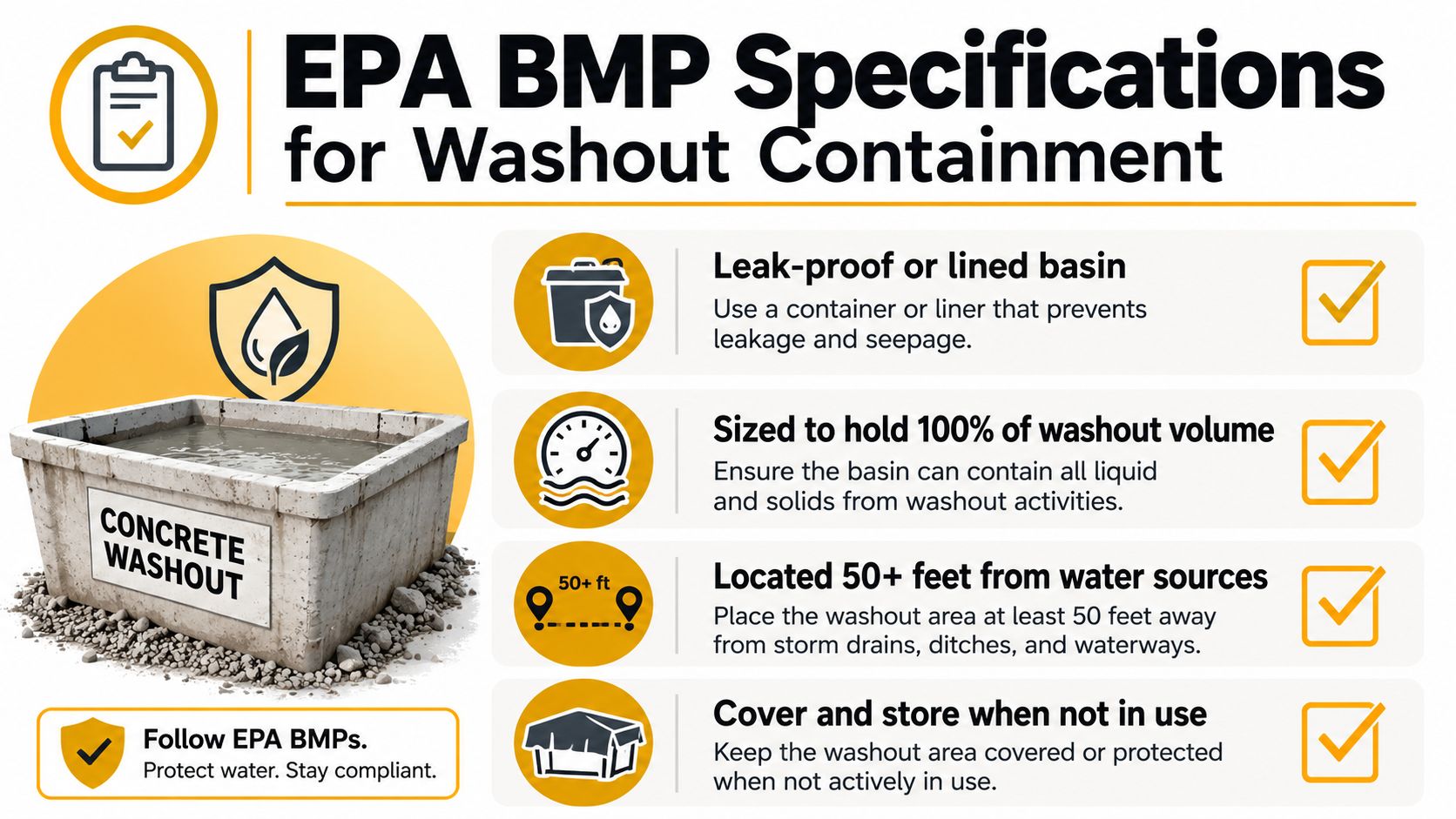
Rain exposes weak installations quickly. Cover the system when it isn't in use where the site plan and equipment allow it, check for accumulated water before a storm, and inspect it afterward for overflow, displaced material, tears, and tracks leading toward drainage. If a spill threatens a stormwater feature, notify site leadership and the responsible SWPPP contact according to the project procedure, record the threatened feature, document the control installed, and complete a follow-up inspection.
Building an Evidence-Led Inspection and Documentation Workflow
A static binder answers only one question, whether somebody completed a form. An evidence-led system answers more useful questions: What did the control look like, where was it, when was it checked, what problem was found, and how was the correction verified?
That distinction matters because compliance pressure is increasingly shaped by tighter regulation, digital monitoring tools, and real-time reporting. Recent construction safety coverage also identifies AI-assisted monitoring and BIM-integrated safety systems as increasingly common developments in the sector. Build North Expo's discussion of construction safety trends provides background for that shift, but the field solution doesn't require an expensive technology stack.
Build the daily record around the control
Start with a mobile checklist assigned to a named supervisor. The checklist should identify the washout location, containment condition, signage, access route, distance from drainage features, available capacity, and any corrective action. A completed form without a location or supporting image is weaker than a short record tied to observable conditions.
Use a repeatable capture routine:
- Before work begins, photograph the empty or serviceable containment area, its sign, surrounding ground, and access route.
- During active concrete work, record use, visible leaks, rising liquid, hardened buildup, and any change in placement.
- After rain, photograph the basin, nearby inlets, berms, cover, and travel paths where runoff could move.
- When correcting a problem, take a before image, describe the action, assign an owner, and attach an after image.
- At closeout, record removal, disposal, replacement, or the condition handed to the next phase.
GPS tagging can help establish location, while timestamps create a defensible sequence. The key is not collecting images for their own sake. It is connecting each image to a checklist item and a completed action.
Preserve the chain of evidence
Store records in a cloud project folder or compliance platform with consistent naming. Link the daily checklist to the relevant SWPPP section, weather event, corrective-action record, and supervisor. If the project already uses tools such as Procore, Autodesk Construction Cloud, or a similar project management platform, add the washout workflow to the existing system rather than creating a separate channel that crews forget to use.
Evidence is strongest when another person can understand the event without calling the person who was there.
Sensors can add value where they answer a defined question, such as water level, rainfall, or movement of a control. They shouldn't replace a field inspection. A sensor may show that a level changed, but a photo can show whether a liner tore, a sign disappeared, or a truck track created a runoff path.
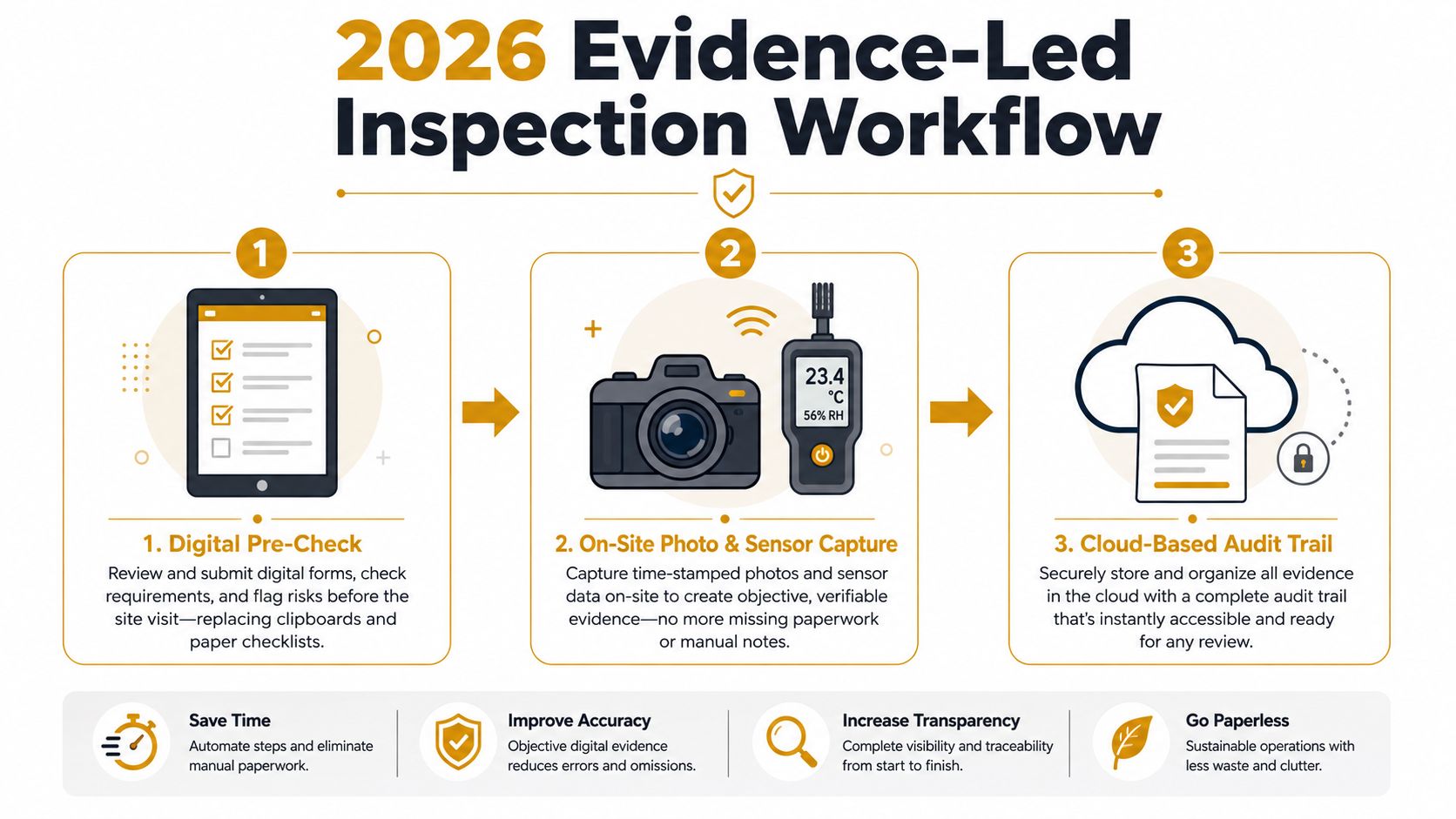
Review the dashboard during the project, not only at audit time. Missing photos, open corrective actions, and overdue inspections should appear as work items with owners. That turns compliance into a live production control instead of a retrospective paperwork exercise.
The Hidden Risk of Small Compliance Failures
The most dangerous compliance problem isn't always the most visible risk to the public. A poorly protected excavation may demand urgent attention, but a slurry trail flowing into a curb inlet can generate a complaint before the safety team knows it exists. Dust, waste, and runoff sit at the boundary between the job and the community, so neighbors can observe and report them without entering the site.
That makes small failures operationally important. A pile of waste beside a fence, a cloud of dust crossing a property line, or an unmarked washout pan tells the public that the project isn't controlling its impacts. Municipal staff can respond to those complaints through local inspection channels, sometimes faster than a national agency would review a broader compliance file.
Prioritize what people can see
A practical risk ranking should include visibility and reporting potential, not only severity. Ask where a failure would appear from the sidewalk, adjacent property, public road, or storm drain. Then assign controls before the work starts.
- Dust: Keep suppression equipment ready, monitor wind and visible drift, and respond before a neighboring property becomes affected.
- Runoff: Inspect inlet protection and washout containment after changing site conditions, especially when water can carry material toward public drainage.
- Waste: Keep bins and stockpiles orderly, stable, and away from boundaries where loose material can escape.
- Noise and access: Maintain clear routes and respond quickly when site activity affects neighbors or public users.
New York City's inspection data demonstrates the scale at which proactive construction enforcement can operate, while Dubai's municipal data shows how public reports can sit alongside site visits and recorded violations. These examples don't establish a universal enforcement sequence, but they support a clear field conclusion: complaints turn visible conditions into documented compliance events.
Make response part of the plan
Don't leave neighbor complaints to whoever answers the phone. Assign a response owner, define who receives the complaint, and require a same-day field check where practical. Record the concern, location, condition observed, control installed, communication made, and follow-up result.
The response should be calm and factual. Arguing that the issue is minor usually makes the situation worse. A dated record showing that the team investigated, corrected, and checked the condition gives the project a stronger position than a verbal assurance.
Comparing Washout Solutions for Compliance Reliability
A washout control can look acceptable during a morning walk and still fail before the last truck leaves. The right choice depends on soil, available space, pour sequence, access, and how long the site needs that control. Purchase price matters, but compliance risk also includes repairs, blocked routes, overflow exposure, and whether the crew can use the system without improvising.
The main options
DIY excavated pits can work where suitable soil, sufficient space, and a crew capable of building and maintaining a lined, bermed enclosure are available. Their flexibility comes with variable field quality. Excavation, liner placement, weather, equipment traffic, and housekeeping all affect performance. Plan removal of hardened concrete before the pit is built, including how equipment will access the area without damaging the containment.
Permanent installed systems fit projects with a stable layout and recurring concrete work. They can provide a durable, engineered control, but require capital, design coordination, and a fixed location. That location can become a liability as work areas shift or access routes close during later phases.
Rental washout pans reduce setup work and can move with the project. Reborn Rentals' washout containment options include pans with published capacities ranging from about 310 gallons to approximately 441 gallons, including a 72' x 72' x 24' option rated for approximately 18.25 tons and a 72' x 72' x 14' option listed at about 310 gallons. Published daily pricing starts at $25 per day, with possible additional charges for delivery, rough terrain, and express orders. Confirm capacity, placement conditions, and logistics before the first pour.
Compare the trade-offs
| Criteria | DIY Excavated Pit | Permanent System | Rental Washout Pan |
|---|---|---|---|
| Setup time | Excavation, lining, berming, and signage are required | Installation and coordination are required | Delivered ready for placement |
| Capacity | Set by excavation and available space | Designed for the project | Selected from listed pan capacities |
| Leak risk | Depends heavily on liner and ground condition | Controlled by installed design and maintenance | Depends on pan condition, placement, and inspection |
| Inspection readiness | Can change after rain or equipment traffic | Consistent when maintained | Visible and repeatable when placed correctly |
| Flexibility | Easy to reshape, but labor-intensive | Low once installed | Useful as phases or work areas change |
| Cost structure | Lower equipment cost, with ongoing labor and repair exposure | Higher capital commitment | Daily rental cost plus applicable logistics charges |
Reliability depends on field evidence as much as equipment selection. Record the control location, condition, capacity, and corrective actions in the daily inspection log, then attach timestamped photos when conditions change. A static binder may show that a control was specified. A current log shows whether it was usable on the day of the inspection.
No option eliminates inspection. A rental pan can overflow, a permanent system can collect excess water, and a DIY pit can develop a torn liner. Choose the system that matches the pour schedule, remains accessible, and makes correct use straightforward for every concrete crew.
Your Action Plan for Staying Ahead of Inspections
Start with a field audit, not a document review. Walk the concrete route and compare the actual washout location with the EPA BMP expectations and the project SWPPP. Check distance from drains and receiving waters, containment integrity, capacity, signage, truck access, and the path water would take during rain.
Then make the corrections in this order:
- Fix location problems first. Relocate containment away from inlets, channels, low spots, and receiving waters.
- Remove leak and overflow risks. Repair liners, replace damaged containers, add usable capacity, and preserve freeboard.
- Make the control obvious. Install durable signage and keep the access route clear for every concrete crew.
- Digitize the daily proof. Use a mobile checklist, timestamped photos, corrective-action ownership, and cloud storage.
- Train the people who use it. Concrete truck drivers, pump crews, finishers, and laborers should know where washout belongs and what to do before overflow.
- Inspect after changing conditions. Cover or protect the area before rain, check it afterward, and schedule a mid-week review before problems accumulate.
- Create a complaint response. Give one person responsibility for logging, investigating, correcting, and closing neighbor concerns.
A contractor who can demonstrate consistent field control has more than a compliance file. They have a repeatable operating process that protects the schedule, the environment, and the project's reputation.
Reborn Rentals provides ready-to-deploy concrete washout pans and containers with listed capacities, delivery coordination, and transparent daily pricing starting at $25 per day, subject to applicable logistics charges. If your current containment is difficult to size, move, or document, review the available options at Reborn Rentals and arrange the equipment around your next pour.