A concrete crew is halfway through a booking when the questions start moving. The foreman sends a Messenger note asking whether a washout pan is available for the pour date, a superintendent follows up on WhatsApp with a site photo, and the office requests a formal quote by email. Later, someone calls to explain that the delivery route includes rough terrain and a narrow access point.
That's normal rental behavior. The problem starts when each conversation lives in a separate inbox. The customer repeats the project address, delivery date, pan requirements, and urgency, while the field team works from incomplete information. Multi-channel customer service only helps when the rental workflow, not the individual channel, owns the conversation.
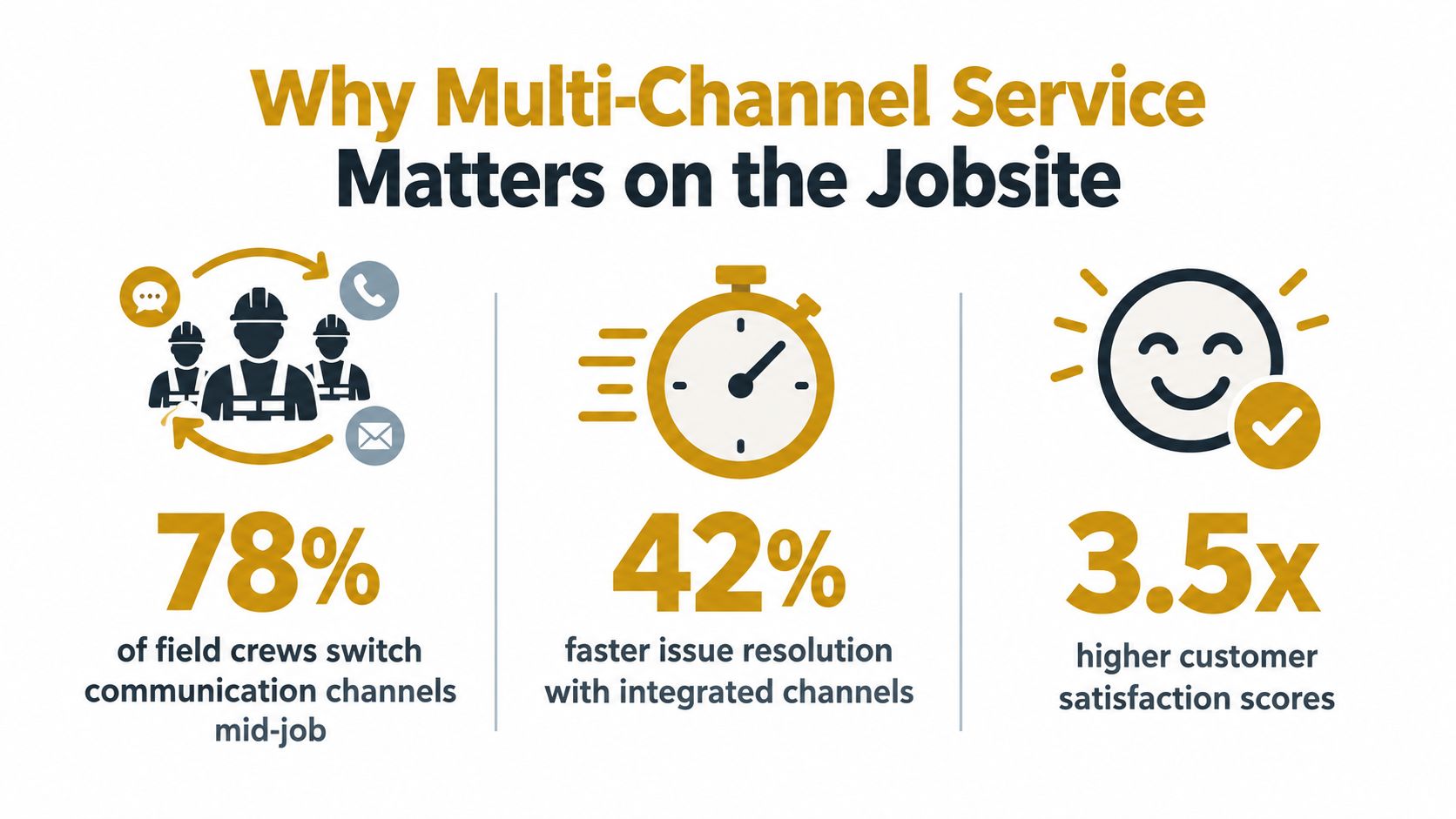
Why Multi-Channel Service Matters on the Jobsite
A crew can move from Cart to Details to Checkout while the questions keep changing. Someone checks washout pan availability from a truck, sends a site pin through Messenger, confirms dates by WhatsApp, then requests a callback about rough terrain and an express delivery fee. Each channel fits the moment. The rental request still belongs to one job.
That distinction matters in Reborn Rentals' workflow. A customer may select a washout pan, enter the delivery location, and reach Checkout before asking whether a truck can reach the site or whether an urgent order changes the fee. If those answers remain outside the booking record, dispatch receives an assignment without the context behind the order.
A large-scale customer support benchmark found that 76% of customers use more than one channel during a single support interaction, while 81% of companies offer support through three or more channels. Only 35% say their cross-channel experience is fully connected, according to the customer support benchmark on omnichannel service. For equipment rentals, that gap shows up as repeated questions, unclear commitments, and dispatch calls that should have been avoided.
The cost of losing context
Connected channels can also control service costs. The same benchmark places self-service at about $0.10 to $0.25 per resolution, compared with roughly $8 to $12 for phone support. A clear delivery-preparation FAQ can handle a routine question, while a rough-terrain access issue should reach a dispatcher or operations lead.
The satisfaction difference affects retention and rework. SQM research reports 67% CSAT for smooth omnichannel experiences, compared with 28% for multi-channel but non-integrated service, a 39-point gap, documented in SQM's omnichannel satisfaction research. For rental operations, consistency means carrying the address, dates, item, access notes, and fee decisions with the customer when the conversation shifts platforms.
Field rule: Treat every channel change as a handoff inside one booking, not as a new inquiry.
Map the journey from product selection through delivery and post-rental questions. Then connect Messenger, WhatsApp, email, callbacks, the CRM, and booking status to that path. A CRM chosen before the team understands how contractors confirm capacity, dates, access, and express fees usually leaves field crews with several inboxes and no shared operating record.
Choosing the Right Channels for Rental Workflows
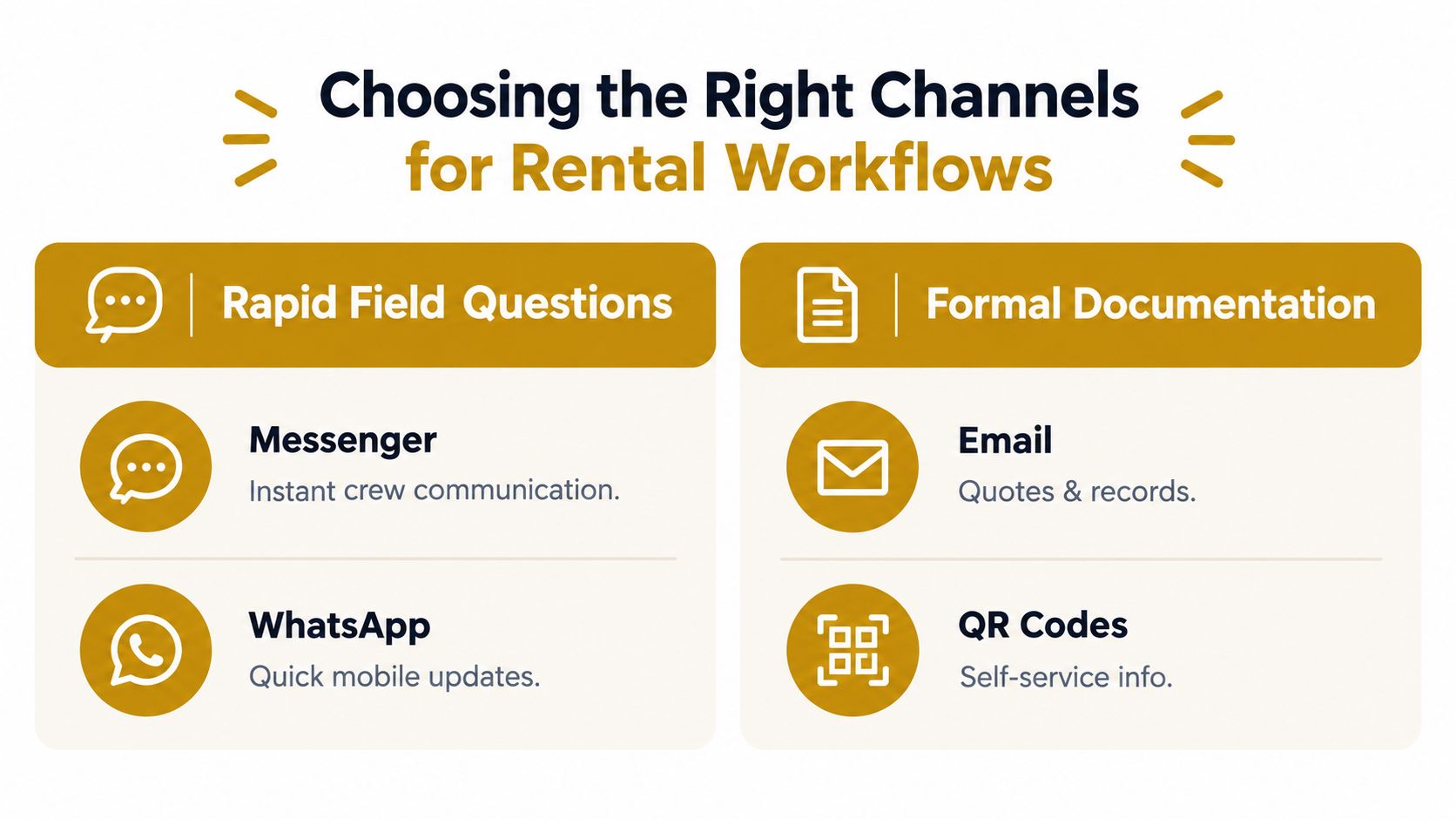
Each channel should have a job. A contractor asking, “Do you have a pan available for Friday?” needs a faster path than an office administrator requesting a documented quote with delivery terms. The right mix depends on urgency, detail, attachments, customer preference, and whether the answer affects dispatch.
Messenger and WhatsApp work well for quick field communication. They suit short questions, location updates, photos, and clarifications while crews are moving between tasks. They're less suitable as the only record for a price-sensitive order, because a casual message can omit dates, billing details, or the exact item being discussed.
Email remains the formal channel for quotes, confirmations, payment documentation, terms, and written summaries. It gives the office a durable record and makes it easier to include product specifications, delivery notes, and fee explanations. The trade-off is speed. A long email exchange can delay a decision when a crew needs a simple availability answer.
Match the channel to the question
Use a QR code as a bridge rather than another inbox. A code on a delivery document, equipment label, or site packet can open contact options, setup information, or a self-service answer. It reduces the need for a crew member to search for the right contact while keeping the operational destination clear.
Scheduled callbacks are better for questions that require judgment or coordination. Delivery windows, rough terrain, access restrictions, express fees, and changes to a confirmed booking often need a conversation with someone who can assess the whole situation. A callback also protects the customer from a long chain of fragmented messages.
A practical channel decision looks like this:
- Messenger: Use for fast availability checks, short clarifications, and conversation starts from social or web activity.
- WhatsApp: Use for mobile updates, photos, location details, and crew-side communication.
- Email: Use for quotes, booking summaries, receipts, policy references, and information the customer may need to forward.
- QR codes: Use for self-service contact access, rental instructions, and site-facing information.
- Scheduled callbacks: Use for delivery planning, unusual access, urgent exceptions, and disputes that need careful explanation.
Don't publish every channel with the same promise. A live messaging option needs a clear operating window, while email can support an asynchronous process. If a channel is monitored only periodically, say so. False immediacy creates more frustration than a clearly limited service path.
The best channel mix is usually narrow and deliberate. Add a channel when it solves a recurring customer problem and when the team can route, record, and answer it consistently. Reborn Rentals supports Messenger, WhatsApp, email, QR-based contact sharing, and scheduled callbacks as distinct paths for confirming availability, specifications, and logistics. The important design choice is not only offering those options, but tying each conversation to the same rental request.
Integrating Channels With Booking and CRM
A customer can start in Messenger, add site details in WhatsApp, ask about an express fee by email, and still expect the same answer at checkout. The integration plan must keep that journey attached to one rental request. Begin with what the customer needs to provide and what the field crew needs before delivery, including the selected washout pan, rental dates, location, access conditions, rough terrain, urgency, contact details, capacity questions, and fee questions.
Map those requirements before choosing software. A neutral industry analysis identifies starting with technology instead of the customer journey as a common implementation mistake. It recommends mapping movement across channels first, then connecting identity, history, and service standards before launch, as described in this analysis of omnichannel implementation mistakes.
Build one record around the rental issue
Create one case for each booking question or service issue. Capture the source channel, customer identity, equipment, dates, location, delivery requirements, urgency, current owner, and next promised action. A WhatsApp message should update the existing case rather than create a second record because the customer entered through a different number or path.
Keep channel details visible instead of reducing every interaction to the same text field. The agent should know whether the request came through Messenger, WhatsApp, email, or a callback, since each channel supports a different response style and timing. The full conversation history should remain available, including answers already given about capacity, access, delivery, or fees.
Connect the record to checkout
The booking flow provides a practical CRM structure:
- Cart: Record the selected equipment, including the specific washout pan or container.
- Details: Attach rental dates, delivery location, contact identity, access information, and terrain notes.
- Checkout: Preserve final pricing context, delivery instructions, payment status, and unresolved questions.
That structure prevents a field handoff from losing the conversation. An agent may answer a capacity question in chat, while the delivery coordinator sees only the item and address. Linking the answer to the booking record keeps product information beside the operational commitment.
Integrate before automating
Test the data flow before turning on automated routing. A handoff should carry the customer's identity, request details, previous answers, promised follow-up, and verification status. If those fields disappear, automation only moves incomplete work faster and leaves staff to reconcile records manually.
The implementation analysis also points to inconsistent service standards, excluding agents from design, missing baselines, and treating launch as the finish line. Reborn Rentals should review the workflow with dispatchers, customer service staff, and field crews. They can identify the missing detail that makes a truck wait, forces a delivery reschedule, or sends a customer back to another channel.
Designing Workflows Handoffs and SLAs That Hold
A field crew is waiting, the customer has sent a site photo through WhatsApp, and the original booking started in Messenger. Without a defined workflow, the next agent may see only “delivery question” and miss the rough terrain, express fee, or promised callback time. A reliable workflow gives each inquiry an owner, a service target, and a required handoff record.
For a washout rental, route the conversation by operational risk. Customer service can handle a basic availability question. A request involving limited access, rough terrain, a tight delivery window, or an express fee should move to dispatch or account coordination. The customer should not have to find the right team by trial and error.
Use a controlled handoff sequence
The receiving agent should create or locate the case, attach the conversation to the booking stage, and record the next commitment. That record needs the original request, customer identity, booking reference, previous answers, promised follow-up, and verification status. A paraphrase that omits site details creates work for the next team.
A callback requires more than a phone number. Log the reason, preferred time, contact number, location, unresolved decision, and responsible owner. After the call, record the outcome and any change to delivery, pricing, or timing.
Shared standards matter because customers often continue the same inquiry across channels. SQM Group found 40% used two or more channels to resolve the same inquiry, while 37% simultaneously used two or more contact channels. Repeat requests for the same information should therefore trigger a workflow review.
| Channel | Best Use Case | Target Response | Handoff Rule |
|---|---|---|---|
| Messenger | Fast questions about availability or product fit | Publish a specific operating-window target | Create one case and attach the conversation before replying |
| Mobile updates, photos, and site details | Publish a specific operating-window target | Preserve media, location details, and the booking reference | |
| Quotes, confirmations, records, and policy details | State a clear business-hour target | Link the thread to Cart, Details, or Checkout and assign an owner | |
| Callback | Delivery, terrain, access, urgency, or disputed charges | Confirm the callback window explicitly | Log the outcome, commitment, and next responsible person |
Make pricing part of the service workflow
Delivery conditions, rough terrain, and express orders can change the operational plan. Before the customer treats the displayed daily rate as the full cost, explain when delivery or express charges may apply. Keep that explanation in the booking record so dispatch and accounts teams work from the same expectation.
Set baselines for transfer rate, first-contact resolution, and abandonment from day one, following the implementation guidance cited earlier. Review exceptions, not just averages. A low transfer rate can still conceal unresolved work if agents retain cases they cannot answer.
Use self-service for routine status updates, common preparation questions, and straightforward product information. Use live support when the answer depends on site conditions, delivery judgment, pricing exceptions, or a decision that could affect the pour schedule. The workflow should move simple questions away from dispatch while sending field-sensitive decisions to the right person with the full booking context.
Training Staff Templates and Compliance Essentials
Channel consistency comes from shared judgment, not identical scripts. A Messenger reply can be concise and conversational. An email quote should present the rental terms, delivery conditions, and next steps in a format the customer can save. A callback must end with a written summary that the customer, dispatch team, and field crew can use.
Staff also need practical product knowledge. They should know how to discuss washout pan dimensions, load and liquid capacity, delivery conditions, rough terrain, and the difference between a general availability question and a site-specific suitability decision. They do not need to improvise technical claims. Give them a current reference, approved wording, and a clear escalation path for anything that depends on the jobsite.
Build a small template library
Templates provide a safe starting point while leaving room for the facts of each rental. Useful templates include:
- Availability response: Confirm the requested item and rental dates, then state the next step without promising inventory before it is checked.
- Specification response: Link the relevant product information, identify the pan under discussion, and ask for the site detail needed to assess suitability.
- Delivery response: Confirm the location and access conditions, then explain that rough terrain or unusual access may require operational review.
- Express-order response: Acknowledge the deadline, record the urgency, and route the request to the person responsible for dispatch confirmation and any express fee.
- Handoff summary: Record what the customer asked, what has been answered, what remains open, and who owns the next action.
Templates should expose uncertainty rather than hide it. If delivery conditions are not confirmed, the agent should state what is being checked and when the customer will receive the next update. That wording protects trust and gives dispatch a defined follow-up task.

Train for policy without adding friction
SMS and email communications must follow the company's consent, privacy, and terms requirements. Agents should know what information they may request, how to handle a customer asking to stop messages, and where to send privacy questions. A short approved notice and a clear escalation route are easier to follow than a policy document that staff rarely consult.
Fee transparency needs the same discipline. Staff should know where to find the current terms for delivery, rough terrain, and express orders. They should explain those conditions before the customer treats Checkout as final, then record the explanation in the booking or CRM record so dispatch and accounts work from the same expectation.
Include the people doing the work
Agents and field crews should review templates before launch. They can identify office-friendly wording that creates confusion on a rough-access site, particularly around access, delivery timing, preparation, and responsibility.
Quality reviews should check four items: correct customer identity, complete booking context, accurate product information, and a documented next action. Apply the implementation failure guidance cited earlier by involving staff in design and using the same standards across Messenger, WhatsApp, email, and callbacks. Staff participation turns those risks into controls the booking team and field crew can use.
Measuring and Optimizing Your Multi-Channel Performance
A useful dashboard follows the rental journey, not just the inbox. Track response time by channel, transfer rate, first-contact resolution, abandonment, repeat contacts, and channel changes for the same request. A contractor who starts in Messenger, repeats the question in WhatsApp, then calls is showing a handoff problem. Review whether the cause is slow response, unclear ownership, missing booking data, or a channel promising faster service than the operation can provide.
Read satisfaction with continuity in mind
The earlier SQM comparison, 67% CSAT for integrated omnichannel service versus 28% for basic multi-channel service, is a design signal, not a customer promise. Segment your own results by request type and journey stage. A delivery question before Cart may need a different response target from an access problem raised after Checkout.
The earlier support-cost benchmark also supports practical routing. Send routine questions to accurate self-service content, while exceptions stay with live staff. Cost savings count only when the answer covers the actual workflow, including delivery, rough terrain, and express fees, and when the escalation path is clear.
Run a disciplined improvement loop
Review a small case sample each week. Check for missing fields, repeated explanations, unclear fee language, unassigned callbacks, and questions that should become FAQ or QR-linked content. Change one routing rule or template at a time, then compare the next review with the baseline.
Track SLA performance by channel and handoff, not only as an overall average. A missed callback, an unanswered WhatsApp message, or a booking that reaches dispatch without access details should create a specific corrective action. Keep the queue tied to Cart, Details, and Checkout, and ask dispatch which information is still missing.
Channel switching is a quality signal. Used consistently, these measures show whether Messenger, WhatsApp, email, and callbacks support office staff, field crews, and contractors working under concrete-pour pressure.
Reborn Rentals provides washout pan and container rentals through a Cart → Details → Checkout booking flow, with Messenger, WhatsApp, email, QR-based contact sharing, and scheduled callbacks for availability and delivery questions. Visit Reborn Rentals to review rental options and organize the communication path for your next concrete project.