A storm is on the radar, the grading crew just opened up a slope, the concrete sub is washing tools somewhere you haven't approved, and the inspector could show up tomorrow morning. That's how erosion control usually becomes urgent. Not in a design meeting. On a muddy afternoon when runoff is already moving and everybody wants a fast answer.
On an active site, erosion prevention isn't just about keeping dirt in place. It protects schedule, keeps discharge off adjacent property, avoids cleanup work nobody budgeted for, and gives the superintendent something solid to point to when the SWPPP inspector asks what controls were installed and maintained. The crews that stay ahead of it don't treat BMPs as a paperwork requirement. They treat them like temporary utilities. If they're missing, undersized, or installed badly, the whole job starts working against you.
The good news is that most erosion failures are predictable. Bare soil on a slope, concentrated flow through a low spot, tracking at the exit, wash water dumped where it shouldn't be, and controls installed after disturbance instead of before it. Fix those patterns early and the site runs cleaner, faster, and with fewer surprises.
Your Guide to Erosion Prevention on Construction Sites
A common failure sequence on construction sites starts the same way. Earthwork moves quickly, rough grading gets ahead of stabilization, and someone says the seed and blankets can go in next week. Then rain hits before next week arrives.
By the next morning, the access road is tracking mud, water has cut a path down the slope, and the toe of the fill looks like chocolate soup. The problem isn't only the mess. Sediment has a way of turning one miss into five. The ditch needs cleaning, the inlet protection plugs up, the laborer crew gets pulled off planned work, and somebody has to explain why the controls in the SWPPP weren't installed when the area was opened.
That's why experienced site teams don't separate erosion control from production. If you disturb soil, you need a same-day plan to protect it. If you redirect water, you need to know where that water will go under actual storm conditions, not ideal ones. If you bring in concrete work, washout has to be contained so slurry doesn't undermine the rest of your stormwater controls.
What site pressure really looks like
Most jobs don't fail because the team never heard of mulch, blankets, or silt fence. They fail because sequencing breaks down.
A few examples show up over and over:
- Grading outruns stabilization. The slope is finished, but the blanket crew isn't scheduled yet.
- Perimeter controls get treated like decoration. Fence goes in without trenching, rolls gap at the joints, and runoff goes around the system instead of through it.
- Temporary becomes permanent. A stopgap ditch or stockpile sits exposed far longer than anyone planned.
- Trade coordination falls apart. One subcontractor cuts through a stabilized area or dumps wash water where it compromises nearby BMPs.
Practical rule: If a storm tonight would make tomorrow harder, the site isn't ready today.
What good erosion prevention looks like
Good erosion prevention techniques are simple in principle. Keep soil covered. Shorten slope length. Slow water down. Break up concentrated flow before it gains energy. Protect outlets and channels. Inspect after weather and repair fast.
That sounds basic because it is basic. The challenge is applying those rules under jobsite conditions where access changes daily, trades overlap, and every crew wants room to work. A solid site plan accounts for that reality. It doesn't rely on one BMP to solve everything, and it doesn't assume vegetation will establish fast enough to protect disturbed ground on its own.
When teams get this right, erosion control stops being a scramble. It becomes part of how the site is built.
Understanding Erosion Causes and Site Risks

Bare soil is vulnerable the moment you disturb it. Rainfall breaks apart the surface, runoff picks up the loosened particles, and wheel traffic keeps the soil from knitting back together. Wind can move dry fines, but on most active sites water is the main driver of visible erosion and off-site discharge.
A construction site acts like a damaged skin barrier. Once the cover is gone, the surface loses protection and every storm tests the weak spots. That's why exposed slopes, stockpiles, haul roads, utility trenches, and unfinished drainage swales demand attention early, not after the first washout.
According to an industry summary of erosion-prevention practices, effective erosion control can reduce soil loss by up to 90%, and the same summary emphasizes that it's more cost-effective to prevent soil from eroding than to remove it after deposition elsewhere. That principle matches what field crews already know. Cleanup is slower, dirtier, and more expensive than prevention.
Where sites usually lose control
You can usually identify the problem areas during a walkdown before the weather does it for you.
Look first at these locations:
- Long exposed slopes. Water gains speed as it travels. The longer the uninterrupted run, the more likely you'll see rilling and washouts.
- Low points and channelized areas. Once sheet flow becomes concentrated, soft controls alone often stop being enough.
- Soil stockpiles. They're often left bare, steeper than intended, and too close to perimeter discharge paths.
- Traffic zones. Repeated equipment movement breaks surface cover, compacts some areas, loosens others, and creates informal drainage paths.
- Transition points. Tops of slopes, slope toes, culvert outlets, and turns in ditches fail first when installation is weak.
Why the physics becomes a business problem
Erosion isn't only a field condition. It becomes a compliance and operations problem fast.
If sediment leaves the site, several consequences usually follow:
- Inspection exposure. Inspectors look for unstabilized disturbance, failed BMPs, poor maintenance, and signs that the site team reacted too late.
- Schedule disruption. Labor shifts from productive work to emergency repairs, sediment removal, and re-stabilization.
- Trade interference. Muddy access and unstable slopes slow deliveries, pumping, forming, paving, and utility work.
- Reputation damage. Owners, neighbors, and local reviewers remember which sites stay controlled and which ones send mud into the street.
Sediment rarely leaves the site because one BMP was missing. It leaves because water found a route nobody closed off.
Diagnose before you prescribe
A good superintendent or SWPPP consultant doesn't ask only, “What BMP do we need?” The better question is, “What force are we trying to control here?”
Use that lens:
| Site condition | Main force at work | Typical failure mode |
|---|---|---|
| Bare open ground | Raindrop impact and shallow runoff | Surface sealing, sheet erosion |
| Long slope | Accelerating runoff | Rills, undercut blanket edges |
| Ditch or swale | Concentrated flow | Scour, bypass, sediment transport |
| Exit and haul road | Tire tracking and displaced fines | Mud tracking, sediment migration |
| Reworked pad area | Repeated disturbance | Loss of cover, uneven drainage |
That diagnosis matters because different erosion prevention techniques solve different problems. A blanket protects a surface. A check dam slows channel flow. A perimeter barrier filters runoff. Treating them as interchangeable is how sites lose control.
Navigating SWPPP and Regulatory Requirements
A SWPPP is the site's operational playbook for stormwater. If it's useful, crews can read it, inspectors can follow it, and foremen can match work in the field to what the plan says should be there. If it sits in a binder and never guides sequencing, it's just paperwork waiting to fail an inspection.
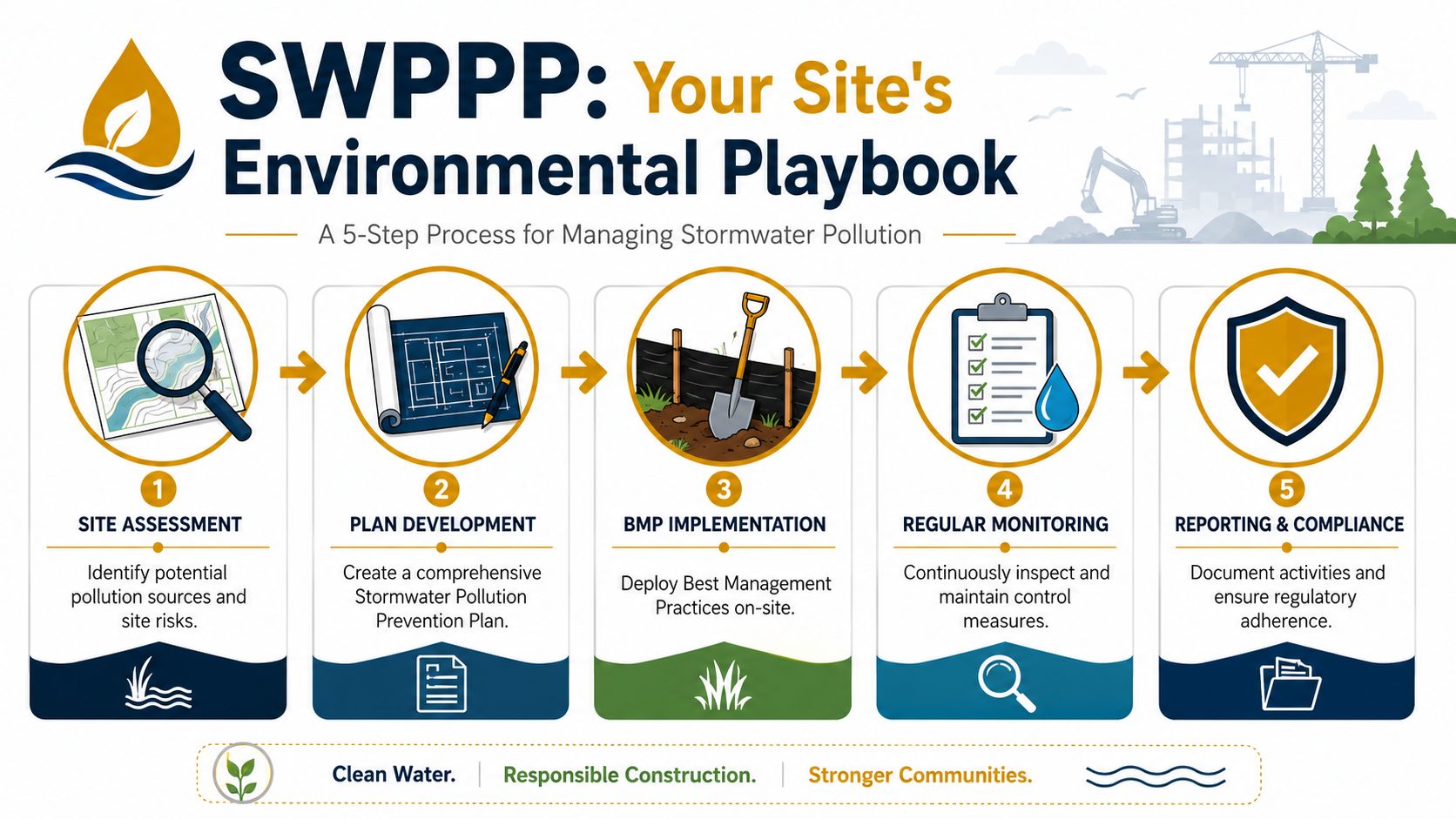
The most practical way to look at a SWPPP is this. It answers four questions before the storm asks them for you. Where will water go. What pollutants could it contact. Which BMPs will break that path. Who is responsible for keeping those BMPs functional.
What a field-usable SWPPP includes
A workable plan isn't bloated. It's specific.
At minimum, site teams should be able to pull these items from it quickly:
- Disturbance limits. Clear boundaries for what can be opened and what must stay protected.
- Drainage patterns. Existing and temporary flow paths, including where clean water should be diverted away from disturbed areas.
- BMP locations. Perimeter controls, inlet protection, slope stabilization, channel protection, stockpile controls, stabilized entrances, and washout containment areas.
- Inspection and maintenance expectations. What gets checked, when it gets checked, and who closes the loop on repairs.
- Stabilization triggers. Temporary and final stabilization expectations for inactive and completed areas.
Why inspectors care about details
Inspectors usually aren't impressed because a site has every product under the sun. They want to see that the controls match the risks and that the team is maintaining them. A perfect plan on paper doesn't help if the ditch is scoured, the blanket is loose at the crest, and the washout area is nonexistent or overflowing.
The word BMP gets used so often that it becomes abstract. It shouldn't. A BMP is just a practical control chosen for a specific failure mode. Silt fence at the perimeter. Fiber rolls on slope contours. Blankets on freshly seeded slopes. Check dams in a swale. Stabilized construction entrance at the exit. Washout containment where concrete crews can use it.
Field note: The best compliance documents mirror the site as it exists today, not the site as it looked three revisions ago.
Turn the SWPPP into a management tool
The most reliable jobs make the SWPPP part of production meetings. Not a separate environmental topic that comes up only after rain.
A simple operating rhythm works well:
- Review the next disturbance area before crews open it.
- Install controls first where runoff will start immediately.
- Confirm trade impacts so one crew doesn't destroy another crew's BMPs.
- Walk after weather and document repairs while the evidence is fresh.
- Update the plan when phasing, drainage, or staging changes.
This is also where specialized controls matter. Concrete washout is a good example. If wash water or slurry is dumped onto bare ground, into a ditch, or near perimeter BMPs, you haven't just created a housekeeping issue. You've added a pollutant source that can compromise the whole stormwater program. Washout containment belongs in the SWPPP because crews need a designated, maintained location that fits actual operations.
Sites stay compliant when the plan is treated like a live set of instructions. Not a binder. Not a permit artifact. A field document tied to daily work.
A Field Guide to Common Erosion Control Methods
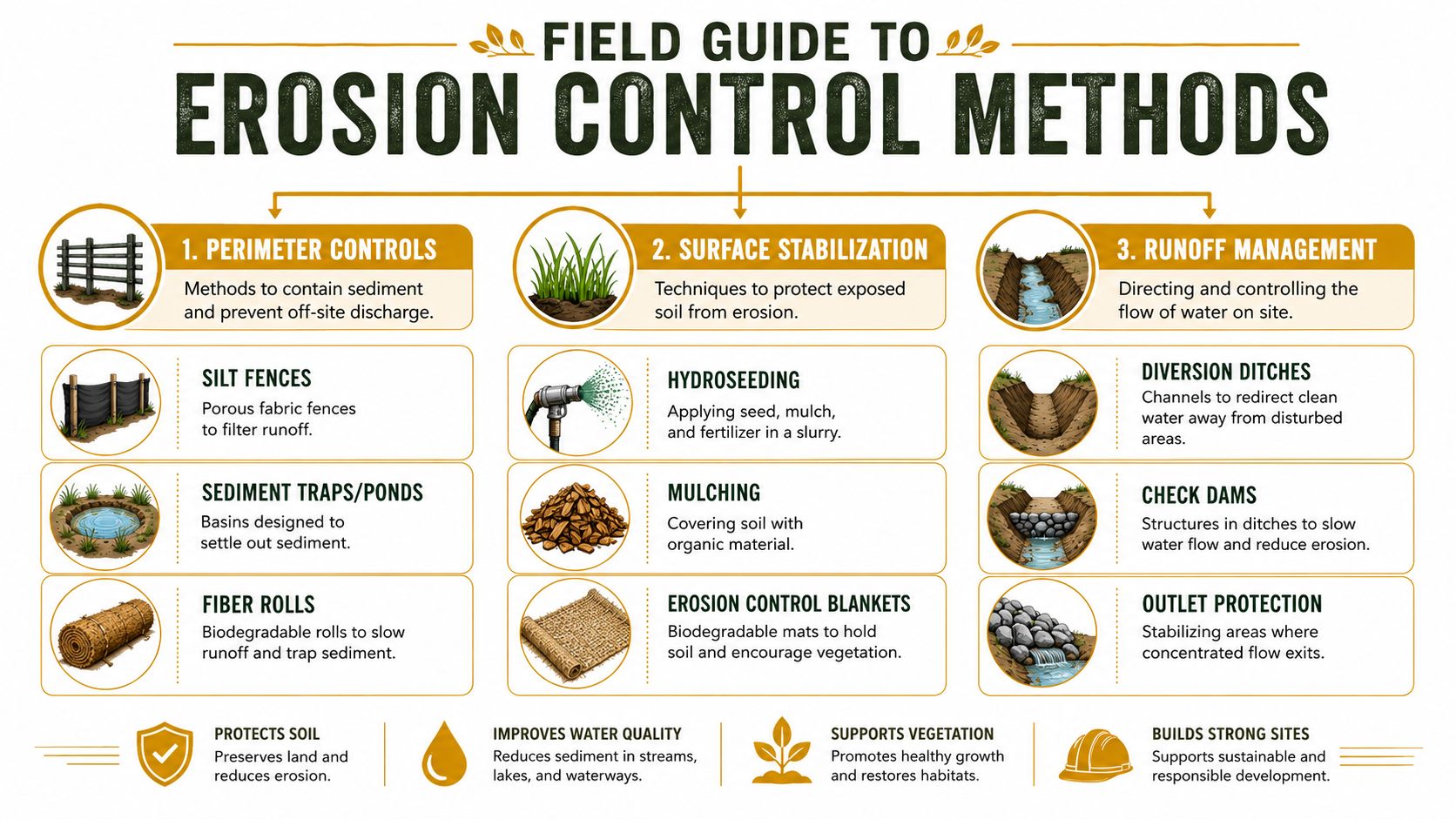
The strongest erosion prevention techniques work in layers. One control reduces slope runoff length. Another protects the soil surface. Another captures sediment before discharge. If you expect one BMP to solve every site condition, you'll either overspend or underperform.
The long-term foundation is straightforward. The USDA NRCS states that the most effective long-term strategy is keeping soil covered and minimizing disturbance, using practices such as no-till, mulch till, cover crops, and vegetative barriers to reduce wind and water erosion by anchoring soil and interrupting runoff pathways, as explained in the USDA NRCS small-scale erosion guidance. Construction sites apply the same principle with temporary and permanent stabilization.
Perimeter controls
Perimeter controls are your site edge defense. Their job is to intercept runoff, slow it, and keep sediment from leaving the disturbed area.
Silt fence is the classic example, but it gets misused constantly. It is a filter barrier, not a dam. It works where runoff arrives as shallow sheet flow. It fails when crews install it across a concentrated drainage path and expect fabric to stop channel flow.
Fiber rolls and compost socks fit the same broad family but behave differently. They can break up sheet flow on slopes, define work edges, and help intercept runoff before it builds speed. On disturbed ground, they're useful where you need flexibility and fast installation.
Sediment traps and basins handle bigger drainage areas and hold runoff long enough for suspended particles to settle. They belong where drainage is predictable and enough room exists to build, access, and maintain them. They are not low-maintenance by default. If sediment accumulates and nobody cleans them out, capacity drops and performance follows.
A quick rule set helps:
- Use silt fence for perimeter sheet flow, not ditch flow.
- Use fiber rolls to segment slope runoff and provide short-run interception.
- Use sediment traps or ponds where runoff volume and drainage pattern justify a settling feature.
Surface stabilization
This category protects soil where it sits. On active sites, that's often the difference between minor staining and actual sediment movement.
Mulch is simple and effective when applied promptly on low-risk disturbed areas. It cushions raindrop impact, reduces crusting, and helps hold moisture for seed establishment. It isn't the right answer everywhere. On steeper or more exposed areas, loose mulch can move unless it's anchored properly or paired with another control.
Temporary seeding and permanent vegetation are the goal whenever the schedule allows. Roots hold soil, stems disrupt shallow flow, and cover protects the surface. The catch is timing. Seed doesn't solve the vulnerable period immediately after disturbance.
That's where rolled erosion control products come in. Caltrans notes that rolled products such as straw blankets, jute mesh, and coir netting provide immediate surface protection by reducing raindrop impact, improving infiltration, retaining soil moisture, and helping seed germination and vegetation establishment, as described in the Caltrans erosion control design guidance. The same guidance notes that fiber rolls and compost socks can shorten slope length, intercept runoff, reduce flow velocity, and remove sediment.
Blankets buy time for vegetation. They don't replace vegetation on sites that need durable long-term stabilization.
Hydraulic mulch or hydromulch can cover large areas efficiently, especially where access is good and slopes are moderate. It provides fast surface coverage and supports seed, but it usually isn't the best single answer where concentrated flow, steep grades, or repeated disturbance are expected.
Runoff management and concentrated flow controls
Once runoff concentrates, surface treatments alone often stop being enough. Water in a channel has more energy, and the fix has to match that energy.
Diversion ditches and berms redirect clean runoff away from disturbed work. This is one of the most overlooked moves on a site. If you keep upslope water out of the problem area, every downstream BMP works better.
Check dams go inside ditches, swales, and temporary channels to slow flow and reduce scour. They don't stop water. They step it down. If installed too far apart, too low, or with bypass at the edges, they become decorations instead of controls.
Outlet protection matters wherever water exits a pipe, slope drain, or temporary channel. Without stabilization at the discharge point, concentrated flow cuts immediately into unprotected soil.
Turf reinforcement mats belong in tougher conditions, especially where high-flow channels or steep slopes won't be protected adequately by unreinforced vegetation alone. They reinforce the root zone and are often part of a hybrid approach rather than a stand-alone fix.
Hybrid systems usually work better than single products
The cleanest-performing sites combine methods based on the risk area. A common slope package might use diversion at the crest, fiber rolls to break up slope length, blanket over seed on the face, and stabilized discharge at the toe. A disturbed channel might need shaping, check dams, reinforced lining, and sediment interception downstream.
Here's the point crews should remember: every BMP has a job description. Problems start when people ask one control to do three jobs badly instead of giving the site the right combination.
Choosing the Right Technique for Your Site Conditions
Selection starts with the slope. A technical guide classifies slopes up to 33% as low-to-moderate, 33% to 50% as moderate-to-steep, and over 50% as steep, with more intensive controls recommended as grade increases. On slopes above 50%, terraces and retaining walls may be necessary, while lower grades can often be managed with vegetation and mulch, according to the slope erosion guidance from EOSDA.
That threshold matters because crews often choose controls by habit instead of by site geometry. A product that works on a short mild slope can fail quickly on a long steep one, especially if runoff concentrates or traffic keeps disturbing the surface.
The decision filter that works in the field
Before picking a control, answer these questions:
- How steep is the area. Mild, moderate, or steep changes what “basic” protection means.
- How long is the uninterrupted flow path. Longer slope means more runoff energy.
- Will flow stay shallow or become concentrated. That single distinction changes product choice fast.
- How long must the control last. A short-duration rough grade and a long exposed slope don't need the same package.
- Will crews keep crossing it. Repeated traffic destroys some stabilization methods before they ever get established.
If runoff is concentrated, stop thinking only about cover. Start thinking about channel protection, grade breaks, and reinforced systems.
Erosion Control Technique Selection Matrix
| Technique | Ideal Slope | Primary Use Case | Relative Cost |
|---|---|---|---|
| Mulch | Up to 33% | Short-term surface cover on lower-risk disturbed soil | Low |
| Temporary seeding | Up to 33% | Areas that can remain undisturbed long enough to establish cover | Low |
| Erosion control blanket | 33% to 50% | Immediate surface protection on seeded slopes and disturbed faces | Moderate |
| Fiber rolls | Up to 50% | Breaking slope length and intercepting shallow runoff | Low to moderate |
| Check dams | Concentrated flow areas | Slowing water in swales, ditches, and channels | Moderate |
| Turf reinforcement mat | Steep slopes or high-flow channels | Reinforced long-term protection where vegetation alone may not hold | Higher |
| Terraces or retaining walls | Over 50% | Structural control where grade is too steep for surface treatment alone | Higher |
Don't ignore the non-slope factors
Slope is first, but it isn't the only factor. Soil that seals easily, channels that stay wet, and project phases with repeated rework all push you toward more durable systems. The same goes for areas that won't get vegetation established quickly.
A practical way to choose is to separate the site into condition zones. Flat disturbed pad. Moderate finished slope. Steep fill face. Temporary ditch. Equipment crossing. Then assign the BMP package for each zone. That's how SWPPP designers think, and it's how superintendents avoid overbuilding one area while missing another entirely.
Implementation and Maintenance Best Practices
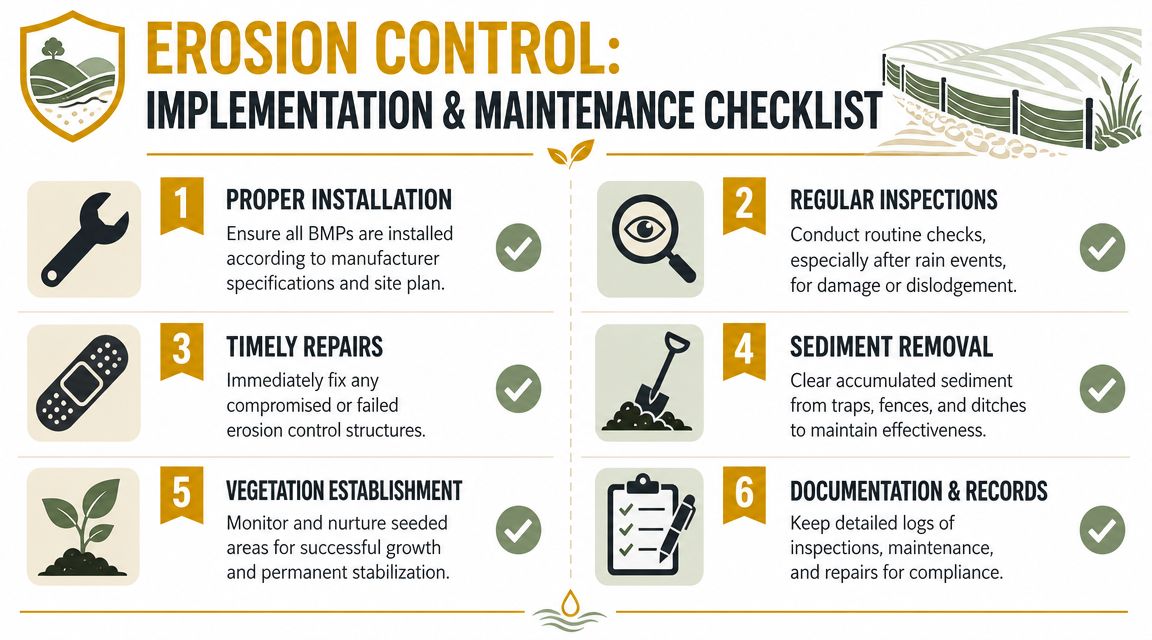
Installation quality determines whether a BMP works or occupies space. Most failures I see aren't product failures. They're installation failures, sequencing failures, or maintenance failures.
That matters most with rolled erosion control products. The USDA Forest Service specifies installation details that prevent common failures: trench blanket tops 6 inches, overlap adjacent blankets by at least 6 inches, and use 6- to 8-inch staples, especially in loose soil or high-flow areas, as outlined in the USDA Forest Service erosion control manual. Those details aren't cosmetic. They keep runoff from getting under the blanket and peeling it back.
What crews get wrong most often
Some mistakes show up on site after site:
- Loose crest installation. If the top edge isn't trenched in, water gets under the product and lifts it.
- Poor overlaps. Side seams gap open, especially after the first weather event.
- Wrong staple pattern for the soil condition. Loose soil and high-flow areas need stronger fastening.
- Controls installed after disturbance. By then the stormwater path is already established.
- No maintenance access. Sediment traps, check dams, and washout areas become hard to service, so nobody services them.
The same principle applies beyond blankets. Silt fence has to be keyed in and supported. Fiber rolls need full contact with the ground. Check dams need proper tie-in at the edges. Outlet protection has to cover the actual discharge zone, not an idealized point shown on a plan.
A practical maintenance rhythm
BMPs aren't install-and-forget items. A simple inspection routine prevents small damage from turning into a reportable failure.
Use a checklist that covers:
- Crests and edges. Look for undercutting, gaps, and bypass.
- Sediment buildup. If sediment accumulates against barriers and in traps, function drops fast.
- Traffic damage. Watch for tire rutting through stabilized areas and informal crossings.
- Channel scour. Check swales, ditch bends, and outlets first after rainfall.
- Vegetation progress. Surface cover has to transition from temporary protection to rooted stabilization.
Jobsite advice: The first hour after a storm tells you more about your plan than a week of meetings.
Concrete washout is part of erosion control, not separate from it
Many teams treat concrete washout like a housekeeping detail. It isn't. It's a water-quality BMP that directly affects the rest of your site controls.
If crews wash chutes, pumps, buckets, or tools onto bare soil, that slurry can move with runoff, harden in drainage paths, contaminate sediment controls, and create a secondary cleanup problem where you already need stormwater performance. If they dump near a slope toe, ditch, or inlet, you've just compromised the exact areas that need reliable flow management.
A compliant site plan gives concrete crews a designated washout location that is:
- Contained so liquid and solids stay where they belong
- Accessible enough that crews will use it
- Placed away from drainage paths and storm inlets
- Inspected and serviced before it overflows or gets abandoned
Erosion prevention techniques must work as a system. Surface stabilization, perimeter controls, runoff management, and pollutant-source controls all support one another. If one part is ignored, the others carry more load than they were meant to carry.
Train the field, not just the paperwork owner
One more point matters. The superintendent and SWPPP preparer can't carry the whole program alone. Operators, laborers, concrete crews, and foremen need to know which areas are protected, where crossings are allowed, and what to do before a storm.
The best sites make expectations visible. Flag the protected areas. Mark the washout. Show the crew where the water is supposed to go. If people can understand the site logic at a glance, they're less likely to break it under production pressure.
Building a Proactive Erosion Control Plan
Reactive erosion control always costs more in time and attention. Somebody has to stop planned work, track down material, regrade damage, remove sediment, repair BMPs, document the issue, and explain why the problem was allowed to develop. Proactive control is simpler. Disturb less ground at once, install the right BMPs before exposure, and maintain them while they still work.
That mindset changes how a project runs. The SWPPP becomes a field tool. Grading and stabilization get sequenced together. Concentrated flow areas get stronger controls than open surfaces. Concrete washout gets treated as part of stormwater compliance, not an afterthought. The site stays cleaner because the system was designed to handle the work occurring on it.
Professional crews understand that erosion control isn't separate from production. It supports production. Stable slopes hold schedule. Clean exits protect relationships with owners and neighbors. Maintained BMPs reduce inspection headaches. Clear washout practices prevent one trade from creating problems for everyone else.
A strong site culture makes this routine. The foreman knows where runoff will go. The labor crew knows what has to be repaired today, not next week. The concrete team uses the designated containment. The superintendent walks the site with weather in mind, not just manpower and deliveries.
That's what effective erosion prevention looks like in practice. Keep soil where it belongs. Keep water under control. Make compliance part of how the job gets built.
If your project needs dependable concrete washout containment as part of a cleaner SWPPP setup, Reborn Rentals gives site teams a straightforward way to rent washout pans and containers with clear pricing, delivery coordination, and fast communication. It's a practical fit for contractors who want designated washout capacity on site before concrete work starts, not after slurry becomes a stormwater problem.