The pour starts on time. The pump is set. The finishers are in place. The inspector already walked the forms. On paper, the job looks clean.
Then the first truck lands late. The crew slows down but stays on the clock. A second trade blocks the access lane with a lift. Drivers wait for direction because nobody marked a washout spot clearly. By lunch, nobody thinks the job is failing, but the profit is already thinner than it should be.
That's how most operational cost reduction problems show up on concrete work. Not as one disaster. As a stack of small misses that eat margin all day. Concrete jobs punish poor timing, poor flow, and poor cleanup faster than almost any other scope because once trucks roll and mud is moving, every mistake hits labor, equipment, material, and schedule at the same time.
Beyond the Budget Finding Hidden Job Site Costs
Most cost reviews start too high up. People look at labor totals, concrete price, pump rental, and fuel. Those matter. But the money that slips away on concrete jobs usually sits lower down in the field, inside waiting time, rework, scrap, extra handling, and cleanup nobody planned properly.
That is why the old manufacturing term cost of poor quality, or COPQ, fits concrete work better than most office-style budgeting advice. The DMAIC cycle from Lean Six Sigma remains foundational because it gives teams a repeatable way to define, measure, analyze, improve, and control the losses tied to defects, scrap, rework, and wasted material. On a concrete site, that can mean bad sequencing, blown finish timing, rejected loads, over-ordering, or washout mess that turns into labor-heavy remediation.

What hidden cost looks like on a concrete site
A slab crew rarely says, “We have a COPQ problem.” They say:
- The pump sat too long: Setup happened on time, but delivery spacing didn't match crew capacity.
- The finishers got pinched: One area tightened up because placement got ahead of strike-off and edging.
- The site got muddy and disorganized: Material staging forced extra walking, extra handling, and extra cleanup.
- The washout became a problem late: Drivers improvised, laborers got pulled off productive work, and someone had to fix the mess before turnover.
Each one feels minor in the moment. Together, they turn a decent gross margin into a frustrating closeout.
Field truth: Most bad concrete costs don't arrive as line items. They show up as wasted motion, idle hands, and cleanup that should never have existed.
Why budget thinking misses the real issue
A budget tells you what you planned to spend. It doesn't tell you where the work leaked efficiency. If you only compare estimate to actual, you can miss the pattern. Maybe labor came in high because trucks bunched up. Maybe cleanup took longer because nobody protected site flow. Maybe waste disposal became a headache because slurry handling was treated as an afterthought.
That's why operational cost reduction on concrete work has to start with observation, not just accounting. Watch the pour path. Watch how many times laborers touch the same material. Watch how far people walk for tools, water, and access. Watch what happens in the final hour, when fatigue and schedule pressure usually expose every weak setup decision made earlier.
The better question to ask
Don't ask only, “Where can we cut cost?”
Ask, “What keeps making this work harder than it needs to be?”
That question finds the profit killers generic cost-cutting articles usually miss.
Mastering Job Site Flow and Logistics
On concrete jobs, flow is cost. If the site moves cleanly, the pour usually makes money. If flow breaks down, everyone starts burning hours at the same time.
Recent analysis in Harvard Business Review on extraordinary low-cost operators points to controlling cycle time and reducing variability as the bigger source of durable savings. That lines up with what happens in the field. A concrete crew can work hard all day and still lose money if the job keeps changing tempo.
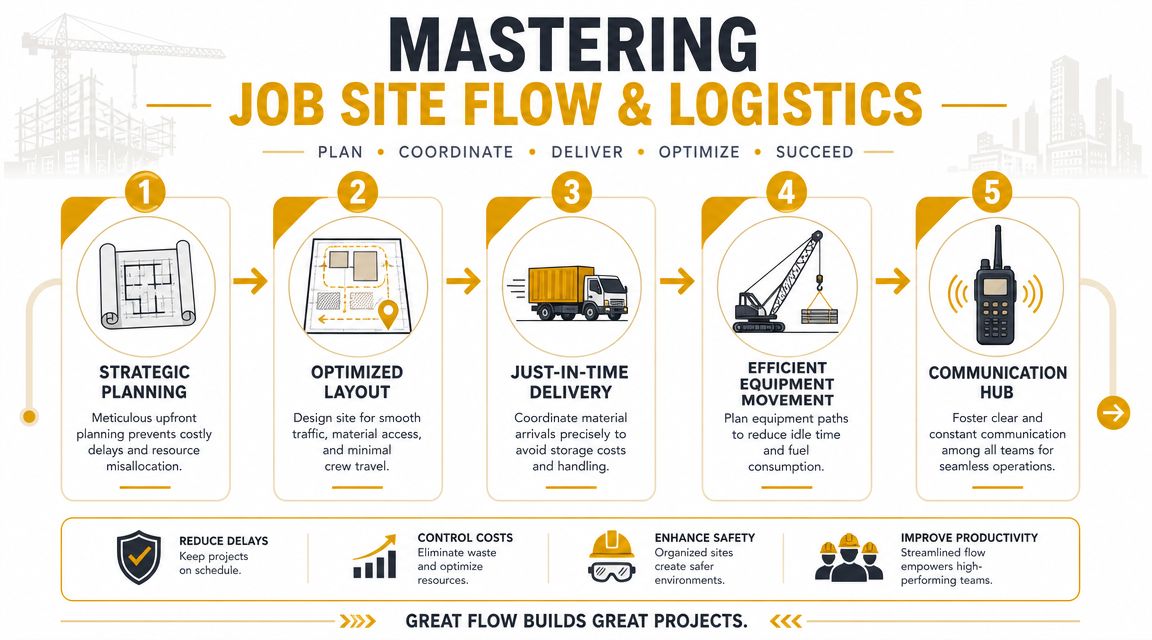
One late truck can jam the whole site
A delayed truck doesn't only affect placement. It changes the rhythm of the entire operation.
The pump operator starts waiting. The placing crew hesitates between sections. Finishers either get starved for work or suddenly get overloaded when trucks start arriving too close together. If another trade is sharing access, the lane gets congested right when you need smooth movement most. By the end of the pour, supervisors are solving avoidable traffic problems instead of managing quality.
That is the hidden cost of complexity at job-site level. Not complexity on a chart. Complexity in gate access, truck spacing, crew pacing, and handoffs.
Pre-pour checks that protect margin
Before the first truck leaves the plant, lock down these points:
- Confirm the route in and route out: Don't assume the same access used yesterday still works today. Check gates, turning radius, backing room, and whether another trade has occupied the lane.
- Match delivery rhythm to placement capacity: The right schedule is the one your crew and pump can absorb, not the most aggressive dispatch board.
- Set one washout location early: Mark it, communicate it, and make sure drivers can reach it without guessing.
- Stage tools where the work will move: Hoses, vibrators, rakes, screeds, and finishing tools should be placed around the sequence of work, not piled where they looked convenient at sunrise.
- Clear trade conflicts in advance: If electricians, framers, steel crews, or inspectors share the area, settle that before mud starts moving.
- Walk the site for foot traffic: Look for places where labor will cross hoses, climb around forms, or carry tools farther than needed.
Site layout mistakes that keep repeating
Some jobs lose money because the layout was never treated as a productivity tool.
A few common examples:
| Layout issue | What it causes in the field | Profit effect |
|---|---|---|
| Pump set too far from best reach | Extra hose moves and awkward placement | Slower cycle time, more fatigue |
| Rebar, forms, or pallets in access lane | Truck and labor interference | Waiting and rehandling |
| Washout location set too late | Driver confusion and improvised cleanup | Labor diversion and compliance risk |
| Material staged without sequence in mind | Crew backtracking across the site | Lost motion and uneven pacing |
Jobs run better when one person owns movement. If nobody owns movement, everybody loses time.
The standard that actually works
The best concrete foremen and PMs don't just “coordinate.” They build a simple operating rhythm:
- Walk the route.
- Mark the flow.
- Confirm the sequence with dispatch, pump, and crew lead.
- Reconfirm after any weather shift, schedule change, or trade conflict.
That discipline feels basic. It also protects margin better than most last-minute cost cutting.
Optimizing Your Crew and Equipment Uptime
Labor and equipment carry the job. They also expose every planning mistake fast. A pump can be on site, fueled, staffed, and technically ready, yet still spend too much of the day waiting on decisions. The same goes for finishers and laborers. Headcount alone doesn't create production. Clarity does.
For repetitive, high-volume, error-prone tasks, Planisware's guidance on reducing operational costs recommends targeting automation carefully and weighing setup, integration, training, and support against savings. That same rule belongs on concrete jobs even when the “automation” is just adding software, digital tickets, or crew messaging. If the process is broken, tech won't fix it. It will just make the confusion faster.
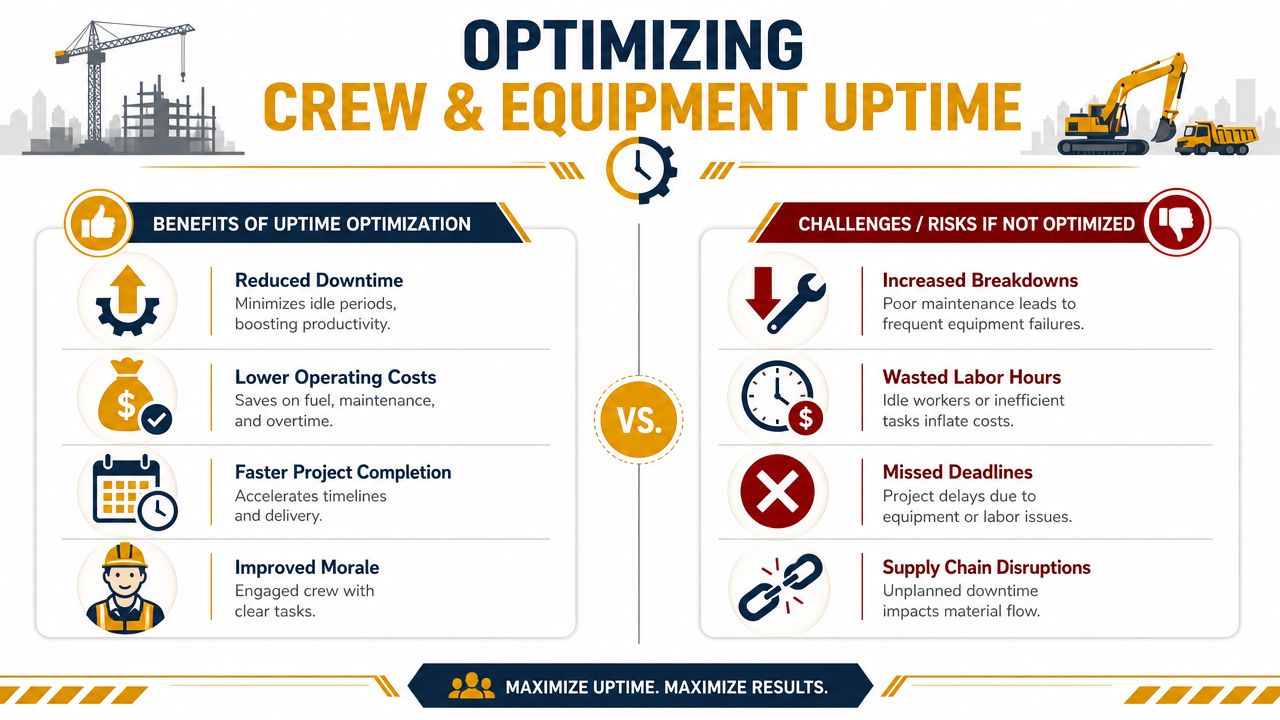
Do this with crews
A good crew plan is not “get more hands.” It is getting the right hands doing the right work at the right phase of the pour.
Do
- Run a short pre-pour huddle: Confirm sequence, truck spacing, hose path, finish expectations, washout location, and who makes calls if conditions shift.
- Assign zones clearly: One area, one lead. Confusion usually starts at the edge where two people think the other person owns it.
- Move support labor with the pour: Keep helpers where bottlenecks are forming, not where they started.
- Use simple mobile communication: Group texts, shared task updates, or basic field apps work well when they reduce shouting and missed direction.
Don't
- Overstaff “just in case”: Extra labor without a clean plan creates crowding, not speed.
- Leave finish timing vague: The placing crew and finishing crew need the same picture of pace.
- Pull key people into side tasks mid-pour: Fetching materials, hunting tools, or solving avoidable cleanup issues destroys productive rhythm.
- Confuse activity with output: A busy-looking crew can still be wasting time.
Do this with equipment
Concrete equipment should be scheduled around productive windows, not around convenience.
Here's the comparison I use on real jobs:
| Equipment habit | Efficient practice | Costly habit |
|---|---|---|
| Pump planning | Set for best reach and minimal hose moves | Reposition after placement starts |
| Maintenance timing | Handle service before the pour or off-hours | Discover issues during active placement |
| Fuel and accessory prep | Check before deployment | Stop work for mid-task fixes |
| Tool staging | Put tools near sequence of use | Keep everything at one central pile |
The pump doesn't make money by being present. It makes money by moving concrete consistently.
Where simple tech helps and where it doesn't
Digital delivery tracking, crew messaging, and mobile checklists can help. So can ticket capture and photo documentation. They work best when they remove repeatable friction.
They do not help when the underlying problem is poor sequencing, weak supervision, or a site that was never laid out for clean movement. In those cases, the tablet becomes one more thing people carry while the same bad process keeps burning labor.
The practical test is simple. If a tool shortens a repeated task, reduces errors, or keeps a handoff from slipping, keep it. If it adds screens but doesn't improve field rhythm, drop it.
Slashing Costs Through Smart Waste Handling
The truck is on site, the crew is ready, and then someone asks where the washout is going. Five minutes turns into fifteen. A laborer gets pulled off useful work, the driver waits, slurry ends up where it should not, and cleanup gets pushed to the end of the day. That is how a small waste-handling miss turns into lost margin on a concrete job.
Waste handling belongs in the production plan because concrete waste keeps showing up in labor, hauling, schedule, and compliance costs at the same time.

Waste control is a cost lever, not a housekeeping task
On concrete work, waste is rarely just "trash." It is leftover mud, wash water, broken-out sections, rejected material, pallets, rebar cutoffs, bag stock, and contaminated debris that can no longer be hauled the cheap way. Once crews mix those streams together or let them spread across the site, the job pays more to move them, more to clean them, and more to explain them to an inspector or owner.
The field fix is straightforward. Order tighter. Set a washout location before the first truck rolls in. Keep recyclable and contaminated material separate. Assign one person to own the process.
Small misses add up fast. Ten minutes spent figuring out washout with a waiting driver is one thing. Add a diverted laborer, a delayed next truck, and extra cleanup at closeout, and the cost is no longer minor.
Where concrete jobs actually lose money on waste
The expensive problems are usually routine problems:
- Overage with no plan for where it goes
- Washout set up late or not at all
- Broken concrete mixed with general debris
- Packaging, forms, and scrap piled where crews still need access
- Cleanup handled at the end of the shift instead of controlled during the work
- Improper disposal that creates rehandling or compliance exposure
Non-compliant waste handling is one of the quiet profit killers on concrete sites. A sloppy washout area can trigger cleanup, hauling changes, surface repair, and inspector attention on the same job. Even without a fine, the site burns hours fixing something that should have been controlled before placement started.
Why dedicated containment usually pays for itself
Dedicated washout pans, lined containment, and marked waste areas cost money up front. They usually cost less than one reactive cleanup event.
Here is what that looks like in practice:
| Poor waste setup | What it costs on site | Better result with planned containment |
|---|---|---|
| Drivers ask where to wash out | Waiting time, confusion, rushed decisions | One marked location every time |
| Slurry hits open ground or traffic paths | Cleanup labor, slower movement, possible surface damage | Cleaner access and easier pickup |
| Scrap and debris are thrown into one pile | Higher hauling cost and more sorting later | Cleaner separation and simpler removal |
| Overage is dumped wherever space exists | Rehandling with machine and labor later | Controlled placement for reuse or disposal |
| Waste area has no owner | The problem spreads all day | One person keeps it under control |
A clean waste setup protects production. It also protects crew rhythm, which is where a lot of hidden cost lives on concrete work.
What to track in the field
Do not overcomplicate this. Track the waste items that hit job cost directly:
- Material overage by pour
- Cleanup labor hours
- Haul-off loads by waste type
- Rehandling events
- Washout issues
- Non-compliant disposal incidents or near misses
I want notes that a superintendent can use later. "Two labor hours lost to washout cleanup" is useful. "Site untidy" is not.
If the same waste problem shows up on three jobs in a row, it is no longer bad luck. It is a process failure, and process failures are expensive on concrete sites because they keep stealing labor in small pieces all day.
How to Calculate Savings and Find Quick Wins
A pump is on site. Six finishers are standing by. Two trucks are stacked at the gate because one delivery came early and another cannot get past stored material. Nobody calls that a budget problem in the moment. It gets written off as a rough start. Then the job pays for it anyway.
That is why budget thinking misses the issue. Concrete work loses margin in small chunks, and small chunks add up fast when labor, equipment, and trucks are all tied to the same sequence. If a delay happens more than once, put a cost on it. Once people see the dollars attached to waiting, rehandling, and cleanup drift, quick wins get easier to approve.
You do not need a dashboard to do this. A foreman log, daily report, or phone note works if the crew uses the same math every time.
Back-of-the-napkin formulas that work on site
Keep the formulas simple enough to use during the pour, not a week later in the trailer.
| Inefficiency Type | Calculation Formula | Example (1-hour delay) |
|---|---|---|
| Crew idle time | (Hourly labor cost per worker × Number of workers) × Idle hours | A full crew waits 1 hour |
| Equipment idle time | Equipment hourly cost × Idle hours | Pump or lift sits 1 hour |
| Rehandling material | Extra labor hours × Blended labor rate | Labor spends 1 hour moving material twice |
| Cleanup from poor field control | Cleanup labor hours × Blended labor rate | Crew spends 1 extra hour on remediation |
| Delivery mismatch | Idle crew cost + idle equipment cost during delay | Trucks and field team fall out of sequence |
| Rework | Labor hours to correct + material replacement cost + equipment time | Finish issue forces corrective work |
Use rough numbers if that is what you have. Speed matters more than perfect precision here.
A superintendent does not need exact accounting to spot a leak. If the same half-hour delay shows up on three pours, and each time it burns crew time, pump time, and truck rhythm, that is a process problem with a price tag.
A quick-win audit for the next concrete job
Before the next pour, walk the site and check the points that usually create hidden cost:
- Access is clear: Trucks, pump, buggies, and crew can move without crossing stored material, parked equipment, or another trade's setup.
- Staging matches the sequence: Tools, forms, inserts, and finishing gear are where the crew needs them before placement starts.
- Crew ownership is clear: Each lead knows who handles placement support, hose management, finishing sequence, and closeout.
- Delivery timing matches production pace: Dispatch timing fits pump capacity, haul time, and what the crew can place without bunching trucks.
- Recovery steps are planned: If a truck is late, a lane gets blocked, or weather changes the pace, somebody already owns the adjustment.
- End-of-pour reset is assigned: Cleanup, remaining material, and site reset are planned before the first load hits.
This walk takes minutes. It can save hours.
Where to find the fastest savings
Start where one fix removes repeated friction from every pour. On concrete jobs, the quickest savings usually come from better sequence control, not big policy changes.
Look first at these areas:
- Truck arrival gaps that leave labor and pump time burning
- Poor staging that adds extra walking, extra handling, and stop-start production
- Blocked access that breaks site flow
- Crew members pulled off placement to solve preventable side issues
- Loose closeout routines that turn the last part of the pour into overtime
Track cycle time, waiting time, and cleanup time for three pours in a row. Repeating losses usually show up there before they show up in the cost report.
What to measure after the change
After you make a change, check field results instead of declaring success because the plan looked good in a meeting. On a concrete project, the useful measures are plain: labor hours used, waiting time, placement duration, cleanup hours, rehandling events, and cost per yard or per pour if you track it that way.
Compare the next few pours against the last few under similar conditions. If the crew spends less time waiting, equipment sits less, and closeout gets tighter, the fix worked. If the same delays keep showing up, the process did not improve. It just got renamed.
Building a Culture of Cost-Conscious Work
The best cost control on concrete jobs doesn't look like cost control. It looks like a crew that knows the plan, a site that stays organized, and a manager who fixes repeat friction instead of fighting the same fire every week.
That mindset matters because broad cuts often backfire. Cut too hard in the wrong place and service drops, quality slips, or capacity disappears right when the next job needs it. Deloitte's work on cost optimization in operations strategy makes the bigger point well. Strong cost optimization preserves growth by finding synergies across functions and partners instead of relying on siloed cuts.
What a cost-conscious crew actually looks like
You can spot it quickly:
- Foremen report delays accurately: They don't hide waste to protect appearances.
- PMs review recurring losses by process: Access, delivery timing, washout, cleanup, and rework all get discussed.
- Labor sees setup as production: Clean staging and site order aren't “extra.” They're part of output.
- Partners get pulled into the system: Dispatch, pump operators, truck drivers, and cleanup support work from the same field plan.
That kind of culture doesn't come from posters or speeches. It comes from repetition and supervision.
What leadership has to enforce
Field leaders set the standard in small ways:
| Leadership habit | Crew takeaway |
|---|---|
| Start pours with a clear huddle | Planning matters here |
| Mark routes and washout early | Order matters here |
| Log delays and rework causes | Facts matter here |
| Clean as work progresses | Pride and pace matter here |
People usually follow what the superintendent and PM tolerate. If disorder gets shrugged off, disorder becomes normal. If waste gets measured and corrected, crews start seeing inefficiency before management has to point it out.
The long game
Operational cost reduction on concrete work isn't about squeezing every invoice until nobody wants to work with you. It's about removing the friction that keeps jobs from flowing cleanly.
That means fewer improvised decisions, fewer site conflicts, less rework, cleaner waste handling, and better control of the hours you're already paying for. Those gains hold up because they come from better operating design, not panic cutting.
Pick one change on the next job. Lock in the washout plan earlier. Tighten truck sequencing. Run a better pre-pour huddle. Track cleanup hours. One field habit done consistently beats a binder full of cost-saving ideas nobody uses.
If concrete washout is one of the recurring pain points on your jobs, Reborn Rentals gives crews a straightforward way to contain slurry, keep sites cleaner, and plan disposal logistics before the first truck arrives. Their rental process is simple, pricing is upfront, and the equipment is built for concrete work that can't afford messy, improvised washout solutions.