You know the feeling. The crew finished the pour, the site looks clean, the client's happy, and everyone calls the job a win. Then the dust settles, invoices land, a rental ran longer than planned, two extra trips hit the fuel bill, the foreman spent more hours babysitting the site than anyone budgeted, and the “good” job turns out to be thin or upside down.
That's where project profitability analysis stops being office paperwork and starts acting like field insurance. If you run concrete work, civil packages, site improvements, or renovation pours, you can't judge a job by contract value, installed yards, or how busy the crew stayed. You need a way to trace what the job consumed and pressure-test the bid before the first truck rolls.
Most bad surprises come from two places. First, weak cost allocation. Shared labor, supervision, rentals, trucks, cleanup, and overhead get dumped into a general bucket, so the job looks healthier than it really was. Second, teams treat the estimate like a fixed truth instead of a live forecast, even though weather, access, sequencing, change orders, and rework can move margin fast. Fix those two failure points and your numbers start matching the bank account a lot more often.
Why 'Profitable' Jobs Can Still Lose Money
Friday afternoon, the super says the job made money. The production looked good, the client signed off, and the crew moved on. Two weeks later, the job cost report catches up. The telehandler stayed on rent three extra days, the foreman burned hours on coordination calls, one inspection miss forced a return trip, and the margin you thought you had is gone.
That happens for two reasons over and over. Contractors miss costs that belong to the job, or they price the work as if nothing will go sideways. In the field, both mistakes are expensive.
The first problem is incomplete cost capture. Everybody loads the obvious items into the estimate and job cost report: concrete, rebar, pump, labor. The leaks come from the edges. Cleanup labor, layout revisits, saw blades, fuel, small tools, washout handling, traffic control, standby time, disposal, and supervisor time often sit in overhead or get buried in another cost code. A job can look clean on paper while consuming cash all week.
Weak allocation makes it worse. Shared costs are where a lot of "profitable" jobs lie to you. If one project needs constant babysitting, extra site logistics, or repeated client hand-holding, that project should carry more supervision, truck time, office support, and rental burden than a straightforward pour of the same value. If it does not, the margin report is flattering the job instead of measuring it.
I see this all the time on tight-access work.
A small infill slab may bid well against standard production rates. Then the site gives you one narrow delivery window, no material staging, and a neighbor who complains about every truck. The crew spends more time waiting and shuffling than placing concrete. The direct labor line still looks close to budget, but the job has chewed up PM time, superintendent attention, extra deliveries, and equipment days that never got assigned where they belonged.
The other failure point is volatility. Estimates often get treated like fixed truth when they are really one version of how the job might go. Weather shifts. Access changes. Another trade misses its handoff. A supplier splits deliveries. The owner slows approvals. None of that is unusual. It is normal construction. If the bid only works under perfect conditions, it is not a strong bid.
That is why project profitability analysis has to answer more than one simple question at closeout. It needs to show:
- which costs belong to the job
- how shared expenses should be assigned so margin reflects reality
- whether the expected margin survives common disruptions like delays, remobilization, or low productivity
- when a thin job still makes sense for crew loading or client strategy, and when the risk makes it a bad piece of work
A profitable job is not just a job with revenue above direct cost. It is a job where all actual costs were mapped to the work, and the margin could survive normal project turbulence. If your system cannot show both, it is giving you history, not control.
Mapping Every Dollar From Bid to Debris
A bid can look clean on bid day and still bleed cash by punch list if the cost map stops at labor, material, and a few obvious rentals. That miss usually shows up in the field, not in the estimate. The second pump day gets coded nowhere. The superintendent spends half a day solving access problems for one tight site. The dumpster swap, toilet service, washout setup, and remobilization all happen, but they land in overhead or get buried in another cost code.
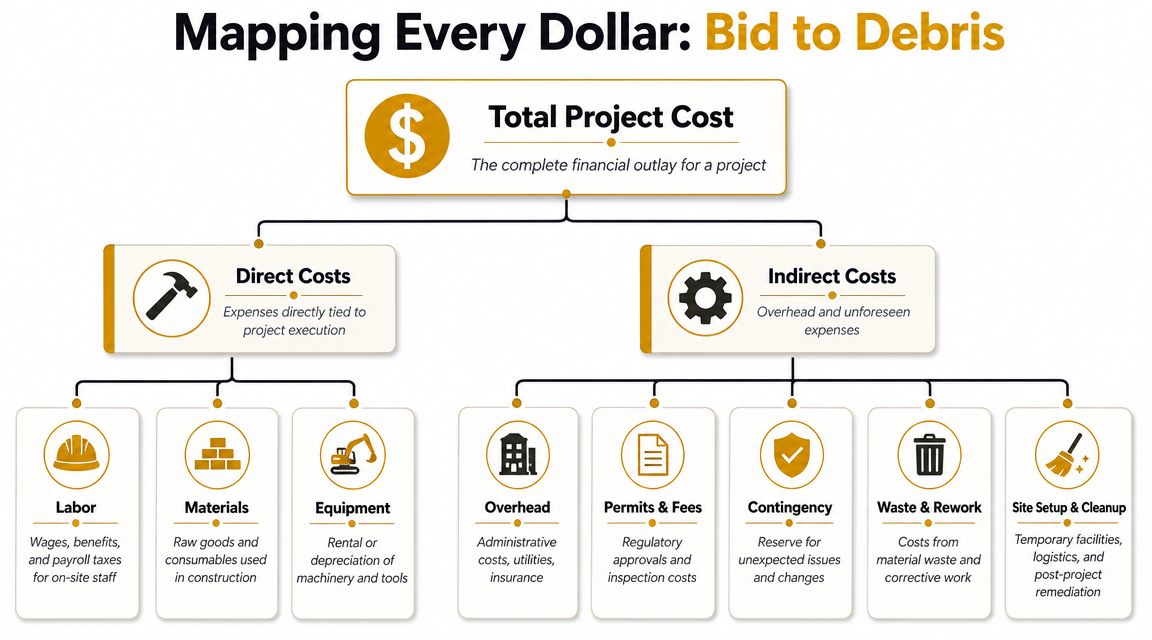
That is how a job looks profitable on paper and weak in the bank account.
Start with the full direct-cost picture
Direct cost should cover every dollar required to put work in place and finish the scope. For a concrete package, that goes well past the basic trio of crew, concrete, and pump.
A working direct-cost list usually includes:
- Field labor: Crew wages, burden, overtime, foreman time, operator time, cleanup, protection, punch work, and return trips.
- Materials: Concrete, rebar, mesh, form lumber, stakes, anchor bolts, admixtures, curing compound, patch material, and consumables.
- Equipment: Pumps, saws, trowels, compactors, skid steers, generators, heaters, and any project-specific rental gear.
- Site rentals and services: Dumpsters, washout containment, fencing, toilets, lighting, traffic control, water trucks, and specialty hauling.
- Delivery and logistics: Freight, redelivery, short-load charges, crane picks, restricted-hour deliveries, and extra trucking caused by access limits.
The field misses the same items over and over. Saw cutting gets treated as an afterthought. Slab protection is assumed to be free. A rental stays on site three extra days because another trade blocks the area. None of that is unusual. It is normal jobsite friction, and the estimate has to leave room for it.
Separate support costs from true overhead
The next leak is weak cost allocation. Some costs are not direct production, but they still belong to the job because the job consumed them.
That includes PM time, superintendent coverage, layout support, safety paperwork, submittals, billing admin, truck wear, fuel handling, yard loading, and equipment prep. If a school addition takes constant coordination, phased pours, and repeated site visits, it should carry more support cost than a clean slab-on-grade job with easy access and one mobilization.
As noted earlier, the point of cost tracing is to assign expenses to the work that created them. In practice, that means treating support labor and shared assets as job costs when the project uses them, instead of burying them in a flat company percentage.
A difficult job is more expensive to run, even when the direct labor production looks decent.
Match the allocation method to the resource
Flat overhead percentages are easy. They are also one of the fastest ways to hide bad work.
Use an allocation method that follows actual usage:
| Cost type | Better allocation method | Why it works |
|---|---|---|
| PM and superintendent time | Hours charged by job | Ties management cost to actual attention required |
| Trucks and small fleet | Trips, mileage, or days assigned | Captures travel, fuel, and wear more accurately |
| Yard and shop support | Mobilizations, loads pulled, or prep events | Reflects handling effort instead of spreading it evenly |
| Office support | Labor hours or direct labor dollars | A workable proxy for billing, payroll, and admin load |
| Insurance and compliance | Project value, risk class, or exposure | Better fit than a flat charge across every job |
I have seen contractors treat a high-maintenance urban infill project and an open-access tilt-up site the same on overhead. The books showed similar margins. The field knew better. One job tied up supervision, deliveries, and coordination all month. The other moved with very little support drag.
Build the checklist once, then use it on every bid
Fancy software does not fix a shallow cost map. A standard checklist usually does more for margin control.
Use a pre-job review that answers five questions every time:
- What has to be on site to perform the work?
- What has to be on site to support the work?
- What keeps costing money if production slows or stops?
- What happens after placement that still belongs to this scope?
- Which shared people, trucks, or equipment will this job pull away from other revenue work?
That last question matters more than many estimators admit. If a project ties up your best finisher, your pump, and your superintendent for longer than planned, the cost is not limited to that one job code. It also affects what the company cannot do elsewhere.
For a concrete contractor, this review should run from bid day to final cleanup. Include mobilization, staging limits, weather protection, cleanup, disposal, demob, and closeout. Include rentals that extend if the sequence slips. Include support costs that rise when the owner, site, or schedule gets choppy.
Map every dollar before the contract is signed. Then keep updating that map as the job changes. That is how profitability analysis stops being spreadsheet math and starts reflecting the way construction jobs make or lose money.
Calculating Your Key Profitability Metrics
Once the cost map is honest, the math gets simpler. Yet, a common misstep involves the opposite: obsessing over formulas while feeding those formulas weak inputs.
For job decisions, I rely on four core views: gross profit, gross profit margin, net profit, and break-even point. I also keep an eye on ROI when comparing one opportunity against another. None of these metrics are complicated. The hard part is making sure every major cost has somewhere to land.
The formulas that matter on a job
These are the basic calculations:
- Gross profit = Revenue – Direct costs
- Gross profit margin = Gross profit / Revenue
- Net profit = Revenue – Direct costs – allocated indirect costs
- Net profit margin = Net profit / Revenue
- ROI = Net profit / Total project cost
- Break-even point = The revenue level where total costs are fully covered
That's the clean version. In practice, gross profit tells you whether production pricing makes sense. Net profit tells you whether the job helped the business after support burden, shared labor, and operational overhead are considered.
A practical sample for a 50-yard pour
Use one sample job and plug in your own numbers. The point isn't the exact amount. The point is seeing how the line items flow.
Sample Profitability Calculation for a 50-Yard Pour
| Line Item | Amount | Notes |
|---|---|---|
| Contract revenue | [enter your contract value] | Fixed-price amount for the pour scope |
| Direct labor | [enter amount] | Crew wages, payroll burden, cleanup labor |
| Materials | [enter amount] | Concrete, reinforcement, consumables |
| Equipment and rentals | [enter amount] | Pump, saws, compaction, washout, other rentals |
| Delivery and logistics | [enter amount] | Hauling, access charges, extra trips |
| Total direct costs | [sum] | Add all direct field costs |
| Gross profit | [revenue – direct costs] | Production-level profit before overhead allocation |
| Allocated PM and supervision | [enter amount] | Based on actual hours or management load |
| Allocated company overhead | [enter amount] | Office burden, insurance, support costs |
| Waste and rework | [enter amount] | Corrections, material loss, return visits |
| Total indirect costs | [sum] | Add all allocated indirects |
| Net profit | [gross profit – total indirect costs] | What the job really contributed |
| Gross profit margin | [gross profit / revenue] | Compare this across similar jobs |
| Net profit margin | [net profit / revenue] | The more decision-useful number |
| ROI | [net profit / total project cost] | Useful for comparing opportunities |
| Break-even revenue | [total costs] | Revenue needed to avoid losing money |
How to read the numbers like an operator
A healthy-looking gross profit can still hide a weak net profit. That usually happens when the job pulled more support time, more coordination effort, or more cleanup burden than the estimate recognized. If a job keeps showing this pattern, don't just blame the field. Fix the estimate template and allocation method.
BigTime's distinction between project profit and resource margin, referenced in the verified guidance above, is important in spirit even if you're not using that system. A crew can stay productive and still work on a job that underperforms because the full project economics include more than crew output. Resource efficiency alone doesn't equal project profitability.
If your gross margin looks fine but cash doesn't build the way you expected, the problem is usually in the costs sitting outside direct production.
Break-even is a decision tool, not a bookkeeping exercise
Break-even matters before you sign the contract and while the job is underway.
If a client pushes for a lower price, don't respond from gut feel. Rebuild the break-even view. Ask what revenue level covers field execution, expected support load, and realistic cleanup or rework exposure. If the client's number falls under that line, you either change scope, tighten assumptions, or pass.
That same logic helps with change orders. A small scope addition that looks harmless can still be bad business if it triggers another mobilization, more site supervision, or another rental day. The added revenue has to clear the added cost burden, not just the material and labor tied to the extra work.
Use the same metric set every time
Comparing jobs only works if the metrics are consistent. Don't calculate net margin on one project, gross margin on another, and rough markup on a third. Pick a standard view for every estimate and every closeout.
That discipline turns project profitability analysis into a learning loop. The estimate becomes the baseline. Actual cost capture tests it. Closeout shows where assumptions broke. The next bid gets sharper because it's built on job reality, not memory.
Stress-Testing Your Bid with Scenario Analysis
You bid a slab package at a margin that looked workable on bid day. Then the site stays muddy for a week, the pump rental runs longer than planned, and the crew loses half-days waiting on embed revisions. The estimate did not fail because the math was sloppy. It failed because the job moved outside the assumptions.
That is why I do not trust a single-number bid, especially on work with schedule risk, shared access, or rented equipment. Every serious estimate needs at least three views: best case, most likely, and downside. If you only price the clean run, you are really betting that weather, coordination, production, and client behavior all stay on your side.

Build scenarios around the costs that actually move
Scenario analysis is simple in principle. Change the assumptions that break jobs in the field, then recalculate margin and cash impact.
The two failure points show up fast here. First, weak cost allocation conceals the full downside. Second, teams ignore volatility and treat the estimate like a fixed truth. A proper stress test fixes both. It forces you to map support costs, rentals, supervision, delivery constraints, cleanup, and remobilization into each scenario instead of leaving them buried in overhead or forgotten entirely.
For a concrete package, I usually test these variables:
- Weather exposure: Rain delays, heat protocols, cold-weather protection, and slower finishing rates
- Access and logistics: Limited truck routes, crane conflicts, off-hour pours, and staging problems
- Scope instability: Late embed changes, elevation revisions, owner-driven resequencing, and partial releases
- Resource strain: Shared crews, missing operators, overtime pressure, and overlap with another job
- Rework risk: Soft subgrade, failed inspection items, edge repair, finish correction, and extra cleanup
- Running costs that do not stop: Pump rental, telehandler, dumpster, traffic control, field supervision, and temporary protection
That last bucket is where a lot of profitable-looking bids get hurt. Direct labor may pause. Rental days, support staff, and site costs often keep burning.
Pressure-test the bid like a superintendent would
A useful scenario review sounds like a preconstruction meeting with people who will build the work. It does not sound like a finance exercise.
Ask blunt questions:
- If the site is not ready, how many days of labor inefficiency or standby are realistic
- Which rentals and support costs keep running if placement slips
- What happens to margin if production drops but headcount stays the same
- Which cost codes pick up the hit if the client changes sequence late
- Does the job still clear your minimum return after one rework event or one extra mobilization
Those questions expose bad assumptions fast. They also show whether your cost allocation is honest. If a downside scenario only changes labor and material, the estimate is probably missing real field burden.
A bid that works only in a clean-run scenario is not resilient enough for construction.
Use three scenarios, but make them specific
Best case should reflect favorable conditions, not fantasy. Most likely should reflect how your jobs usually run, with normal friction built in. Worst case should represent a plausible rough job, not a catastrophe.
For example, on a sidewalk and curb package, the best case might assume clean access, no utility conflicts, and standard disposal. The most likely case might add broken production from pedestrian control, a few partial removals, and one extra haul-off. The downside case might add utility hand-digging, a second mobilization, traffic-control extensions, and extra sawcut and patch. Same scope on paper. Very different result once the field realities hit the cost structure.
That is the point. Scenario analysis is not there to make the bid look conservative. It is there to show how much abuse the job can take before your margin folds.
Know when a thin job still makes sense
Some low-margin work is worth taking. It may keep a concrete crew busy between larger pours, hold a client relationship, or position you for a cleaner follow-on phase.
Still, that decision has to survive the downside case. If the strategic value is real, fine. Price the risk realistically and set the walk-away line before negotiations start. If the downside includes repeated remobilization, heavy PM time, long rental exposure, or likely rework, a busy schedule can turn into expensive busy work.
Good bids do more than win work. They survive contact with the job site.
In-Flight Controls to Protect Your Margin
Good estimating wins work. Daily controls keep the money.
Most margin loss doesn't come from one dramatic mistake. It comes from small misses nobody acts on quickly enough. A rental sits an extra day. The crew burns hours waiting for access. Material waste climbs. A field change gets discussed, then built, but not priced. By the time someone reviews the job cost report, the margin is already gone.
Watch production and cost at the same time
A lot of supers track schedule hard and cost loosely. That split causes trouble. If you only know that the work is moving, you can still be bleeding margin.
The field needs a simple rhythm:
- Daily cost capture: Log labor hours, rental usage, delivered materials, disposal, and any extra support brought onto the site.
- Production check: Compare installed work against the plan, not just time spent on site.
- Exception reporting: Flag anything that changed the original assumptions, including standby time, access problems, damaged material, or extra cleanup.
- Scope discipline: No verbal freebies. If the client changed the work, document it before it disappears into the job cost.
Run a weekly margin review with the people doing the work
This doesn't need to be complicated. It needs to be honest.
A weekly profitability huddle should include the PM, superintendent, and whoever controls purchasing or cost coding. Review where the estimate assumed one thing and the field saw another. If labor is drifting because of sequencing, fix the sequence. If a rental is staying longer than planned, ask whether the work plan changed or the pickup lagged. If a cleanup item keeps growing, make it visible as its own cost problem.
Use a short checklist:
| Weekly control | What to ask |
|---|---|
| Labor drift | Are actual crew hours matching the production plan? |
| Rental exposure | Is every active rental still needed right now? |
| Material usage | Are waste, damage, or partial loads showing up? |
| Scope changes | Has anything been built that wasn't priced yet? |
| Support burden | Is management time increasing beyond estimate? |
Protect margin without turning the site into a paperwork exercise
The answer isn't more forms. The answer is better triggers.
If a cost item changes the plan, somebody should act that same day. That might mean repricing a pending change, resequencing the crew, returning idle equipment, or escalating a client-caused delay while the situation can still be influenced. Project profitability analysis works best when it's tied to decisions, not just reports.
A strong field team treats margin like safety and quality. It gets checked continuously because waiting until closeout is too late.
The best time to save a job's profit is the first day the numbers start moving the wrong way.
Turning Analysis into a Profitable Habit
Profitable contractors don't rely on one good estimate or one hardworking superintendent. They build a repeatable habit. The estimate carries a full cost map. The bid gets stress-tested against real volatility. The field tracks what the job consumes. Closeout feeds the next estimate.
That cycle matters because construction work changes. Crew mix changes. client behavior changes. Site conditions change. If your pricing and project profitability analysis stay frozen while operations keep shifting, the business gets less predictable every quarter.
Start with your next bid. Don't overhaul the whole company at once. Build a cleaner cost map, especially around rentals, support labor, and overhead allocation. Run three scenarios instead of one. During execution, review labor, rentals, change orders, and rework before the week gets away from you. Then close the job with enough honesty to improve the next one.
Do that consistently and two things happen. First, fewer “good” jobs disappoint you later. Second, your estimating gets faster because the assumptions are grounded in real job history, not gut feel.
That's what good project profitability analysis really is. Not a finance exercise. A field-tested operating system for keeping jobs in the black.
If your concrete work depends on clean, compliant washout planning, Reborn Rentals makes that part easier to budget and execute. Their catalog is built around concrete washout containment, with clear daily pricing, straightforward delivery setup, and upfront notes on logistics that can affect job cost. If you want fewer surprises in your rental planning and a cleaner handle on site support costs, they're worth a look before your next pour.