You see it at the worst possible time. A ready-mix truck pulls out, leaves a ribbon of mud and slurry across the lane, and the inspector's car turns onto the street before your laborer can even grab a broom.
That's when a lot of new project managers learn the hard way that track-out isn't a housekeeping issue. It's a site control issue, a schedule issue, and a compliance issue. If you treat it like “just some dirt on the road,” you usually spend more money cleaning it up than you would have spent preventing it.
A workable track out solution starts before the first truck exits the gate. It also doesn't end when the device is dropped off or installed. Selection, rental timing, driver behavior, maintenance, cleanup, and disposal all decide whether the control works or just looks good on the site logistics plan. That lifecycle is where most jobs either stay ahead of the problem or keep paying for the same mistake.
Beyond the Mud Why Track-Out Is a Costly Problem
The common scene is simple. Rain overnight. Subgrade gets soft. Concrete activity starts early. Trucks roll through a muddy access point, hit the public road, and leave a mix of soil, aggregate, and sometimes washwater residue behind. The superintendent sees a mess. The city sees sediment leaving the site.
That distinction matters.
Concrete washwater is part of the reason regulators take this seriously. Published guidance notes that concrete washwater can exceed a pH of 12 and is treated as a pollutant that must be contained on site under the EPA construction stormwater framework described in this concrete washwater guidance summary). Once that material or associated residue gets dragged onto pavement and toward drainage paths, you're not just dealing with appearance. You're dealing with a pollutant pathway.
What the job team usually feels first
Most crews don't first notice track-out because of environmental language. They notice it because of friction:
- The owner notices it: Dirty streets make the whole operation look unmanaged.
- The municipality notices it: Repeated complaints can bring more scrutiny to the site exit and SWPPP controls.
- The field team notices it: Labor gets pulled from productive work into repeat cleanup.
- The schedule notices it: Truck movement slows down when the exit becomes a muddy bottleneck.
Track-out is one of those problems that starts at the gate and ends up in every meeting. Safety talks, owner walks, city calls, and closeout punch lists.
Why reactive cleanup gets expensive fast
The biggest mistake is waiting until mud reaches the street and then treating cleanup as the main plan. That approach burns labor and usually means the root cause is still active. If trucks keep exiting through soft ground, you're cleaning the same problem over and over.
A better way to think about it is this:
| Problem on the road | Actual source on site | Better response |
|---|---|---|
| Mud streaks after rain | Unstable travel path | Stabilize and harden the route |
| Aggregate and clay at gate | Exit control too short or overloaded | Upgrade the entrance control |
| Slurry residue after pours | Washout and egress too close or poorly separated | Isolate washout from the exit flow |
| Recurring street sweeping | Prevention controls underbuilt | Rework the whole exit sequence |
Track-out costs you twice. First in cleanup. Then in lost credibility.
The Hierarchy of Track-Out Control Methods
The best crews don't start by asking what product to buy. They start by asking how to keep tires from picking up material in the first place. That's the right frame.
Wisconsin DNR's trackout standard lays out the logic clearly: prevent track-out first, reduce it with pads or devices, and mitigate it with street cleaning. It also gives useful field dimensions, calling for a minimum 50-foot length for stone tracking pads when feasible and a minimum 32-foot length for stand-alone manufactured devices in the Wisconsin DNR trackout control standard. Longer engagement matters because tires need enough distance to shed material.
Prevent first
Prevention means reducing the amount of loose, wet material vehicles can pick up before they ever reach the gate. On a good site, that usually includes stabilized haul routes, controlled traffic patterns, and separation between muddy work zones and the exit.
If your trucks have to drive through active excavation to leave the site, no device at the gate will fully save you.
Reduce at the exit
The common understanding of a track out solution involves this particular layer. Stone pads, rumble devices, mats, and wheel wash systems all sit in this layer. Their job is to knock off or wash off what the tires already picked up.
These controls matter, but they work best when they're handling residual mud, not acting as the only line of defense.
Mitigate only when needed
Street sweeping and cleanup have their place. They're the last layer, not the first one. If you rely on sweeping as your main strategy, you're admitting the rest of the system isn't doing enough.
Practical rule: If the sweeper is solving the same issue every day, the sweeper isn't the solution. The exit design is the problem.
A simple way to judge your plan
Ask three questions:
- Can vehicles avoid the mud before the exit?
- Does the exit control have enough length and support to do real work?
- If material still gets out, do you have a compliant cleanup method ready that same day?
If the answer to any of those is no, the site isn't set up yet.
Surveying Practical Track-Out Solutions
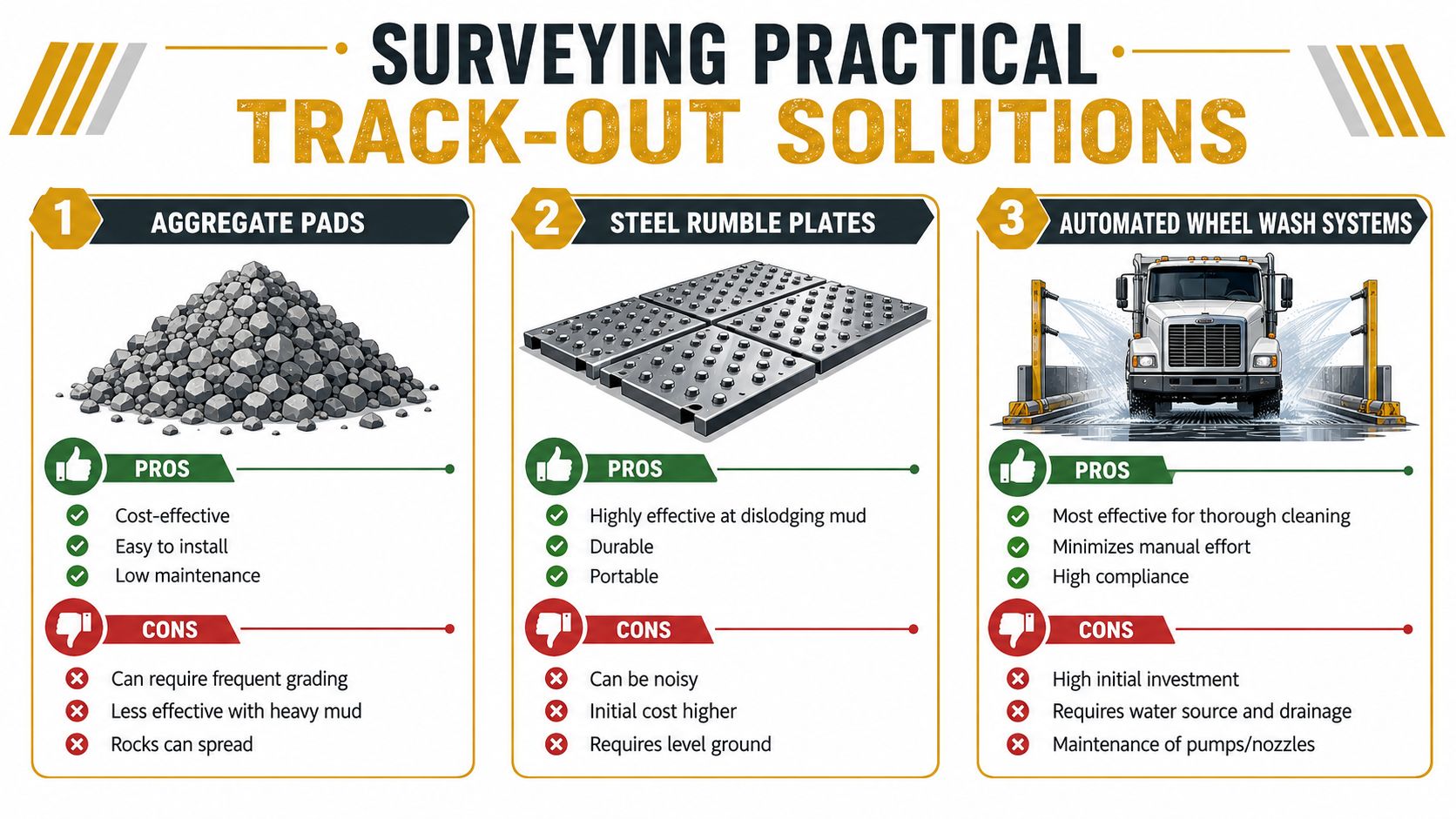
A track out solution usually lands in one of three practical buckets on real jobs: aggregate entrances, steel or manufactured rumble devices, and wheel wash systems. All three can work. All three can also disappoint you if they're used on the wrong site.
Stabilized stone entrances
This is the standard starting point because it's familiar and relatively straightforward to build. The EPA recommends stone or gravel at a depth of at least 6 inches over the full length and width of the stabilized entrance in its construction track-out control BMP guidance. That full-depth, full-width detail matters. Thin rock over soft mud becomes decorative in a hurry.
A stone entrance works by creating a rough surface that forces tire lugs to flex and drop mud before the truck reaches pavement.
What it does well:
- Handles general site traffic well when the subgrade below it is prepared and the rock stays clean
- Fits short and medium jobs where installing heavier equipment isn't justified
- Takes abuse from mixed traffic if it's maintained
Where it falls short:
- In heavy clay, the voids fill with mud and the pad starts acting like a muddy road.
- On tight sites, there often isn't enough run length.
- Crews forget that width matters too. If drivers ride the edge, they bypass the roughest section.
Rumble grids, plates, and track-out mats
These systems work by shaking or mechanically dislodging material from tires as trucks pass over them. They're useful when you need a cleaner, more controlled exit footprint than a rock pad gives you, or when you can't keep replacing contaminated aggregate.
Manufactured systems also make sense where rental flexibility matters. Some teams use heavy steel grids. Others use modular track-out mats or purpose-built systems. For example, Reborn Rentals offers trackout control mats and a trackout control system for site entrances as one equipment option alongside more traditional controls.
These are often a good fit when:
- The site entrance is fixed and narrow
- The project needs a cleaner urban setup
- You want a device that can be delivered, set, removed, and reused across jobs
Trade-offs are real:
| Solution type | Best fit | Common issue |
|---|---|---|
| Aggregate pad | Broad access, basic traffic control | Mud packs into stone and reduces performance |
| Rumble plate or mat | Controlled entrance, reusable setup | Needs proper placement and support underneath |
| Wheel wash | High-sensitivity sites or dirty traffic | Water handling and maintenance become the new job |
Automated wheel wash systems
Wheel wash systems are the most aggressive option when tires leave the site carrying heavy mud or slurry. They can be the right answer on long-duration, high-scrutiny projects, especially where public exposure is high and off-site contamination isn't tolerable.
They also create another operation to manage. You need water, drainage planning, cleaning, and disposal discipline. If nozzles clog or the sump fills and nobody owns the maintenance, performance drops fast.
A wheel wash is not a set-it-and-forget-it piece of gear. It's a process.
If your site can't support daily attention to water, sediment, and access, a wheel wash can turn into an expensive monument to poor follow-through.
Choosing the Right Track-Out Solution for Your Site
The wrong way to choose is by copying the last job. The right way is by matching the control to traffic, soil, layout, and how long the site will stay in that condition.
Start with the site, not the catalog
A compact infill project and a large civil site don't need the same exit control. Clay behaves differently from sandy soils. Concrete pours create different risks than dry framing work. You need to decide what the tires will carry out, not what you hope they'll carry out.
Use these questions in the trailer before you rent or build anything:
- How dirty will vehicles be at the gate? Light dust and occasional mud call for a different setup than saturated clay or concrete residue.
- How fixed is the entrance? A stable single gate is easier to control than multiple shifting access points.
- How long will this traffic pattern last? Temporary conditions may support rental. Long-term fixed conditions may justify a more sturdy installed system.
- What does the public side look like? Residential streets, busy roads, and sensitive drainage areas all raise the stakes.
Match the control to the failure mode
If the problem is occasional soil on pickup trucks, a well-built stabilized entrance may be enough. If mixer trucks are dragging slurry and mud after storms or pours, you need more than stone. If a site can't separate washout activity from vehicle egress, the exit control has to be part of a larger traffic plan.
A simple field comparison helps:
| Site condition | Usually works | Usually fails |
|---|---|---|
| Light traffic, moderate soil | Stabilized stone entrance | Bare-soil exit with cleanup after the fact |
| Repetitive heavy trucks, urban street | Manufactured track-out device | Short rock pad with no maintenance |
| Muddy operations with strict compliance exposure | Wheel wash plus controlled routing | Single control with no backup cleanup plan |
Rent or buy
For many contractors, renting makes more sense when the equipment is specialized, bulky, or tied to project-specific conditions. Ownership sounds efficient until you account for transport, storage, cleaning, repair, and whether the device fits the next job.
Buying tends to make sense when your operation repeats the same type of work on similar site conditions. Renting tends to make sense when your jobs vary and you need the option to scale up, swap out, or remove controls quickly.
The field question is simple: does the control need to travel with your business, or does it only need to solve this one gate on this one job?
Implementation and Ongoing Maintenance Best Practices
A lot of track-out controls fail for boring reasons. They're undersized. They're installed on weak ground. Drivers cut around them. Nobody owns inspection. Then the team blames the device.
That's not a product problem. That's an operations problem.
Install it like it has to work tomorrow morning
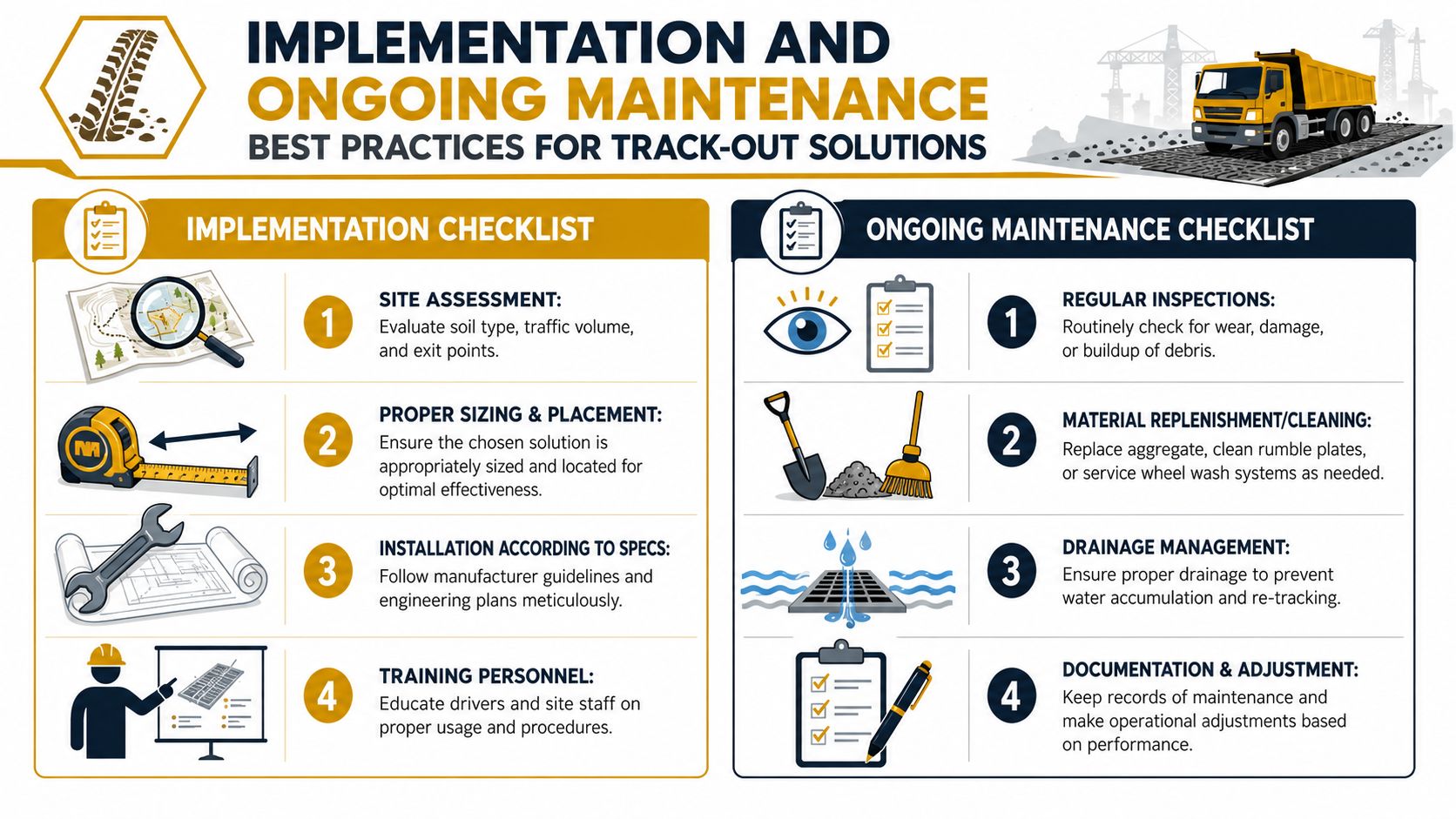
Exit controls should be placed where drivers naturally travel, not where the site plan looked neat. If drivers have an easier bypass route, they'll find it. The device or pad also has to sit on a surface that can carry the loads expected on the job. If the base pumps, shifts, or settles, the control loses effectiveness and becomes another muddy spot.
For startup, check these items:
- Build the approach: Trucks need a stable lead-in, not just a device sitting at the edge of chaos.
- Protect the full width: If the control doesn't cover the actual access width, tires will track around it.
- Control the turn: Tight turns at the gate reduce contact and can throw material past the control.
- Train drivers early: New drivers should know the route, speed, and where washout is prohibited.
Daily maintenance makes the difference
Most controls work well on day one. Day ten is where discipline shows.
Use a field routine that someone owns:
- Inspect at the start of shift. Look for packed mud, damaged sections, ponding, and edge bypass.
- Inspect again after rain or heavy concrete activity. That's when performance changes fastest.
- Remove buildup before it hardens. Packed material turns active controls into smooth surfaces.
- Replenish or regrade as needed. Aggregate pads especially need attention once they start sealing over.
- Document what changed. A quick log helps when the inspector asks what your maintenance plan is.
The best exit control on the site still fails if nobody checks it after the first storm.
What to do when standard controls fail
This is the gap that catches people. Mud gets onto the road anyway. The instinct is to hose it down and get it off the asphalt before anyone complains. That can create a second compliance problem.
Public guidance on sediment and material track-out is explicit that crews must not hose down track-out areas into storm drains, and any wash water must be captured and disposed of in the sanitary sewer, as stated in Portland's track-out pollution prevention guidance.
That means your failure plan should already exist before you need it.
Emergency cleanup that stays compliant
When material escapes the site, use a sequence like this:
- Stop the source first: Pause the traffic route or reroute vehicles so you don't keep extending the problem.
- Dry remove what you can: Shovel, scrape, broom, or vacuum the bulk material first.
- Use sweeping, not uncontrolled flushing: Vacuum sweeping is usually the cleaner answer for paved public areas.
- Capture any water used: If you must use water, contain it and dispose of it properly. Don't let it run to a storm drain.
- Reset the gate controls: Cleanup without fixing the exit just guarantees another cleanup.
That last step is the one crews skip when they're rushed. Don't just clean the road. Fix the reason the road got dirty.
Integrating Washout Containment with Track-Out Control
On concrete jobs, track-out and washout are tied together more often than people admit. Mixer trucks, pump trucks, buggies, and finishing equipment can carry not just mud but concrete residue. If washout activity is too close to traffic paths, the site creates its own contamination loop.
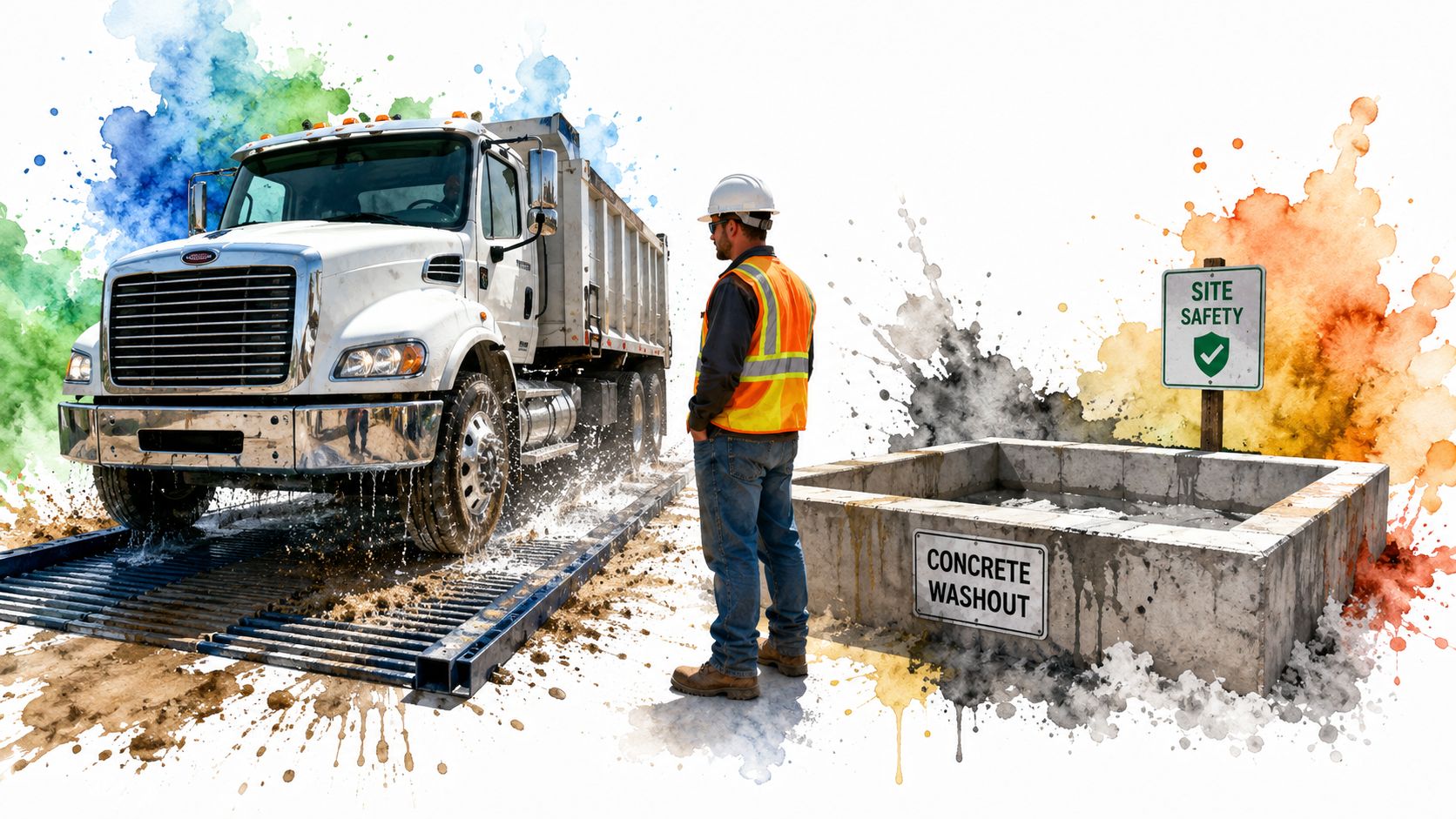
A clean site plan separates these functions. Trucks should have a defined washout area that doesn't force them back through uncontrolled mud or leave them crossing public-facing egress routes with wet slurry still on tires. If your washout setup sits right beside the exit and the area around it gets sloppy, your track-out control is already behind.
Treat the exit and the washout area as one system
Good layout usually does three things:
- Keeps washout containment away from the public egress path
- Creates a stable route between concrete activity and the gate
- Prevents runoff or residue from migrating into traffic lanes
That's where dedicated washout containment matters. A site that uses a proper contained washout pan or container isn't just checking another environmental box. It's reducing the chance that concrete residue gets tracked onto pavement, carried to drainage structures, or spread by labor trying to clean up in a hurry.
What a defensible plan looks like
A defensible setup is easy to explain in the field:
| Site element | Purpose |
|---|---|
| Controlled washout area | Keeps alkaline residue contained |
| Stabilized route from work zone to gate | Limits tire loading before exit |
| Track-out control at gate | Removes remaining material from tires |
| Cleanup plan with capture requirements | Handles failures without violating stormwater rules |
When these are disconnected, crews improvise. Improvisation is how slurry ends up on the road.
Navigating Compliance and Smart Rental Solutions
The cleanest jobs usually aren't the jobs with the fanciest gear. They're the jobs where somebody planned the exit like it mattered.
That means choosing controls based on site conditions, installing them where traffic runs, maintaining them after weather and pours, and having a compliant cleanup plan ready before the first failure. It also means not treating track-out as separate from washout containment on concrete work. Those two controls support each other.
Rental can be the smarter move when the solution is specialized or temporary. It gives a project team flexibility. You can match the equipment to the job, avoid storing underused gear between projects, and bring in a different setup when site conditions change. For a short-duration gate problem, a rental device can make more sense than buying. For concrete work with changing phases, rental washout containment can keep the site compliant without adding another ownership burden to the fleet.
The big advantage is operational, not just financial. A rented track out solution forces the conversation early. What's the entrance condition, what traffic is expected, where will cleanup happen, and who owns maintenance? Those are the questions that keep roads cleaner and inspectors calmer.
A well-managed site exit tells everyone the same thing. This crew pays attention.
If you need equipment for concrete-related site controls, Reborn Rentals offers rental options focused on washout containment, along with trackout control equipment for site entrances. That can be useful when you need a job-specific setup without taking on long-term storage, transport, and maintenance of specialized gear.