You're usually not shopping for custom fabrication solutions because you woke up wanting a bespoke steel asset. You're shopping because the site is awkward, the standard unit doesn't fit, the inspector won't accept a workaround, or the crew keeps losing time wrestling equipment that was never built for that job in the first place.
That's where a lot of project budgets get distorted. Teams compare a rental rate to a fabrication quote and think they're making an apples-to-apples decision. They aren't. The true comparison is total cost of ownership against short-term access. One path buys speed and predictability. The other can solve a recurring operational problem, but only if the design, procurement, and maintenance side are handled with discipline.
On paper, custom work often gets sold as a precision story. In the field, it's a fit, compliance, and lifecycle story. A perfectly cut part that arrives late, traps water, can't be lifted safely, or burns labor every time it moves is not a good solution. It's just an expensive headache in cleaner welds.
When Standard Equipment Just Wont Cut It
A tight site changes the whole conversation.
Say you're on a downtown infill project with zero spare laydown area, neighboring walls close on both sides, and one awkward corner left for concrete washout. A standard washout pan might work on a wide suburban pad. On that site, it becomes a problem. It blocks access, interferes with staging, or forces the crew into a placement that creates spill risk and extra handling.
That's when standard equipment stops being the safe choice and starts becoming the hidden cost. The crew loses time shuffling around it. The superintendent keeps revisiting the setup. The SWPPP side gets harder because the containment solution isn't aligned with actual site geometry.
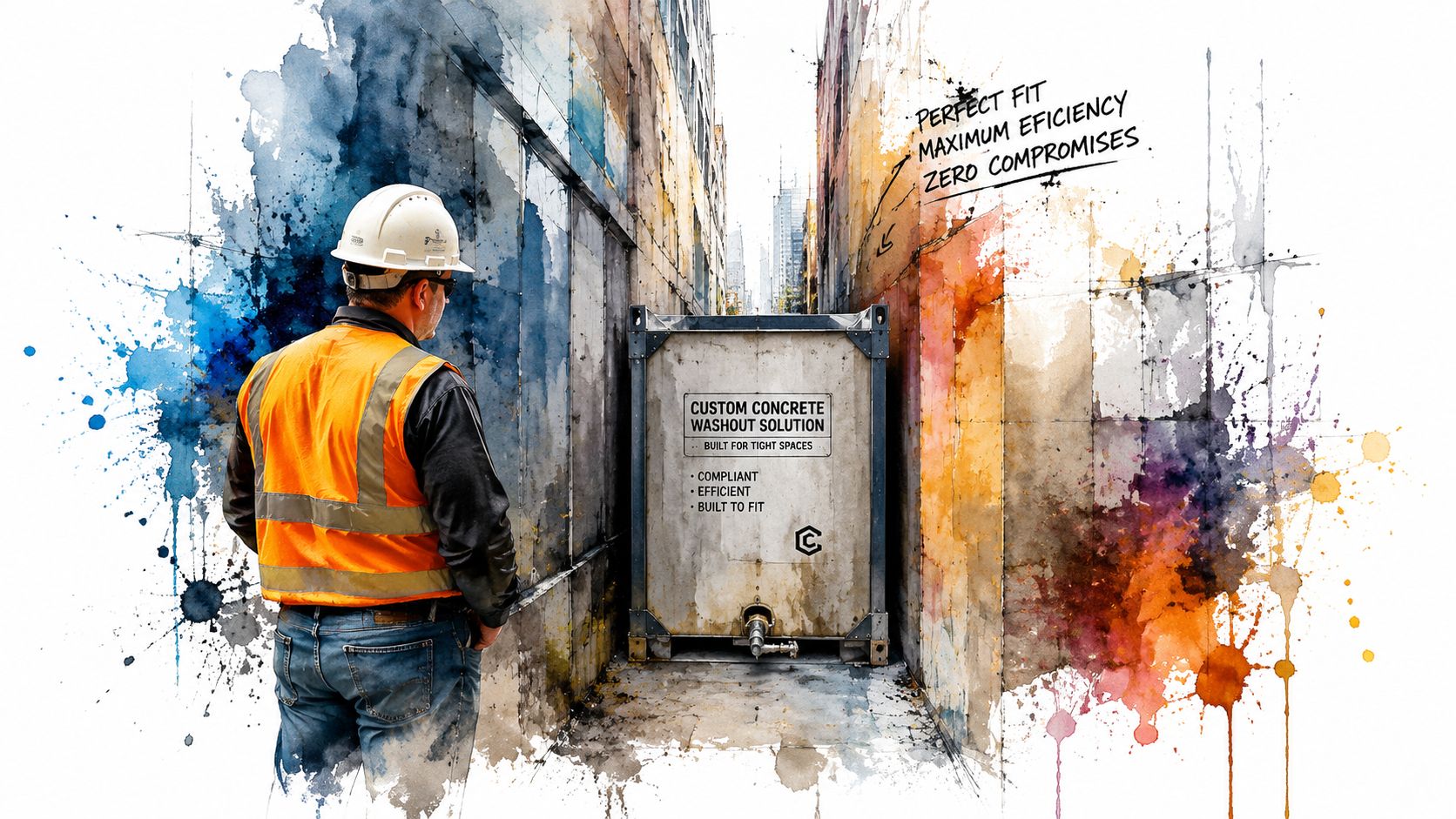
The field problem that triggers a custom build
Custom fabrication solutions earn their keep when the job has one or more of these conditions:
- Space constraints: Narrow alleys, podium decks, interior courtyards, or odd corners where standard dimensions don't work.
- Special handling needs: You need forklift pockets, crane pick points, stackability, or a shape that supports repeated relocation.
- Compliance pressure: Containment, drainage control, access safety, or load requirements can't rely on a field modification.
- Repeat use across jobs: A one-off build can become a reusable company asset if your crews face the same problem repeatedly.
A lot of contractors learn this the hard way. They start with the off-the-shelf option because it's faster. Then they spend days building wood cribbing, adding protection, changing traffic flow, and managing the fallout from a poor fit. That's like forcing a stock door into an out-of-square opening. You can make it happen, but the labor and frustration pile up fast.
Standard equipment is cheap only when it fits the job without creating three other problems.
Why demand keeps rising
The market itself reflects that shift toward specialized work. The global precision steel fabrication market was valued at USD 42.6 billion in 2025 and is projected to reach USD 75.1 billion by 2035, with 2026 estimated at USD 45.4 billion, according to Research Nester's precision steel fabrication market report.
That doesn't mean every contractor should custom-build everything. It does mean more projects now have tighter tolerances, tougher site constraints, and less room for “close enough.” In those conditions, custom fabrication solutions stop being a luxury line item and become a practical tool, like ordering the right shoring package instead of trying to invent one out of spare lumber.
Defining Custom Fabrication in Construction
Custom fabrication in construction is not the same as cutting a hole in a standard unit or welding on an extra tab after delivery. It means designing and building a piece from raw material to meet a specific project need.
The cleanest analogy is a custom-made suit. Off the rack might be acceptable. Custom is built around actual dimensions, specific movement, and the exact use case. In construction terms, that can mean a washout container sized to a constrained footprint, a bracket designed for a nonstandard connection, or an access platform built around actual obstructions and load paths.
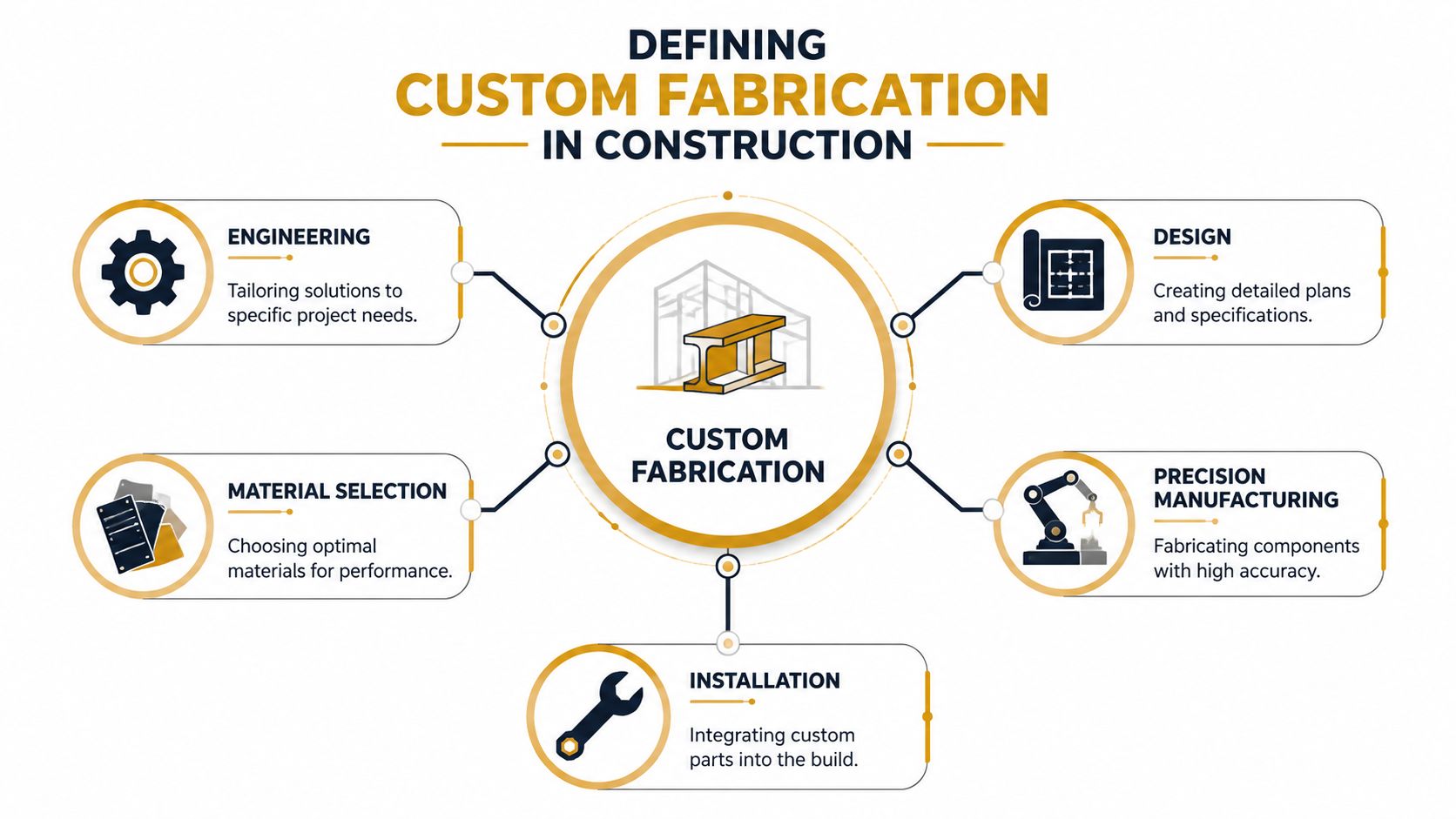
What separates fabrication from a modification
A field modification usually starts with an existing item and alters it. Sometimes that's fine for minor convenience. Often it creates a chain of new risks.
Custom fabrication solutions start earlier and ask better questions:
- What problem has to be solved
- What loads, fluids, traffic, or exposure will the item face
- How will it be moved, installed, cleaned, and maintained
- What documentation or inspection may be required
- What happens if the jobsite conditions change
That process matters because construction equipment doesn't fail on paper. It fails when someone forks it from the wrong side, drags it over rough ground, overloads one edge, or leaves slurry sitting in a trap point that was never thought through.
Common examples on active projects
Custom work shows up in more places than many teams realize:
- Containment equipment: Nonstandard washout containers, bermed trays, and pans sized for restricted access areas.
- Steel support pieces: Specialty brackets, embeds, and transition plates where standard catalog parts don't match field conditions.
- Access and handling gear: Platforms, frames, guards, lifting attachments, and transport features suited to site logistics.
- Process-specific equipment: Cradles, bins, hoppers, shields, and mounts built around a crew's actual workflow.
Practical rule: If your “temporary workaround” needs repeated labor, repeated explanation, or repeated risk acceptance, you probably need a fabricated solution instead.
When it makes sense
The best reasons to go custom usually fall into a short list:
| Trigger | Why custom helps |
|---|---|
| Irregular footprint | It uses the available space instead of fighting it |
| Repeated use case | Ownership can make more sense than repeating rental compromises |
| Compliance-sensitive task | The design can incorporate containment, lifting, and safety requirements from the start |
| Operational bottleneck | The right build reduces crew handling and site friction |
A good custom item should feel boring once it's deployed. That's the test. If the crew uses it without debate, the site team stops babysitting it, and it does the job cleanly, the design is doing what it should.
Custom Build vs Standard Rental A Clear Comparison
This decision usually gets framed the wrong way. People ask, “Which one costs less?” The better question is, “Which one creates the fewest total problems for this job and the next one?”
Rentals and custom builds solve different business problems. A rental is a tool for immediate deployment. A custom build is a tool for exact fit and repeat ownership.
Custom fabrication vs. standard rental at a glance
| Factor | Custom Fabrication | Standard Rental |
|---|---|---|
| Upfront cost | Higher initial spend and more preplanning | Lower immediate commitment and easier approval |
| Timeline | Requires design review, shop time, and delivery coordination | Usually faster if the equipment is in stock |
| Site fit | Built around the actual footprint and use case | Works best when the site matches standard dimensions |
| Compliance confidence | Can incorporate required features from day one | Depends on whether the standard unit truly fits the use |
| Long-term value | Can become a reusable asset across similar jobs | Best for temporary need without ownership responsibility |
| Maintenance | Owner carries inspection, repair, and storage duties | Provider typically handles service between rentals |
Where rentals win
Rentals are hard to beat when the site conditions are ordinary and the project window is short. If you need a known piece of equipment, delivered quickly, with straightforward pricing and no long-term storage burden, rental is usually the smart move.
That's especially true when the item is peripheral to the job. If the equipment just needs to be present and functional, not specialized, ownership can become a distraction. You don't want to buy a custom tool for a problem you may never see again.
Where custom wins
Custom fabrication solutions take the lead when standard dimensions create recurring inefficiency. If the same type of urban site, plant retrofit, or constrained access condition keeps showing up in your backlog, a purpose-built asset can remove friction every time it rolls onto a job.
The value isn't only in physical fit. It can show up in simpler placement, cleaner material handling, fewer field fixes, better crew acceptance, and less argument about whether the setup is “good enough.”
Owning a custom unit makes sense only when you intend to use the design advantage more than once.
The trade-off most teams miss
A rental gives you cost certainty up front. A custom build can give you operational certainty later.
That's why the decision shouldn't sit only with procurement. The superintendent, project manager, safety lead, and whoever handles environmental compliance should all weigh in. A cheap option that burns site time every day is not cheap. A premium option that sits in the yard after one use is not smart either.
Key Design and Material Considerations
Once you decide to build, the expensive mistakes usually happen in design, not in the shop. Bad assumptions at this stage get welded into the final product.
Start with use, not material. Ask what the item will carry, hold, resist, and survive. Slurry, standing water, fork handling, crane picks, impact from buckets, repeated loading, chemical exposure, and outdoor storage all matter. The right custom fabrication solution comes from matching the build to those conditions, not from choosing whatever steel is easiest to source.
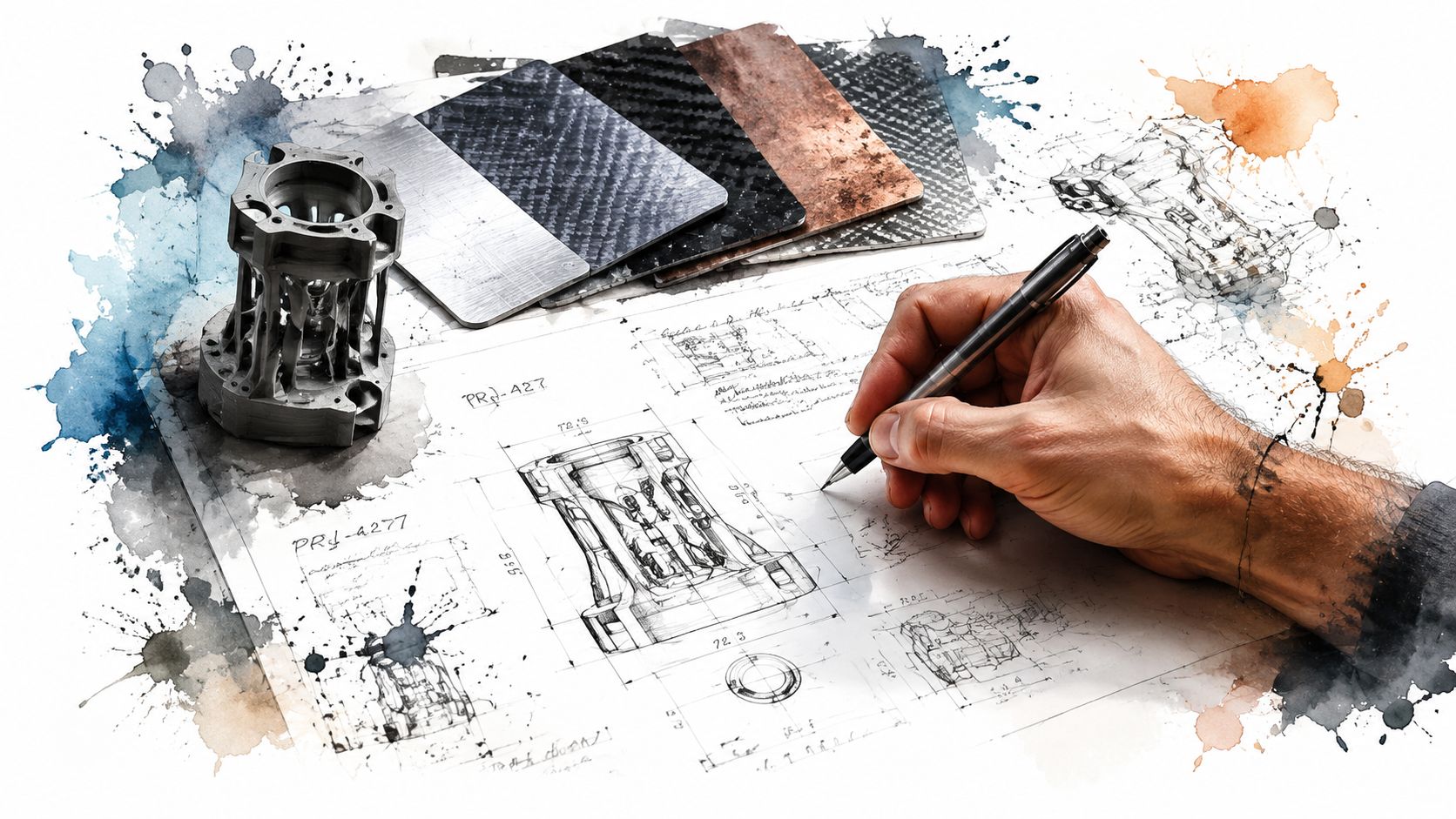
Material selection that matches the job
For many construction applications, carbon steel is the practical baseline because it's durable, repairable, and familiar to most fabricators. In harsher environments, stainless steel may make sense where corrosion resistance matters more than initial cost.
That choice affects more than durability. It changes finishing approach, repair method, long-term appearance, and how forgiving the asset will be after rough handling. A washout-related container, for example, doesn't just need to be strong. It needs seams and surfaces that can be cleaned, inspected, and maintained without becoming a rust trap.
Here's the mistake I see often: teams specify premium material where geometry or handling is the actual issue. That's like buying a stronger ladder when the core problem is that the opening is in the wrong place.
Features worth specifying early
A custom unit should be easy to move and hard to misuse. Those are two different goals, and both matter.
Consider these details before the RFQ goes out:
- Forklift pockets: Needed if the unit will be moved across the site without rigging every time.
- Lifting eyes or lugs: Important when crane handling is part of the plan. Their location matters as much as their presence.
- Leak-resistant seam design: Critical for any containment application.
- Drainage and cleanout access: Useful where residue buildup can shorten service life.
- Edge protection and reinforcement: Helps in high-contact environments where forks or buckets may hit the unit.
- Stacking or nesting features: Worth considering if storage yard space is tight.
A fabricated item that's hard to clean or awkward to move will cost you every week you own it.
Design for use, not for the shop drawing
A clean drawing can still produce a clumsy field asset. Review the design with the people who'll work with it.
Ask them:
- Where will the forks enter from on a crowded site?
- Can the crew see the pick points easily?
- Will residue collect in corners that nobody can reach?
- Does the shape create dead space that wastes footprint?
- Can the trucker load and unload it without special drama?
That review doesn't need to be fancy. It just needs to be honest. The best custom fabrication solutions feel like they were built by someone who has stood in mud, rushed a pour, and tried to move steel with half the site blocked off.
Navigating Procurement and Key Cost Drivers
A custom fabrication quote is rarely the whole cost. It's the front door, not the whole building.
That's why procurement discipline matters. If the RFQ is loose, the proposals won't align. One vendor prices a bare unit. Another includes engineering review. Another assumes simple shop pickup while your actual job requires special delivery coordination. Then everybody acts surprised when change orders appear.
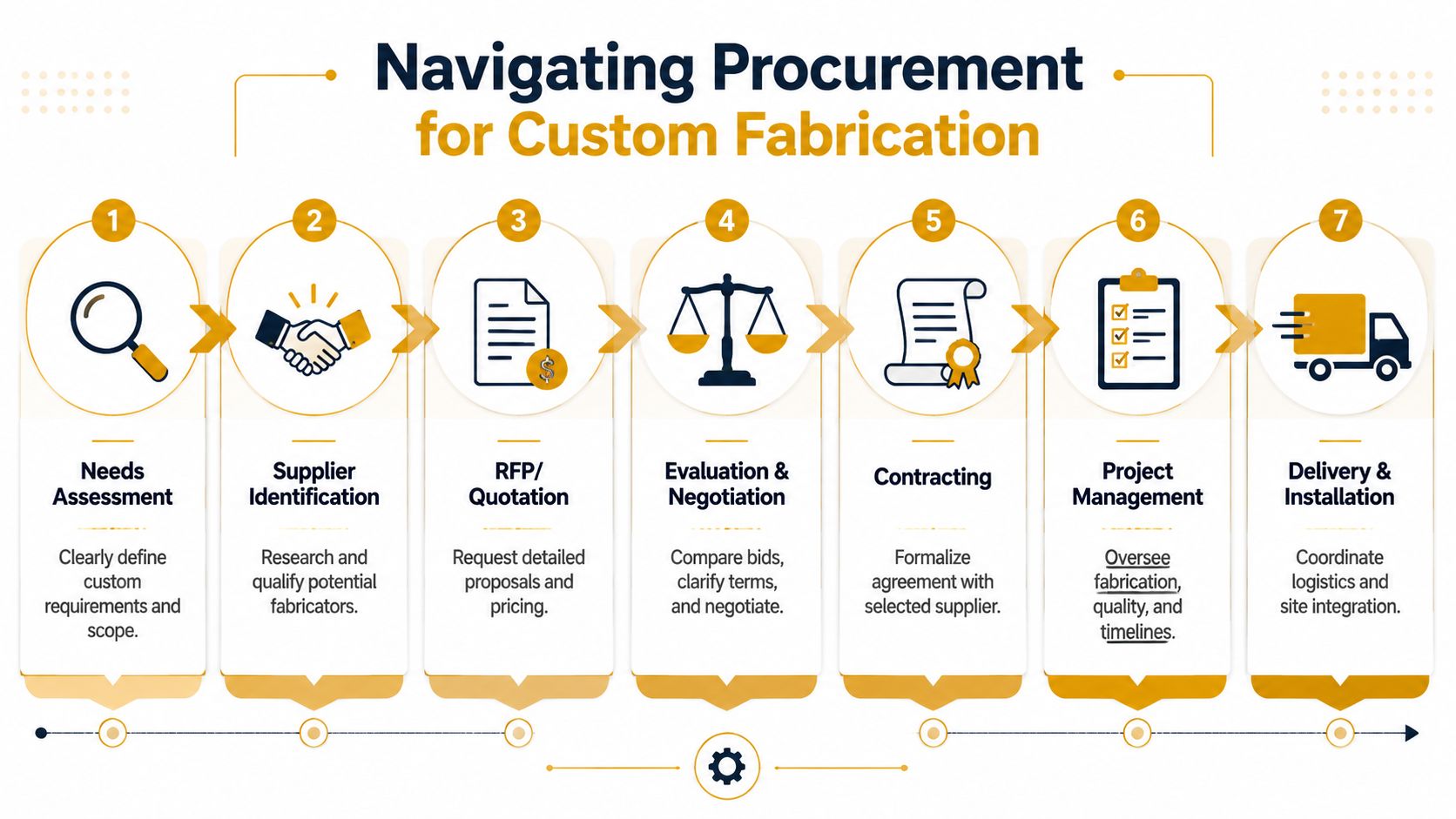
Build a better RFQ
A strong request for quotation should include enough detail that vendors are pricing the same job. At minimum, provide:
- Use case: What the item does in the field, not just its dimensions
- Drawings or sketches: Even a marked-up concept is better than a phone description
- Handling requirements: Fork pockets, crane picks, truck loading constraints
- Finish requirements: Raw steel, paint, coating, or a corrosion-focused finish
- Documentation needs: Shop drawings, calculations, inspection records, or stamped engineering if required
- Delivery conditions: Site access limits, unloading method, and target timing
If you leave those details vague, the lowest quote often wins on paper and loses in execution.
The hidden costs that hit TCO
Material waste is one of the least discussed cost drivers in custom work. According to Endura Steel's discussion of custom fabrication waste factors, structural steel waste in custom fabrication projects averages 12-15% beyond standard allowances and directly inflates project budgets by 8-10% without transparent line-item reporting.
That matters because clients often hear “precision cutting” and assume material use is efficient by default. It isn't always. Complex geometries, unusual bends, and nonstandard nesting can turn expensive plate or structural stock into a pile of paid-for scrap.
Other cost drivers appear with similar subtlety:
| Cost driver | Why it grows |
|---|---|
| Design revisions | Each redraw can ripple into material, labor, and schedule |
| Finishing | Coating systems add process steps and rework risk if damaged in transit |
| Inspection and documentation | Special review requirements increase admin and coordination |
| Freight and handling | Oversized items can complicate loading, delivery, and site unloading |
| Long-term ownership | Storage, touch-up, inspection, and repair become your problem after closeout |
Budget warning: If a quote doesn't mention waste assumptions, revisions, finish scope, and freight conditions, it probably doesn't reflect your true total cost.
What works in practice
Lock the design before release. Limit who can revise it. Ask vendors to state assumptions in writing. Request a separate line for freight and any finish system. And ask directly whether the quote includes likely scrap factors for the geometry you've specified.
Good procurement for custom fabrication solutions feels less like buying a commodity and more like preplanning a lift. Everybody involved needs the same picture before the work starts.
How to Evaluate a Fabrication Vendor
The vendor matters as much as the design. A capable fabricator can spot problems in your concept before steel is cut. A weak one just says yes, takes the order, and leaves your team to discover the flaws in the field.
That's not a small issue in a crowded market. North America held 35.2% of the global sheet metal fabrication services market in 2024, according to Congruence Market Insights' sheet metal fabrication services market report. For contractors, that means plenty of options, but also a wide spread in quality, responsiveness, and practical construction knowledge.
Questions that separate strong vendors from risky ones
Use a checklist, not a sales call impression.
- Ask for comparable work: Not general shop photos. Ask for projects similar in size, handling conditions, and field use.
- Verify welding capability: If the job involves structural integrity, containment, or lifting features, ask what standards they work to and how they control weld quality.
- Review their QA process: A good shop can explain inspection points, fit-up checks, and how they manage rework.
- Confirm engineering support: If the project may require stamped drawings or design review, find out whether they can provide that directly or through a partner.
- Check schedule realism: Shops that promise anything immediately are often the ones that slip first.
- Discuss communication habits: You want a fabricator who flags issues early, not one who stays quiet until delivery week.
Red flags worth taking seriously
Some warning signs are obvious. Some aren't.
A vague quote is a red flag. So is a shop that never asks how the item will be lifted, cleaned, or transported. If they focus only on dimensions and price, they may be building for the drawing instead of the jobsite.
If a fabricator doesn't ask how the crew will use the item, they probably don't understand the risk they're selling you.
What a good partner looks like
A good fabrication partner pushes back where needed. They'll ask about fork tine spacing, load concentration, seam detail, finish durability, and whether your layout creates dead zones or maintenance headaches. That kind of pushback saves money because it catches bad assumptions before they become steel.
Pragmatic Recommendations for Your Next Project
Use the simple option when the simple option fits.
Choose a standard rental when the project is short-term, the site layout is conventional, the equipment need is temporary, and schedule certainty matters more than design optimization. In those cases, speed, known availability, and reduced ownership burden usually beat a custom approach.
Choose custom fabrication solutions when the site has unusual spatial limits, the task has a specialized function that standard gear can't handle cleanly, or your company sees the same operational problem across multiple jobs. That's where ownership can pay back in smoother setup, fewer field adjustments, and better fit with compliance requirements.
The deciding question is straightforward: Are you solving a one-time equipment need, or are you fixing a recurring operational problem?
If it's one-time, rent.
If it's recurring, design it right, buy it with discipline, and treat the asset like part of your fleet instead of a one-off shop experiment.
Frequently Asked Questions
How long does a custom fabricated washout container usually take?
Lead time depends on design complexity, vendor capacity, review cycles, and freight coordination. A simple build with a clear drawing moves much faster than a custom unit that keeps changing after quote approval.
The biggest delay usually isn't cutting or welding. It's indecision. If the footprint, handling features, and finish requirements keep shifting, the fabrication window stretches and delivery becomes harder to predict. The practical move is to finalize the design before release and limit revision authority to one or two people.
What documentation should I request for a crane-lifted or safety-sensitive item?
Ask for the documents that match the risk of the item. For a unit that will be picked by crane or used in a safety-sensitive application, request shop drawings, material information where appropriate, weld-related quality documentation if applicable, and any engineering review or stamped drawings required by your project or jurisdiction.
Also ask the fabricator to identify the intended lifting method on the drawing. That helps prevent field improvisation. A lifting feature that exists without a clear use basis can create more risk, not less.
What maintenance comes with owning a custom steel unit?
Ownership is never free after delivery. Plan to inspect welded areas, high-contact corners, fork-entry zones, coatings, and any points where slurry, moisture, or debris can collect. Clean the unit before residue hardens into a permanent maintenance problem.
For steel containment equipment, regular touch-up, drainage checks, and basic housekeeping go a long way. Most premature deterioration comes from neglect, trapped material, rough handling, and outdoor storage without inspection. If you buy custom, assign responsibility for upkeep the same way you'd assign responsibility for any fleet asset.
If your project needs a dependable rental instead of a custom build, Reborn Rentals is a practical place to start. Their focus on concrete washout containment, transparent pricing, and straightforward delivery coordination makes them a strong fit for crews that need compliant equipment quickly without taking on the cost and maintenance burden of ownership.