You're on a jobsite with concrete scheduled, a dumpster already filling up with mixed debris, and a superintendent asking whether the washout setup is compliant before the pour starts. That's the moment teams stop shopping by catalog and start thinking like procurement. The right trash container manufacturers aren't the ones with the prettiest brochure, they're the ones who can prove the container fits the debris, the access, the schedule, and the paperwork.
The market itself tells the same story. Recent industry research names a concentrated set of major manufacturers, including Rubbermaid, Toter, Sterilite, Continental Commercial Products, Hefty, Carlisle FoodService Products, and Simplehuman. That matters because buyers are usually choosing among a small number of established supply chains, not some endless field of interchangeable vendors, and the key difference shows up in verification, logistics, and durability, not just in color or lid style. Industry research on trash cans and wastebaskets
What Contractors Actually Need From Trash Container Manufacturers
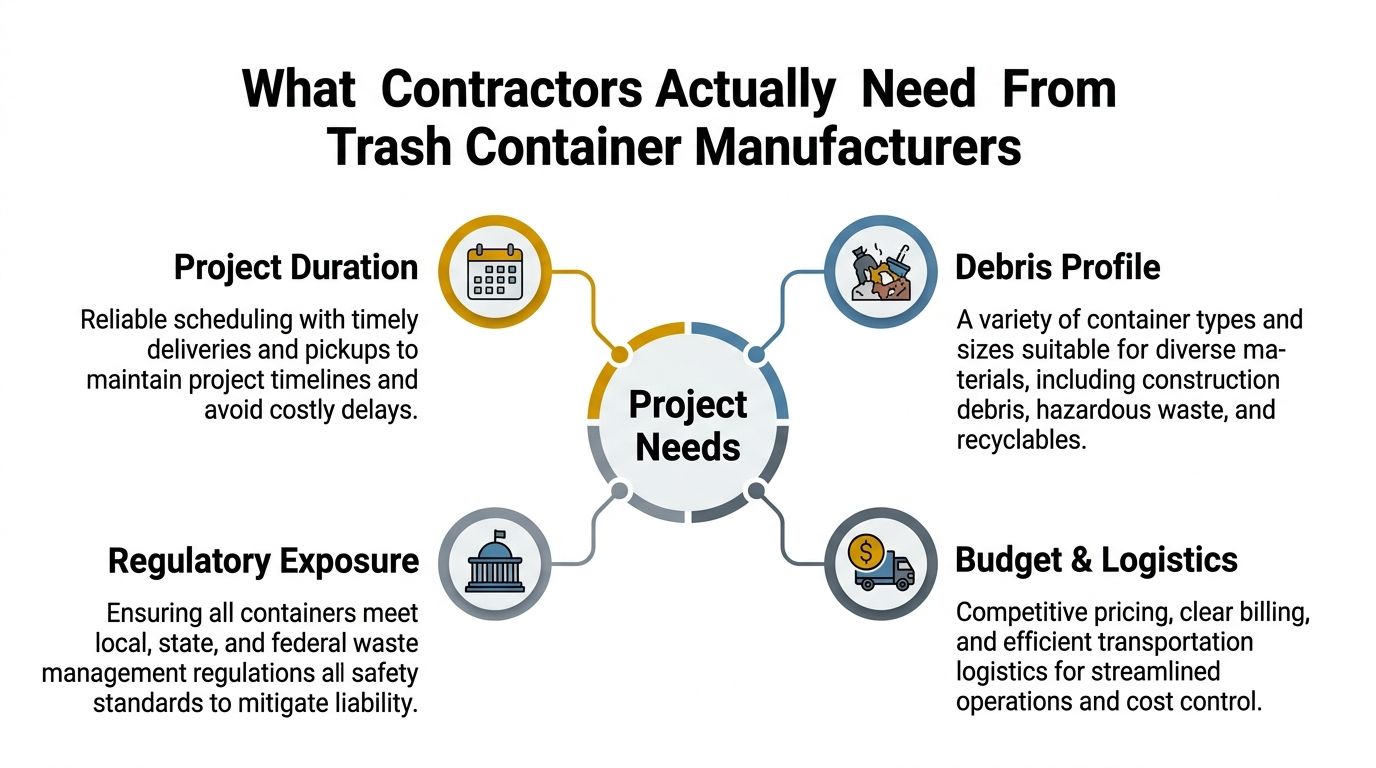
Most buyers start by asking which brand makes the best bin. That's the wrong first question. The better question is which supplier can match project duration, debris profile, regulatory exposure, site access, budget, and the realities of pickup and storage without creating a second problem after the first delivery.
Buy, rent, or do both
A small interior remodel doesn't need the same sourcing plan as a multi-phase concrete pour. A crew doing repetitive hauling over several sites usually wants a durable container it can keep in rotation, while a short pour often makes more sense with a rented washout pan that disappears when the job closes out. The hybrid approach is common in practice, because one container rarely handles both dry debris and slurry well.
Practical rule: if the waste is predictable and recurring, ownership starts to make sense. If the waste is wet, short-lived, or awkward to store, rental is often cleaner operationally.
That's where the seven filters come in. A serious buyer should sort every option by container type, capacity, material, load rating, compliance, logistics, and total cost. Ignore any catalog that makes those choices look interchangeable, because they aren't.
Why the jobsite changes the product
A residential remodel, a foodservice back-of-house upgrade, and a commercial pour all create different waste streams. Household-style receptacles are fine for light, dry trash, but construction debris, saturated materials, and washout slurry create stress that simple bins weren't designed to absorb. Industry research also shows the category is split across household, commercial, and high-capacity applications, which is exactly why one “universal” recommendation usually fails in the field. Trash cans and wastebaskets market research
The procurement mindset is simple. Start with what the site will generate, then decide whether you need an owned asset, a rented containment solution, or both. That order keeps you from overbuying a container that sits idle or underbuying one that fails on the first hard load.
Required Specs Every Container Must Meet Before You Sign Anything
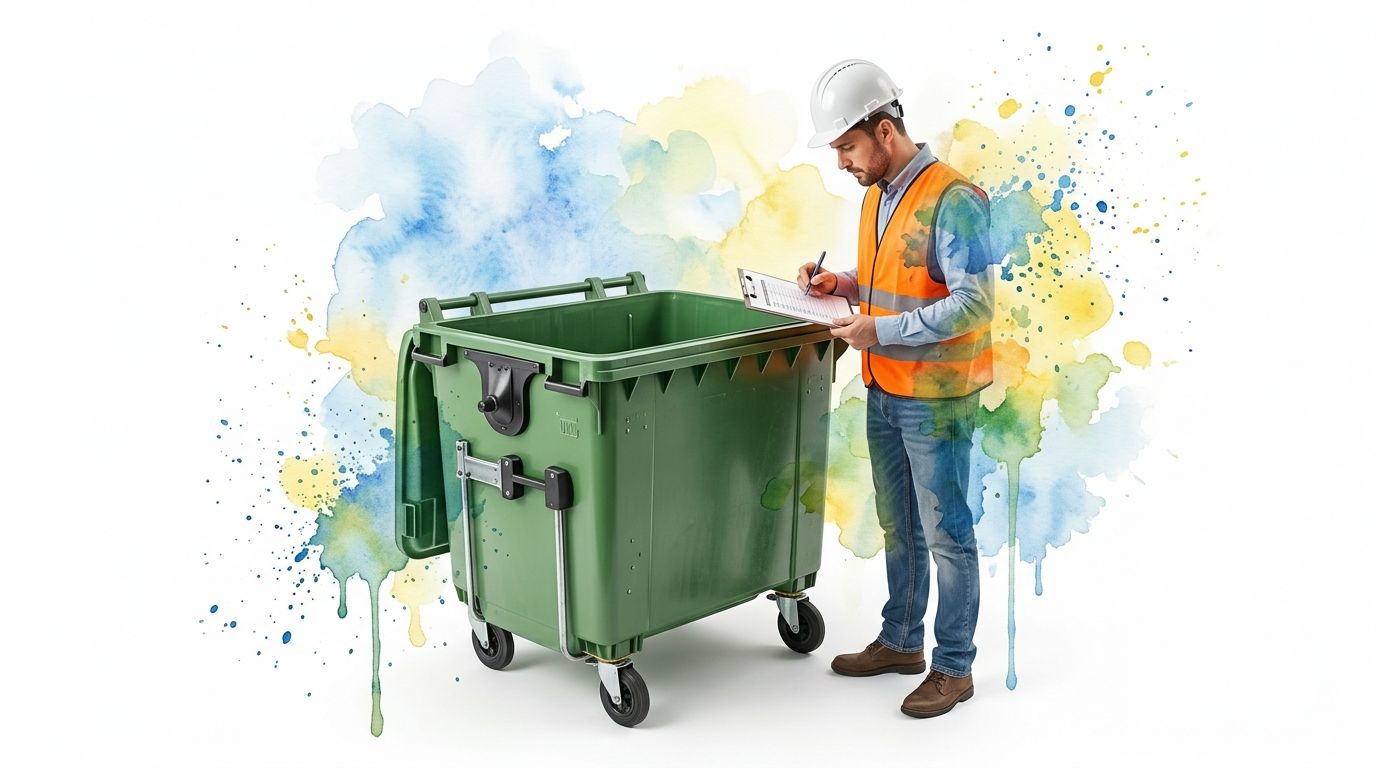
Volume gets attention because it's easy to compare on a page. Weight, geometry, and build quality are what decide whether the container survives the job. If a supplier can't speak clearly about all four, they're not ready for a purchase order.
Start with volume, then challenge the assumption
For stationary waste containers, the European standard EN 12574-1:2017 sets a nominal volume ceiling of 10,000 L and allows only ±5% tolerance on nominal volume, so nominal size alone isn't enough to sign off on quality. EN 12574-1:2017 standard summary
Tolerance matters in the world because a spec sheet can look generous while the physical container lands short. On site, I'd rather see dimensional verification and volume testing than a glossy nominal number with no proof behind it. Buyers who skip that step usually discover the mismatch after delivery, when the truck won't clear, the lid won't seal correctly, or the bin doesn't fit the collection path.
Use load rating as a gate, not a footnote
Front-end load containers have practical benchmarks that can help you disqualify weak suppliers fast. A 2-yard unit is commonly built at about 6 ft × 3 ft × 3 ft with a load limit of roughly 400 lb, while a 4-yard unit is commonly built at about 6 ft × 3 ft × 4 ft with a limit of roughly 800 lb. Commercial dumpster size guide
Those numbers are useful because dense materials punish bad assumptions. Concrete rubble, masonry, and saturated soil can overload a container long before it looks full. If you're comparing vendors, ask them to show both the volume class and the weight capacity, then make them explain what happens when the waste is dense rather than fluffy.
Don't ignore geometry and finish
Standardized geometry helps with loading, pickup, and storage. Material thickness, coating, weld quality, and reinforcement still matter, even when a catalog tries to sell the container as a generic “heavy-duty” product. A cheap container that flexes, corrodes, or dents quickly creates a replacement cycle that wipes out the original savings.
A spec sheet that only shows dimensions is incomplete. A spec sheet that shows dimensions, capacity, and testable construction details is worth reading.
That's the standard I use when vetting suppliers. If they can't document the physical realities of the bin, they're asking you to absorb the risk.
Regulatory and SWPPP Considerations That Shape Your Shortlist
A container can be mechanically fine and still be the wrong purchase if it creates compliance headaches. That's especially true on construction sites where stormwater controls, access restrictions, and waste containment all overlap. The best suppliers understand that buyers aren't just shopping for a receptacle, they're trying to avoid an inspection problem.
The EPA's waste data helps explain why the scrutiny exists. In 2018, containers and packaging generated 82.2 million tons of municipal solid waste, or 28.1% of total U.S. MSW generation, and plastic containers and packaging accounted for 14.5 million tons, or about 5.0% of total MSW. EPA containers and packaging facts
What a good supplier should be able to prove
A reputable manufacturer or distributor should be able to show more than a catalog page. Ask for third-party material certifications, factory audit reports, and sample containers you can stress test before a larger buy. Independent B2B sourcing guidance also points buyers toward video facility tours and QC checks, which is useful because it exposes whether a vendor makes or controls what it sells. Supplier due diligence guidance
If a supplier dodges those requests, that's a warning sign. A supplier that can't document what the container is made of, how it's produced, or how it was checked shouldn't be treated as low-risk just because the unit price looks attractive.
SWPPP fit is about more than a sealed bottom
For washout and slurry control, the practical issue is whether the container keeps material where it belongs while crews are active and the site is wet. Labeling, containment, placement, and pickup all matter, because a bin that looks adequate on paper can still create tracking, overflow, or discharge issues during the workday. That's where a cheap container can become expensive, since it can drive replacement, cleaning, and inefficient collection.
Practical rule: if the site has drainage concerns or active stormwater controls, treat the container as part of the compliance system, not a standalone accessory.
That's the contrarian part many buyers miss. The lowest-price option is sometimes the most expensive once you account for replacement cycles, cleaning, and collection inefficiency. Municipalities, campuses, and commercial properties feel that pain the fastest because they buy for years, not weeks.
Buy Outright or Rent a Washout Pan for Short-Term Work
Short-term concrete work is where a lot of buyers make the wrong ownership decision. They buy a container because it feels cheaper, then spend time storing it, cleaning it, moving it, and explaining why it's sitting in the way after the job ends. Rental wins when the project is brief and the cleanup burden is high.
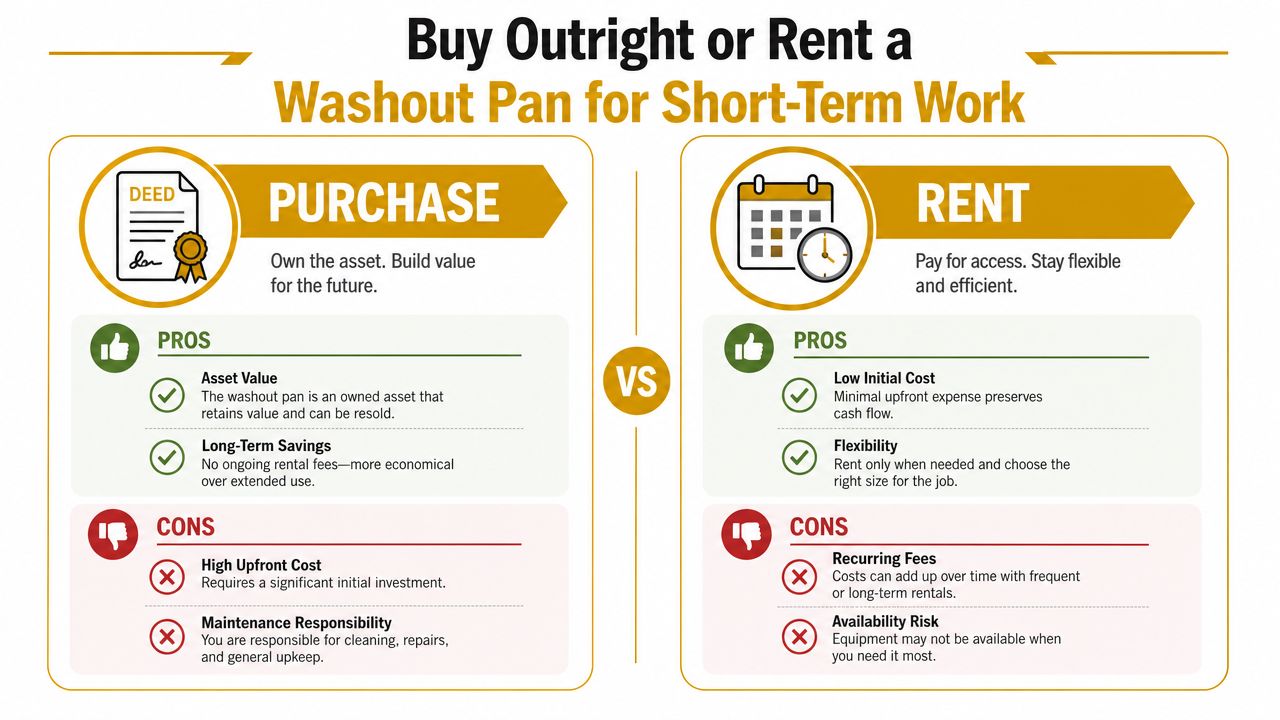
The cleanest comparison is simple. Ownership gives you an asset that can cycle through repeat jobs. Rental gives you flexibility when the work window is narrow and the site can't absorb another stored item. For concrete washout, that difference is bigger than it looks because slurry containment is operationally messy even when the pour itself goes smoothly.
When purchase makes sense
Buying is usually the right move for teams that reuse the same container across multiple sites or consistent work phases. The economics improve when the container stays in motion, the storage plan is already solved, and the crew knows how to maintain it between jobs. It also helps when the debris profile is stable and the container isn't going to be abused by sudden changes in material density.
When rental is the smarter choice
Rental is a better fit for one-off pours, short renovation windows, or sites where there's nowhere practical to store and clean a container after use. It also reduces commitment when the job volume is uncertain, since you're not tying up capital in a unit that might sit idle after the project closes. Reborn Rentals is one example of a rental provider focused on concrete washout containment, with short-term washout pans, clear daily pricing, and delivery-oriented ordering that fits this kind of work. Reborn Rentals
The rental model also lowers the friction around ownership responsibilities. You're not carrying the maintenance burden, and you're less likely to be stuck with a pan that's the wrong size for the next job.
The hybrid model is often the practical answer
A lot of contractors end up with both. Owned containers handle dry haul-off and recurring debris, while rented washout pans handle slurry and short-cycle concrete work. That split keeps the jobsite cleaner and prevents one product from being forced into every role.
The important part is matching the tool to the work. If the waste stream is temporary, wet, or unpredictable, renting often beats buying even when the purchase price looks tempting.
Delivery and Logistics Questions to Ask Before You Book
Logistics is where container deals get expensive. The invoice often looks fine until the site turns out to be awkward, the truck can't get close, or the pickup window doesn't match the pace of the crew. A good vendor expects those questions and answers them before anyone commits.
The first thing I ask is basic access. Can the truck clear the route, and is there enough space for placement, pickup, and swap-out? Then I ask about the surface, because weight on slab, soft ground, or finished paving changes how you should position the container and what protection you need underneath it.
Use this call script before you book
- Access and clearance: Will your truck fit the approach, turning radius, and overhead clearance at the placement point?
- Placement surface: What surface does the container sit on, and do you require pads, blocking, or other protection?
- Pickup timing: What is the normal pickup window, and what happens if the container fills early?
- Swap-out process: Can you replace the unit quickly if the job generates more debris than expected?
- Surcharge disclosure: Do you charge extra for rough terrain, express orders, or out-of-zone delivery?
- Communication method: Can I confirm availability and logistics by phone, chat, WhatsApp, email, or scheduled callback before dispatch?
Those are the questions that surface hidden friction before it turns into a change order. Transparent vendors usually disclose the extra charges early, because they know logistics is where trust gets won or lost.
Support channels matter more than most catalog pages admit. If a supplier is easy to reach before the order but hard to reach once the truck is loaded, that's a problem. Procurement quality shows up in how fast a vendor can confirm specs, delivery timing, and surcharge exposure without making you chase answers.
If you need three callbacks to confirm the truck can access the site, the delivery problem probably isn't solved yet.
That's especially true on compressed schedules. The cost of a missed placement is never just the fee on the invoice, it's the labor and time lost while the crew waits.
Cost Factors Most Buyers Underestimate
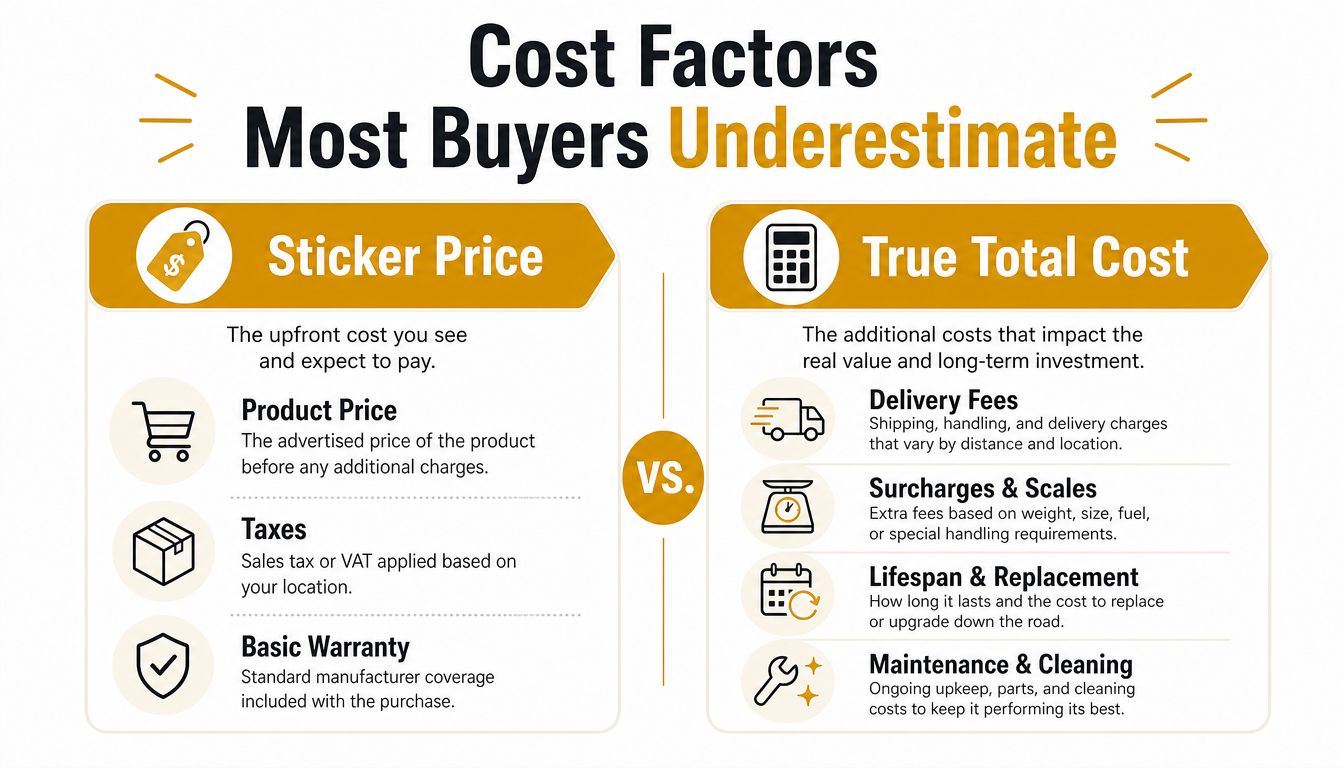
Sticker price is the least informative number in the deal. What matters is the full service cost over the container's actual use, not the first quote that lands in your inbox. A container that's cheap up front can turn expensive fast if it needs special handling or gets replaced too often.
The cost stack usually includes delivery, pickup, terrain-related charges, express orders, cleaning, and the hidden cost of idle time. Those fees don't always look dramatic by themselves, but they change the economics once you multiply them by every move, every pickup, and every project delay.
Price transparency is part of quality
A supplier that lists surcharges in plain language is giving you useful procurement data. A supplier that hides them until the final bill is telling you something too. The container itself may be fine, but the commercial relationship is less predictable, and that unpredictability has a cost.
Maintenance and replacement also matter. A container made with weak materials or poor coating may need replacement long before the project lifecycle you modeled at the start. That's why I don't buy on price alone, and I don't recommend anyone else do it either.
Model the whole service life
Use this simple rule. Estimate what the container will cost across the time you expect to keep it in service, then compare suppliers on that basis. If one option requires more cleaning, more handling, or more frequent replacement, it's not cheaper.
- Delivery Fees: Ask whether delivery is included or billed separately, especially for hard-to-reach sites.
- Surcharges and Scales: Confirm rough-terrain, out-of-zone, or express-order charges before you book.
- Lifespan and Replacement: Ask how long the unit typically lasts under your load profile.
- Maintenance and Cleaning: Clarify who handles cleaning, contamination issues, and return condition.
That list is boring in the best possible way. It keeps you from approving a container that looked affordable on page one and becomes a budget problem by week two.
Quality Assurance Checks and Your Final Procurement Checklist
The last step before award is QA, not excitement. You want proof that the container is what the supplier says it is, and you want a paper trail your superintendent or procurement officer can check later if something goes wrong. That means asking for documentation, not just assurances.
Start with verification. Request third-party material certifications, factory audit reports, and a sample container for stress testing. If possible, confirm production through video facility tours and ask how QC checks are handled at receipt, because the vendor's process is part of the risk you're buying.
Final QA questions to ask every supplier
- Material proof: Can you provide third-party certifications for the material or coating?
- Factory visibility: Will you share an audit report or a live or recorded facility walkthrough?
- Sample testing: Can we test one unit before committing to a larger order?
- Receipt inspection: What should our team inspect when the unit arrives?
- Replacement policy: What happens if the first delivery doesn't match the agreed spec?
The answers should be concrete. Vague promises are easy to make and hard to enforce after delivery.
Print this procurement checklist
Pre-bid
- Confirm the waste stream, site constraints, and compliance exposure.
- Estimate the container type and capacity needed for the job.
Sourcing
- Build a shortlist of manufacturers or rental providers.
- Send the same RFQ to each supplier so the comparison stays fair.
Ordering
- Lock down specs, delivery timing, and surcharge disclosure in writing.
- Verify how the supplier handles access, pickup, and early fill.
On-site
- Check placement, labeling, and SWPPP fit before the crew starts.
- Document the condition of the container at receipt.
Closeout
- Arrange pickup or return, and confirm cleaning responsibility.
- Review whether the container matched the job, then keep that note for the next buy.
That checklist is the fastest way to keep a busy project from drifting into guesswork. It also creates a repeatable standard, which is what good procurement looks like.
If you're comparing trash container manufacturers for a concrete job, a renovation, or a site that needs washout containment without the hassle of ownership, Reborn Rentals provides short-term washout pans with clear ordering, delivery coordination, and upfront pricing. Visit Reborn Rentals to review the rental options and see whether a purchase, a rental, or a hybrid setup fits your next project.