You can spot the bad one fast if you've walked a muddy pour site after a rain. The washout pan that looked stout in the yard starts weeping slurry from a seam, the corners load up with paste, and the crew keeps saying they'll “deal with it after the next truck.” By the time anyone does, the cleanup is uglier, the site is harder to keep compliant, and the cheap container has already turned into a recurring problem.
That's why corrosion resistant materials matter on construction sites. The core issue isn't just rust on a spec sheet, it's what happens when alkaline concrete slurry, standing water, abrasion, and rough handling all hit the same piece of equipment. Once a washout system starts leaking or flaking apart, the cost shows up in labor, replacements, downtime, and environmental risk long before anyone talks about the original purchase price.
Why Material Choice Matters on the Pour Site
I've seen crews buy a washout pan because it looked heavy enough to last, only to find pinhole leaks at the welds and scuffed coatings after a few weeks of hard use. The metal itself might still be serviceable, but the seams, fasteners, and corners are already telling a different story. That is usually when the site superintendent starts chasing the problem instead of running the pour.
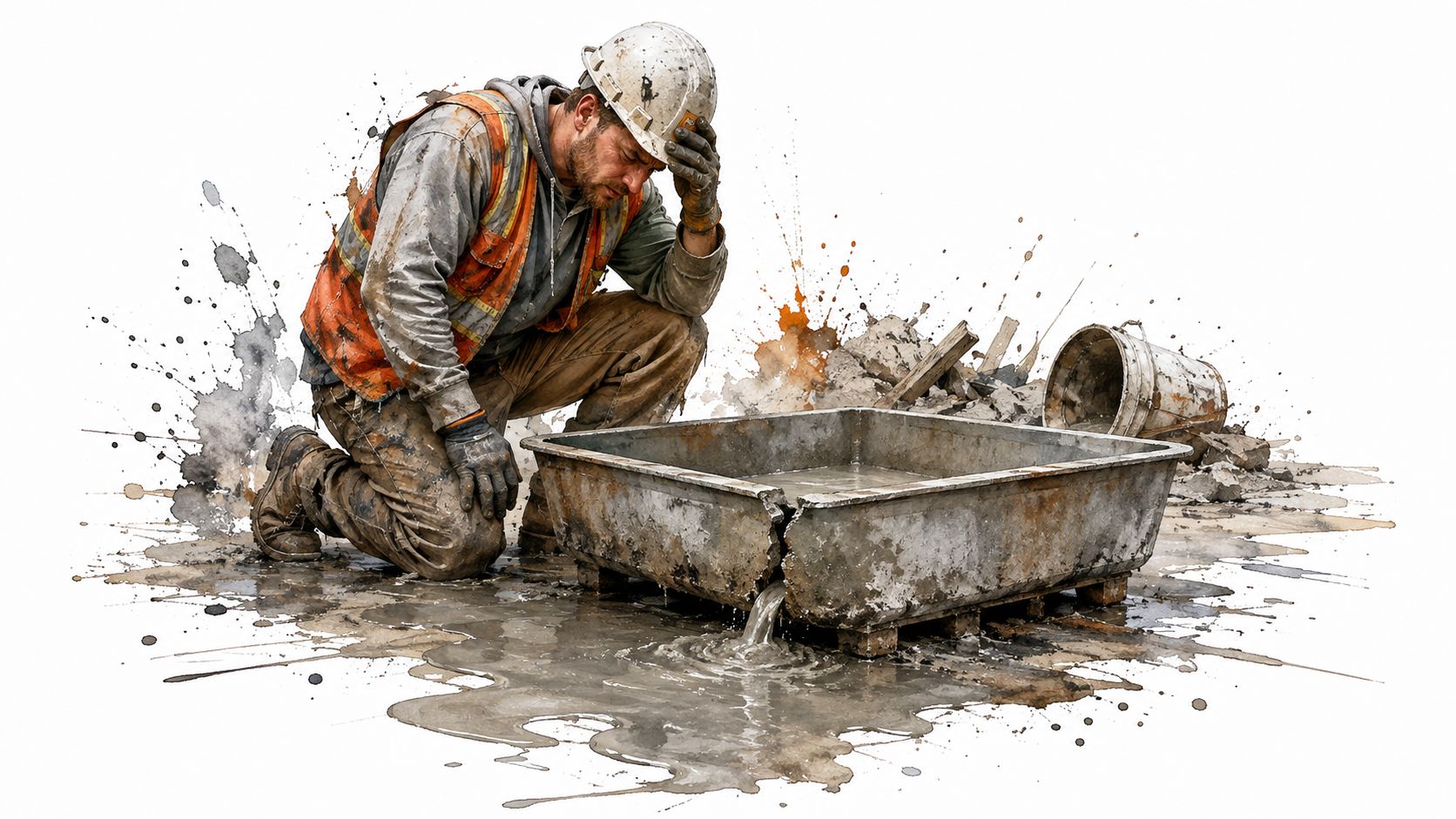
A failed pan costs more than the pan
Concrete washout is hard service. It is wet, alkaline, abrasive, and usually handled on a deadline, which is a rough combination for any containment system. When a pan fails, the crew does not just lose hardware, they lose time spent moving slurry, cleaning the pad, and reworking the site layout.
The bigger problem is that washout failure spreads. A leak can contaminate the ground, trigger cleanup work, and create headaches with stormwater control. In the broader industrial world, corrosion is expensive enough that it is widely cited as a major economic burden. NACE International's benchmark figures place the annual global cost of corrosion at about $2.5 trillion, roughly 3.4% of global GDP, and estimate the U.S. manufacturing sector loses $30 billion per year to corrosion, according to NACE International's benchmark study. That scale is exactly why a “good enough” container often turns out to be anything but.
Practical rule: on a pour site, the cheapest container is the one that does not send you back for cleanup, replacement, and documentation.
The spec sheet is only the start
Material choice matters because the failure usually happens in the field, not in the catalog. A washout pan can be made from a corrosion resistant base material and still fail early if the coating gets damaged, the welds are poor, or the geometry traps slurry. Weld toes, bolt holes, lap joints, and tight corners are where I watch first, because that is where slurry sits and where a small defect turns into a leak.
That is the part people miss when they only compare alloy names. You can spend more up front and still lose if the fabricator leaves sharp crevices, thin cover at the edges, or a finish that cannot handle constant scraping and rinse cycles. The right choice protects both the environment and the budget, but only if the material, the fabrication, and the details all hold up together.
The selection question is never just “what metal is it?” It is “what happens after the first scratch, the first rain, and the first week of use?” On a construction site, that is the question that separates equipment that stays in service from equipment that becomes a repeated line item.
How Corrosion Attacks Construction Equipment
Concrete washout creates a nasty little chemistry lesson in the field. Fresh slurry is highly alkaline, wet conditions keep the reaction going, and any chloride exposure from coastal air, de-icing residue, or contaminated runoff makes the environment harsher still. Add wet-dry cycling and you get a setup that punishes weak coatings, exposed edges, and trapped seams.
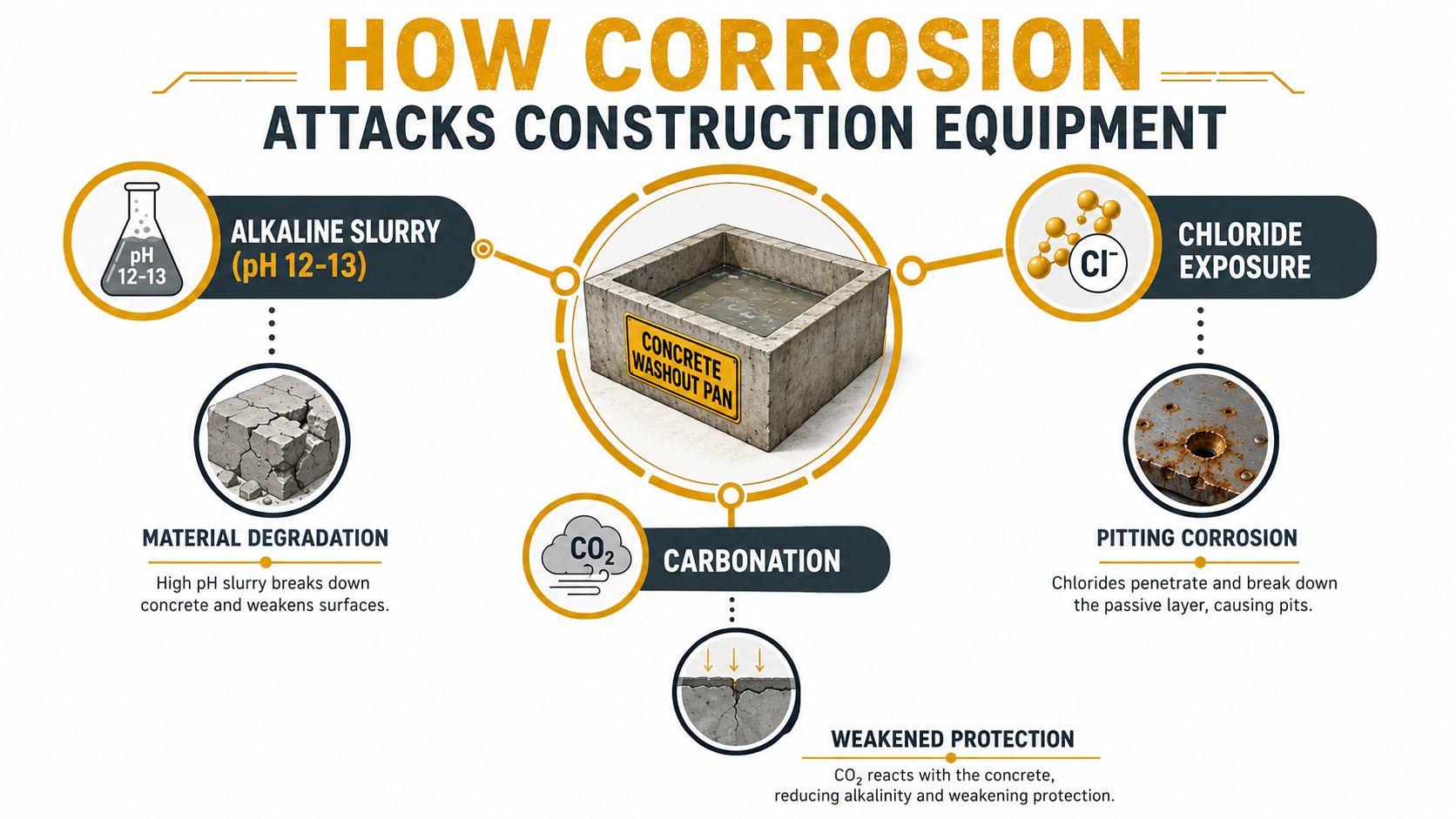
Start with the surface, then watch the weak spots
Corrosion often begins as a broad surface change. On steel, that might look like discoloration, dulling, or early rust bloom. In a washout setting, the damage can seem slow at first because the container still “looks fine” from ten feet away.
That's the trap. Once the protective layer is compromised, water and contaminants keep working on the surface. Materials with a stable passive film, like stainless steels, resist that better because chromium helps form a thin self-healing oxide layer in oxidizing environments, and industry references commonly treat about 10.5 to 12% chromium as the minimum threshold for stainless behavior, according to Outokumpu's corrosion resistance guidance.
Localized attack is the one that gets expensive
The ugly failures are usually localized. Pitting corrosion shows up as small, deep holes, while crevice corrosion hides under gaskets, overlaps, weld toes, fasteners, and trapped debris. Those failures matter more than uniform surface wear because they can progress out of sight until the base material suddenly loses integrity.
A useful benchmark in corrosion tables is about 0.1 mm/year as an upper limit for a material to be considered corrosion resistant, and environment-specific rankings put austenitic stainless steel far ahead of mild steel in seawater, while titanium and zirconium sit at the high end for freshwater, seawater, steam, and industrial air exposures, according to this corrosion resistance table. That doesn't mean every washout pan needs titanium. It means the environment matters as much as the alloy family.
Field truth: a container usually doesn't fail where everyone can see it. It fails under a clamp, inside a lap joint, or at a weld that never drained cleanly.
What changes the attack rate
Three site conditions make corrosion worse very quickly, alkaline slurry that sits, chloride-bearing moisture, and geometry that traps residue. Temperature, flow, and drying time matter too, but the simple point is this: if slurry stays on the material, the material loses.
That's why two pans made from the same nominal material can age very differently. The one with better drainage, cleaner welds, and fewer crevices will last. The one with dead pockets and sloppy interface details will start shedding performance long before the bulk material is “worn out.”
Comparing Corrosion Resistant Material Families
A washout pan can look fine on day one and still be the wrong choice for the site. I've seen the same material perform well on a short interior slab pour, then get chewed up fast on a long civil job where slurry sits, edges get knocked, and the crew is working in wet conditions day after day. The material family matters, but the question is how the part is built, how it drains, and where the joints are hidden.
What each family does well, and where it falls apart
| Material Family | Key Advantages | Limitations | Expected Lifetime | Relative Cost |
|---|---|---|---|---|
| Stainless steel, especially 304 and 316 | Strong general corrosion resistance, easy to source, familiar to fabricators | Can still pit or crevice-corrode in chlorides, weld details matter a lot | Good in clean service, variable in harsh washout use | Moderate to high |
| Galvanized steel | Lower upfront cost, zinc helps slow surface attack | Coating damage exposes the base steel, life depends on coating condition | Fair in light-duty use, shorter in harsh wet service | Lower |
| Coated steel | Familiar fabrication, can be cost-effective when well maintained | Coating failures often start at edges, welds, and abrasion points | Good only if the coating stays intact | Low to moderate |
| HDPE and LDPE plastics | Don't rust, lightweight, easy to move | Impact damage, UV exposure, and structural limits can matter | Useful for lighter-duty containment | Moderate |
| UHMW polyethylene | High abrasion resistance, tough in rough handling | Can be more expensive than standard polyethylene, fastening details still matter | Strong for wear-heavy use | Moderate to high |
| Fiberglass and GRP | Good chemical resistance, nonmetallic, corrosion resistant | Can crack under impact, quality varies by fabrication | Good when handled carefully | Moderate to high |
| Aluminum alloys | Lightweight and easy to handle | Can suffer in certain wet or chloride-rich conditions, joints need attention | Mixed in washout environments | Moderate |
| Protective coating systems | Extend life of base metals, flexible for budget control | Need inspection, repair, and reapplication | Depends on upkeep | Often the lowest upfront, higher maintenance |
Stainless, plastic, and composite are not interchangeable
316 stainless gives more margin than 304 in chloride exposure, but neither alloy solves poor detailing. If a pan holds slurry in a seam, if the weld bead leaves a pocket, or if a fastener creates a hidden gap, the bulk metal can outlast the design around it. That is where crews get surprised, because the visible shell still looks serviceable while the weak spot is already working underneath.
Plastics like HDPE and UHMW avoid rust, which makes them practical for some containment jobs, but they still need honest handling and decent support. A light-duty plastic pan can be the right call where weight and mobility matter, yet it will not forgive abuse from a loader bucket, a dropped tool, or poor fastening that lets the panel flex at the corner. Fiberglass and GRP can also do well, provided the fabrication quality is steady and the part is not expected to take the kind of punishment that dents steel and chips coatings.
Galvanized and coated steel stay common because crews know how to fabricate them and the starting price is manageable. The catch is simple. Once the coating is cut at an edge, scratched at a bracket, or burned back at a weld, the barrier is gone in that spot and corrosion starts there first. On washout gear, those damaged edges and attachments are usually the places that age fastest.
The expensive material is not always the best answer
I've seen buyers reach for premium alloy names when the better answer was a smarter build. The GlobalSpec's material selection article points to coatings, linings, and hybrid systems as practical ways to manage corrosion without making the whole unit from an expensive alloy. That matches what holds up on site. A well-detailed base material with a sound protective system often lasts longer than a costly material that was welded, trimmed, or assembled carelessly.
The decision is lifecycle, not badge value. If coated steel or HDPE fits the exposure, the handling, and the maintenance plan, there is no reason to spend more just to say the unit was built from a premium metal.
Hidden Failure Modes That Defeat Resistant Materials
The biggest mistake I see is assuming the base material alone decides the outcome. It doesn't. The pan, tank, or tray usually loses at the interfaces, where water sits, metals touch, or debris packs into a corner and stays wet.
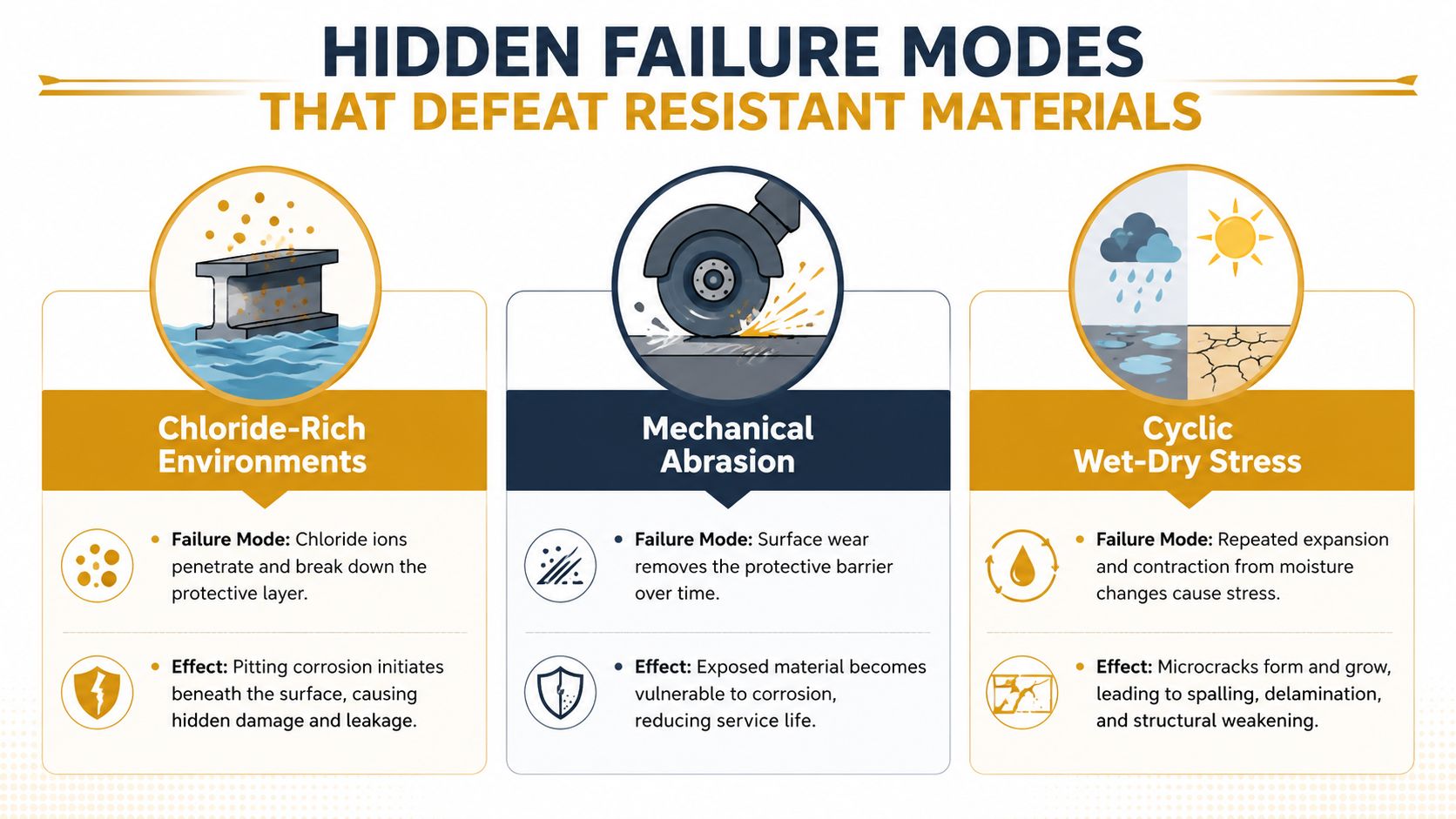
Chlorides, dissimilar metals, and crevices
Independent materials guidance points to chloride environments, dissimilar-metal contact, and stagnant crevices as the three conditions that often defeat otherwise adequate corrosion resistant materials. That tracks with real jobsite failures. A washout system near the coast, next to de-icing storage, or exposed to salty splash can behave very differently from the same system on a dry inland site.
Swagelok's corrosion guidance is blunt about two details that matter on sites, limit voltage differences between metals to 0.2V and minimize crevice-corrosion sites. That's a reminder that clamps, brackets, fasteners, and supports can create the weak point even when the main body looks fine. Swagelok's corrosion control guide is worth reading for exactly that reason.
Welds and fasteners are where the problems start
On construction equipment, welds and fasteners are common failure points because they combine heat-affected zones, rough edges, and geometry that traps moisture. A continuous weld that drains cleanly is much better than a stitch pattern that leaves pockets for slurry to sit in. The same idea applies to overlapping joints, tight lap seams, and threaded hardware that never gets a full rinse.
Keep water moving off the part, and keep like metals together when you can.
That simple habit goes a long way. If you force moisture into a dead pocket, the material doesn't get a fair fight.
Design the corrosion mechanism out
The best fix is usually design, not heroics. Use continuous welds where possible, avoid overlapping joints, specify compatible fasteners, and keep drains open so slurry can't park in hidden corners. If a dissimilar-metal interface is unavoidable, isolate it thoughtfully instead of hoping the coating will save it forever.
A good field test is easy to remember. If you can't inspect it, clean it, and dry it, you're building a future problem. That's true whether the part is stainless, galvanized, composite, or coated steel.
Selecting the Right Material for Your Washout Setup
The right material starts with how the pan will be used, not with the name on the spec sheet. A washout setup that sits in wet, alkaline slurry needs a different answer than a light-duty container that only sees short-term use on an interior job. Budget matters, but the test is what the asset costs over its full service life.
Use the site conditions as the first filter
Start with the exposure. If chlorides are part of the mix, stainless gets narrower fast. If UV, impact, and rough handling are part of the day, plastics and composites need a harder look. If the setup will be dragged, bumped, or loaded hard, a material that looks fine in a catalog can split, gouge, or crack once it gets into the mud.
Service duration matters just as much. A short-term rental may make sense with a simpler material if it is clean, inspected, and easy to replace. Long-term owned equipment needs more attention to upkeep, coating condition, and repairability. The best answer for a two-week job is not always the best answer for a multi-month program.
Match the base material to the protection strategy
Hybrid systems earn their place. If full fabrication from a premium alloy does not pencil out, coatings, linings, or protective barriers can give you the resistance you need without paying for more metal than the site needs. That same practical approach shows up in GlobalSpec's 2025 material selection article, use the simplest system that still matches the service conditions and the inspection burden.
A few combinations show up again and again on real jobs:
- Coated steel for moderate exposure, when the site can support inspection and touch-up.
- HDPE or UHMW for lighter-duty containment, when weight and rust matter more than structural abuse.
- Stainless steel for harsher wet service, when chloride exposure or long life pushes the decision.
- Lined or coated hybrid systems for aggressive environments, when replacing the whole structure with an exotic alloy would be too much for the job.
Ask the questions that prevent overspend
Practical rule: if a cheaper base material plus a solid protective system meets the exposure, do not buy the expensive alloy just to feel safe.
That does not mean cutting corners. It means paying for the problem you have, not the one you are worried about. On a washout setup, the best material is the one that survives the mix of slurry, handling, weather, and inspection interval on your site.
Maintenance and Inspection Routines That Extend Equipment Life
A good material still needs stewardship. The fastest way to waste a corrosion resistant system is to leave slurry in place, ignore small coating damage, and assume the part will somehow “take care of itself.” It won't.
What to look for every time the crew checks it
Start with visual signs of trouble. Look for surface discoloration, rust bloom, pitting, coating delamination, cracked sealant, and crevice buildup around joints, hinges, and fasteners. On plastic and composite systems, check for gouging, impact cracking, and deformation at attachment points.
Cleaning matters just as much as inspection. Rinse buildup before it hardens, but don't use a cleaning method that damages the protective surface. Aggressive scraping can do more harm than the slurry itself if it strips a coating or roughens a sealed edge.
Adjust the routine to the material
For stainless, focus on welds, heat-tinted areas, and trapped residue at joints. For galvanized or coated steel, any chip or scratch deserves quick attention because exposed base metal can start to go downhill fast. For HDPE, UHMW, and GRP, inspect for mechanical wear, cracking, and stress at connectors rather than rust.
A simple maintenance habit saves money:
- Rinse after use, especially if slurry has dried in corners.
- Inspect seams and fasteners, because that's where hidden failures begin.
- Touch up coatings early, before damage spreads.
- Replace compromised seals or hardware promptly, rather than waiting for a leak.
Repair when the fix is real, replace when it isn't
Not every flaw means the equipment is done. A scraped coating can often be repaired if the damage is caught early and the substrate is still sound. Once corrosion has migrated into joints, weakened the attachment points, or spread into hidden crevices, replacement usually makes more sense than patchwork.
The habit to build is simple. Catch the first defect, not the fifth one. That's how expensive equipment pays back.
Regulatory Compliance and Environmental Responsibility
Washout containment exists because unmanaged concrete slurry is a site problem and an environmental problem. Stormwater controls, SWPPP requirements, and local rules all exist to keep that material out of drains, soil, and waterways. If the containment leaks, the site team inherits a compliance issue that usually costs more than the hardware did.
Corrosion resistant materials support that effort by keeping the containment system intact. A pan that resists leaks, cracking, and seam failure is easier to keep clean and easier to document as part of a compliant site setup. That matters because a dependable container is part of the control plan, not just a convenience item.
The rental model fits a lot of construction work for the same reason. If you need compliant containment without buying, storing, and maintaining your own inventory, a well-managed rental program gives you access to ready-to-deploy equipment with less overhead. That's especially useful on jobs where the duration is uncertain or the site conditions change fast.
If you need washout containment that's ready to roll, Reborn Rentals offers specialized solutions built for construction sites that can't afford leaks, clutter, or downtime. Visit Reborn Rentals to see how ready-to-deploy washout equipment can help your crew stay organized, protect the site, and keep slurry where it belongs.