You can lose a whole pour to a bad handoff long before anyone talks about a breach. The crew is on site, the pump truck is staged, and the washout pan is still sitting in a yard somewhere because the access road turned to mud and nobody wrote down who was responsible for the delivery window, the site conditions, or the escalation call. That's where service level agreements stop being paperwork and start being the difference between a controlled day and a cleanup problem.
When a Washout Pan Rental Goes Wrong Without an SLA
A superintendent does not need a theory lesson when the pan does not show up. He needs the driver, the dispatcher, and the rental desk to agree on what “on time” means, what counts as an access issue, and who owns the fix when the site is ready but the equipment is not there. Without that, the rental company can call it “best effort,” and the customer is left covering the delay.
The bigger problem is that the failure does not stay small. Concrete keeps moving, labor stays on the clock, and the washout plan turns into a scramble around a missing container. If the agreement never defined the delivery window, the replacement path, or the condition the pan had to meet on arrival, everybody has a story and nobody has a remedy.
What a clear agreement would have changed
A useful service level agreement turns the argument into something the site team can verify. It sets the delivery window, the condition the pan must meet, the access the customer must provide, and the next step if either side misses its part. That is what SLA mechanics do. They turn a vague promise into a measurable threshold that can be checked and enforced, using the same basic logic found in cloud and SaaS contracts, just applied to physical equipment.
Practical rule: if the crew cannot verify it on site, it does not belong in the agreement as a promise.
The hard lesson from rentals is that “we'll do our best” is not a commitment. If the road is muddy, the gate is locked, or the contact number is not answered, that needs to be written down before the truck rolls. A good SLA does not prevent every bad day, but it does prevent the argument about whose bad day it was.
The Essential SLA Clauses Every Equipment Rental Needs
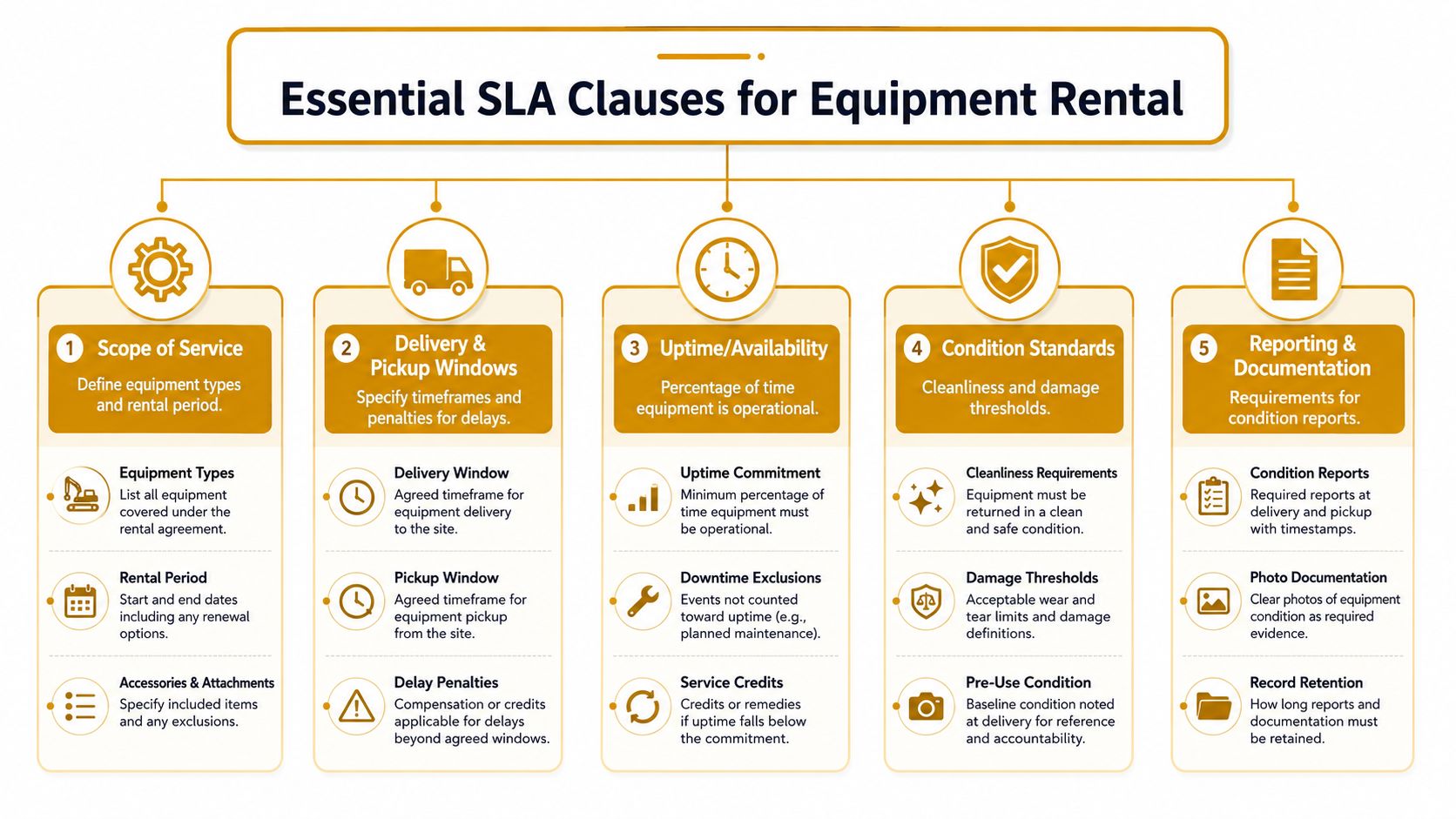
The best way to draft service level agreements for rental work is to follow the sequence of where disputes happen. Delivery fails first, then the gear's availability, then the condition of the unit, then damage claims, then liability and remedies. That order matters, because the clause that solves a problem after it happens is rarely the clause that prevents it.
Start with scope, delivery, and pickup
Scope of service has to name the exact equipment, the rental period, the site address, and any setup or collection expectations. If the agreement just says “washout containment,” someone will eventually argue over size, placement, or whether the rental included pickup at the end of the pour. Delivery and pickup windows need written timeframes, not casual language, because that's what the superintendent and the dispatcher will use when the schedule starts slipping.
Availability or uptime sounds like software language, but the physical version is simple. The unit has to be present, intact, and usable for the agreed work window. If it arrives late, arrives damaged, or can't be used because it's contaminated, the promise has failed in a way the site can prove.
Add condition, liability, and exclusions
Condition standards should say what “clean” and “ready” mean on arrival and at pickup. That avoids fights about residue, cracked corners, missing fittings, or whether the pan was supposed to be washed before return. Damage and loss responsibility needs to assign risk in plain terms, because every rental dispute eventually turns into a question about who pays for impact, misuse, or avoidable site damage.
Liability allocation and exclusions finish the document. They define where the rental company's duty ends and where customer readiness begins, including access problems, weather windows, or missed pickup coordination. Remedies are the enforcement piece, and they only work if the earlier clauses are specific enough to prove a miss.
Practical rule: if the clause can't survive a site walk or a phone call after a missed delivery, rewrite it.
Defining Measurable KPIs for Delivery, Uptime, and Containment
The fastest way to weaken a rental SLA is to write goals that sound professional and can't be audited. “Prompt delivery” and “good condition” create noise, not accountability. A KPI for equipment rental should be simple enough for a foreman, dispatcher, and rental coordinator to check against the same facts.
Turn promises into observable measurements
For delivery, the metric should start at confirmed order and end at on-site placement. The target belongs in hours or a time window, not an open-ended day count, because crews operate on pour times, not billing cycles. The evidence trail should include dispatch logs, driver notes, and timestamped arrival photos.
For uptime or availability, don't borrow server language directly. A washout pan is “up” when it is intact, positioned correctly, not overflowing, and able to accept washout water for the rental period. That makes the metric physical and visible, which is what matters when the jobsite is the measurement environment.
For containment, the cleaner version is pass or fail. Either the pan contained the slurry as intended, or it didn't. If you need more detail, document the fill level, overflow event, or swap-out trigger with photos and site notes so nobody can reinterpret the result later.
Sample KPIs for Washout Pan Rentals
| KPI | Target | Measurement Method | Evidence |
|---|---|---|---|
| Delivery placement | On site by the confirmed window | Compare confirmed order time to arrival time | Dispatch log, timestamped photo |
| Ready for use | Pan delivered intact and positioned correctly | Visual inspection at handoff | Signed condition report |
| Containment performance | No overflow during the agreed use period | Site check and incident log | Photos, foreman note |
| Clean return status | Returned in documented condition | Joint pickup inspection | Pickup checklist, photos |
| Escalation response | Issue acknowledged through the agreed channel | Time from report to reply | Message log, email trail |
Practical rule: if two people can look at the same pan and reach different conclusions, the KPI is too vague.
The measurement method matters as much as the target. Cisco and IBM both stress that SLA measurement has to be auditable, with reporting and escalation built in, because the agreement only holds if both sides can verify the same facts Cisco SLA guidance. That's exactly right in rental work, where photos, timestamps, and the jobsite log are often the only evidence that survives the week.
Penalties, Credits, and Service Credits That Actually Compensate
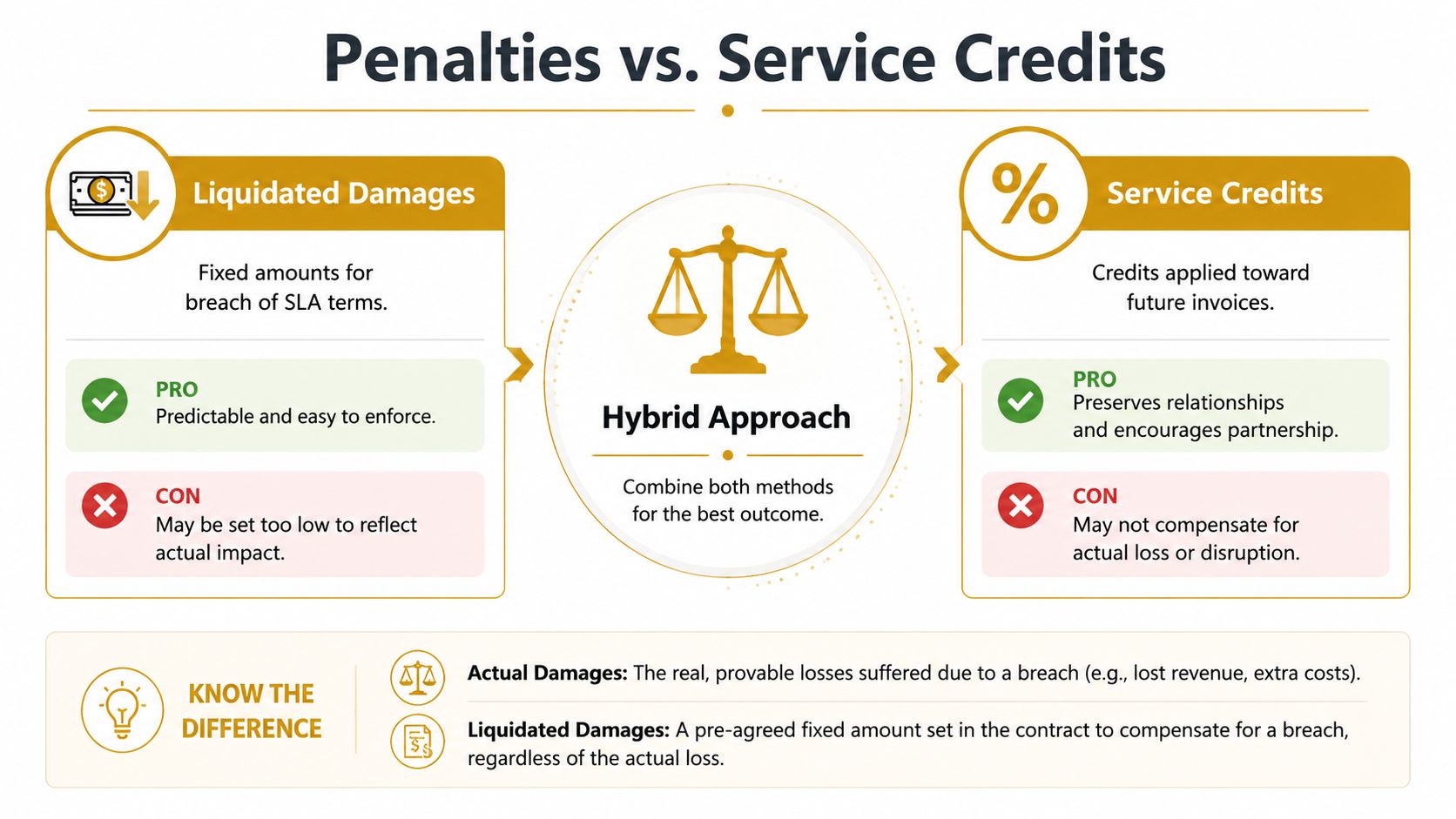
A penalty clause nobody enforces is just decoration. On a rental site, the remedy has to match the actual harm and still be simple enough that both sides will sign it. That usually means choosing between liquidated damages, service credits, or a hybrid that handles routine misses without turning every dispute into a legal fight.
Use the remedy that fits the failure
Liquidated damages work best when the loss is easy to anticipate and the amount needs to be fixed in advance. That matters if a missed delivery window disrupts a short pour or leaves a crew waiting with nowhere to start. Service credits fit better when the relationship matters and the miss is smaller, because they reduce friction and keep the contract moving.
A hybrid clause is usually the most workable option. A late delivery can trigger a partial-day credit, while a contaminated pan on arrival can trigger a replacement plus documented labor reimbursement if the customer already met the prerequisites. That kind of structure follows the same basic SLA logic used in other contract settings, where the remedy tracks the seriousness of the miss and the value at risk.
Keep the cap tied to the transaction
The liability cap should match the rental, not a boilerplate number copied from a different business. A short washout rental does not need the same risk structure as a long-running facilities contract. If the cap is too low, the customer will not trust it. If it is too high, the rental company will push back before signing.
Practical rule: credits should be easy to calculate, easy to document, and hard to dispute later.
The best remedy language is the version both sides can explain to a foreman. If the pan shows up late, state the credit. If the unit arrives damaged, state the replacement duty. If the customer failed to clear access, state the exclusion. That level of clarity keeps the clause usable when someone asks for enforcement.
A Washout Pan SLA Template You Can Adapt Today
A good rental SLA should be short enough to attach to a purchase order and specific enough to survive a dispute. Keep it focused on the parts that matter on site, the equipment, the access, the timing, the condition, and the remedy. Anything else belongs in the main rental terms.
Copy-ready template
Parties.
Customer: [Company name]. Provider: [Rental company name].
Verify the legal entity names exactly as they appear on the invoice.
Service description.
Rental of [equipment type], including delivery to [site address], placement in the designated area, and pickup at the end of the rental period.
Insert the exact unit size, quantity, and any accessory items here.
Rental period.
Start: [date and time]. End: [date and time].
If the job can slip, write down whether extensions are automatic or require approval.
Site access and prerequisites.
Customer will keep the access route clear, confirm the delivery contact, and provide safe placement instructions before arrival.
This is the clause that stops preventable disputes about gates, mud, snow, or blocked paths.
KPI commitments.
Delivery within [window]. Condition on arrival: [pass/fail standard]. Containment performance: [pass/fail standard].
Tie each one to a photo, log entry, or signed checklist.
Reporting and communications.
Primary channels: Messenger, WhatsApp, email, scheduled callback.
Use one named escalation contact on each side so breach notices don't get lost.
Exclusions.
Delays caused by customer access failure, inaccurate site information, or failure to accept delivery during the confirmed window are excluded from breach calculations.
Add weather, permit holds, or site shutdowns only if both sides agree.
Credits and remedies.
If provider misses the confirmed delivery window without an exclusion, customer receives [credit amount or replacement term].
If equipment arrives contaminated or damaged, provider replaces it and addresses documented cleanup or swap-out costs as agreed.
Dispute path.
Initial notice by [channel] within [time]. Escalation to [name or title]. Final review by both parties with supporting photos and logs.
Sign-off.
Customer representative: [name]. Provider representative: [name]. Date: [date].
A single-pour retrofit job usually needs a tighter delivery window and a simpler remedy clause. A multi-week infrastructure project usually needs a broader access section, more detailed pickup language, and a more explicit escalation path. The template doesn't change much. The level of detail does.
Negotiating the SLA Before You Sign
Negotiation usually gets tense around the same four points, delivery timing, cleaning responsibility, damage liability, and exclusions. That's not because either side is trying to be difficult. It's because each party assumes the other one will cover a problem that only becomes visible when something goes wrong.
The project manager usually starts with the window. The rental coordinator usually answers with access conditions. The contractor says the pan has to show up by a certain time. The provider says the route has to be clear and the contact must be reachable. Both are right, but only if the clause captures both obligations.
A practical back-and-forth
“Who clears the snow at the access point?” is a real question, not a nuisance question. If the contract doesn't say it, the dispatcher will treat it as the customer's problem and the superintendent will treat it as the driver's problem. The fix is to write the access obligation into the agreement so nobody has to improvise in bad weather.
“Who pays if the pan cracks under load?” needs the same treatment. If the unit is misused, the customer should own it. If it arrives defective, the provider should own it. That sounds obvious until the claim is made without photos, without a condition report, and without a shared definition of what counts as misuse.
“If it matters on the day of the pour, it matters in the agreement.”
The most reasonable pushback is against clauses that are vague, one-sided, or impossible to verify. The least reasonable pushback is against basic access, condition, and timing language. Good faith negotiation isn't about winning every line. It's about making sure the jobsite reality matches the paper before anyone signs.
Enforcing the SLA After Signature
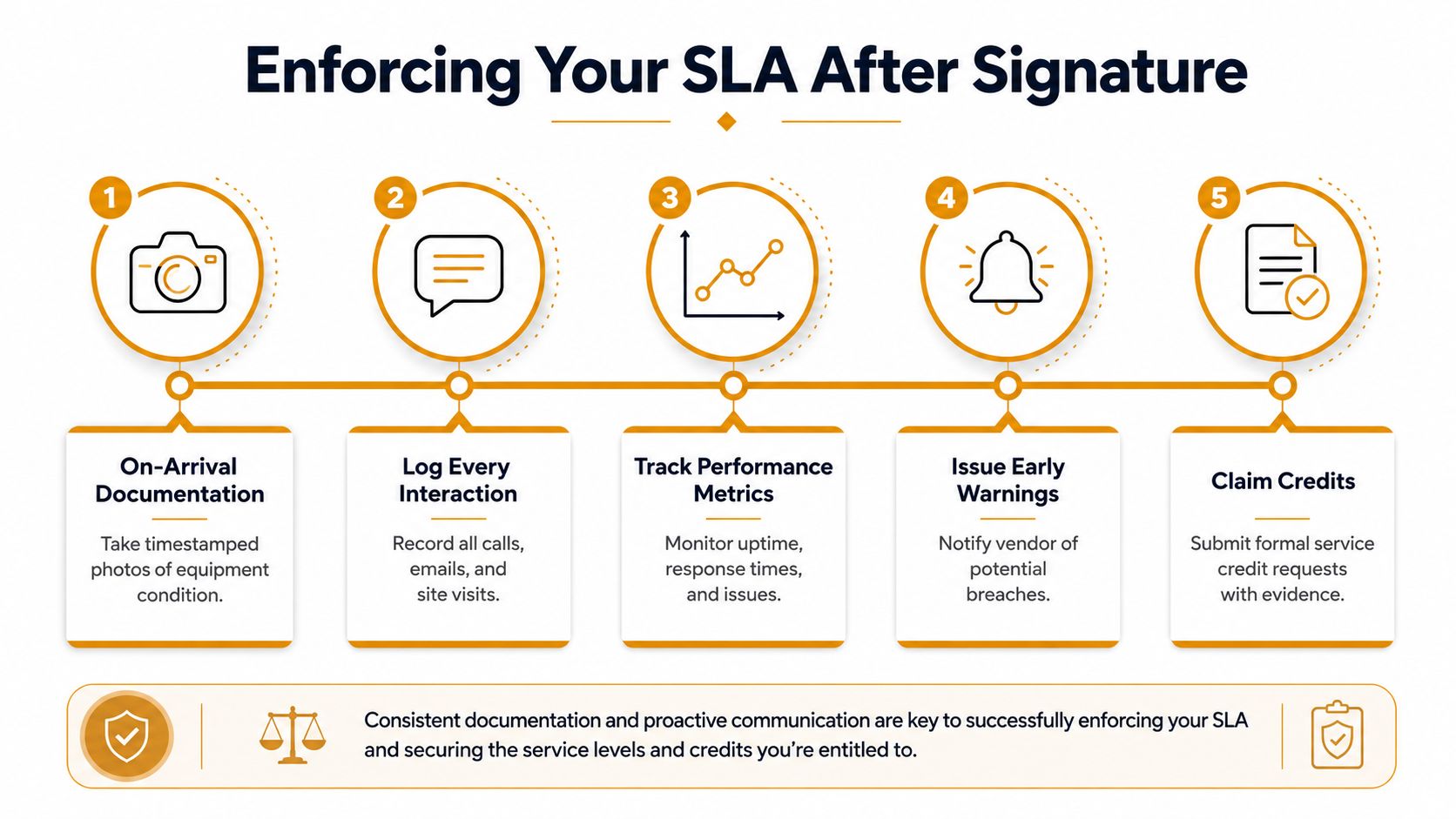
Signing the agreement doesn't enforce itself. The people who stay out of trouble are the ones who document the handoff, keep the communication trail clean, and raise a breach while there's still time to fix it. That's where the earlier KPI definitions become useful, because enforcement depends on the same evidence the contract was built around.
Run the job the same way every time
On-arrival documentation starts with timestamped photos before the equipment is used. Capture condition, placement, and any obvious defects as soon as the unit lands. If you don't do that, the provider can later argue that the damage happened on site.
Log every interaction through the agreed channel. Calls are useful, but they're weak evidence unless they're followed by a message or email that records what was said. The cleaner the trail, the easier it is to resolve a dispute without turning it into a memory contest.
Track performance metrics during the rental, not just at the end. If the unit is approaching overflow, if the access path is changing, or if the pickup window is at risk, document it early. That gives the other side a chance to cure the issue before it becomes a breach.
Issue early warnings when the job is drifting toward a miss. A breach notice doesn't have to be hostile. It just has to be clear, timely, and backed by the same facts that the SLA requires.
Claim credits with the evidence attached. Photos, logs, and the signed condition report should be enough for a straight claim if the clause was written well. If the provider pushes back, the dispute should move to the named escalation contact, not into a long email chain.
Close out the rental with the same discipline
A joint pickup inspection is where bad handoffs get exposed. Confirm the condition, note exceptions, and sign only after both sides have seen the same unit. That closeout record becomes the baseline for the next rental, which is why iterative drafting matters in real operations. The first agreement is usually a draft of the one you'll keep.
Practical rule: a clean closeout is worth more than a clever clause.
If you manage concrete washout rentals, keep your agreements as operational as your crews are. Reborn Rentals focuses on ready-to-deploy washout containment for construction and renovation work, and their process is built for the same kind of clarity this article is about. Visit Reborn Rentals to review how a straightforward rental workflow can support cleaner jobsite coordination and better service expectations.