33% of contractors tie site coordination issues to construction quality problems, and those coordination failures are linked to an average 9% budget increase plus about 10% erosion in annual company profit margin (industry survey summary). On a concrete job, that isn't an abstract management issue. It shows up when the pump is parked wrong, the finisher is waiting, the truck is circling, and the crew starts burning money before the slab is even placed.
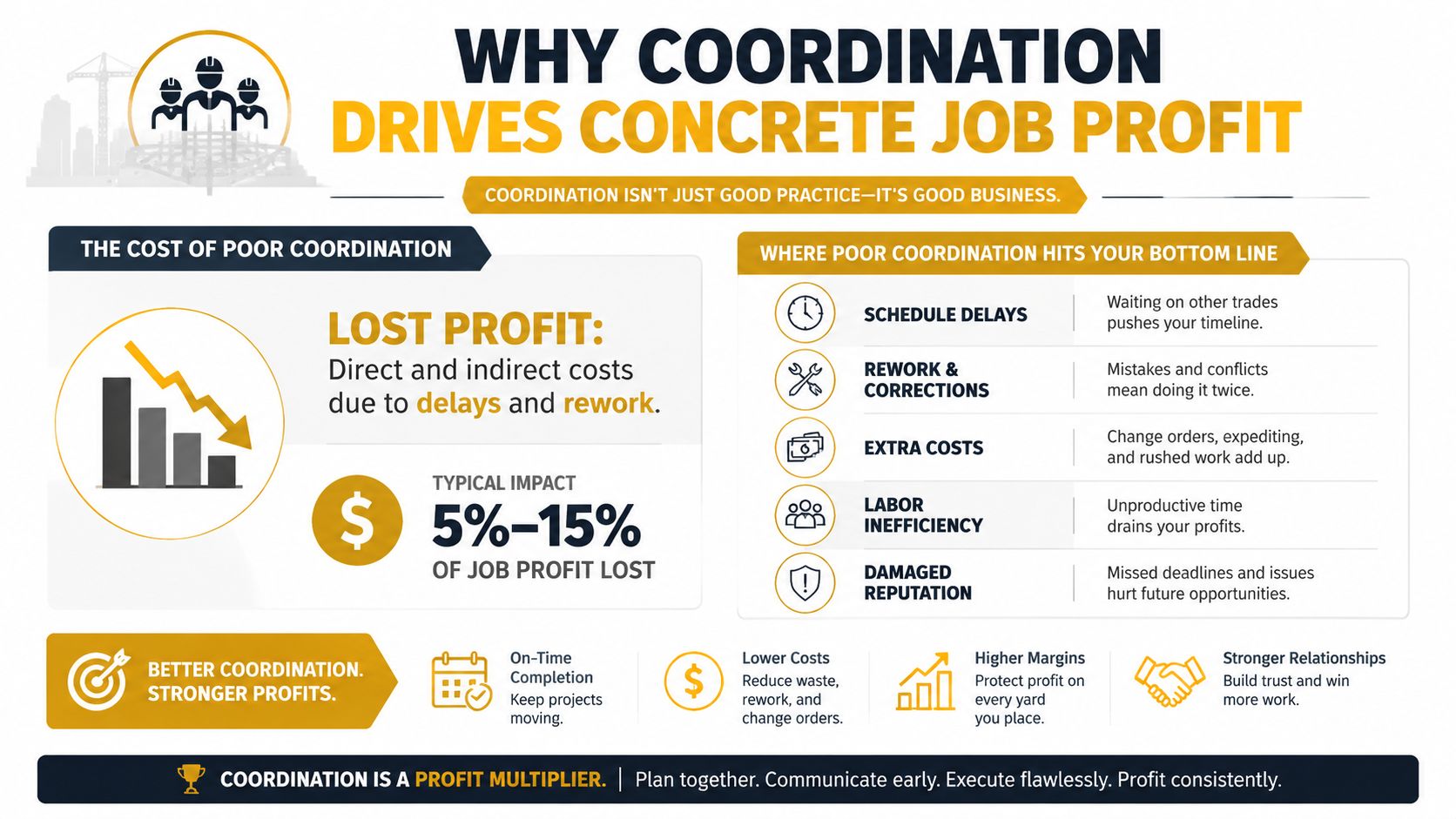
The jobs that stay profitable usually don't rely on heroics. They rely on subcontractor coordination that treats interfaces, access routes, staging, and handoffs as real work, not administrative cleanup. When that discipline is missing, crews don't just lose time, they lose margin through rework, idle labor, and avoidable confusion.
Why Coordination Drives Concrete Job Profit
The hard truth is that coordination quality lands on the P&L whether anyone tracks it or not. The construction survey data is blunt, 33% of contractors point to site coordination as the root cause of quality trouble, and those issues are associated with an average 9% budget increase and about 10% profit-margin erosion (survey summary). On a concrete job, that shows up fast in pump time, finishing windows, truck flow, and the rework the crew has to absorb when interfaces are not set before the pour starts.
Start before the first truck shows up
The jobs that hold margin usually begin with a pre-mobilization kickoff that maps trade activities, access needs, and handoffs, then turns them into documented decisions. Good workflow guidance calls for a master schedule plus short-interval control, with collaboration first, then 2- to 3-week lookaheads, firm commitments, constraint removal, and weekly updates (workflow guidance). That is the practical difference between controlled production and a day spent reacting to the gate, the pump truck, and the finisher all at once. One gives every trade a shared baseline. The other leaves the field team to solve the same problem twice.
Practical rule: If a scope detail could affect access, sequencing, or elevation, get it written down before crews mobilize.
A simple one-page scope matrix does a lot of heavy lifting. It should name each sub's start point, stop point, and handoff point, plus the routing and elevation priorities that matter on the slab. That same kickoff should require current coordination drawings before rough-in, because stale revisions and unclear scope are two of the failures repeatedly called out in subcontractor coordination guidance (coordination tips). If the drawings are out of date, the meeting did not solve the job.
Why the kickoff protects margin
Concrete work punishes vagueness faster than most trades. A finish crew cannot wait around while someone else figures out a hose route. A pump operator cannot guess where the access lane is supposed to be. A superintendent who locks in those decisions early protects schedule and labor utilization.
The highest-value habit is documenting who owns each interface. That means the truck route, pump placement, washout area, and finish access are not “everyone's problem.” They are assigned, reviewed, and confirmed. Washout needs the same treatment, with containment planned early so slurry does not spill into traffic paths or force a cleanup delay after the pour. On jobs where containment is tight, a setup built around Reborn Rentals washout options can keep that risk contained instead of turning it into a field fight. That kind of clarity keeps weekly plans from reopening old arguments and turning planned production into site-side negotiation.
Sequence Pours Pumps and Finishing
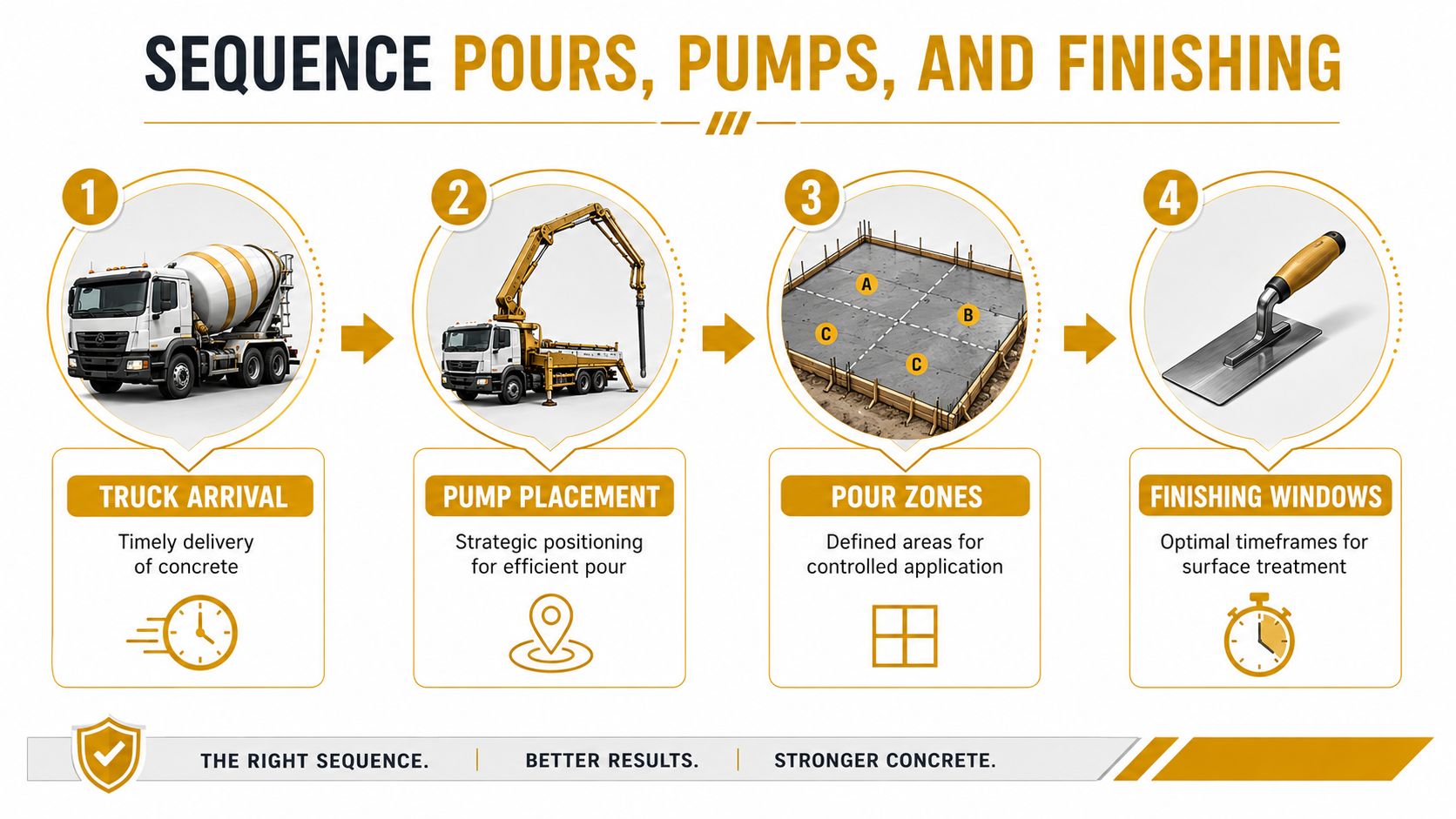
Concrete sequencing usually breaks at the handoff points, and that is where margin gets burned. The truck shows up before the pump is ready, the pour zone is still occupied, and finishing gets squeezed into whatever time is left. A better workflow ties the master plan to lookahead guidance and keeps Week 1 firm commitments, Week 2 planned activities, and Week 3 anticipated activities visible enough that routing problems surface before the crew hits the gate.
Build the pour sequence around the bottleneck
The sequence should start with truck arrival, then pump placement, then defined pour zones, then the finishing window. That order seems simple until access gets blocked and the pump becomes a parked obstacle. Once that happens, the finish crew loses workable surface time, and the whole pour starts drifting into cleanup and overtime.
A pre-set access lane removes a lot of friction. It keeps the pump from competing with other trades for entry, and it keeps the driver from inventing a route that crosses the slab path or staging area. A key test is whether the pump can reach the right position without conflict. If it cannot, the sequence was never ready for the field.
Use the lookahead to remove constraints
Short-interval control works because it forces crews to talk about constraints while there is still time to fix them. Week 1 should stay a commitment list. Week 2 should stay a planning list. Week 3 should flag what is likely to become a constraint if nobody acts now.
That split helps the superintendent separate promises from possibilities. It also helps the finisher, pump operator, and material handler see which tasks are locked and which ones still carry risk. The result is a sequence that holds up under site conditions instead of collapsing on paper.
Washout belongs in the same planning pass. If slurry has nowhere to go, it ends up in traffic paths, delays the next crew, or forces a cleanup that should have been contained from the start. On tighter jobs, a setup built around Reborn Rentals washout options keeps that risk inside the workflow instead of turning it into a field dispute.
A concrete job runs smoothly when access, sequence, finishing time, and washout containment are planned together before the first truck backs in.
Set Communication Protocols That Stick
A concrete pour can lose time fast when the field has to chase the right person for a simple answer. On mixed-trade jobs, that delay turns into idle labor, missed windows, and a schedule that starts slipping before anyone notices. A tighter communication system cuts that risk by naming who decides, where the decision lives, and which revision the crew should follow before work starts.
Name the contact, the backup, and the channel
Every trade needs one primary contact and one backup contact on the sheet. The crew also needs to know which channel is used for which issue, so a routing question does not disappear into a group chat full of unrelated updates. A Friday decision log helps only if the people in the field read it and the superintendent uses it to clear open items before the next week starts.
The biggest communication mistake is assuming everyone heard the same thing. They did not. A decision that affects a pour day should be written down, tied to the current drawing revision, and sent to the specific people who need it.
The contact list should also reflect the chain of responsibility on site. If the finisher has to wait on the pump lead, or the material handler has to confirm access with another subcontractor, that path needs to be visible before the truck arrives. Otherwise the crew wastes time trying to find out who can approve a change.
Keep logistics confirmation fast
Washout containment, staging changes, and delivery timing all need fast confirmation, not phone-tag. Reborn Rentals supports that kind of coordination through Messenger, WhatsApp, email, QR contact sharing, and scheduled callbacks, which fits concrete work where timing shifts quickly. The point is not convenience for its own sake. It is getting the right person to confirm a pan, a delivery window, or a location without slowing the job down.
That same speed matters when concrete-specific washout logistics are part of the plan. If the crew has to wait while someone decides where slurry goes, the cleanout starts competing with traffic paths, the next trade, and the finish window. A provider that can answer quickly helps keep containment inside the workflow instead of turning it into a field argument.
If a trade does not know where to look for decisions, they will make their own. That is when the field version and the approved version stop matching. The cleanest jobs use one channel per trade, one decision log, and one revision source, so the superintendent can keep interface management under control and protect margin from avoidable rework.
Own Safety and Washout Containment
Concrete coordination isn't only about sequence. It also covers the site controls that keep the pour legal, clean, and easy to review. PPE, clear access routes, spill response, and a designated work area still have to be in place, because construction safety audits review those controls alongside subcontractor coordination and documentation (audit overview).

Put the washout area in the plan, not off to the side
The washout area should be designated before the pour starts. Waiting until the first truck unloads usually means the crew is solving a containment problem while the site is already moving. The container needs to sit close enough to support the crew efficiently, but far enough from drains, walk paths, and active work zones that slurry does not migrate where it should not. If rain is in the forecast, cover the area and keep the containment secure.
For concrete work, washout belongs on the same coordination sheet as the pump, the finish crew, and the access lane. That gives the superintendent a place to verify where slurry goes before the job gets busy. It also keeps the next trade from losing work space because washout was left to chance.
Use the right containment size for the job
Reborn Rentals lists washout pans in 72x72x24 and 72x72x14 options, with the larger pan listed at approximately 18.25 tons and about 441 gallons, and the smaller option at about 310 gallons (product details). The checkout flow is a three-step Cart to Checkout process (product details). Those details matter because containment is easier to manage when the capacity and ordering path are straightforward.
Use the right container for the pour, then keep the washout area under control. Reborn Rentals can provide that containment through its listed pan options, and once the pan is on site, the field rule stays simple. Do not overfill it, let the material harden, then dispose of it according to local requirements. A clean washout area protects the site from inspector issues and keeps alkaline slurry out of the drainage system. That is part of the coordination package, not a side task.
Stop Treating Coordination as More Meetings
Weekly meetings can help, but they do not fix interface problems by themselves. Historical subcontractor coordination research in Hong Kong found subcontractors averaging only about 70% of planned time-performance targets, with only about 10% completing work exactly according to program, and a separate study of main-contractor coordination problems reported 35.10% productivity waste caused by site coordination issues (Hong Kong research summary). Those figures point to one practical conclusion. Calendar time does not solve spatial clashes, access issues, or trade handoffs.
Interface management beats status updates
The most missed angle in subcontractor coordination is interface management. That means resolving where one trade's work meets another trade's work before the crews hit the site. It covers spatial conflicts, sequencing, access routes, document revisions, and handoffs.
Practical rule: If the conflict can be seen on a drawing, it should be resolved on the drawing, not in a meeting after the field crew is already waiting.
A weekly check-in without closure is expensive talk. A good meeting ends with names, dates, and documented actions. A weak one ends with more discussion and the same conflict still sitting in the trailer.
Separate the core problem from the symptom
When a pour slips, ask whether the issue was communication or interface. If the message was sent but the route was blocked, that is an interface failure. If the route was clear but the crew never got the update, that is a communication failure. The fix depends on the cause.
Fragmented processes, informal communication, and weak system planning drive idle labor, resequencing, and rework. More meetings will not repair those problems if the job still lacks clear access, current revisions, and decision ownership. On concrete jobs, control comes from removing the conflict before the truck arrives.
Resolve Conflicts and Track KPIs
A missed commitment is not a small scheduling hiccup. On concrete jobs, it can throw off a pump booking, push a finishing crew into a bad window, and leave the site carrying extra labor cost while everyone waits for the next handoff.
Escalation only works when the job has a rule for it. If a trade misses a commitment, the superintendent should route the issue to the named contact the same day, document the option with cost or schedule impact, and escalate to the PM if the lookahead is affected. That keeps the problem from getting buried in side conversations, and it gives the field a record of what was changed and why.
Use a scorecard the field can actually read
The best coordination scorecard is short. Percent plan complete shows whether weekly commitments are being kept. A weekly commitment rate shows whether the field is making promises it can hold. A washout compliance check shows whether containment stayed in place and the site stayed clean.
Those measures do not need to be complicated to be useful. They need to be visible in the huddle and tied to action. If the same trade keeps missing commitments, the issue is usually not the meeting format. It is capacity, access, or sequence.
A concrete job also needs a washout line item that the field can verify without a long walk. If the containment setup is too far from the pour, crews cut corners. If it sits in the way of staging or finishing, it creates a different bottleneck. Reborn Rentals offers containment options that fit into that workflow, but the superintendent still has to place the unit where it supports the pour instead of slowing it down.
Make the red lines obvious
A useful scorecard has two red lines, one for sequence slip and one for containment miss. If a pour sequence slips, the superintendent needs to know whether the delay came from access, readiness, or handoff failure. If containment is missed, the site needs an immediate correction, not a note for next week.
The bigger win is dispute control. Documented decisions, named contacts, and KPI tracking make it easier to separate performance problems from communication problems. That lowers the chance that a jobsite argument turns into rework, idle labor, or a margin hit that nobody planned for.
Keep the huddle focused on what changed, what is blocked, and who owns the fix. Anything else is background noise.
FAQ on Concrete Subcontractor Coordination
How do you size a washout pan for a smaller retrofit?
Start with the work volume and the space you have on site. If the pour is tight and the containment area is limited, the smaller washout option can be easier to place and manage than a larger pan. The key decision is whether the pan can sit close enough to the pour without interfering with access, staging, or the finishing path.
What should happen when a sub misses a weekly commitment?
Treat it as an action item, not a complaint. The superintendent should contact the named trade lead the same day, document the new option and its effect on the lookahead, and update the weekly plan if the miss affects another crew. If the delay changes the sequence, escalate it before the next crew mobilizes.
How should washout containment be staged on rough ground?
Use the site's access plan and confirm any placement concerns before delivery. The pan should be set where it can serve the pour efficiently, but the ground has to support the placement and keep slurry away from drainage paths. If there's any chance of rain, secure the containment and keep the area protected until the material hardens.
What KPI tells you the most about coordination health?
Percent plan complete is the cleanest starting point because it shows whether the weekly commitments are being met. Pair it with the Week 1, Week 2, and Week 3 lookahead structure, then use a containment check to catch washout misses before they turn into cleanup problems. That combination gives the field a fast read on whether the plan is real.
What's the quickest way to reduce Friday problems?
Close decisions early. Get the latest drawing revision, confirm the contacts, document the handoffs, and lock the access route before the week is half gone. Most Friday escalations started as a small Tuesday gap that nobody owned.
Reborn Rentals gives concrete teams a straightforward way to cover washout containment without slowing down the job. If you're planning a pour, coordinating multiple subs, or trying to keep slurry out of the wrong places, visit Reborn Rentals to review the washout options and set up the logistics before the crew mobilizes.