The pour is still running when the washout area starts to fail. A sudden storm has filled the pit, the berm is softening, and the next mixer has nowhere safe to rinse its chute. The superintendent is now managing traffic, slurry, runoff, and an environmental problem at the same time.
That situation is why dumpsters on wheels have become useful on construction sites. A mobile container can be positioned close to the pour, moved as the work area changes, and used as a contained washout point instead of relying on an improvised pit. But mobility doesn't remove the planning burden. You still have to account for rainfall, freeboard, truck access, local storage rules, and the difference between liquid capacity and structural load.
Why Wheeled Dumpsters Are Reshaping Concrete Washout Plans
Fixed pits and open berms can work on a large site with suitable soil, room for excavation, and enough time to build the system correctly. They become less attractive on short-duration pours, renovation sites, tight urban lots, and projects where the work face moves from one area to another. A crew may have plenty of concrete activity but no practical place to excavate, line, maintain, and eventually close a permanent washout area.
A wheeled container changes the sequence. The delivery team places it on a prepared surface, the crew directs wash water and residual concrete into it, and the unit can be relocated when access or the pour location changes. The useful part isn't just that it has wheels. The useful part is that the containment system can arrive ready for deployment without turning the site crew into a temporary excavation crew.
Where mobility earns its keep
A mobile washout unit fits best where deployment speed and site flexibility matter more than permanent capacity. Typical examples include:
- Short concrete operations: A curb repair, slab replacement, retrofit, or small foundation pour may not justify building a fixed basin.
- Constrained sites: Alley access, occupied facilities, and urban work zones leave little space for a broad berm or excavated pit.
- Moving work fronts: Civil crews may need the washout point near successive pour locations rather than at one distant corner of the project.
- Sensitive drainage areas: A sealed container gives the superintendent a defined containment point that can be inspected and managed.
The trade-off is straightforward. A wheeled dumpster takes less site-building effort, but it has a finite liquid capacity and a rated load. If the crew treats it as an unlimited pit, the container can overflow or become overloaded.
Practical rule: A mobile washout container is a good fit when the project needs controlled containment quickly and the crew can manage its fill level actively. It isn't a substitute for estimating slurry, rinse water, solids, and rain.
The first question isn't whether a dumpster on wheels is convenient. Ask whether the team can place it on stable ground, keep mixer and pump routes clear, monitor the level during the pour, and arrange compliant storage when collection isn't imminent. If the answer is yes, mobile containment can be more reliable than an improvised washout area. If not, a properly designed fixed system may offer better capacity and less daily handling.
What Dumpsters on Wheels Actually Are
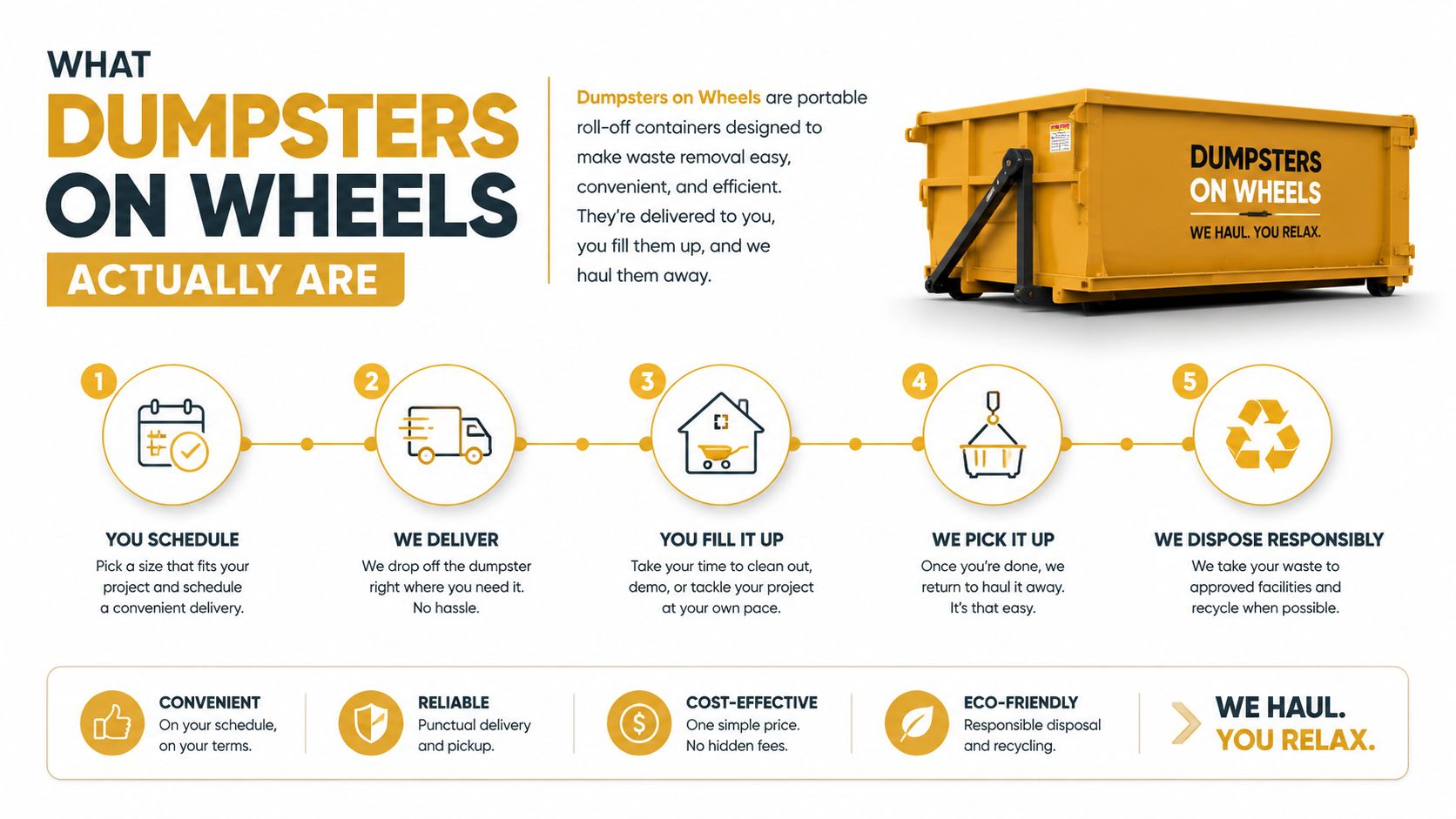
A dumpster on wheels is a container mounted on a mobile chassis, designed to be positioned, filled, and moved without rebuilding the containment area. In construction use, the container may have a sealed or impermeable interior, a reinforced base, wheels or rollers, and an interface that allows a truck or handling system to move it. The exact design matters because a general debris bin isn't automatically suitable for wet concrete washout.
The distinction from a standard roll-off dumpster is operational. A conventional roll-off is commonly selected for dry debris and hauled away when full. A washout container must manage liquid, cement solids, repeated chute rinsing, and the risk of leakage. A fixed washout pan, by contrast, stays in one location and depends on the site team to build access and drainage controls around it.
The design logic behind the format
Think of the unit as a small, movable work zone rather than a trash can. The chassis carries the container, the containment surface keeps slurry from reaching soil or drainage, and the handling connection allows relocation or removal. That arrangement only works if the ground, access route, and handling equipment can support the loaded unit.
The history explains why this format feels familiar. George Dempster's 1935 patented system introduced standardized mechanically handled containers that could be tipped into a truck, and the word “dumpster” entered commercial use in 1936. Nashville, Tennessee, followed with the first city adoption in 1937, shifting waste handling away from manual lifting and toward containerized collection, as described in the history of garbage trucks and containerized collection.
The modern wheelie-bin form arrived later. Frank Rotherham Mouldings invented the modern wheelie bin on March 12, 1968, in Slough, England, according to this history of the wheelie bin. Similar wheeled systems only became common in the 1970s, after the Dempster-Dumpmaster era and the development of smaller bins and automated collection vehicles.
That evolution matters on a job site. Mechanical handling reduced the need to lift heavy containers manually, while wheels made it easier to position collection equipment near the work. A modern mobile washout unit applies the same basic principle to a more demanding material stream: keep the waste contained, reduce unnecessary handling, and make the collection point fit the operation.
Common Types and Sizes for Construction Sites
Not every wheeled container belongs beside a concrete pump. Small wheelie bins are useful for lightweight dry waste, packaging, and minor cleanup. They generally aren't the right choice for wet cement residue because their capacity, stability, and load rating may not match the material.
Larger mobile roll-off units provide more room and stronger handling hardware, but they also require more space for placement and movement. The larger format commonly uses a footprint of roughly 20 to 22 feet long by 8 feet wide, according to roll-off dumpster size guidance. That footprint can control the site plan before the container's nominal volume does.
| Type | Dimensions (L x W x H) | Weight Limit | Liquid Capacity | Best For |
|---|---|---|---|---|
| Compact wheelie-bin format | Varies by manufacturer | Confirm with the supplier | Limited, confirm before washout use | Light site waste and small cleanup tasks |
| Mobile washout pan or low-sided container | Varies by manufacturer | Confirm the rated load | Sized for slurry, rinse water, and rain | Small pours and renovation work with frequent monitoring |
| Larger wheeled roll-off container | Larger standardized footprint, often roughly 20–22 feet by 8 feet for major units | Common limits range from 1 to 6 tons, depending on size | Higher than compact units, but supplier-specific | Repeated washout activity and larger work zones |
| Heavy-duty mobile container | Manufacturer-specific | Specialized units can reach around 10 tons | High capacity, subject to design and freeboard | Heavy solids and demanding construction operations |
The load figures and larger-unit footprint come from roll-off dumpster sizing information. They aren't universal specifications. A supplier's rating, chassis design, wheel arrangement, and hoist interface control what the unit can safely carry.
Match the container to the material
Dry wood and packaging occupy space without behaving like wet concrete. Washout slurry brings water, cement paste, aggregate residue, and rain into the same container. That combination can fill the unit slowly while adding weight quickly.
A low-sided pan may make chute rinsing easier because drivers can approach it without awkward positioning. A taller container may provide more reserve volume, but it can make access, inspection, and safe cleaning more difficult. The right choice depends on the pour schedule, the number of trucks, the available footprint, and the supplier's written liquid and weight limits.
Don't choose solely by cubic-yard capacity. For concrete work, the container must handle the combined mass of wet residue and absorbed water, not just the visible level. A unit that looks half full can still be too heavy for its wheels, chassis, or hoist connection.
How to Size a Wheeled Dumpster for Your Pour
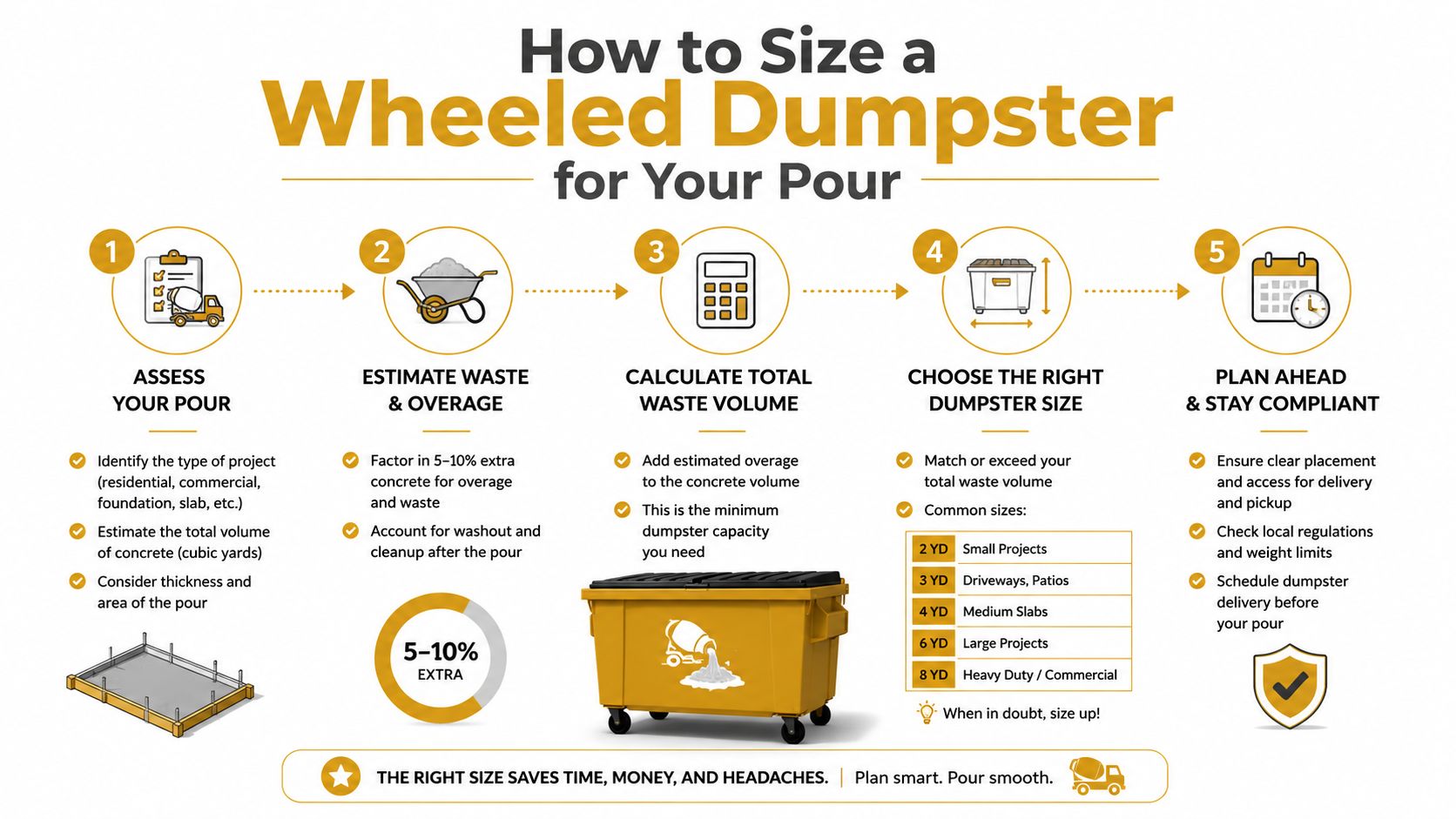
Sizing starts with the material stream, not the container catalog. List the expected truck cleanouts, pump and hopper rinsing, tools that will be washed, solids that will settle, and rainfall that may enter while the unit is on site. Then compare that expected load with both the liquid capacity and the structural weight rating.
A useful decision rule is to calculate in two directions. First, estimate how much volume the container must hold while preserving freeboard. Second, estimate whether the resulting wet material could exceed the rated load. The lower practical limit controls.
Use freeboard as working capacity
The Iowa Concrete Washout BMP recommends 12 inches of freeboard and locating the system at least 50 feet from storm sewer intakes, open ditches, or waterbodies, as summarized in this roll-off dumpster washout guide. Freeboard isn't empty space that the crew can casually fill later. It's reserve capacity for rain, movement, splashing, and uneven accumulation.
The setback also affects placement. A unit that sits beside an inlet may be convenient for the driver but difficult to defend during an overflow. Place it where the ground is stable, drainage moves away from the container, and the crew can inspect the perimeter without walking through truck traffic.
A municipal example shows why local sizing rules can differ. Denton guidance specifies at least 6 cubic feet of containment per 10 cubic yards poured and calls for washout areas at least 50 feet from inlets when feasible, according to the city's concrete waste management document. Treat that as a local example, not a universal formula. The authority having jurisdiction may impose a different rule.
Volume doesn't tell the whole story
Suppose the container has plenty of apparent room after several truck rinses. That doesn't prove the chassis is within its limit. Wet concrete residue and retained water can create a heavy load before the container reaches its visual fill point. Exceeding the rating can damage the wheels, chassis, and hoist interface, especially during pickup or relocation.
Use a conservative field check:
- Estimate inputs: Account for truck count, rinse frequency, slurry, settled solids, and predicted rain.
- Protect freeboard: Keep the required reserve space available throughout the operation.
- Check both ratings: Confirm liquid capacity and maximum weight with the rental provider.
- Monitor during the pour: Assign one person to watch the level and the surrounding ground.
- Change the system when conditions change: Move to a larger or fixed system if rainfall, pour volume, or truck-cleanout frequency exceeds the original plan.
A mobile unit is usually the better fit for a short, controlled operation with a manageable work area. A fixed berm or larger engineered system may work better when the project produces sustained washout, receives substantial rainfall, or can't support frequent inspection and servicing.
The Compliance Risks Most Washout Guides Miss
A container can be environmentally sound and still violate a local ordinance. Many crews focus on whether slurry can leak, but municipalities may also regulate where a wheeled dumpster sits, how long it remains there, and what protection it needs beneath the wheels.
One ordinance expressly addresses “rollout containers, trash cans or dumpsters, compactors or recycling dumpsters on wheels.” It requires prompt post-collection storage, out-of-view placement when the container isn't scheduled for pickup, and wheel or pad provisions intended to protect streets and alleys, as stated in the Charlotte County ordinance. The local wording and enforcement process will vary, but the operational lesson is broad.
Treat the container as regulated equipment
Before delivery, confirm the rules for:
- Public rights-of-way: A curb lane, alley, sidewalk edge, or street may require permission even if the container is only there temporarily.
- Storage after collection: Some codes require the unit to move promptly or remain out of public view when it isn't awaiting service.
- Surface protection: Wheels, pads, or other protective measures may be required to prevent pavement damage.
- Nuisance conditions: Overflow, tracking, blocked access, and visual obstruction can create enforcement issues separate from water pollution.
- Permit triggers: A site may need approval for placement, traffic control, or work within the right-of-way.
The superintendent should assign one person to verify these details before the truck arrives. Don't assume the rental company's delivery route answers the legal question. The provider may know common placement practices, but the property owner, contractor, and permit holder still need to follow the jurisdiction's requirements.
Field lesson: “It has wheels” doesn't mean “it can go anywhere.” A mobile container can be easier to place physically while creating more questions under local right-of-way and nuisance rules.
Keep documentation with the site environmental records. Save the placement approval, delivery instructions, supplier specifications, inspection notes, and pickup arrangements. If an inspector asks why the container is beside an alley or how the crew will prevent runoff, the answer should come from the site plan, not from guesswork made during the pour.
Operational and Safety Best Practices on the Job Site
Place the container where it helps the crew work without becoming an obstacle. A flat, stable surface near the pour reduces hose movement and unnecessary travel, but the unit must remain outside mixer-truck swing paths, pump outriggers, pedestrian routes, and emergency access lanes.
Before the first truck arrives, mark the washout zone and brief the drivers. Everyone should know where chutes, tools, pump lines, and equipment may be rinsed. If one driver uses the approved point and another washes into a nearby drain, the site has two different control systems, and only one is defensible.
Build the routine before the concrete arrives
Use a short pre-pour check:
- Inspect the base: Confirm the container is stable, intact, and supported on an appropriate surface.
- Check the perimeter: Look for gaps, seepage, soft ground, or drainage paths leading away from the unit.
- Confirm access: Keep the route open for mixers, pumps, service vehicles, and the eventual pickup.
- Brief the crew: Explain what belongs in the container and who watches the level.
- Stage protection: Keep suitable spill-control materials and required PPE where the crew can reach them.
Washout water is highly alkaline, and direct contact can injure skin and eyes. Workers handling hoses, residue, or cleanup need task-appropriate protective equipment, and the crew should follow the project's safety program and product guidance rather than treating washout as ordinary dirty water.
Rain is a work condition, not a surprise
Keep the system covered where the design and operation allow it, and lower the liquid level before a storm. Recent 2026 updates cited in municipal and state guidance continue to emphasize covering washout systems or reducing liquid levels before storms, which confirms that rainfall remains an active overflow risk rather than a problem solved by selecting a container once.
Assign inspection responsibility during heavy weather. If the level rises, stop adding washout, protect nearby inlets, and follow the project's spill and notification procedure. Don't wait until water is already moving across the slab or access road.
Periodic cleaning keeps solids from reducing usable volume and makes the container easier to inspect. The crew should never climb into a container without a site-approved method and proper hazard controls. Arrange servicing before accumulated material turns a manageable unit into an overloaded one.
Rental Logistics and Cost Factors for Site Managers
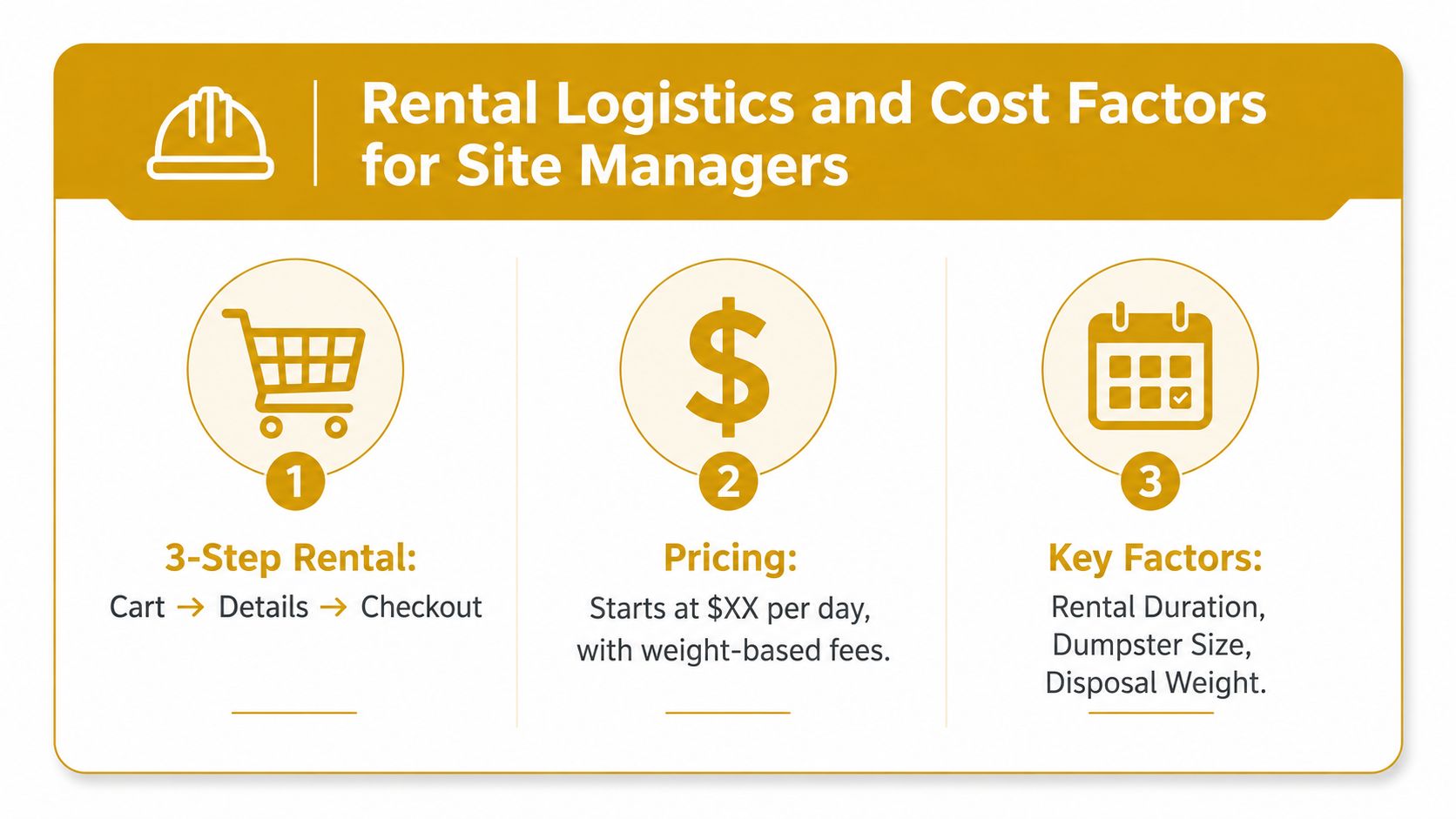
A clean rental process starts with information the supplier can act on. Give the delivery team the project address, exact placement area, surface conditions, access restrictions, pour dates, expected service needs, and whether the unit will sit near a public road or alley. “Bring a washout dumpster” isn't enough for a tight site with changing access.
The basic online sequence can be simple: Cart, Details, Checkout. Add the selected equipment, enter dates and location information, then review the order before confirming delivery. The process is only useful if the specifications match the actual pour, so verify the container's dimensions, liquid capacity, weight rating, handling method, and pickup requirements.
Build the real rental budget
Published daily pricing can start at $25 per day, according to the publisher information supplied for Reborn Rentals. That starting price is not a complete project budget. Delivery, rough terrain, express orders, duration, container size, and disposal weight can affect the final charge, so ask for those conditions in writing before scheduling.
Support channels matter when a pour date changes. Confirm availability, specifications, delivery timing, and placement questions through the supplier's available contact options, then keep the response with the job file. A fast answer about access or load limits is more valuable than discovering a mismatch when the concrete truck is already on the road.
Use this site manager checklist before placing the order:
- Project fit: Decide whether the pour is short and controlled enough for mobile containment.
- Capacity: Estimate slurry, rinse water, solids, and rainfall while preserving freeboard.
- Load: Confirm the wet material won't exceed the container's rated weight.
- Placement: Select stable ground away from drainage paths and maintain truck access.
- Compliance: Check right-of-way, storage, pad, permit, and nuisance requirements locally.
- Weather: Set a storm response, including cover or liquid-level reduction.
- Service: Schedule pickup or cleaning before the container becomes a capacity or access problem.
- Records: Save specifications, approvals, delivery details, inspections, and disposal arrangements.
The best rental is the one the crew can operate without improvising. If the unit fits the site, the load plan, the weather risk, and the local rules, dumpsters on wheels can make concrete washout cleaner and easier to control. If any of those pieces remain uncertain, resolve them before the pour, not after the first overflow.
Reborn Rentals provides ready-to-deploy concrete washout containment with a straightforward Cart, Details, Checkout process and daily pricing starting at $25. Visit Reborn Rentals to review available equipment, confirm specifications and delivery logistics, and choose a mobile washout solution that fits your next pour.