The slurry pit is already rising, the concrete pump is still working, and the crew has nowhere clean to put the next load of washout water. The nearest swale looks convenient until gray water crosses the edge of the unlined ground. Then the inspector calls, the pour sequence stops, and everyone starts asking who approved the containment setup.
That's where a dewatering box earns its place. The right unit can hold the slurry, separate solids from water, and keep pumping moving without turning a production problem into an environmental one. The wrong unit becomes another obstruction, with clogged media, a collapsed lid, emergency hauling, and a rental invoice that bears little resemblance to the advertised rate.
Buying from the dewatering boxes for sale market requires more than comparing container capacity. You need to match the box to the project calendar, vacuum equipment, hauling plan, site access, discharge rules, and the fees buried beneath the headline price.
Why the Right Dewatering Box Changes the Whole Job
The pour is moving, the pump is still running, and the washout box is nearly full. Fines have blinded the screen, while gray water is creeping toward a drainage swale. The finishing crew cannot stop without losing time, yet allowing the water beyond containment can trigger a larger site problem.
Uncured concrete wash water is strongly alkaline. Public guidance places its pH around 12 and sometimes up to 13, compared with typical safe surface-water pH of about 6.5 to 9. An uncontrolled release can harm aquatic life, damage vegetation, and contaminate groundwater. The concrete washout guidance from the Illinois Ready Mixed Concrete Association calls for leak-proof containers or lined pits, with protection against overflow.
The inspector's call often arrives before the vacuum truck. Access to the pour area is restricted, the general contractor requests a corrective plan, and the project manager arranges cleanup, records, and replacement containment. The invoice is only the first cost. A shutdown disrupts other trades, reduces confidence in the subcontractor, and can delay the next approval.
Containment controls the sequence
A properly specified box gives the pump operator a controlled receiving point and provides space for solids to settle. It also gives the crew time to remove or treat captured water before the unit overfills. Monitoring still matters, but reliable containment keeps a manageable washout operation from becoming an uncontrolled discharge.
Field rule: A dewatering box isn't a commodity container. It's part of the pour plan, the stormwater plan, and the hauling plan.
Placement matters as much as capacity. A box behind the building may be difficult for the concrete crew to reach. A unit beside a storm drain creates an immediate compliance risk. EPA concrete washout BMP guidance states that containers must hold the expected washout volume without overflowing and that captured water should evaporate or be removed before the box fills. The guidance also identifies 50 feet as a commonly cited setback benchmark from storm drains, open ditches, and water bodies.
Account for the project calendar before choosing to rent or buy. A short pour may favor a rental, but delivery, rough-terrain placement, express service, pickup, cleaning, and disposal fees can erase the advertised saving. A longer project may justify ownership if the box will serve repeated pours and your crew can handle transport, maintenance, and storage. The right decision protects production, keeps inspections orderly, and prevents buried surcharges from deciding the job after the first truck arrives.
What a Dewatering Box Is and How It Works
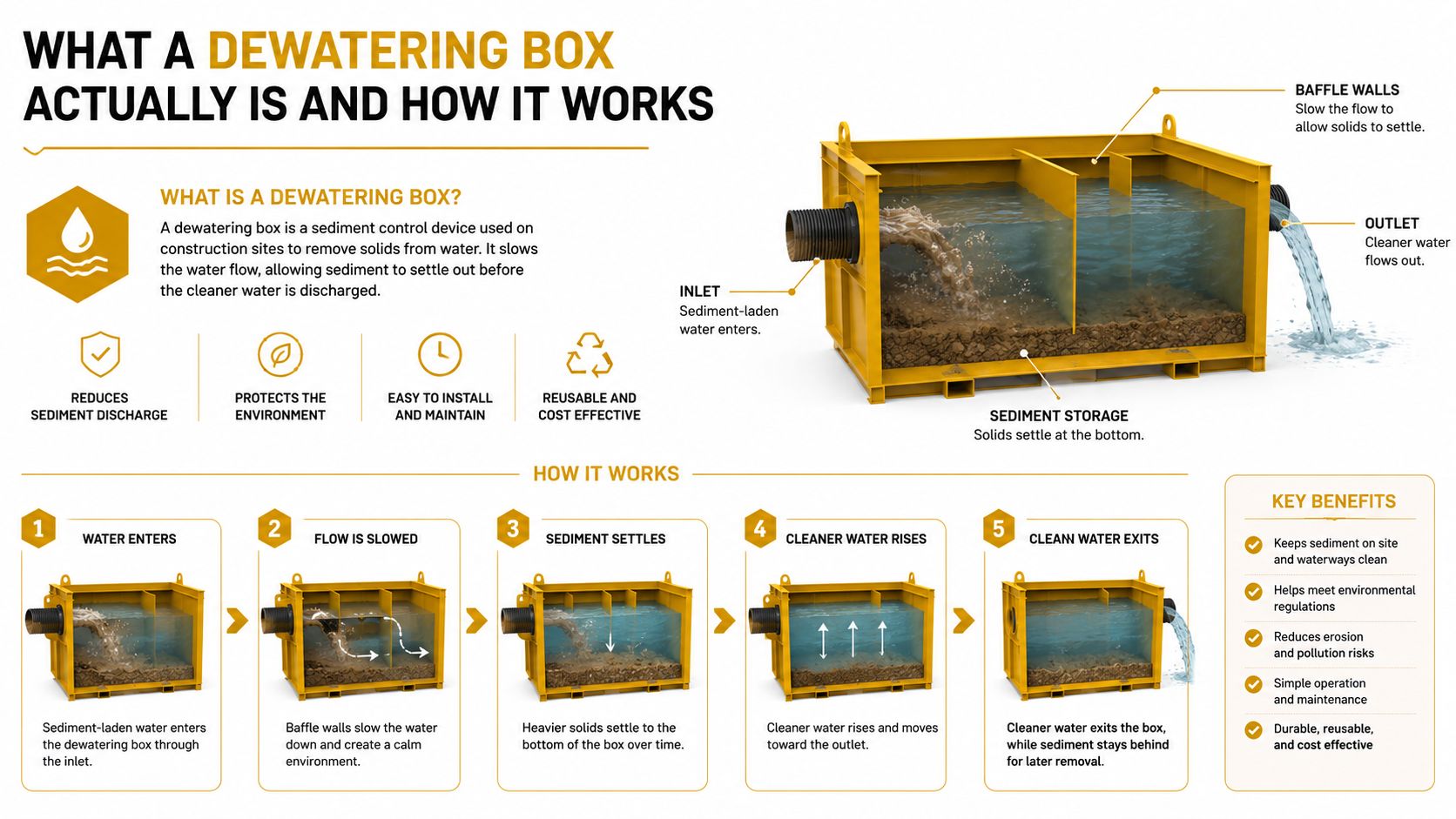
A dewatering box is a sealed, vacuum-rated container for water carrying sediment, cement fines, or other heavy solids. It holds the slurry long enough for solids to settle, then keeps the liquid contained for controlled pump-out, treatment, evaporation, or lawful discharge.
The usual large unit is a steel roll-off with a sloped floor, internal baffles or weirs, and a screened top or filter media. Smaller washout pans suit chute rinsing and pump cleanup. Larger boxes handle trench water, excavation sediment, and high-volume slurry that would fill a shallow pan too quickly.
The separation process
The operating sequence is simple:
- Inlet capture: Slurry enters the container instead of reaching soil, drains, or open water.
- Coarse settling: Aggregate and heavy debris drop behind the first baffle or onto the sloped floor.
- Fine settling: Cement fines and sediment collect in the lower section as flow slows.
- Water collection: Clarified water gathers above the settled material or passes through the screen.
- Controlled removal: A vacuum truck, pump, or approved filtration system removes water before the box reaches its overflow point.
Performance depends on available settling area and open filter media. A screen that clogs quickly turns the separation unit into a storage tank. That tank still needs scheduled service, or the crew risks overflow, extra hauling, and an unplanned discharge.
Vacuum-rated versus gravity-only
A vacuum-rated box is built to tolerate suction from a vacuum truck or industrial pump. Depending on its design, it may include a sealed lid, reinforced panels, pressure-tested fittings, and dedicated drains. A gravity-only pan depends on liquid level and open flow, and it is not built for strong negative pressure.
Match the box to the pumper's suction capacity, hose arrangement, fittings, and operating procedure. A heavy steel container is not automatically vacuum-safe. Before connecting equipment, get the rated vacuum, connection details, and operating limits in writing. Put those requirements on the rental or purchase file, because a mismatch can stop the pour and add delivery, service, or emergency replacement charges to the project calendar.
Sizing and Specifying the Box Your Job Demands
Capacity is the first number most listings display, but it's the least useful number when viewed alone. A box can hold a large volume and still process water poorly if the screened area is small, the baffles are weak, or the floor deforms under wet solids.
A practical specification review should cover four dimensions:
- Capacity: This controls how much slurry the container can receive before service or pump-out. Estimate the peak flow from the pour and cleanup sequence, not the average day.
- Dewatering surface area: This controls how much screen or filter area is available for separation. More usable area generally gives solids more room to settle and reduces the risk of rapid blinding.
- Vacuum rating: This confirms whether the container can tolerate the suction equipment assigned to the job. The rating should be stated in inches of mercury and reviewed alongside the pumper's operating requirements.
- Structural section: Floor and wall plate thickness affect rigidity during filling, pumping, dumping, forklift handling, and roll-off transport.
A published 25-yard vacuum dewatering box specification lists a 152 square foot dewatering surface area, a 30-inch Hg vacuum rating, and a 14,000-pound empty weight. A separate 20-yard dewatering roll-off box lists 4,040 gallons of capacity, a 1/4-inch A36 floor plate, 3/16-inch A36 walls, 6 x 2 x 1/4-inch long sills, and dual 4-inch flanged drains in the United Rentals dewatering box specification.
Capacity tells you how much the box can hold. Surface area and construction tell you whether it can keep working.
Compare the specifications directly
| Spec Dimension | What It Controls | Minimum to Confirm | Jobsite Failure Mode If Undersized |
|---|---|---|---|
| Capacity | Slurry volume between service events | Rated liquid and solids capacity, plus usable operating volume | Overflow, emergency pump-out, interrupted work |
| Dewatering surface area | Separation throughput and screen loading | Published area and media type | Blinding, slow clarification, repeated cleaning |
| Vacuum rating | Safe suction performance | Rated inches Hg and compatible fittings | Lid deformation, seal failure, unsafe extraction |
| Floor and wall section | Structural stability under wet loads | Plate thickness, reinforcement, and load limits | Warping, leaks, handling damage |
A 2,000-gallon box with inadequate screen area can clog while it still has substantial unused storage. That's why a listing that shows capacity but omits dewatering area, vacuum rating, or plate construction deserves a hard pass.
Put these questions into the quote request: What is the rated vacuum in inches Hg? What is the floor plate gauge? What axle or handling load is allowed? Is the unit compliant for over-the-road hauling when full? If the vendor won't provide those answers, you aren't comparing equipment. You're comparing guesses.
Compliance and Environmental Considerations That Shape Your Choice
Concrete washout containment affects both compliance and your total project cost. If the box overflows, leaks, or needs an unscheduled pump-out, you face cleanup, disposal, schedule disruption, and possible enforcement costs. Select the containment method before mobilization, not after the first truck arrives.
An open pan can work for a controlled rinse-out operation with an attentive crew. Choose a sealed sump or lined containment system where rainfall, overflow, vehicle movement, or uneven ground could carry liquid toward a drain or waterway. Secondary containment, compatible liners, protected fittings, and a cover can matter more than extra nominal capacity.
Match the box to the discharge plan
Stormwater BMP guidance expects operators to prevent washout containers from overflowing. Captured water may need to evaporate under controlled conditions, be removed before the container fills, or receive treatment approved for the site. Place the unit away from storm drains, open ditches, and surface waters, and confirm the required setback with the project's permit and environmental manager. The EPA concrete washout BMP document provides useful containment and placement guidance.
| Requirement | What to Confirm | Box Spec or Procedure |
|---|---|---|
| Leak and overflow control | The unit can hold expected washout between service events | Leak-proof construction, liner, usable capacity, and a pump-out plan |
| Stormwater separation | The placement meets the site's permit and local requirements | Stable pad, protected perimeter, and deliberate setback |
| Solids control | Cement fines and sediment stay contained during water handling | Baffles, dewatering screen, filter media, and cleanable access |
| Treatment compatibility | The box works with the planned treatment or removal method | Suitable fittings, access for sampling, and documented handling |
| Disposal records | The crew can prove where liquid and solids went | Pump-out tickets, inspection notes, and disposal documentation |
Do not assume settling alone makes water dischargeable. Some sites require pH adjustment, carbon dioxide neutralization, filtration, or off-site removal. Confirm the treatment method with the responsible environmental manager before buying or renting. A box that cannot accept the planned equipment or removal process can force a late change, extra hauling, or a second mobilization.
The project calendar should include those compliance tasks. Delivery may cost more for rough terrain, express service, or a location that requires special placement. A rental that appears cheaper for a short deployment can lose its advantage after delivery, pickup, cleaning, treatment, and disposal surcharges. Compare those line items against the ownership cost of storage, inspection, repairs, and future use.
Inspectors also expect operating discipline. Keep the unit's placard, capacity information, inspection records, pump-out tickets, and disposal documentation available. The box is part of the site's compliance system, not merely a steel container. Crew training and a written response plan matter just as much as the selected model.
Renting vs Buying a Dewatering Box for Your Crew
A short, isolated job usually favors rental. A four-week pour on one site doesn't justify owning equipment that will occupy yard space, need inspection, and wait for its next assignment. Rental keeps the capital decision small and lets the vendor carry more responsibility for delivery, pickup, cleaning, and end-of-rental handling.
Ownership makes more sense when the same equipment will support repeated work across multiple sites. A fleet serving four or more pours a year may reach purchase economics within 18 to 24 months, but that conclusion depends on utilization, storage, hauling, maintenance, and local rental rates. Those figures come from the project assumptions in this buying brief, not a universal market rule.
Use the project calendar, not instinct
Build the comparison around actual occupied days:
- Short deployment: Rent when the box will support one defined project and then sit idle.
- Repeated deployment: Consider buying when crews have recurring washout or excavation work and can schedule the unit across sites.
- Difficult logistics: Rent when the vendor can provide specialized delivery, service, or replacement equipment that your yard can't support.
- Known standard work: Buy when your team repeatedly uses the same configuration and has secure storage and maintenance capacity.
The purchase side includes more than the invoice. Add storage, insurance, coating repairs, seals, filter media, hauling, inspections, and disposal coordination. The rental side includes the base rate, minimum term, delivery and pickup, damage waiver, cleaning, environmental handling, and any extension charges.
A simple breakeven example
Suppose a vendor quotes a monthly rental cost of R. Suppose the purchase price is P, expected ownership period is M months, and the maintenance and storage reserve over that period is S. The ownership cost per month is:
(P + S) ÷ M
Rental reaches the purchase breakeven when:
R × months rented = P + S
For a real estimate, replace the letters with the vendor's written quote and your finance team's assumptions. Include idle time, because a purchased box costs money while it sits. Include resale value only if you have a realistic buyer or trade-in path. Used roll-off boxes can be difficult to sell when coatings, seals, drains, or structural condition are uncertain.
Supervisor's recommendation: Rent the first unit for a demanding job if your team hasn't operated that design before. Buy only after you know the configuration fits your pumps, trucks, operators, and storage yard.
Pricing, Fees, and the Surcharges That Drive Cost
A rental quote can look affordable until delivery, access, cleaning, and disposal reach the invoice. Request an all-in quote before scheduling the truck. Require separate fixed and variable charges so you can compare the rental against ownership across the project calendar, including idle weeks.
| Fee Category | Typical Trigger | What to Ask the Vendor |
|---|---|---|
| Base rental | Time the unit remains on rent | Is billing daily, weekly, or monthly? Is there a minimum term? |
| Delivery and pickup | Distance, mileage, or repeated mobilization | Is transport flat rate or mileage-based? What radius is included? |
| Rough-terrain surcharge | Truck can't stage on a firm, accessible surface | Can the delivery vehicle reach the placement point without special handling? |
| Express delivery | Same-day or short-notice dispatch | What premium applies, and does it include after-hours service? |
| Permit or escort | Oversized or overweight hauling requirements | Who obtains permits, and who pays the related charges? |
| Environmental disposal | Removal of solidified slurry or contaminated material | Is disposal billed by load, weight, treatment, or labor? |
| Washout and recoating | Cleaning or coating restoration after return | What condition standard avoids a cleaning or recoating charge? |
| Damage waiver | Optional protection against specified damage | What exclusions remain, and what deductible applies? |
Rough terrain creates a frequent cost gap. A roll-off truck may reach the project yet fail to place the box at the required location. Soft ground, narrow access, overhead obstructions, or limited turning space can require special handling or a second mobilization. Confirm the route and staging surface before accepting the quote.
Express delivery also needs a written scope. After-hours labor, special routing, or a substitute box can raise the price and leave the crew with equipment that does not match the specified design. Ask whether the premium covers transport only, or includes setup and removal.
Price the full rental period, not just the active pumping days. A minimum term, extension charge, and pickup delay can make a short rental more expensive than expected. For a purchase, compare the same calendar window and include storage, insurance, freight, coating upgrades, custom plumbing, replacement geotextile, seals, commissioning inspection, and future disposal coordination.
Ask whether fuel adjustments apply, whether pickup can be canceled without charge, and whether cleaning is included in the base rate. If these terms sit inside general conditions instead of the proposal, the price is not transparent enough for approval.
On-Site Setup, Maintenance, and Disposal Best Practices
Set the box before the pour, not after the first overflow. Choose a level, stable pad with a clear truck approach, keep it outside stormwater conveyance paths, and verify that the vacuum truck can reach the fittings from its planned parking position.
A good placement review answers practical questions:
- Access: Can the delivery truck place the unit without driving across unstable ground?
- Reach: Can the hose reach the box without crossing active haul lanes?
- Containment: Will rainfall, wash water, or a ruptured hose move liquid toward a drain?
- Operations: Can every concrete truck and pump operator reach the inlet safely?
- Service: Can the pump-out crew work without shutting down the entire site?
Line the collection area with the specified geotextile, rigid plastic, or compatible liner when the equipment design calls for it. The liner should protect the steel floor from aggressive slurry and make solids removal more predictable. Don't improvise with material that can tear, float, react with the slurry, or block a drain.
Maintain flow instead of chasing emergencies
Pump-out cadence should follow volume and solids loading, not a calendar reminder. A box receiving heavy cement fines may need service before a visually obvious fill level, because settled material can occupy working volume and blind the screen.
Have the operator check the following during each inspection:
- Screen condition: Remove buildup before the media loses usable flow area.
- Baffles and weirs: Confirm they remain seated and free of hardened concrete.
- Floatables: Skim debris before it reaches drains, pumps, or filter media.
- Connections: Inspect seals, flanges, hoses, and vacuum fittings for leaks.
- Freeboard: Maintain enough room to handle the next active washout cycle.
Practical rule: If the water is moving slowly through a clean-looking box, inspect the screen and settled solids before ordering a larger pump.
Close the job cleanly
Before pickup, coordinate the final pump-out and remove as much liquid as the disposal plan allows. Confirm where the solids are going, obtain disposal manifests when required, and photograph the empty, cleaned condition of the box and surrounding pad.
A clean return protects the deposit and prevents arguments over hardened residue, damaged liners, blocked drains, or missing fittings. For an owned unit, the same documentation gives your maintenance team a baseline for coating repairs and seal replacement before the box moves to the next project.
The Pre-Purchase Decision Checklist for Contractors
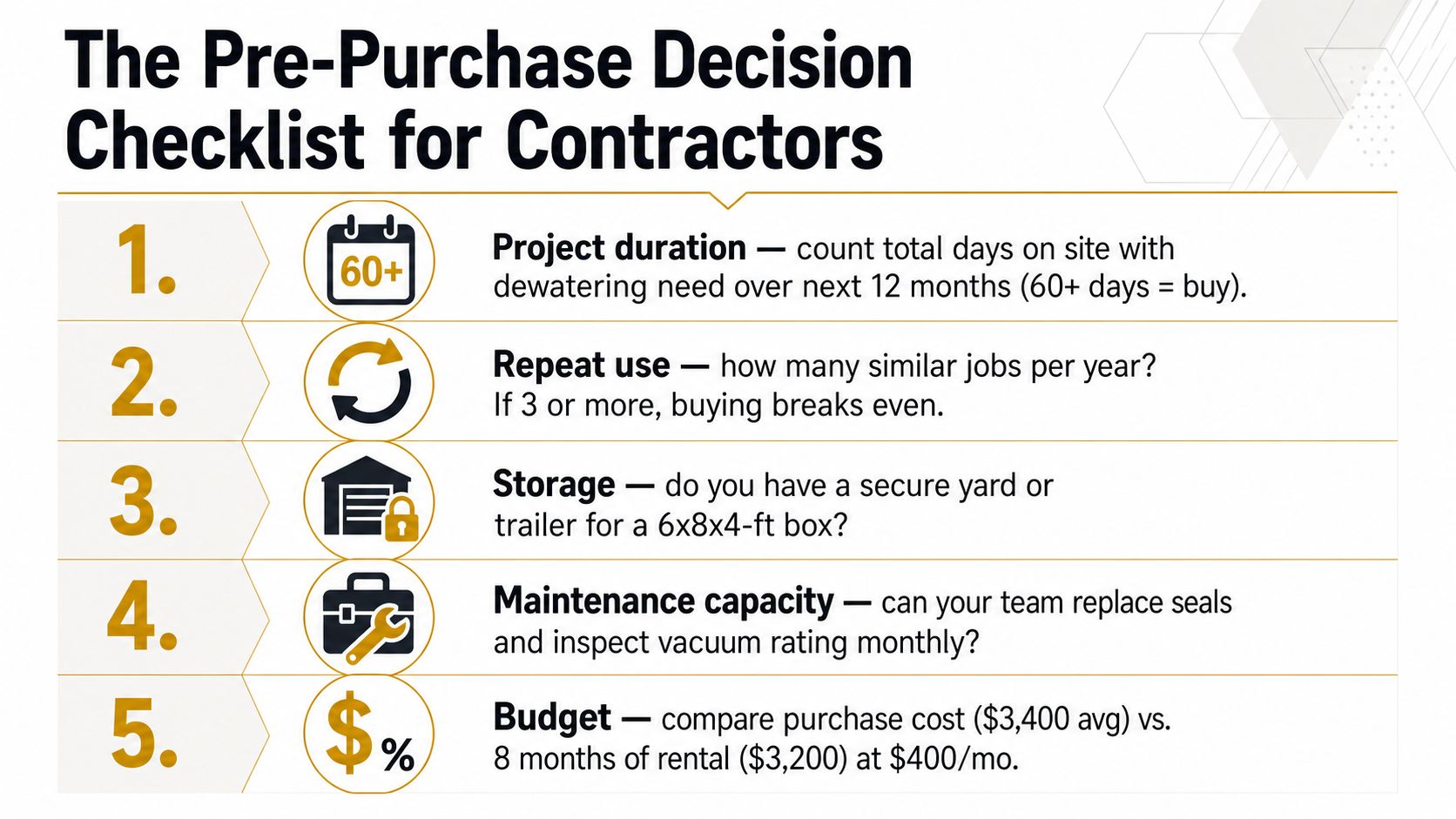
Before signing a quote or purchase order, get five answers in writing. Tie each answer to a document your superintendent, environmental manager, and accounting team can review.
1. What does the project calendar require?
Count the days the box will actively receive slurry, idle periods between pours, and the likely peak volume. A single-site pour lasting several weeks has a different ownership case from recurring work across multiple locations.
Use the schedule, pour plan, and cleanup sequence. Replace “we'll use it often” with a utilization estimate that includes idle time and future deployments.
2. Does the specification match the worst load?
Confirm capacity, dewatering surface area, vacuum rating, floor and wall plate, drains, fittings, and handling limits. Request the manufacturer's data sheet, drawings, and transport limits. Do not rely on a salesperson's verbal estimate.
Use the sizing details discussed above as a comparison point, then ask the vendor to identify which specifications apply to the quoted model, how they were tested, and what operating limits void responsibility. Verify the actual serial-numbered unit before delivery.
3. Can the site operate compliantly?
Identify the permit, discharge route, pH monitoring method, treatment requirements, setback, secondary containment, and disposal process. Concrete wash water can be around pH 12 or higher, so the environmental plan must address alkalinity rather than treating the box as ordinary sediment storage. Confirm who records tests and who signs disposal documents.
4. Does renting or buying fit the calendar?
Compare the all-in rental cost with purchase, storage, insurance, maintenance reserve, hauling, and realistic resale value. Test the break-even calculation against idle periods and scheduled deployments. Include delivery and pickup for every move. A box that sits between projects can turn a sound purchase into dead capital, while repeated short rentals can hide the same costs in minimum terms and cleaning fees.
5. Which charges can change the invoice?
Separate delivery, pickup, rough-terrain handling, express service, permits, escorts, environmental disposal, cleaning, recoating, fuel adjustments, minimum terms, and damage liability. Demand a quote that states whether each charge is fixed or variable and names its trigger.
The right box must fit the entire operating chain, from first washout through final disposal. If the vendor cannot document capacity, vacuum limits, structural details, transport terms, and return requirements, keep looking. A low listed price will not cover an overflow, blocked equipment, or an unbudgeted surcharge.
Reborn Rentals offers ready-to-deploy concrete washout containment with upfront daily pricing, clear notes on delivery, rough-terrain, and express charges, plus support for confirming availability and specifications. Visit Reborn Rentals to review washout solutions, set dates and location, and arrange delivery before the next pour.