The quote looked harmless: a daily rate for a washout pan, a delivery window, and a crew ready to pour. Then the slab schedule moved, the pan stayed on site, and the final invoice reflected more than the advertised rental price. That's how a small containment decision turns into a budget problem.
The phrase equipment rental rates daily weekly monthly matters because the cheapest-looking rate isn't always the cheapest choice. Term length, delivery, access conditions, cleaning, environmental handling, and extension rules all affect what you pay. A site manager should compare the delivered and completed cost, not just the number printed beside the equipment.
Why Rental Rate Tiers Matter on the Job Site
A concrete foreman once orders a washout pan for a short pour. The work expands into a three-week slab operation, but nobody changes the rental agreement. The crew keeps the same pan, the rental desk keeps billing the daily rate, and the containment budget takes a hit that could have been avoided with a weekly or monthly conversion.
That mistake is common because the daily rate feels flexible. It lets a superintendent react to weather, inspections, and changing pour dates without making a long commitment. Flexibility has a price, though. Rental companies use higher short-term rates to recover the costs of frequent turnover, scheduling, transport, inspection, cleaning, and idle time between customers.
The rate structure isn't an arbitrary markup. A widely used equipment rental cost-recovery benchmark places the weekly rate at about 28% of the monthly rate, the daily rate at about 25% of the weekly rate, and the hourly rate at about 15% of the daily rate. The benchmark assumes that some usable time is lost as the rental period gets shorter, including roughly 32 hours lost on weekly pricing, 60 hours on daily pricing, and 80 hours on hourly pricing.
Practical rule: If the equipment will remain on site beyond the immediate task, ask for the next rate tier before the first billing period closes.
For containment equipment, the difference can be especially important. A washout pan may sit through multiple pours, inspection holds, cleanup periods, or weather delays. The effective daily cost under a longer agreement can be far lower than repeatedly renewing a daily rental, while the supplier still has predictable use of the asset.
The rest of the decision comes down to three questions:
- How long will the pan physically remain on site?
- What will delivery, pickup, access, and cleaning add to the base rate?
- What written rule applies if the project finishes early or runs long?
A rate comparison that ignores those questions is only a partial estimate.
How Daily Weekly and Monthly Rates Are Calculated
Rental companies price time in tiers because the cost of owning equipment continues whether the asset is earning revenue or sitting in a yard. Depreciation, maintenance reserves, insurance, storage, inspection labor, scheduling, and transport all need to be recovered through rentals. Short commitments create more turnover and more opportunities for idle time, so their pricing usually carries a higher effective daily charge.
The benchmark from EquipmentWatch's cost-recovery guidance gives a useful structure. Weekly pricing is about 28% of the monthly rate, daily pricing is about 25% of the weekly rate, and hourly pricing is about 15% of the daily rate. These are conventions, not mandatory tariffs, and a supplier can adjust them for local demand, equipment scarcity, delivery complexity, and risk.
What each tier is paying for
A daily rental suits a short, defined task. The customer pays for access and flexibility, while the rental company accepts the possibility that the item will need to be returned, inspected, cleaned, and redeployed quickly.
A weekly rental gives the supplier a longer planning window. The customer gets a lower effective daily cost, particularly when the work spans several consecutive shifts or the schedule includes normal site interruptions.
A monthly rental provides the strongest utilization commitment. It can make sense when equipment must remain available throughout a project phase, even if the crew won't actively use it every day.
The benchmark's assumed utilization losses explain why the tiers step down rather than scale linearly. A contractor paying daily rates for a long project is effectively paying the supplier's short-term turnover premium over and over.
Specialized containment equipment can depart from a general rate pattern. A washout pan may require inspection for residual concrete, cleaning before the next deployment, and condition checks tied to environmental compliance. Those activities can influence the supplier's pricing or appear as separate invoice items.
Don't treat the rate card as the invoice. Treat it as the starting point for a delivered-cost quote.
The right comparison is therefore not daily multiplied by calendar days versus weekly multiplied by weeks. It's the complete charge for the same scope, including transport, access requirements, cleaning expectations, taxes, waivers, and any pro-rated extension.
Comparing Rental Duration Trends and Revenue Share
A washout pan can sit on a project for weeks while active use happens only after pours. That gap matters: the headline daily, weekly, or monthly rate reflects the rental term, while delivery, pickup, cleaning, and site requirements determine the delivered cost.
For market context, weekly rentals represented about 41.7% of global short-term equipment rental transaction revenue in 2025. Monthly rentals represented about 35.8%, and daily rentals about 22.5%, according to EquipmentWorld's coverage of EquipmentWatch's market reporting.
| Rental Term | Transaction Volume % | Revenue Share % | Typical Use Case |
|---|---|---|---|
| Daily | Not provided in the verified source | 22.5% | Short pours, urgent replacement, small repair work |
| Weekly | Not provided in the verified source | 41.7% | Extended site phases, formwork, finishing, repeated pours |
| Monthly | Not provided in the verified source | 35.8% | Long slab operations, infrastructure phases, sustained site needs |
The same source valued the global short-term equipment rental market for the peak season at $68.4 billion in 2025 and projected $127.6 billion by 2034. Its projected 7.2% compound annual growth rate for 2026 through 2034 included projected growth of 7.6% for daily rentals, 7.5% for weekly rentals, and 6.9% for monthly rentals.
These figures are market context, not a local washout-pan quote. They help explain supplier pricing: weekly terms generate the largest reported revenue share, while monthly terms reserve inventory for longer periods. Daily terms offer flexibility, but repeated delivery, pickup, inspection, and cleaning cycles can create more turnover work.
Term length changes the cost trade-off. A residential slab with one tightly scheduled pour may suit daily or weekly billing. A commercial slab with repeated placements, inspections, and changing access conditions may justify a monthly agreement, even when the pan is not used every day.
Compare the complete delivered charge for the same scope. Include transport, access requirements, cleaning expectations, taxes, waivers, and extension rules before deciding which rate tier costs less.
Worked Cost Examples Using Reborn Rentals Washout Pans
The arithmetic is easy once the supplier gives you the three rates and the extension rules. The difficult part is obtaining those terms before the pan ships. Reborn Rentals publishes washout containment equipment with daily, weekly, and monthly pricing options, but the exact project charge still depends on the selected item, dates, location, and applicable logistics.
Because no verified weekly or monthly dollar rates are provided here, the examples below use symbols rather than invented prices. Let D represent the quoted daily rate, W the quoted weekly rate, and M the quoted monthly rate. Let L represent any logistics and service charges that apply to the project.
Short pour over three days
For a three-day pour, the base rental charge is:
3 × D
The effective daily rental cost is still D, before delivery and other charges. The delivered effective daily cost is:
(3D + L) ÷ 3
If the pan returns on schedule and the supplier doesn't apply a minimum period, daily pricing may be appropriate. It avoids paying for unused capacity, but it only works if the job really ends within the planned window.
Ten-day foundation job
For ten days, compare the weekly structure with daily billing:
Daily alternative: 10 × D
Weekly structure: W + 3 × D, if the supplier bills the remaining days at the daily rate.
The effective daily rental cost under that structure is:
(W + 3D) ÷ 10
The savings versus rolling daily rates are:
[(10D – (W + 3D)) ÷ 10D] × 100
That calculation is only valid if the supplier permits daily pro-rating for the overage. Some agreements use a weekly extension, so confirm the rule in writing.
Forty-five-day commercial slab
A longer project calls for a monthly comparison:
Monthly structure: M + 2 × W + 3 × D, if the supplier bills one month, two weekly extensions, and three daily days.
The effective daily rental cost is:
(M + 2W + 3D) ÷ 45
The savings versus daily billing are:
[(45D – (M + 2W + 3D)) ÷ 45D] × 100
| Scenario | Duration | Rate Tier Applied | Headline Cost | Effective Daily Cost | Savings vs Daily |
|---|---|---|---|---|---|
| Short pour | 3 days | Daily | 3D | D before logistics | Compare with daily baseline |
| Foundation job | 10 days | Weekly plus daily overage | W + 3D | (W + 3D) ÷ 10 | Use the formula above |
| Commercial slab | 45 days | Monthly plus weekly and daily extensions | M + 2W + 3D | (M + 2W + 3D) ÷ 45 | Use the formula above |
The break-even point is where the next tier becomes cheaper than continuing with the current one. Ask the rental desk to calculate that point from the actual quote, rather than assuming every supplier uses the same conversion.
One warning: don't assume pro-rating means you'll automatically receive money back for an early return. It may mean the supplier charges only for the agreed period, or it may apply a defined minimum. Confirm both early-return treatment and extension billing before approving the order.
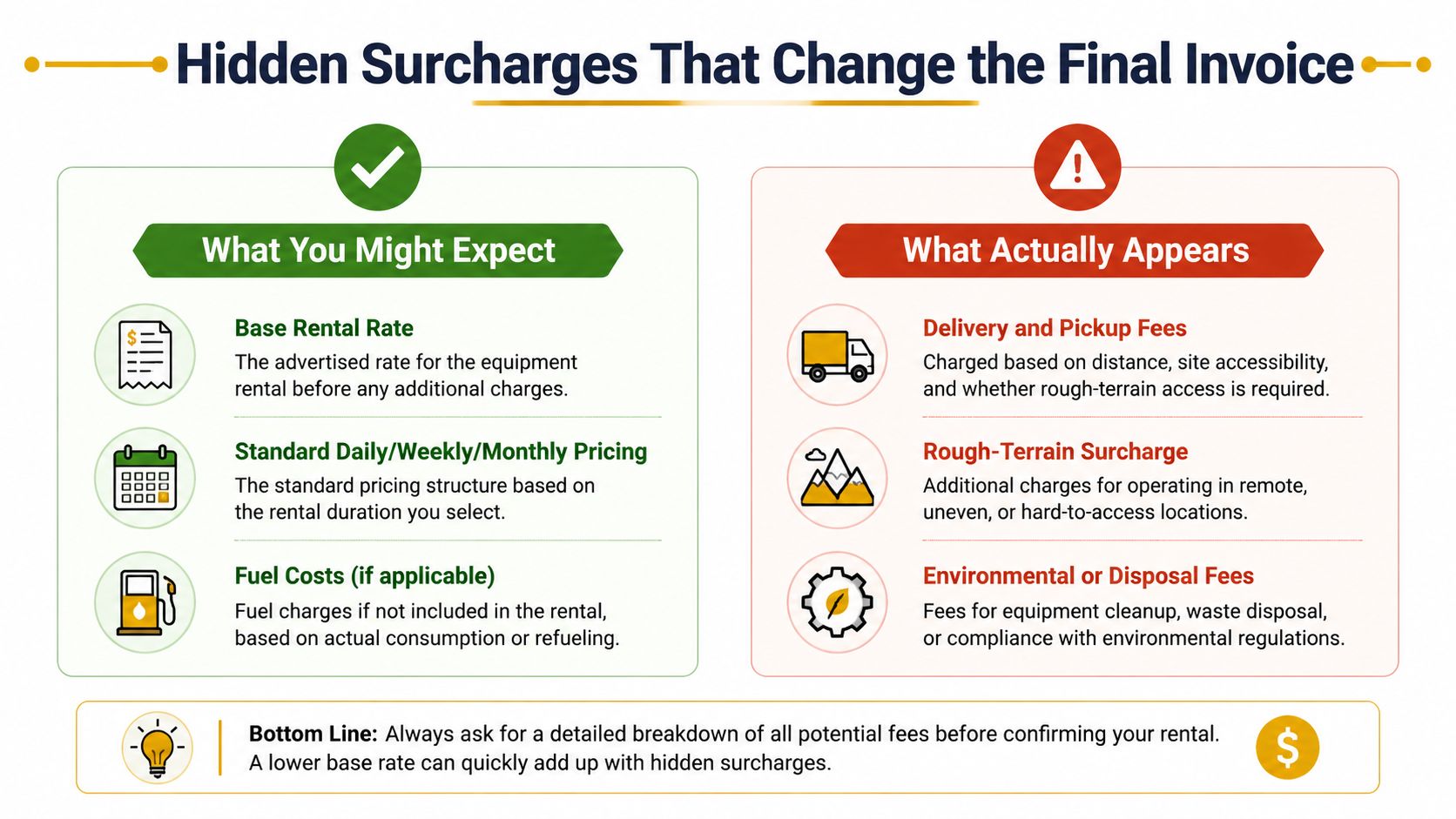
Hidden Surcharges That Change the Final Invoice
The base rate answers only one question: what does it cost to use the equipment for the stated term? It doesn't necessarily answer what it costs to get the pan to an unfinished site, retrieve it from a difficult access point, inspect it after use, or process material left inside it.
The Caltrans equipment rental rate resource illustrates how public-sector pricing can be location-sensitive and frequently updated, with miscellaneous equipment rates maintained in a CSV format and updated daily. That doesn't establish your private rental price, but it's a useful reminder that equipment pricing isn't a universal static schedule.
Charges that deserve a line-by-line answer
- Delivery and pickup: Distance, site access, scheduling, and return logistics can add charges beyond the rental term.
- Rough-terrain access: An unfinished road, steep grade, mud, or a restricted staging area may require different delivery equipment or additional handling.
- Express fulfillment: Same-day or short-notice delivery can carry a premium when the supplier must rearrange routes.
- Weekend coordination: Pickup outside normal operating arrangements may be billed separately.
- Cleaning and environmental handling: Residual concrete, cured buildup, contaminated washout, or improper return conditions can trigger service or damage charges.
- Fuel and mileage: Some suppliers separate transport costs from the base rental and adjust them according to route or fuel conditions.
- Tax, insurance, and damage waivers: These may depend on jurisdiction and contract selection, so don't assume they're bundled.
A hypothetical invoice makes the issue clear. A $200 weekly washout pan rental could reach $385 after delivery, cleaning, and fuel surcharges, an example supplied in the project brief rather than a universal market price. The lesson is not that every invoice will rise by the same amount. It's that a headline weekly rate can hide the cost categories that matter most on a remote or unfinished job.
Request an all-in written quote that names the rental term, delivery address, access assumptions, pickup conditions, cleaning standard, taxes, waivers, and extension rules. If the supplier can't price a variable item in advance, ask what triggers it and how it will be calculated.
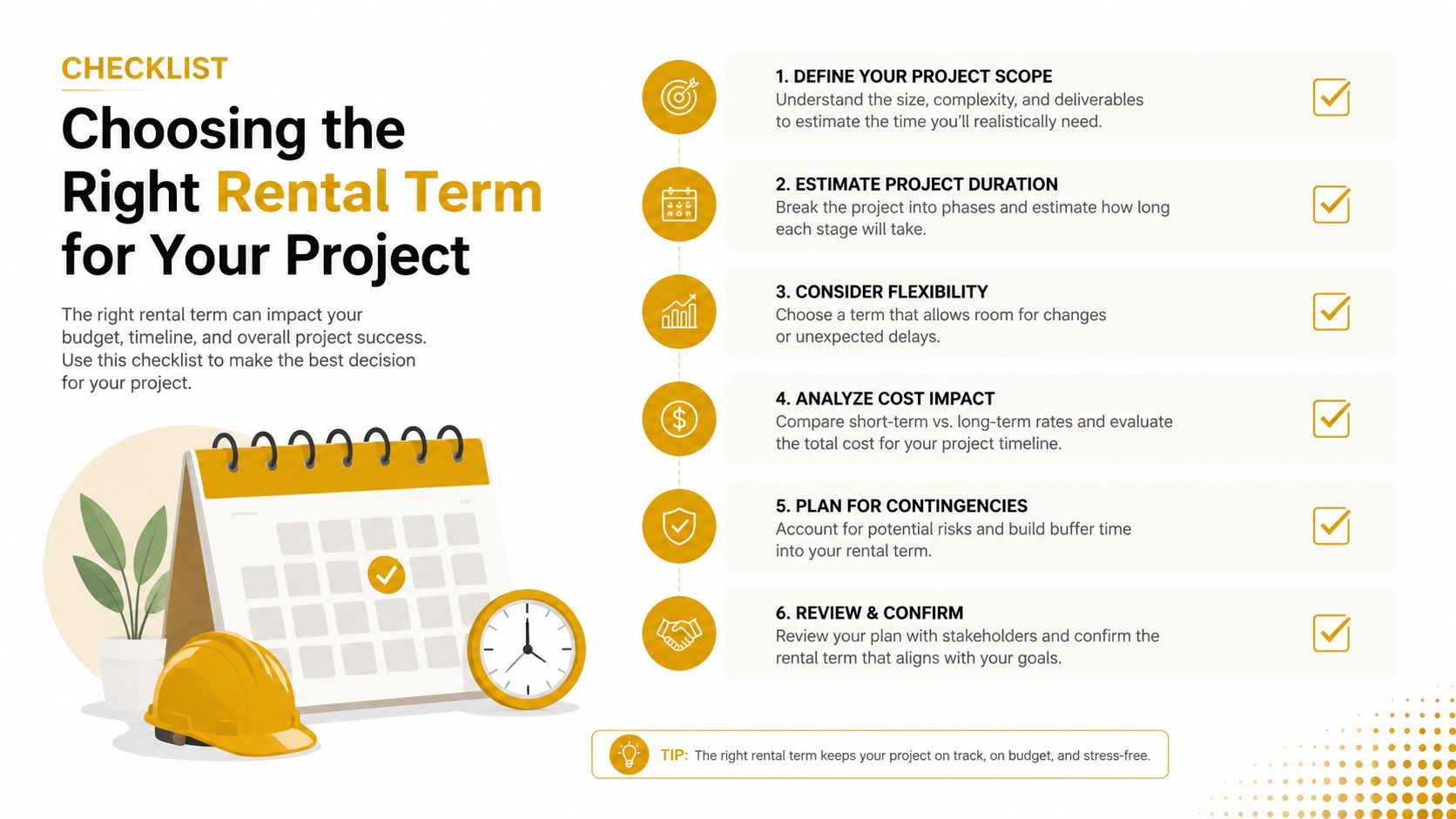
Choosing the Right Rental Term for Your Project
Start with the schedule, not the rate card. Mark the first pour, final pour, cure or cleanup requirements, inspection hold points, weather exposure, and the date the site can release the pan. The rental period should cover the equipment's required presence, not only the hours when the crew is actively placing concrete.
A useful screening rule is to price the weekly tier when the rental may exceed four days, then price the monthly tier when it may exceed three weeks. Those thresholds are decision prompts, not universal break-even points. The supplier's actual W, M, minimum period, and pro-rating terms still control the result.
Build the quote around uncertainty
Use a simple site checklist before committing:
- Confirm the work window: Include all planned pours and the time needed for cleanup or inspection.
- Allow for schedule movement: Ask how weather delays and postponed pours affect the billing period.
- Check access: Describe the road, staging area, grade, surface, and any gate or delivery restrictions.
- Define return condition: Ask what counts as ordinary residue and what triggers cleaning or damage charges.
- Plan rotation: If one pan will move between sites, include transport and the time needed between assignments.
- Read early-return terms: A shorter actual use period doesn't always cancel a minimum commitment.
- Get extensions in writing: Confirm whether extra days use daily, weekly, or another agreed rate.
Over-renting “just in case” can waste money if the project finishes early and the contract doesn't provide a useful early-return adjustment. Under-renting can be worse when a long project rolls into expensive daily renewals or forces an emergency replacement.
A monthly rental split across two sequential sites can make sense when the combined project window is continuous and the transport plan is clear. Separate short rentals may be better when the sites have uncertain schedules, distant locations, or different access requirements. Compare the combined delivered cost, not just the monthly base rate.
Booking Your Rental and Confirming Logistics
Request the quote online or by phone with enough detail for the rental desk to price the job. Name the washout pan or container type, requested start and end dates, job-site address, contact person, and expected delivery conditions.
Before signing, confirm:
- Delivery timing: Establish the delivery window and what happens if the site isn't ready.
- Placement requirements: Identify whether a crane, forklift, suitable staging area, or clear access route is required.
- Ground conditions: Explain rough terrain, soft ground, narrow entrances, slopes, and unfinished roads.
- Billing conversions: Get daily, weekly, and monthly extension rules in writing.
- Pickup or swap-outs: Schedule retrieval around the final pour, cleaning, and any later phase.
- Invoice scope: Ask for every delivery, fuel, environmental, cleaning, tax, waiver, and damage item to be listed.
Don't leave pro-rated extensions to a verbal promise. If the slab runs long, written terms can prevent an automatic move into a new full billing cycle or an unexpected higher rate.
Use the supplier's available contact channels for real-time changes, including phone, email, online ordering, Messenger, WhatsApp, or a scheduled callback where offered. Before shipment, request an itemized invoice preview and compare it with the approved quote. That final check catches missing access notes and surcharge assumptions before the truck is on the road.
For concrete teams, Reborn Rentals provides washout pans and containment equipment with daily, weekly, and monthly rental options, plus delivery arrangements that can be reviewed before booking. Visit Reborn Rentals to request an itemized quote, confirm site logistics, and match the rental term to your actual pour schedule.