At 6:15 a.m., the crew is ready for a commercial foundation pour. The pump truck is idling, mixers are lining up, and two washout pans are still sitting on the trailer. One spec sheet lists an empty weight of 1,200 pounds, while the other lists 1,450. The superintendent has fifteen minutes to decide which unit fits the chute swing, the boom setup, the available forklift, and the washout volume expected through the morning.
That decision isn't about choosing the pan with the larger number. It's about whether the equipment fits the site and the work sequence. Construction equipment specifications connect dimensions, capacity, materials, handling points, compliance, delivery, and total cost. Read them correctly, and teardown stays orderly. Read them casually, and slurry can end up in a parking lot, a storm drain, or a truck lane.
Why Specs Decide Whether Your Pour Day Goes Smoothly
Pour-day problems often start with a specification that looked acceptable during ordering. A pan may fit the listed footprint, yet its interior opening or side height can prevent the chute from discharging cleanly. If the chute reaches beyond the opening, the crew loses time repositioning equipment, and concrete can reach the ground.
Weight adds another site constraint. Check the empty weight against the delivery truck, forklift, crane, or skid steer assigned to unloading and placement. A unit that appears manageable in a catalog may exceed fork capacity or sit beyond the machine's reach once barriers, slopes, and staging space are considered.
Capacity must match the work sequence, not just the published maximum. Washwater and solids need leak-proof containment, convenient placement near the pour, regular inspection, and removal before the unit overflows. Those requirements are covered in the EPA concrete washout guidance.
Pour-day rule: Select a washout unit that fits the truck approach, discharge path, handling equipment, and expected slurry load. Capacity is only one part of the decision.
Shell and liner construction affect both containment and rental cost. Rebar offcuts, broken stakes, sharp aggregate, and skid steer traffic can puncture a weak liner or damage an exposed surface. A watertight unit with usable lifting points may cost more up front, but it reduces repositioning, cleanup exposure, and handling trouble during the pour.
The same specification review should include delivery logistics. Confirm gate width, turning space, unloading access, and the planned location for washout before the rental arrives. A unit that cannot reach its intended position can force an improvised setup, disrupt truck flow, and create extra labor.
Before approving the rental, record the dimensions, empty weight, usable capacity, construction, handling points, access limits, and waste-management requirements. That checklist connects the equipment sheet to the actual pour plan and exposes budget trade-offs before the crew is waiting.
How Construction Equipment Specifications Are Organized
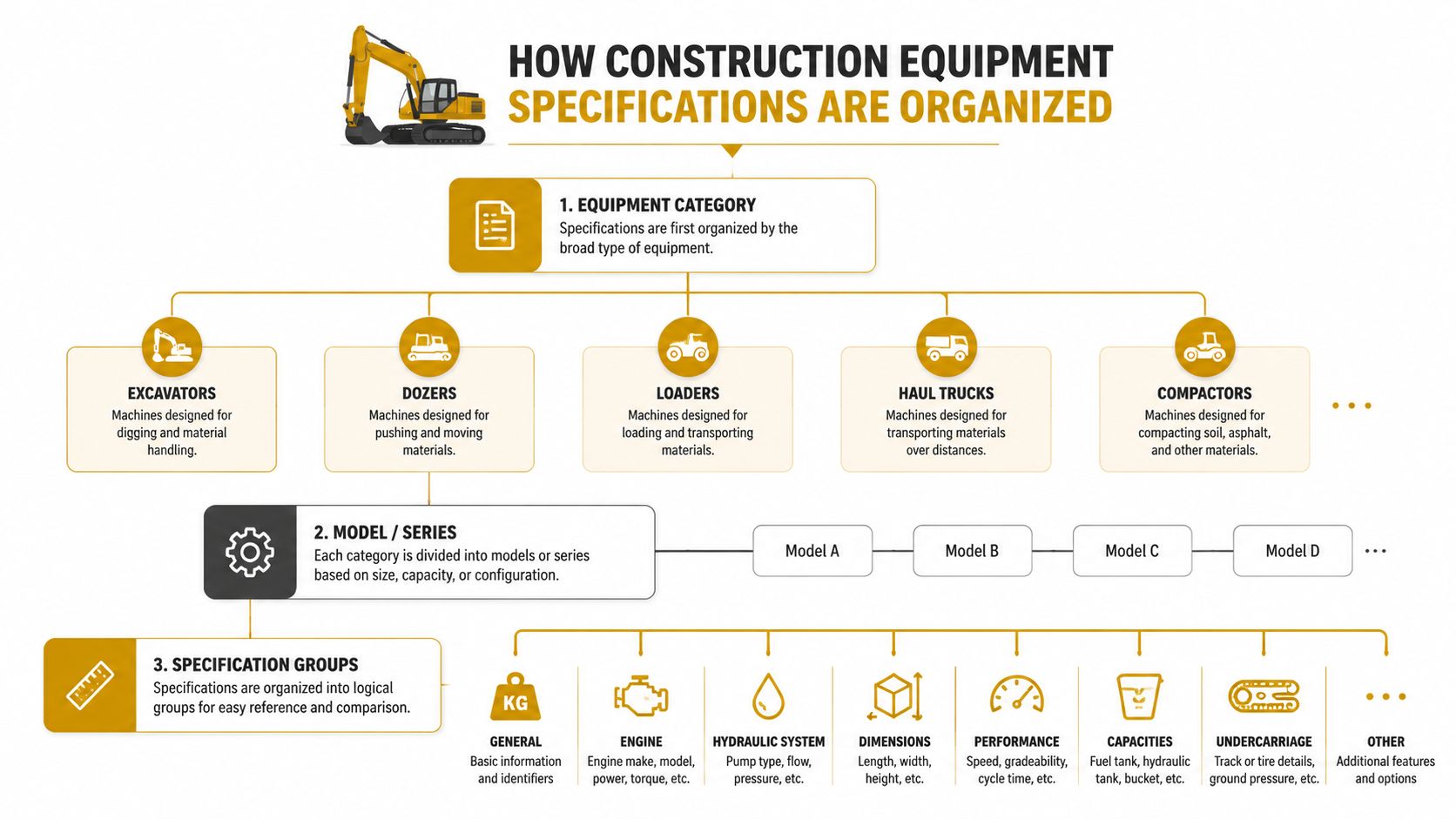
A spec sheet becomes easier to use when you read it in the same order that you make a field decision. ISO category 91.220 covers construction equipment, and ISO/TC 195 publishes commercial-specification standards for machine families such as concrete batching plants, concrete mixers, paver-finishers, soil stabilizers, and concrete surface-finishing equipment. The ISO construction equipment classification shows why specifications use common machine definitions and measurable characteristics rather than relying only on marketing language.
Start with identification. Confirm the manufacturer, model, product name, revision, and any part or rental number. If the quote names one model but the attached sheet describes another, stop there. A correct specification for the wrong unit is still the wrong specification.
Read from identity to approval
Next, check the physical envelope. For a concrete washout pan, that means external length, width, height, interior footprint, wall height, and any folded or deployed dimensions. The question is simple: will it fit where the trucks and crew need it?
Then review capacity. Separate liquid capacity, usable working capacity, solid-load capacity, and any stated fill-line restriction. A manufacturer may publish the volume to the rim, while the job's environmental plan requires the unit to remain below that level.
Materials follow capacity. Look for steel thickness, polymer type, liner gauge, coatings, welded seams, and corrosion resistance. After that, review operational requirements, including fork pockets, lifting lugs, D-rings, tie-down points, rigging instructions, and ground-support requirements.
Finish with compliance and service conditions. Confirm inspection expectations, disposal responsibilities, cleaning requirements, and any jurisdiction-specific acceptance criteria. This sequence answers the superintendent's real questions in order: what is it, will it fit, can it hold the load, will it survive the site, and can we use it compliantly?
The Core Specification Categories You Will See on Every Sheet
A washout pan spec sheet usually looks like a list of disconnected numbers. On site, those numbers form a chain. One dimension affects truck positioning, one weight affects unloading, and one capacity affects how often the crew must service the unit.
| Spec Category | Example Value (Washout Pan) | What to Verify on Site |
|---|---|---|
| Dimensions | 10-foot class pan, with stated width and height | Chute swing, truck approach, gate clearance, and interior usable footprint |
| Load capacity | Rated solid or liquid load | Static versus dynamic rating and the capacity of the forklift or lifting equipment |
| Liquid capacity | Stated gallons to the working line | Usable capacity below the fill limit and expected washout volume |
| Materials | Steel shell, polymer liner, or coated containment surface | Watertight seams, puncture resistance, corrosion protection, and liner compatibility |
| Handling points | Fork pockets, D-rings, lifting lugs | Rigging access, pocket dimensions, tie-down locations, and safe lifting instructions |
| Weight | Empty, loaded, and shipping weights | Trailer limits, axle loading, forklift rating, and crane requirements |
Dimensions determine whether the pan works in the pour sequence
Overall length and width tell you whether the unit can occupy the designated area. Interior footprint tells you whether the chute can discharge into the pan without hitting a sidewall. A pan with a nominal 10-foot length may still be a poor choice if its opening is narrowed by sloped walls, braces, or a heavy rim.
Height affects both containment and access. A taller wall can provide useful freeboard, but it may make chute placement harder and require a pump truck or washout crew to work at an awkward angle. Measure the deployed unit, not just the folded shipping dimensions.
Capacity must match the material being contained
Liquid capacity is a volume measurement, not a promise that the pan can receive that amount during normal operation. Concrete slurry includes cement paste, aggregate residue, and solids. It doesn't behave like clean water, and accumulated material reduces the remaining working space.
Indiana's stormwater manual recommends estimating 20 to 40 gallons of washwater per ready-mix truckload and calls for a minimum containment depth of 1 foot. It also recommends watertight construction and a location at least 50 feet from creeks, wetlands, ditches, karst features, and storm drains. Those benchmarks appear in the Indiana stormwater manual reference.
Materials and handling points decide serviceability
Liner gauge is only useful when paired with installation quality and site conditions. A thicker liner can provide more resistance to puncture, but sharp debris can still damage an improperly supported or badly folded liner. Steel shells need sound welds, protected edges, and a surface that can tolerate repeated cleaning.
Fork pockets and lifting points are pass-fail items if the site depends on mechanical handling. Confirm their spacing, rated use, and access before delivery. Never assume a D-ring is a crane point just because it looks substantial. The manufacturer's rigging notes control.
For approval, prioritize watertightness, usable capacity, handling safety, setbacks, and material suitability. For project convenience, dimensions, color, stacking arrangement, and pickup timing may be negotiable, but only after the hard requirements are satisfied.
Reading a Real Spec Table Without Getting Lost
Take a sample 10-foot steel washout pan. The sheet might combine dimensions, weight, capacity, liner construction, and handling features in one dense block. Don't read it left to right as if every value carries equal importance. Read it in the order the site will test the equipment.
| Specification | Value | Notes |
|---|---|---|
| Overall length | 10 feet | Compare with the truck's chute path and available pad |
| Overall width | Manufacturer-stated width | Check gate, trailer, and working-clearance limits |
| Wall height | Manufacturer-stated height | Confirm access for chutes, hoses, and inspection |
| Empty weight | Manufacturer-stated tare weight | Use for trailer, forklift, and crane planning |
| Liquid capacity | Stated gallons | Confirm whether this is total or usable working capacity |
| Liner gauge | Manufacturer-stated mil thickness | Verify material, seams, and puncture protection |
| Fork pockets | Included or not included | Confirm pocket dimensions and forklift compatibility |
| Lifting points | Lugs, D-rings, or other points | Review rated lifting method and rigging instructions |
Use a four-pass reading method
First, confirm fit. Compare length, width, height, and deployed footprint with the actual washout location. Account for chute swing, truck turning, pedestrian routes, and storm-drain setbacks.
Second, confirm handling. Use the empty weight for unloading and the loaded weight for transport and lifting calculations. If the sheet lists only one weight, ask whether it's tare, shipping, or operating weight.
Third, confirm capacity. Find the working line, not just the maximum volume. Ask how the manufacturer defines gallons and whether residual concrete buildup is included in the maintenance plan.
Fourth, confirm construction. Check liner gauge, shell material, seam design, corrosion protection, and lifting hardware. Missing information is a procurement issue, not a detail to resolve after delivery.
Red flags include mismatched units, a capacity column with no fill-line explanation, missing tare weight, and lifting points without a stated working limit. A clean sheet makes comparison faster. A vague sheet transfers the risk to the foreman.
Quick Conversions for the Field
Use field conversions beside the trailer, then confirm the manufacturer's units before approving a rental or delivery. The wrong conversion can distort both capacity planning and handling requirements.
- Gallons to liters: Multiply gallons by 3.785.
- Cubic feet to cubic yards: Divide cubic feet by 27. One cubic yard equals 27 cubic feet.
- Pounds to kilograms: Multiply pounds by approximately 0.4536.
- Feet to meters: Multiply feet by approximately 0.3048.
- Mils to millimeters: Multiply mils by approximately 0.0254.
- Kilograms to pounds: Multiply kilograms by approximately 2.205.
- Millimeters to inches: Multiply millimeters by approximately 0.03937.
- Kilopascals to PSI: Multiply kPa by approximately 0.145.
Start capacity planning with the delivery schedule. Multiply expected washout trucks by the average washout volume per truck, then compare the result with the pan's usable working capacity. Indiana guidance uses 20 to 40 gallons per ready-mix truckload as a planning range. Adjust the estimate for actual truck turnover and for pump hoses, chutes, and tools that may discharge into the containment area. See the Indiana stormwater guidance for that planning benchmark.
A pan rated below the expected discharge volume is undersized, even if its footprint fits the site. Keep room below the fill line for rain, settled solids, and uneven ground. That reserve protects the pour-day plan from overflow and can prevent a convenient rental from becoming a cleanup or compliance problem.
Matching Specs to Project Size and Scope
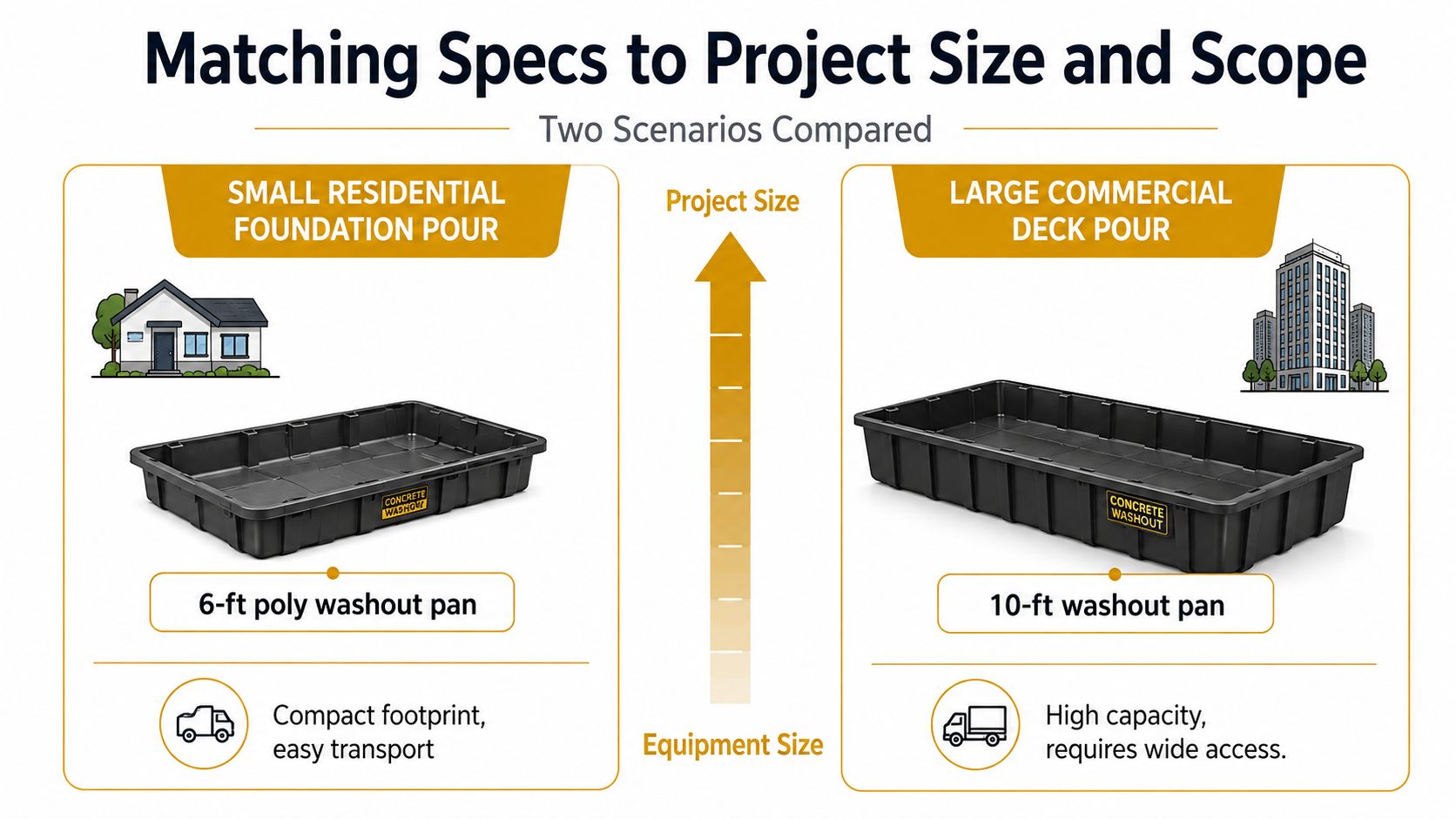
A small residential foundation and a commercial deck pour may use the same type of washout equipment, but they don't create the same operating problem.
For a small foundation or driveway placement, a compact 6-foot poly washout pan can be practical. It takes less staging space, is easier to position near a narrow access route, and can suit a short delivery sequence with limited truck turnover. The project engineer still needs to confirm its usable capacity and liner condition before approving it.
A continuous commercial deck pour requires a different profile. A 10-foot steel unit with reinforced lifting points offers more working area and more controlled handling, but it also demands a wider approach, a stable pad, and a delivery plan that accounts for its weight and footprint.
Match the pan to the pour, not the project label
Use this sequence:
- Count expected trucks. Include the planned fleet and any likely stagger in deliveries.
- Estimate washout volume. Apply the per-truck planning range from the applicable stormwater guidance.
- Add operating reserve. Maintain a buffer below the stated maximum so the unit can receive discharge without approaching overflow.
- Check the footprint. A larger pan may require a straighter truck approach and more room for inspection.
- Confirm service access. The unit must remain reachable for pumping, cleaning, and removal.
A compact pan that works for one truck can become a bottleneck when several mixers arrive in sequence. The problem isn't only volume. Crews may have to wait for access, move hoses around the pan, or wash out in an improvised location while the unit is being serviced.

Over-specifying creates its own waste. A large rigid pan can cost more to deliver and occupy valuable yard space on a small renovation without improving the work. Under-specifying creates delay, cleanup exposure, and possible noncompliance. The right choice is the smallest unit that meets the usable capacity, access, handling, and environmental requirements with room for real site conditions.
Compliance Specs That Make or Break Approval
Environmental requirements turn several specification fields into approval criteria. Inspectors assess whether a washout unit can contain slurry and solids throughout the pour, withstand handling, and remain accessible for inspection and removal. A unit that looks sound during delivery can still fail review if its seams, liner, placement, or service plan do not match the project documents.
Use the EPA washout guidance linked earlier in this article as the baseline, then check the requirements written into the permit, SWPPP, and agency specifications. Inspectors commonly look for visible leaks, damaged liners, exposed seams, unstable placement, blocked access, and evidence that the unit has been allowed to fill too far. They may also compare the installed equipment with the approved site plan rather than accepting a substitute based only on its advertised capacity.
Treat the specification as a checklist
Confirm these items before the purchase order or rental agreement:
- Containment surface: Verify that the pan, liner, seams, and drain details are watertight.
- Liner construction: Confirm the specified thickness, polymer type, weld quality, and resistance to expected site exposure.
- Capacity definition: Determine whether the listed volume is maximum, usable, or measured below a required fill line.
- Setback location: Compare the planned placement with the project stormwater plan and local requirements.
- Inspection access: Leave enough room to inspect the full unit, spot damage, and remove accumulated solids.
- Removal method: Confirm how liquid and hardened material will be removed without tearing or shifting the containment system.
Jurisdictional rules can add measurable conditions. Iowa DOT specifications, for example, address leak-proof roll-off containers or collection bags, impermeable liner systems for below-grade and above-grade containment, and cleanout at 75% of total capacity. Indiana guidance addresses a 1-foot minimum containment depth and a 50-foot setback from specified drainage and water features. These figures are examples of how agencies convert environmental control into equipment and placement requirements, not universal substitutes for the project permit.
A thinner rental unit may be rejected even when it appears serviceable. A steel tray may also fail if it does not provide the required secondary containment. Confirm the current jurisdictional guidance, SWPPP language, inspection access, and removal plan before reserving equipment. Include those checks with delivery planning, because a compliant unit still fails the job if trucks cannot reach it or crews cannot service it safely.
Delivery Logistics and Site Access as Hidden Specs
A specification sheet tells you what the equipment is. The delivery plan determines whether you can place it where it needs to work.
Start with three weights: empty, loaded, and shipping. Empty weight affects unloading. Loaded weight affects transport, ground bearing, forklift selection, and lifting. Shipping weight may include packaging or accessories that won't remain on site, so don't use it blindly for every calculation.
Walk the route before the truck arrives
Check the access path in the same direction the delivery vehicle will travel:
- Gate and lane width: Include mirrors, trailer swing, and any temporary barriers.
- Ground condition: Soft soil, fresh aggregate, and sloped approaches can prevent safe placement.
- Overhead clearance: Look for utility lines, scaffold, temporary lighting, and structural obstructions.
- Unloading zone: Reserve a level area with enough room for forks, a liftgate, or crane outriggers.
- Working radius: Confirm that the delivery crane or forklift can reach the final location without exceeding its rated setup.
- Return access: Leave a route for pumping, inspection, cleaning, and pickup.
Fork pockets deserve special attention. Their opening, spacing, and height must match the forklift, and the machine's rated capacity decreases as the load moves farther from the backrest. If the pan requires a crane, use only the manufacturer-approved lifting points and rigging arrangement.
Delivery cost also follows the specifications. Ask the rental provider to separate base delivery, mileage, fuel, rough-terrain handling, weekend or after-hours service, express orders, cleaning, and return trips. Reborn Rentals lists upfront daily pricing and identifies possible charges for delivery, rough terrain, and express orders, so the project team can connect the equipment choice with landed cost.
Gate-check workflow: Photograph the route, measure the narrowest opening, identify overhead hazards, confirm the unloading machine, mark the placement pad, and send the delivery contact a site sketch before dispatch.
Budgeting Beyond the Daily Rate
The daily rental rate is only the starting point. A sound equipment budget connects the rate to duration, delivery conditions, environmental handling, and return condition.
Use this model:
Total rental cost = duration charge + fixed delivery and pickup fees + variable site fees + approved cleaning or damage charges.
The project engineer should ask what triggers each variable fee. Rough terrain, extended mileage, express delivery, after-hours access, and hardened concrete left in the unit can all change the final invoice. A lightweight collapsible pan may reduce hauling effort, but it can require more careful liner handling and may not tolerate the same abuse as a rigid steel unit.
| Line Item | Spec Trigger | Estimated Cost |
|---|---|---|
| Rental duration | Agreed number of rental days | Quote required |
| Delivery | Equipment footprint, route, and service area | Quote required |
| Pickup | Return access and timing | Quote required |
| Mileage | Distance beyond included service area | Quote required |
| Rough-terrain handling | Ground condition and unloading method | Quote required |
| Cleaning | Hardened material or unreturned liner | Quote required |
| Environmental service | Pumping, liquid removal, or disposal responsibility | Quote required |
For a 10-day rental, write the number of days into the quote and identify whether the daily rate applies to calendar days, workdays, or a minimum rental period. Don't accept “standard charges apply” when a project budget depends on the answer.
A heavier rigid unit may cost more to transport, but it can reduce handling risk and withstand repeated use. A lighter unit may arrive more cheaply, yet become expensive if the crew replaces liners, repairs punctures, or orders an unscheduled pickup. Compare the full cost against the specification risks, not the headline rate.
Cross-Reference Glossary of Common Spec Terms
Use this as a field lookup rather than reading it like a manual.
Dimensions and capacity
- OAL: Overall length, usually feet or millimeters. It describes the full outside length of a pan or machine.
- ID: Inside diameter or dimension, used for usable openings.
- OD: Outside diameter or dimension, used for clearance planning.
- GVWR: Gross vehicle weight rating, the maximum permitted loaded vehicle weight.
- SWL: Safe working load, the allowable working load for a lifting or handling component.
- WLL: Working load limit, the rated load a device can handle under stated conditions.
- Cu ft: Cubic feet, a volume unit used for containment and material capacity.
- Cu yd: Cubic yards, common for concrete and earthwork volume.
Material and compliance
- ASTM: A standards designation used for materials, tests, and construction requirements.
- MIL: One-thousandth of an inch, commonly used for liner thickness.
- HDPE: High-density polyethylene, a durable plastic used in liners and containment products.
- LLDPE: Linear low-density polyethylene, a flexible polymer used in some liners.
- IPN: Often a product-specific or manufacturer-specific designation. Confirm the sheet's definition.
- NPT: National Pipe Thread, used for compatible threaded fittings.
- Lbs/gal: Pounds per gallon, useful when estimating liquid weight and handling loads.
- PSI: Pounds per square inch, a pressure unit.
- kPa: Kilopascals, another pressure unit.
- mPa: Confirm whether the sheet means MPa, megapascal, or another manufacturer-defined abbreviation. Capitalization matters.
If a term affects lifting, containment, or compliance and the sheet doesn't define it, ask the supplier before approving the equipment.
Quick-Reference Card You Can Tape in the Truck
Print the card, then fill in project-specific values before the pour. Keep it with the delivery paperwork and pour plan.
Conversion side
- Gallons to liters: gallons × 3.785
- Cubic feet to cubic yards: cubic feet ÷ 27
- Pounds to kilograms: pounds × 0.4536
- Feet to meters: feet × 0.3048
- Mils to millimeters: mils × 0.0254
- kPa to PSI: kPa × 0.145
- Millimeters to inches: millimeters × 0.03937
Approval side
- Capacity: Match expected truck traffic and the washout volume. Indiana guidance uses 20 to 40 gallons per ready-mix truckload. Confirm the applicable agency benchmark before approval.
- Fill limit: Service the unit before it exceeds 75% capacity, consistent with the applicable washout guidance.
- Depth: Check the required containment depth. Indiana guidance identifies 1 foot as a minimum.
- Setback: Confirm the project requirement. Indiana guidance identifies 50 feet from specified drainage and water features.
- Handling: Verify fork pockets, lifting points, rigging notes, and loaded weight.
- Access: Confirm the truck route, unloading pad, inspection path, and pump-out access.
- Return condition: Record cleaning, liner removal, hardened material, and pickup timing.
A card is useful only if the crew can act on it. Tie the listed limits to the actual truck count, site access, washout plan, and rental return requirements. Visit Reborn Rentals to compare concrete washout rental options, confirm specifications and delivery conditions, and select containment that fits the pour instead of judging the daily rate alone.