If you're breaking ground in Colorado, there's a number you need to know: one acre. Anytime your construction project disturbs that much land—or more—you'll need a Stormwater Pollution Prevention Plan (SWPPP), also known as a Stormwater Management Plan (SWMP).
Think of it as the playbook for keeping your site clean and compliant throughout 2026. Get it wrong, and you're looking at steep fines and frustrating project delays that can derail your entire schedule.
What Your SWPPP Actually Does
For contractors and project managers in Colorado, getting a handle on the rules from the Colorado Department of Public Health and Environment (CDPHE) is step one. A SWPPP isn't just another piece of paper to file away; it's a living document that shows your team exactly how to stop pollution from washing off your job site.

The whole point is to control stormwater runoff. Rain and snowmelt can easily carry sediment, chemicals, and other construction debris off your site and straight into Colorado's rivers and streams. This isn't just a suggestion—it's mandated by the Clean Water Act and strictly enforced at the state level.
When Is a Permit Triggered?
The main trigger is simple: any construction activity disturbing one acre or more of soil needs a permit. This also ropes in smaller projects if they're part of a bigger development—like a single home in a new subdivision—that adds up to over an acre.
It all falls under the CDPS Construction Stormwater General Permit COR400000. Under this permit, you have to create that comprehensive SWMP. In Colorado, fines for slipping up can hit a staggering $37,500 per day, so planning ahead is non-negotiable. The clock starts when you file a Notice of Intent (NOI) with the CDPHE at least 10 days before you break ground. You can find more details about these state-specific stormwater regulations directly from the source.
The one-acre rule is the most important threshold to remember. Even if your individual lot is smaller, if it's part of a larger subdivision or commercial development that collectively exceeds one acre, you are still required to obtain permit coverage.
This table breaks down the essential triggers and timing you need to nail down for your 2026 projects.
Quick Guide to 2026 Colorado SWPPP Triggers and Key Deadlines
| Requirement | Threshold or Deadline | Key Detail |
|---|---|---|
| Permit Required | 1+ acre of land disturbance | Includes smaller sites in a larger common development plan. |
| Notice of Intent (NOI) | At least 10 days before work begins | This is your official notification to the state that you're starting. |
| Regular Inspections | Every 14 days (minimum) | Also required within 24 hours after a significant storm event. |
| Inspector Certification | Renewed every 3 years | Your site must be inspected by a certified Stormwater Management Professional Inspector (SMPI). |
| Potential Fines | Up to $37,500 per day | Non-compliance penalties are severe and can accumulate quickly. |
Keeping these dates and thresholds in mind is the first step toward a smooth, penalty-free project.
Your Core Responsibilities at a Glance
Meeting your SWPPP duties isn't a one-time task; it's a commitment that lasts the entire life of the project. Here’s a quick rundown of what’s on your plate for 2026:
- Filing Your NOI: This is your first official step. You have to submit your Notice of Intent to the state before a single scoop of dirt is moved.
- Creating the Plan: This is your SWPPP/SWMP. It needs to detail all potential pollutants on your site and the specific Best Management Practices (BMPs) you’ll use to control them.
- Conducting Inspections: You’ll need to perform regular site checks to make sure your BMPs are installed correctly and working as intended. These inspections are required every 14 days and after any major storm.
- Keeping Good Records: Document everything. You need to maintain a log of all inspections, any maintenance you perform, and every update made to the SWPPP.
These responsibilities are overseen by a state-certified Stormwater Management Professional Inspector (SMPI), who has to renew their certification every three years. When you manage these tasks correctly, compliance stops feeling like a burden and becomes what it truly is: a sign of a professionally run project.
Decoding the COR400000 General Permit
If you're digging into the Colorado SWPPP requirements for 2026, the first thing you'll run into is the COR400000 General Permit. This is the master rulebook from the Colorado Department of Public Health and Environment (CDPHE) for any construction site that moves dirt.
Think of it as a universal permit for construction. Instead of forcing every single project to get a custom-written permit—which would bury everyone in paperwork—this general permit covers most standard construction activities. It sets the ground rules for protecting our state's water.
But it’s not a one-size-fits-all solution. Just like a commercial driver's license has special endorsements, your site might have stricter rules. If you're working near a sensitive creek or on a steep, erosion-prone hill, you'll face higher expectations for your Best Management Practices (BMPs) than a project on a flat, stable lot.
Who Needs to Follow This Permit
So, does this apply to you? The rule is pretty simple: any construction work that disturbs one or more acres of land requires coverage. This includes everything from clearing and grading to excavation.
Don't get caught by the fine print. The rule also applies to smaller lots that are part of a bigger project. If you're building on a half-acre lot inside a new five-acre subdivision, you're on the hook. The total disturbed area of the whole project is what matters.
This permit isn't just for one person. Responsibility is shared among:
- General contractors running the show.
- Subcontractors handling major earthwork.
- Developers and property owners who kicked off the project.
Bottom line: if your work moves soil, you share the responsibility for compliance. This keeps everyone accountable for preventing stormwater pollution.
The Notice of Intent Is Your Official Starting Line
Before you even think about breaking ground, you have to raise your hand and tell the CDPHE what you’re planning. This is done by filing a Notice of Intent (NOI).
The NOI is your formal application for permit coverage. It tells the state about your project's location, size, and what kind of work you'll be doing.
This step is absolutely critical and time-sensitive. You must submit your NOI at least 10 days before you start digging. This gives the state time to review your plans and grant coverage. Starting work before you're approved is a major violation that can lead to stop-work orders and some hefty fines.
Filing the NOI is the official starting gun for your project. It’s your way of saying you know the Colorado SWPPP requirements for 2026 and you’re ready to follow them.
What Happens After You File Your NOI
Once the CDPHE processes your NOI and your permit coverage is active, you're cleared to start construction. But from that moment on, you’re on their radar.
The department can show up for an inspection at any time to make sure your site is living up to the promises made in your permit and SWMP. This is why your SWMP is more than just paperwork—it’s your playbook and your proof that you’re doing everything right to protect Colorado's water quality.
Essential Best Management Practices for Colorado Job Sites
Once your permit is approved, the real work begins on the ground. Your focus shifts to the practical strategies that keep your site compliant and the environment safe. These are your Best Management Practices (BMPs), and they are the absolute heart of your stormwater plan.
Think of BMPs as your site's defensive line against erosion and pollution. They aren't just suggestions from the state; they are mandatory requirements under your COR400000 permit. Nailing their implementation is how you meet the Colorado SWPPP requirements for 2026.
Why Colorado Demands Robust BMPs
Let's be honest: Colorado is a tough place to manage runoff. Our unique mix of steep terrain and intense summer downpours creates a serious challenge. A simple silt fence that works fine in a flatter, drier state can be completely overwhelmed here in minutes.
Runoff on a Colorado slope gains speed and destructive power fast, carrying far more sediment with it. This is exactly why the state’s SWPPP demands are so high. You have to use heavy-duty BMPs, like enhanced sediment controls, to handle the sudden, massive volumes of water. You aren’t just preparing for a gentle rain; you’re bracing for a potential flash flood. If you want to see what inspectors are really looking for, check out this SWPPP checklist from A Better Edge.
For every construction project, BMPs must be selected, designed, installed, and maintained to be effective for the specific pollutants, site conditions, and weather patterns expected. One-size-fits-all rarely works in Colorado.
The CDPHE expects you to think ahead and choose BMPs that can stand up to the pressure. It’s a proactive mindset that separates a compliant site from a problem one.
Key Categories of BMPs
Your SWPPP will feel like a playbook with different types of BMPs, each with a specific job. They generally fall into three categories that work as a team to protect your site.
- Erosion Controls: These are your proactive moves. They stop soil from ever moving in the first place. Think applying mulch, seeding temporary grass, or laying down erosion control blankets to hold exposed dirt down.
- Sediment Controls: These are your reactive measures. They’re designed to trap soil that has already started moving. This is where you’ll see familiar tools like silt fences, sediment basins, and fiber wattles (straw logs) positioned to slow water down and let the dirt settle out.
- Good Housekeeping: This is all about keeping your site clean and organized so pollutants never mix with stormwater. It covers things like proper trash disposal, having a spill prevention plan, and keeping materials stored neatly under cover.
A strong SWPPP always uses a mix of all three. You stabilize the soil you can, capture the sediment you can't, and keep the whole site clean to minimize your overall risk.
The Critical Role of Concrete Washout Containment
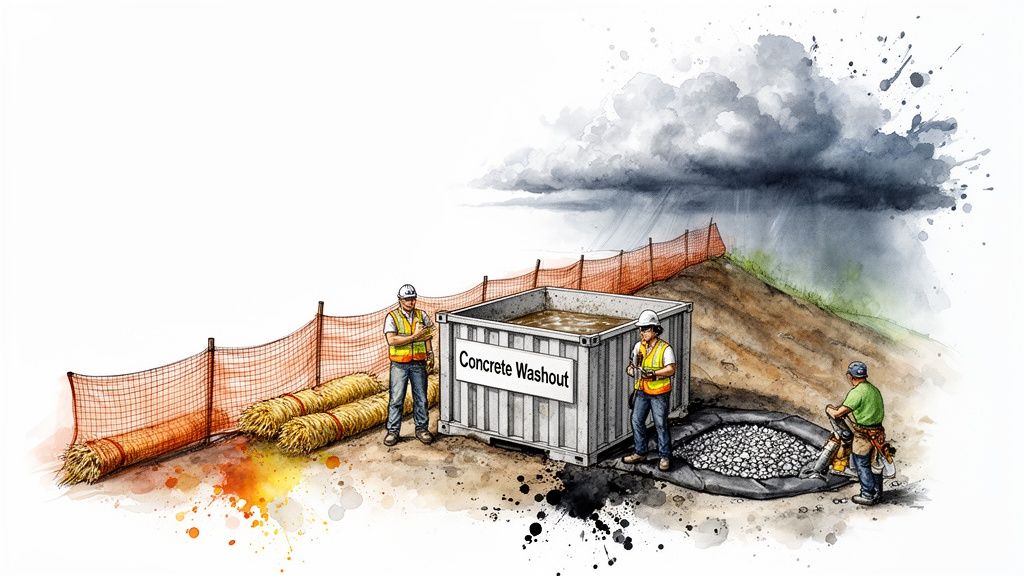
One of the most dangerous—and most frequently cited—pollutants on any construction site is concrete washout water. That gray, alkaline slurry from hosing out concrete trucks, pumps, and tools is highly toxic to fish and can poison the soil, killing all future vegetation.
Because the risk is so high, concrete washout containment is a non-negotiable BMP on any site pouring concrete. Letting a crew wash out onto the dirt or into a flimsy pit dug in the ground is a direct violation that will get you fined on the spot.
A professional, leak-proof washout container is the only truly effective solution. Using a dedicated service like Reborn Rentals means you have a high-capacity, EPA-compliant bin on your site, ready to go. It takes the guesswork out of compliance and gives inspectors a clear, documented solution for one of the most critical parts of your SWPPP.
Mastering Inspections and Recordkeeping Requirements
Your Stormwater Pollution Prevention Plan (SWPPP) isn’t a document you just file away and forget. It’s a living, breathing record of your site’s health and your promise to stay compliant. Getting the hang of inspections and paperwork is the key to meeting the Colorado SWPPP requirements for 2026.
Think of your SWPPP binder as your project’s official medical chart. The regular inspections are the check-ups, and the records are the notes proving you’re keeping the patient—your construction site—healthy. This is your absolute best defense if an auditor ever shows up.

The Mandatory Inspection Schedule
Under Colorado’s COR400000 permit, you can't just check on your Best Management Practices (BMPs) whenever you feel like it. The state lays out a strict, non-negotiable schedule to catch problems before they turn into pollution.
Here’s what’s required:
- Routine Inspections: A full site inspection has to happen at least once every 14 calendar days. No excuses.
- Post-Storm Inspections: You also need to inspect within 24 hours of any rain or snowmelt event that causes surface erosion.
These aren't optional. Missing an inspection is a direct violation that can get you fined, even if no pollution actually happened. Each one has to be documented, creating a paper trail of your site's condition.
The Role of the Certified Inspector
In Colorado, you can't just have any crew member sign off on these reports. The state requires a certified Stormwater Management Plan Inspector (SMPI) to handle the inspections and documentation. This is a Colorado-specific rule designed to make sure a trained professional is watching over your compliance.
The SMPI is responsible for walking the site and confirming that all the BMPs in your SWPPP are:
- Installed correctly and in the right spots according to your site maps.
- Working properly to control sediment and erosion.
- Maintained regularly so they stay effective for the entire project.
If the SMPI finds a BMP that’s busted or failing, they have to write it up and make sure it gets fixed immediately. This creates a simple loop: find it, fix it, and record it all.
By 2026, Colorado SWPPP enforcement under CDPHE's evolving NPDES framework emphasizes this certified oversight. The state mandates a trained Stormwater Management Plan Inspector (SMPI) for most projects over one acre. While no Professional Engineer (PE) certification is needed, inspectors must complete CDPHE-approved courses to ensure every 3-year renewal. This requirement builds on core obligations like the $340 annual permit fee and standardized templates for SWMP content, making compliance clearer for operators. You can explore additional details about SWMP roles in Colorado to better understand these responsibilities.
What Your Records Must Contain
Clean, organized records are your shield during an audit. Your SWPPP binder or digital file needs to be a complete and accurate history of everything you've done for stormwater management. Every single inspection report is a legal document proving you did your due diligence.
Each report needs to include:
- The inspection date and time.
- The name and certification info of the SMPI.
- Weather conditions during the inspection.
- A detailed rundown of all BMPs on site.
- Notes on any problems or areas needing maintenance.
- Photos to document both good and bad areas.
- Records of what you did to fix any problems and when you finished.
Keeping these records organized and on-site is a fundamental permit condition. If an inspector drops by, that logbook is the very first thing they’ll ask to see.
The True Cost of SWPPP Non-Compliance
Everyone in the industry has heard the number that makes project managers sweat: $37,500 per day. That’s the maximum civil penalty the EPA can hit you with for a stormwater violation. While that figure is definitely an attention-getter, it’s only the beginning of the story. The real cost of failing to meet Colorado SWPPP requirements for 2026 goes way beyond a single fine.
Gambling with compliance is a sucker's bet. The true cost isn’t a one-and-done penalty; it’s a domino effect of financial hits and operational headaches that can bring a project to its knees and tarnish your company's name for years.
It often starts with something small. A crew washes out a concrete pump onto the dirt near a storm drain because it’s convenient. Then, a classic Colorado afternoon thunderstorm rolls in, and that toxic slurry gets washed straight into the local water system. That one shortcut just triggered a chain reaction you can’t afford.
More Than Just Fines
That initial fine? That’s just the opening salvo. Once a CDPHE inspector writes you up, the real pain begins. The financial bleeding spreads fast and is hard to stop.
The risks start stacking up immediately:
- Project Shutdowns: A regulator can slap a stop-work order on your site until every violation is fixed and a new, stricter compliance plan is in place. Think about that. Your crew, your equipment rentals, your overhead—all those costs keep piling up while your site sits completely dead in the water.
- Forced Remediation Costs: If your site caused pollution, you’re the one paying to clean it up. That could mean digging up and hauling away contaminated soil or even funding expensive waterway restoration. These cleanup bills are a total wild card and can easily soar into the tens or hundreds of thousands of dollars.
- Increased Scrutiny: Once you're on the CDPHE’s radar, you stay there. Get ready for more frequent, more nit-picky inspections on all your projects, present and future. That extra oversight slows everything down.
A violation isn’t a single event; it’s the start of a long-term problem. The reputational damage from being labeled as a non-compliant contractor can lock you out of future bids and partnerships, costing you far more than any individual fine.
The Long-Term Business Impact
Beyond the immediate project costs, non-compliance inflicts deep wounds on your business that can fester for years.
Think about the ripple effects. A project shutdown means missed deadlines, which can trigger breach of contract clauses and liquidated damages. Now you’re not just dealing with regulators; you’re in legal battles with your own client. Word gets around fast, and suddenly your company has a reputation for being unreliable and careless.
This is why proper compliance isn't just another expense—it's one of the smartest risk management strategies you can have. Budgeting for a certified stormwater inspector, training your team, and using professional equipment like a dedicated concrete washout container aren’t just line items. They’re the armor that protects your budget, your timeline, and the reputation you worked so hard to build.
Your 2026 SWPPP Compliance Action Plan
Knowing the SWPPP rules is one thing. Putting them into practice on a busy Colorado job site is a completely different ballgame. To make it manageable, we’ve broken down the entire process into a straightforward action plan.
Think of your project as having three main stages: before you break ground, while you're working, and after the job is done. Each one has a few key tasks that keep you compliant and clear of any trouble.
Step-by-Step SWPPP Compliance Action Plan
Here’s a simple checklist that walks you through the essential actions for a compliant construction project in Colorado. Following this plan from start to finish helps ensure you've covered all your bases.
| Phase | Action Item | Key Consideration |
|---|---|---|
| Pre-Construction | Determine Permit Need | Is your site disturbance one acre or more? If yes, a permit is required. |
| Pre-Construction | File Notice of Intent (NOI) | Submit to CDPHE at least 10 days before any ground disturbance begins. |
| Pre-Construction | Develop Stormwater Management Plan (SWMP) | Work with a qualified pro to create a detailed site plan with all BMPs. |
| Active Construction | Install & Maintain BMPs | Set up initial controls (silt fence, washout) before major work starts. |
| Active Construction | Conduct & Document Inspections | Certified inspections must happen every 14 days and after big storms. |
| Post-Construction | Achieve Final Stabilization | Re-establish 70% of the original vegetative cover to secure the soil. |
| Post-Construction | Remove Temporary BMPs | Take down silt fences and other controls only after the site is stable. |
| Post-Construction | File Notice of Termination (NOT) | Officially close out your permit with the state once the project is complete. |
This table gives you the high-level view. Now, let’s dig into what each of these steps looks like on the ground.
Pre-Construction Phase
This is all about setting yourself up for a smooth project. Getting this part right saves you from massive headaches and costly mistakes later on.
First things first, you need to know if you even need a permit. If your project disturbs one acre or more of land—or is part of a larger development that does—the answer is yes. No gray area here.
Next, you have to file your Notice of Intent (NOI) with the CDPHE. Make sure this is done at least 10 days before a single shovel hits the dirt. Treat that deadline as sacred. Finally, you’ll develop a comprehensive Stormwater Management Plan (SWMP). This is your playbook, detailing every potential pollutant and the specific BMPs you’ll use to control them.
Active Construction Phase
With your plan locked in, it's time to execute. This is where your crew on the ground turns that SWMP from a document into reality.
Before major earthwork begins, get your initial Best Management Practices (BMPs) installed. We're talking silt fences, vehicle tracking pads, and stabilized entrances.
CRITICAL BMP TASK: Get your concrete washout solution sorted. Concrete slurry is a huge red flag for inspectors. Bringing in a professional, leak-proof washout container from a service like Reborn Rentals is one of the easiest ways to nail this requirement and show you mean business.
Your certified Stormwater Management Plan Inspector (SMPI) also needs to be on-site conducting inspections at least every 14 days and after any significant storm. Every single inspection, along with any maintenance performed, must be meticulously documented.
Don't underestimate the risk of falling behind on this. It's a slippery slope from a simple violation to a full-blown shutdown.
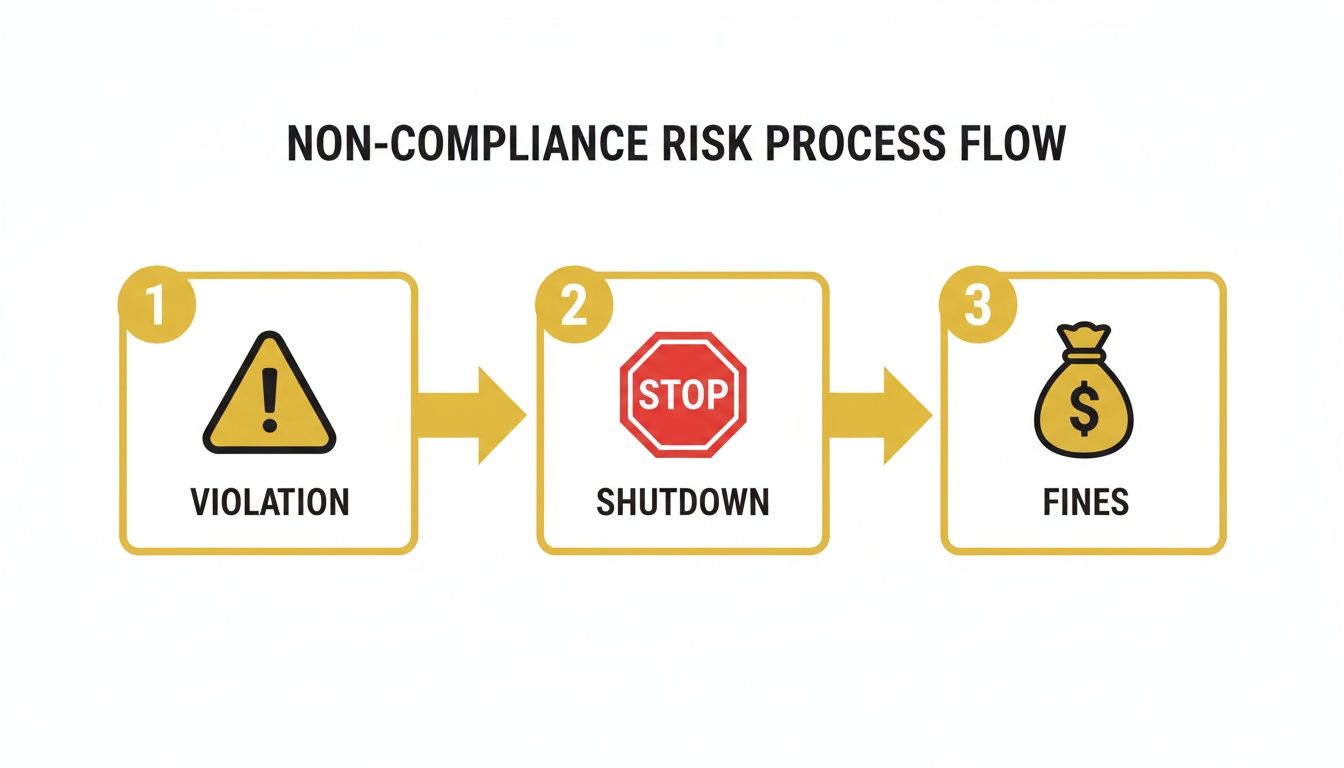
As you can see, what starts as a minor issue can quickly spiral into project delays and hefty fines.
Post-Construction and Final Stabilization
You’re not done when the last truck leaves. The final steps are just as critical for avoiding any long-term liability.
Your primary goal is to achieve final stabilization. This means you’ve successfully re-established at least 70% of the pre-construction vegetative cover across the entire disturbed site. Essentially, the soil is secure and won't wash away.
Once the site is fully stabilized, you can go ahead and remove all the temporary BMPs like silt fences and inlet protection.
The very last step is to file a Notice of Termination (NOT). This is your official notice to the CDPHE that the project is finished, the site is stable, and you're ready to close out your permit coverage for good.
Common Questions About Colorado SWPPP
Trying to get your head around stormwater regulations can feel like a mess. To help you cut through the noise, we've pulled together the most common questions we hear from contractors about Colorado SWPPP requirements for 2026. Here are the straight answers you're looking for.
Do Projects Under One Acre Need a SWPPP?
This one trips up a lot of people, but the state is pretty clear on it. In most cases, if your project disturbs less than one acre of land, you don’t need a state construction stormwater permit.
But here’s the critical exception: if your small project is part of a larger common plan of development or sale, you’re on the hook. Think of it this way—if you're building on a half-acre lot inside a new five-acre subdivision, you absolutely need a SWPPP.
What Is the Difference Between a SWPPP and a SWMP?
You’ll hear both terms thrown around on job sites, often to mean the same thing. The EPA uses Stormwater Pollution Prevention Plan (SWPPP) at the federal level. Here in Colorado, the CDPHE calls it a Stormwater Management Plan (SWMP).
At the end of the day, a SWPPP and a SWMP are the exact same document. It’s your site-specific game plan for keeping pollution out of the storm drains. Both must follow the rules in the state's COR400000 General Permit, so don't sweat the name. Just make sure your plan is solid.
How Do I Find a Certified Inspector?
Colorado law requires a certified Stormwater Management Plan Inspector (SMPI) to handle your site inspections. You can’t just hand this job to someone on your crew. The inspector needs to have completed a state-approved training course and hold a current certification, which they have to renew every three years.
Finding one is simple enough. A quick search for "Colorado certified SMPI" will give you a list of qualified pros and consulting firms. Your best bet is to line up your inspector during pre-construction to make sure they're available for the whole project.
Managing every SWMP detail is a heavy lift, especially high-risk tasks like concrete washout. Let Reborn Rentals handle this critical piece for you. Our professional-grade, EPA-compliant washout containers keep you compliant and your site clean. You can book your container in minutes and keep your project on track.