The concrete pour is booked. The trucks are confirmed. The crew is lined up. Then the first driver pulls in and asks where to wash out.
If that question catches the site flat-footed, the problem is not minor. It turns into idle equipment, confused labor, a bad look in front of the owner, and a mess someone will pay to fix later. That is why you should pre-order a concrete washout pan. Not because it looks organized on a checklist, but because it protects production.
A lot of teams still treat washout containment like a last-minute field decision. That approach works right up until it does not. The day you cannot get a pan, or you get the wrong one, or the inspector arrives before you have a compliant setup in place, the cost shows up fast in lost time and cleanup.
The On-Site Scramble You Can Easily Avoid
The scramble usually starts the same way. A pour is ready to go, but nobody locked down containment. Someone starts looking around for a corner of the site, a makeshift bin, a scrap liner, anything that might pass for a washout area. Meanwhile, the driver is waiting, the pump crew is waiting, and the superintendent is solving a problem that should have been solved before mobilization.

That is not rare bad luck. It is a planning miss that shows up on all kinds of jobs, from small tenant improvements to large site packages.
A 2025 Construction Dive report noted that 28% of mid-sized projects faced 1–3 day delays from containment equipment shortages, and concrete pumping firms were losing $1.2M annually in major metros due to availability issues during peak season, as cited at Certified MTP’s concrete washout pan page.
What the delay looks like in the field
Last-minute sourcing rarely fails in a clean, obvious way. It fails in pieces:
- The wrong rental arrives: The pan is too small, too light, or not practical for the truck access available.
- The crew improvises: Buckets, plastic, or an unprotected patch of ground become the backup plan.
- The pour slows down: Drivers ask questions, laborers redirect, and supervision shifts attention away from production.
- The site gets dirtier: Slurry spreads outside the intended area, and cleanup starts before the pour is even done.
Practical takeaway: If the first truck can arrive before the washout system does, the plan is incomplete.
Why pre-ordering changes the whole day
Pre-ordering does something simple but valuable. It removes uncertainty from one of the easiest failure points on a concrete day.
The pan is accounted for. Delivery timing is set. Placement can be discussed ahead of time with access, traffic flow, and sequencing in mind. The crew knows where washout happens before a driver asks.
That is the professional move. It keeps field decisions focused on production, not on emergency containment.
Guarantee Your Pan Availability and Proper Sizing
Getting a washout pan is one thing. Getting the right pan is what keeps the job moving.
When teams wait until the pour week, they usually end up taking whatever is still available. That is how a high-volume placement gets paired with a pan that was better suited for a much smaller scope. The result is predictable. Overflow risk goes up, truck cycles get awkward, and the crew starts babysitting a containment setup instead of running work.

Match the pan to the job, not to what is left
A small renovation and a large commercial slab do not create the same washout demand. That sounds obvious, but it gets ignored when procurement happens too late.
A practical way to think about it is capacity, truck frequency, and staging space.
| Job condition | Better fit |
|---|---|
| Small concrete scope with limited washout activity | A lower-capacity pan such as a 72' x 72' x 14' unit at about 310 gallons |
| Larger pours with heavier washout demand | A higher-capacity pan such as a 72' x 72' x 24' unit at about 441 gallons and roughly 18.25 tons |
| Tight access with multiple truck moves | A pan selected early so placement works with haul routes and crew movement |
Those capacity figures come from the publisher background and verified data provided for this assignment.
What works and what does not
What works is straightforward. Review the concrete scope early, estimate how many trucks will wash out, and reserve a pan with enough capacity for the operation.
What does not work is assuming a generic pan can handle every job. It also does not work to let the supplier decide sizing without clear information from the field. If you do not communicate the pace of pours, access constraints, and expected washout volume, you are guessing.
A few practical questions settle most of it:
- How many trucks are expected on the busiest pour day
- Will trucks wash out in one location or more than one
- Is the pan accessible without disrupting pump setup or site traffic
- Is there room to service or relocate it if conditions change
Key point: Availability and sizing are tied together. A pan reserved early is more likely to be the pan your site needs.
Pre-ordering is not just a reservation step. It is how you avoid being forced into an undersized option that creates a new problem in the middle of the pour.
Meet SWPPP Compliance Before the First Truck Arrives
Many teams get exposed here. They assume washout is a field housekeeping issue when it is really a pre-installation compliance issue.
EPA stormwater best management practices require concrete washout areas to be installed prior to any concrete placement, with enough quantity and size to contain 100% of liquid and solid waste. Those locations are also prohibited within 1,000 feet of wells or on permeable soils without an impermeable liner of at least 10mm thick, according to the EPA concrete washout guidance.
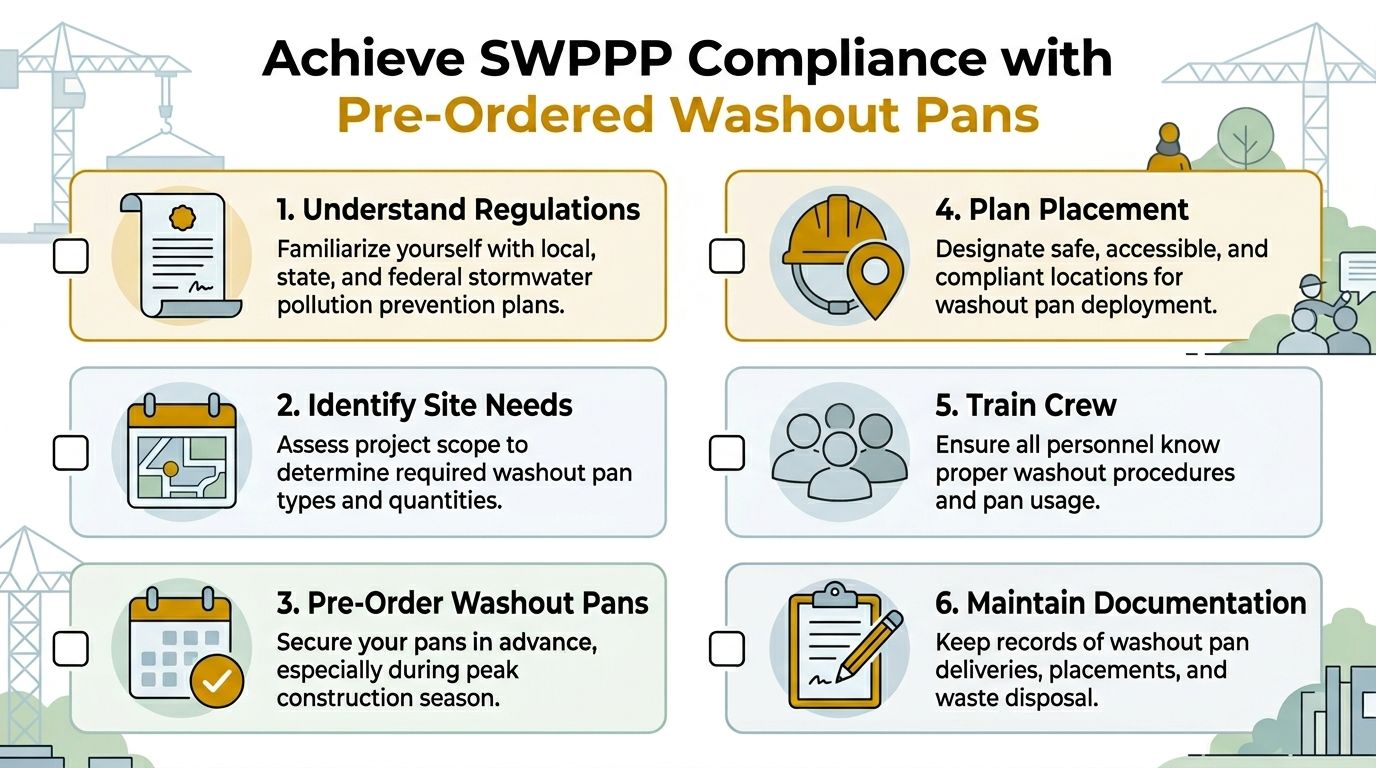
That changes the conversation. You do not just need a washout plan on paper. You need the containment setup on site, in place, and properly located before the first truck starts work.
Why late sourcing creates compliance failures
A late washout order tends to trigger one of three bad outcomes.
First, the pan does not arrive in time. Now the site either delays the pour or improvises.
Second, the pan arrives, but nobody thought through placement. It ends up in a spot that creates truck access problems or conflicts with the SWPPP.
Third, the crew uses an ad-hoc setup because the proper pan is not available. That is the kind of shortcut that attracts attention fast when the site gets inspected.
The practical issue is not only the environmental rule. It is the chain reaction that follows from missing it. A stop, a correction, a cleanup, and a rewritten sequence can cost more than the rental ever would.
Pre-ordering gives you time to plan the details that matter
Compliance goes smoother when the containment plan is handled like any other site logistics item.
Use this checklist before the pour:
- Placement review: Confirm the washout area is accessible for ready-mix trucks and not in a prohibited location.
- Capacity check: Make sure the selected units can contain the full washout stream expected for the operation.
- Crew communication: Drivers, pump operators, laborers, and foremen all need the same answer when washout starts.
- Documentation: Keep the delivery and placement record with the job’s SWPPP materials.
Tip: The best washout setup is the one that needs no debate when trucks arrive. Everyone knows where it is, how to use it, and who is responsible for it.
Compliance is also a scheduling issue
On busy projects, the SWPPP side and the production side are often managed by different people. That split is where things get missed. The environmental plan may call for compliant washout, but if operations do not reserve the equipment early enough, the field team still gets stuck.
Pre-ordering closes that gap. It turns a paper requirement into a scheduled delivery and a real field condition. That is what inspectors expect, and it is what project managers should want. A requirement that is physically in place before work starts is one less risk sitting in the schedule.
How Pre-Ordering Protects Your Timeline and Budget
A washout pan is easy to misclassify as overhead. In practice, it has more to do with throughput.
When washout takes too long, trucks sit. Drivers wait. Dispatch loses flexibility. Then the same team that wanted to save money by delaying the rental starts burning money in operations.
Minutes matter more than people think
The strongest business case is not theoretical. High-speed washout systems can finish the task in minutes and save many minutes daily across an operation. That saved time can allow additional loads of concrete each at a significant cost per yard, producing substantial daily or annually in new revenue, according to For Construction Pros on concrete washout system economics.
That example comes from ready-mix plant operations, but the lesson applies on the jobsite too. Washout friction is not free. It steals production time from assets that cost real money to keep moving.
Where the hidden cost shows up
A delayed or improvised washout setup hits the budget in several ways at once:
- Truck time gets wasted: Every minute a truck is idle is a minute it is not headed to the next load.
- Labor gets reassigned: Someone has to direct traffic, protect the area, or clean up a bad setup.
- Schedules get less predictable: Once a pour falls behind, the rest of the day gets harder to recover.
- Fleet decisions get distorted: Teams often add equipment or keep extra capacity because inefficient processes keep eating hours.
That is why you should pre-order a concrete washout pan if you care about margin, not just compliance. The gain is operational control.
The profitability view
Good project managers do not ask only, “What does the rental cost?” They ask, “What failure does this prevent, and what productive time does it preserve?”
A properly planned washout setup does three things well:
- It protects pour-day flow.
- It keeps truck cycles cleaner.
- It reduces the chance that a cheap oversight turns into expensive delay.
Key takeaway: The best washout plan does not just prevent a mess. It protects the earning capacity of the crew, the trucks, and the schedule.
There is also a bigger strategic point. Efficient washout systems can reclaim sand, stone, and water in a closed-loop process instead of treating all of it like waste, as discussed in the same earlier source. That turns disposal pain into usable material flow. Even when a site is not operating a full recycling loop, the principle still holds. Better containment usually means less waste handling and less cleanup burden downstream.
Minimize On-Site Risks and Final Cleanup Efforts
Improvised washout is not only inefficient. It is unsafe and messy.
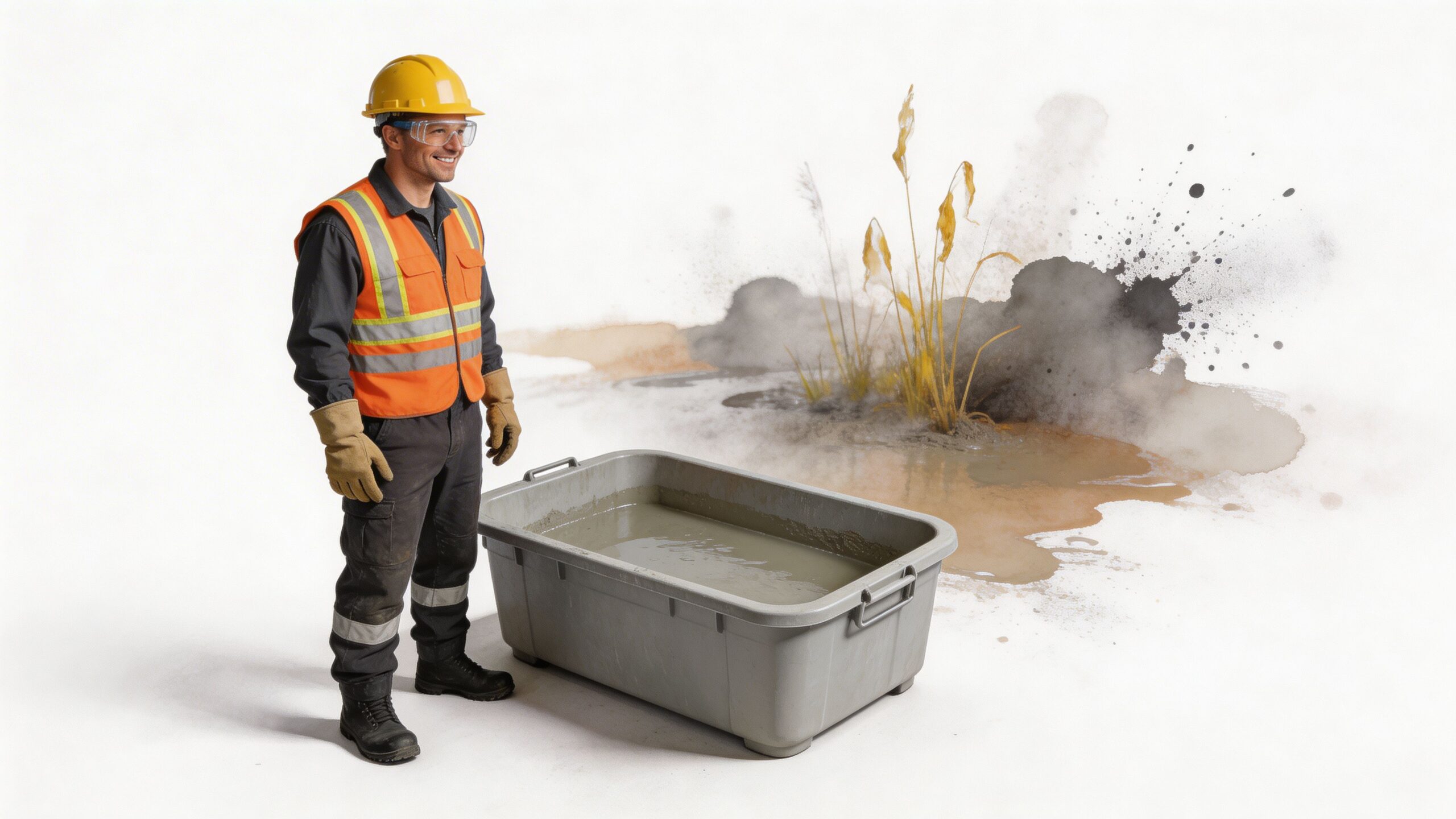
Concrete washwater is caustic. If it migrates outside the intended area, it creates slip hazards, skin exposure issues, and contamination problems that spread beyond the pour zone. A proper pan keeps that risk contained from the start.
Use engineered containment, not improvised containment
Not every steel box on a job should be trusted to hold heavy slurry loads. Engineered pans matter because washout weight builds quickly, especially when multiple trucks are cycling through.
Pre-ordering gives you access to units with a verified 5:1 safety factor against structural failure. The same source warns that unverified pans can collapse, leading to site shutdowns, worker injuries, and rework costs exceeding a significant amount per incident, according to Kent Engineering’s washout pan load testing article.
That is the difference between a piece of safety equipment and a gamble.
What a safer setup looks like
A good washout setup should be treated the same way you treat lifting gear or excavation protection. It needs to be selected, placed, and used with intent.
Field checklist:
- Choose a pan built for the load: Verified engineering is not a luxury on high-volume concrete work.
- Set it where trucks can approach cleanly: Bad access encourages sloppy washout and splash outside the containment zone.
- Keep the area defined: Crews need a clear boundary so washout stays where it belongs.
- Inspect during the job: Check for overfilling, rough handling damage, and movement after heavy use.
The difference in cleanup is huge. When slurry stays in a pan, closeout is controlled. When slurry hits soil, stone, or pavement outside the containment area, labor hours disappear into scraping, hauling, pressure washing, and patching disturbed areas.
This short video shows the kind of washout handling that makes field teams either efficient or miserable later in the job:
Cleanup starts before the pour, not after
The easiest cleanup plan is containment from minute one. That means no random discharge, no hardened spill zones, and no end-of-project surprise where someone realizes the “temporary” washout spot became a removal project.
Professional crews know this already. Clean sites finish better, inspect better, and hand over with fewer arguments. Pre-ordering supports that outcome because the pan is ready before anyone starts making compromises in the field.
How to Pre-Order Your Washout Pan in 3 Simple Steps
Pre-ordering does not need a long procurement exercise. It should be handled like any other short-lead field rental. The goal is simple. Reserve the right unit, lock in timing, and make delivery easy for the site.
Step 1 Pick the pan that matches the work
Start with scope, not habit.
Look at pour volume, truck frequency, and available staging space. A small renovation may only need a lower-capacity unit. A larger commercial pour may need a higher-capacity pan and a clearer access plan. If the site has multiple washout points, decide that early too.
A short booking checklist helps:
- Project start date
- Expected concrete activity
- Site access point
- Delivery contact
- Any terrain or placement issues
Step 2 Set dates and location clearly
Most rental mistakes happen here. The order is placed, but the delivery window is vague or the site instructions are incomplete.
Be specific about when the pan must be on site, where the truck should enter, and who will receive it. If the pour starts early, the pan should not arrive “sometime that day.” It should already be there.
Recent EPA NPDES updates in January 2026 are moving towards mandating digital logging for washout volumes, and pre-ordering through a multi-channel provider can sync rental schedules with compliance apps, simplifying audits and reducing violation risks, as noted by Eco-Pan’s discussion of concrete washout pans.
That matters because rental timing is becoming part of the documentation trail, not just a field convenience.
Step 3 Confirm pricing, support, and delivery details
Before you finalize, confirm the basics:
- Daily rate: Reborn Rentals lists pricing starting at $25/day in the provided publisher background.
- Possible added charges: Review delivery, rough terrain, and express-order notes up front.
- Communication channel: Use whichever is fastest for your team, whether that is WhatsApp, email, Messenger, or callback support.
- Final site instructions: Make sure delivery notes match the site condition.
The best booking process is one your foreman or PM can complete quickly without guessing what comes next. Select the pan. Enter dates and location. Confirm delivery.
That is all pre-ordering needs to be. Simple enough to do early, and valuable enough that waiting rarely makes sense.
If you want a straightforward way to lock in washout containment before your next pour, Reborn Rentals offers specialized concrete washout pan rentals with a simple checkout flow, clear daily pricing starting at $25/day, and support across Messenger, WhatsApp, email, and callbacks. For project managers and supers trying to avoid pour-day chaos, that kind of early scheduling is the practical move.