Most contractors treat concrete washout cost like a small cleanup charge until the bill shows the problem. An industry analysis cited in a washout report estimated that 4,000 ready-mix delivery vehicles in the UK could leave behind more than one-third of a million cubic metres of unproductive concrete, with a supply value of more than £25 million, plus about 109 million litres of washout water worth roughly £1 million in water cost alone bps eco ltd report. That's not a nuisance item, that's material loss, disposal pressure, and compliance risk all stacked together.

Why Concrete Washout Cost Is Bigger Than Most Contractors Expect
A lot of crews still treat washout as the pit, the pan, or the tub sitting near the pour. The cost shows up in the waste, water, labor, and disposal you did not plan to carry. An industry report estimated that across 4,000 ready-mix vehicles in the UK, the existing washout arrangement could leave more than one-third of a million cubic metres of unproductive concrete and more than 109 million litres of washout water onsite, with a supply value above £25 million and water cost around £1 million bps eco ltd report.
That changes the whole job cost conversation. The issue is not whether a washout container costs a few hundred dollars or a few thousand. The core question is how much concrete, water, labor, and disposal you are leaking out of the job every time the crew leaves washout poorly contained.
The hidden loss most quotes ignore
The washout pit only catches part of the damage. Every extra yard that hardens where it should not, every rinse that runs too long, and every cleanup that needs another trip adds to the landed cost. On bigger jobs, the waste is not just a disposal issue, it is embedded product value walking off the site in hardened form.
Practical rule: if a washout setup only looks cheap because it ignores what gets left behind, it is not cheap.
Smart foremen treat washout as a system. They watch where the concrete goes, how fast the container fills, and how much material is left for someone to haul, clean, or replace. Once you start tracking those three pieces, the budget picture gets clearer fast.
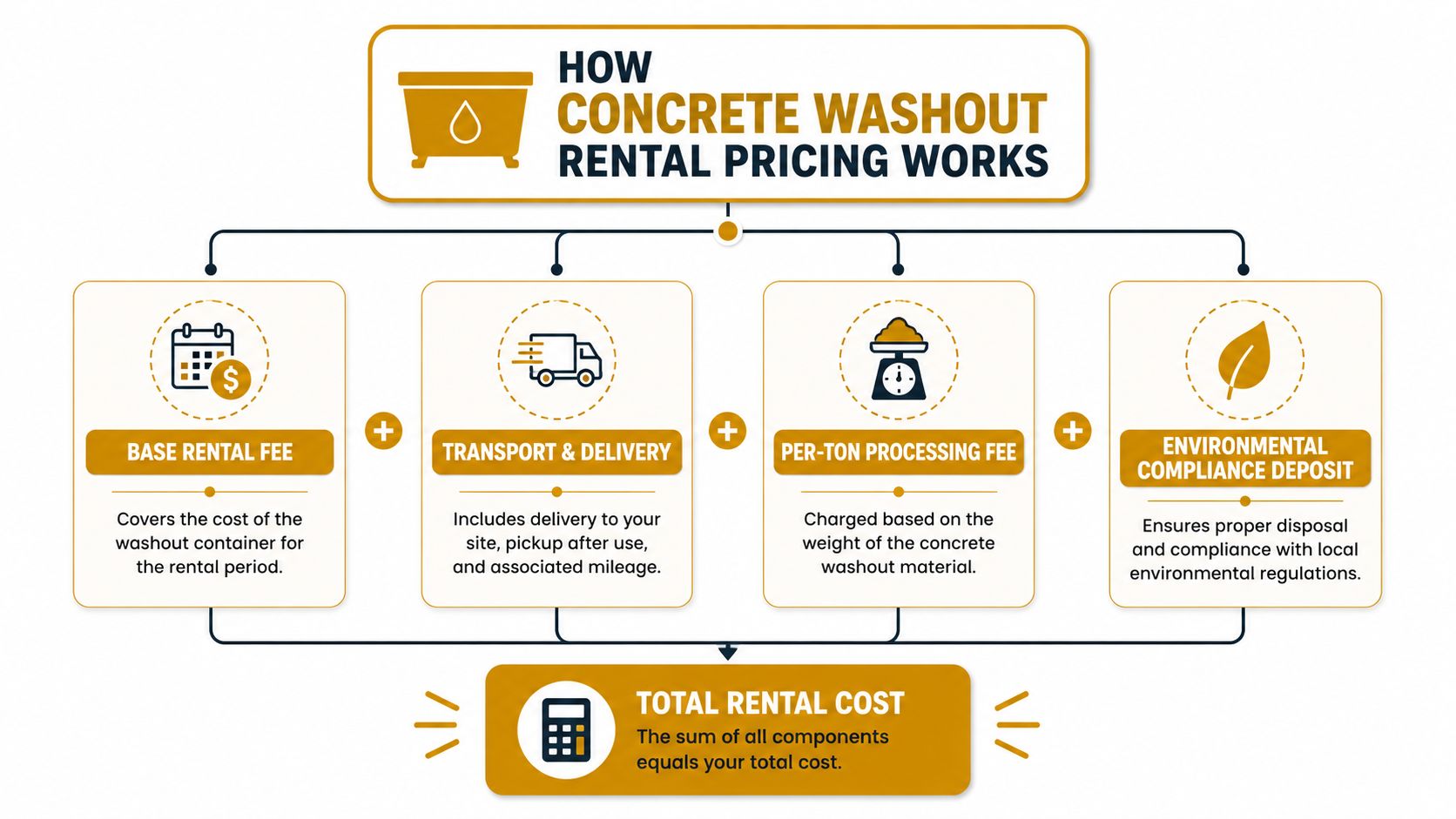
How Concrete Washout Rental Pricing Works
Rental pricing makes sense only when you stop looking at the pan and start looking at the workflow around it. Estimators commonly break the cost into container rental, delivery or pickup, disposal or recycling fees, pump-hose and hopper cleanup, tool and buggy cleanup labor, surface protection or repair allowance, and extra wait-time risk concrete estimator planning formula. That structure matters because the bill changes with how the pour is handled, not just how much concrete gets placed.
What the base rate actually covers
The base daily rate is only the starting point. It usually covers the container itself, nothing more. If the quote doesn't spell out transport, haul-off, or cleaning, you're probably looking at a number that's incomplete on purpose or incomplete by habit.
The best way to read a quote is to ask one question, what happens after the pan shows up? If the answer is vague, expect the final invoice to be less friendly than the estimate. Delivery access, placement location, and cleanup method all matter because they affect time, labor, and machine handling.
Why placement method changes the bill
A mixer rinsing into a portable bin creates a different cleanup load than a pump crew washing hose and hopper residue. A small job with a short pour window may use one container and be done. A heavier placement with multiple crews can generate more residue, more handling, and more replacement pressure.
A washout charge is really a mix of rental, transport, labor, and disposal, not a single flat fee.
That's the language foremen need when they compare bids. If one vendor shows a low rental rate and another shows a fuller landed cost, the lower number isn't necessarily cheaper. It may just be hiding the work somewhere else.
Additional Fees That Inflate Your Washout Budget
The number on the quote is rarely the number that lands on the job cost report. Delivery fees can change with site access, travel time, and how hard it is to set the container where the crew needs it. Tight access, soft ground, or a long carry from the pour area usually means more labor, more machine time, or both.
The charges that sneak in late
Rough terrain adds cost because it changes how the bin gets delivered or removed. A truck that can roll straight in is one thing. A site with unstable ground or a bad approach may need extra handling, and that shows up on the invoice.
Short-notice orders can raise the price too. Vendors have to reshuffle routes, send a truck with less planning time, or absorb a scheduling problem that started on the contractor side. If washout is booked the morning of the pour, the contractor is usually paying for that urgency.
Overfill is the other budget problem that gets missed. Public agency guidance says temporary washout facilities should be sized to contain expected wash water, solids, and rainfall, and some guidance calls for 12 inches of freeboard CICA guidance. A bin is not “safe” at the rim. It is already running out of usable capacity before it looks full.
Replacement charges matter more than most crews think
Replacement charges can turn a routine rental into a messy line item. Some service pricing models list $250 per container and another $250 for each replacement. That kind of fee matters when rain, wash volume, or poor timing fills the bin faster than expected, because the crew ends up paying again to keep the pour moving.
- Check access early: If the truck cannot get close, expect more labor or a harder delivery.
- Plan for weather: Rainwater adds volume and can force earlier pumping or replacement.
- Watch the fill level: Containers need inspection before they become an emergency.
- Book before the pour: Last-minute scheduling usually costs more than planning ahead.
Crews that keep washout cost under control do not stop at the base rate. They ask what happens if the bin fills, the ground is rough, or the haul-off has to happen twice. Those are the charges that push a simple rental into a budget headache.
How Pan Capacity and Size Impact Your Total Cost
Choosing the wrong pan size costs money either way. A pan that is too small fills fast, forces replacements, adds handling time, and can leave the crew cleaning up a spill or overflow. A pan that is too large ties up money in capacity the job never uses. Suppliers show how quickly pricing rises as size and features increase, and that is the first clue that pan selection is a budget decision, not just a storage decision.
Equipment choices that change the numbers
A small prefabricated concrete washout bin sized for roughly 1 per 10 to 12 mixer trucks at about 1.75 cubic yards capacity is listed at about $2,500. Larger ramped cable-hoist bins sized for mixer and pump truck washout are about 5.5 cubic yards and listed at about $7,288 concrete washout systems packet.
For jobs that need solids removal and pH reduction, the cost rises quickly. Integrated water-treatment equipment is listed at about $38,976, and a vacuum truck for water removal is listed at $65,000+ concrete washout systems packet. High-compliance work does not price out like a simple bin rental, because the equipment and handling requirements are different from the start.
Concrete Washout Equipment Sizes and Costs
| Equipment Type | Capacity | Approximate Cost |
|---|---|---|
| Small prefabricated washout bin | 1.75 cubic yards | $2,500 |
| Ramped cable-hoist bin | 5.5 cubic yards | $7,288 |
| Integrated water-treatment equipment | Not specified | $38,976 |
| Vacuum truck for water removal | Not specified | $65,000+ |
The table shows the trade-off plainly. Smaller equipment works when the crew stays disciplined and the washout volume is predictable. Bigger systems start to make sense when residue is heavy enough that treatment, removal, or repeated haul-off becomes part of the normal job routine.
Size the container to the job's washout pattern, not the easiest number on the quote sheet.
That choice saves money because it avoids paying for unused capacity and avoids emergency replacement when the pan fills early. It also keeps the site cleaner, which matters when the inspector shows up or another trade starts working beside the pour.
Real Cost Scenarios for Typical Construction Jobs
The easiest way to understand washout pricing is to walk the job the way the foreman lives it. The bin doesn't exist in a vacuum. It sits next to the pump hose, the wash truck, the crew, the weather, and the clock.
Small residential pour
A small residential pour usually needs a compact setup, and the crew often gets by with a single washout container if the site is organized. The cost stays contained when the pour is short, the access is simple, and the container doesn't need to be moved or replaced mid-job. The main mistake here is treating a tiny site like it's exempt from planning, because one sloppy rinse can create cleanup work that costs more than the rental itself.
Mid-size commercial project
A mid-size commercial project puts more stress on the schedule. Delivery time matters because the bin has to land where the crew can use it, and rough terrain can change how easy that is. If the pour area is awkward, the vendor may need extra effort to place or retrieve the unit, and those delivery-related costs are where a lot of quotes rise.
Large infrastructure pour
Large infrastructure work is a different animal. Multiple pans, repeated replacements, and water treatment can all enter the picture when the washout volume is high or the compliance requirements are tighter. That's also the point where the work stops resembling a rental and starts resembling a managed waste process.
The bigger the pour, the less the job tolerates guesswork.
If you're comparing bids, don't just ask for the container price. Ask how many pickups are included, what happens if it overfills, and whether cleanup or treatment is part of the number. The job cost changes fast when those answers are missing.
Renting Versus Buying Concrete Washout Equipment
Renting makes sense when the job is short and the equipment would sit idle after the pour. Buying makes sense when the same crew is handling concrete often enough that storage, transport, and maintenance become part of normal operations. The right answer depends on how often your team pours, how much residue you generate, and how much time you want to spend managing gear instead of the job.
When renting fits better
If you're dealing with one project or a small run of pours, renting usually keeps the cash tied up where it belongs, in production. You don't have to store the unit, clean it between uses, or worry about whether it's ready when the next truck arrives. That simplicity matters on smaller jobs where space and time are already tight.
When buying starts to make sense
Buying starts to look better when the same operation is using washout gear constantly. The owner gets control over availability, placement, and scheduling, and that control can matter when pours stack up. But ownership also means you're responsible for keeping the equipment serviceable, moving it between sites, and handling whatever maintenance it needs.
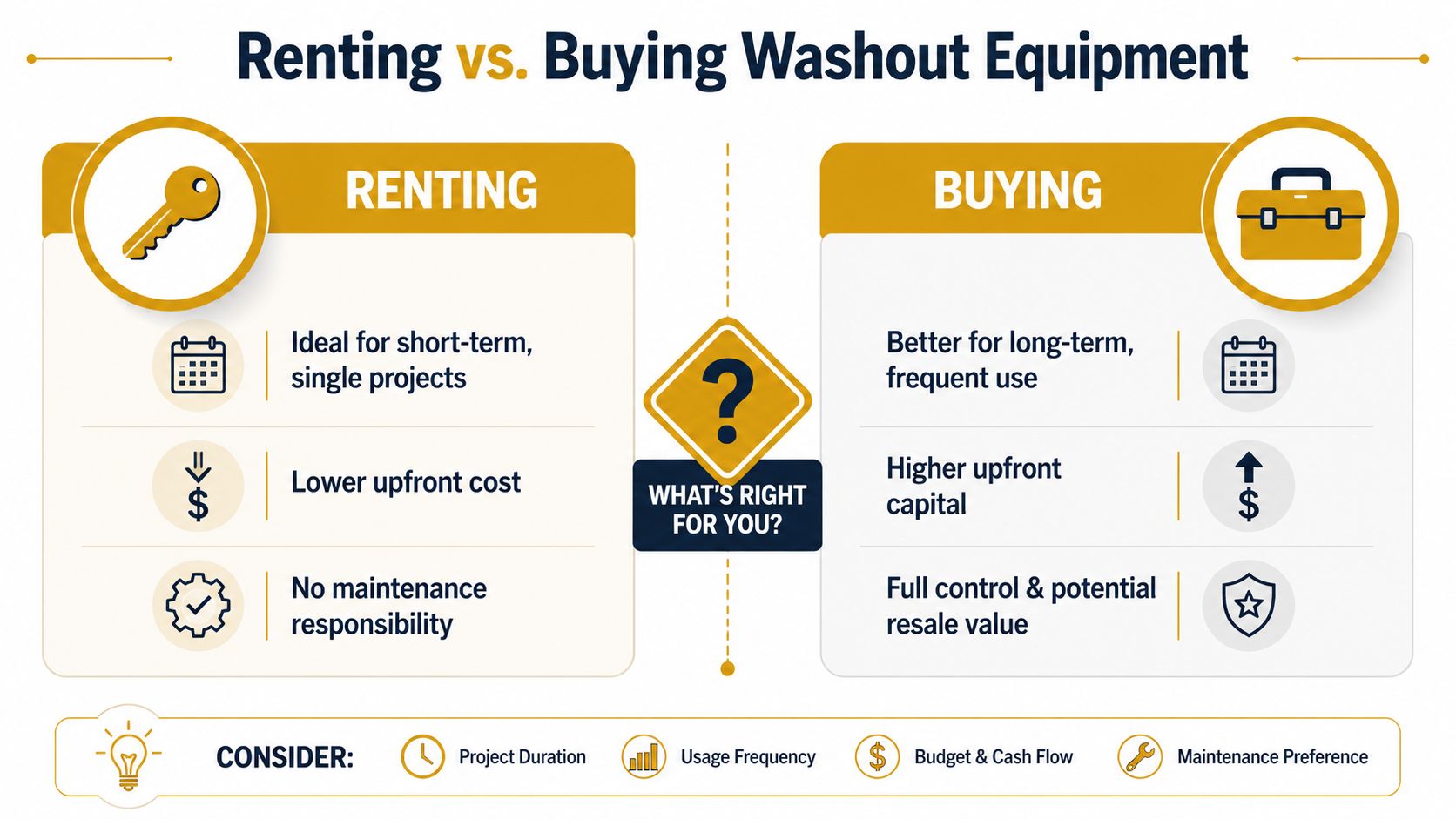
A contractor who pours frequently may eventually prefer ownership for control. A subcontractor bouncing from site to site often does better renting because the logistics stay lighter and the equipment doesn't become another asset to babysit. The better move is to match the gear to the frequency, not to the habit.
One practical rental option is Reborn Rentals, which provides concrete washout pans for rent with delivery and upfront daily pricing, along with washout lids for containment setups. That kind of setup fits jobs where the team wants a ready-to-deploy container without turning the project into an equipment management problem.
Compliance Penalties and Budgeting Strategies That Work
The most expensive washout mistake is usually not a missed pickup. It is a compliance failure, and the bill often shows up after the crew has already moved on. The National Ready Mixed Concrete Association has been cited as saying the average amount of excess concrete per truck per day is 1.5 cubic yards CD Recycler article. In a broader cost model, hauling one 26-ton dump truck load of waste to landfill at $200 per ton once a week can cost $5,200 per load, or $270,400 per year in dumping fees alone, with disposal-plus-freight reaching $297,440 annually before adding roughly $100,000 in management and maintenance costs.
Those numbers are why washout rarely stays a minor cleanup line item. On busy projects, waste handling can become a six-figure annual expense and a direct hit to margin.

What to budget before the pour starts
Start with the container, then add transport, disposal, and cleanup labor. Build in replacement risk if the site is exposed to rain or the pour is likely to run longer than planned. If the project has strict environmental controls, include treatment or haul-off assumptions up front instead of assuming they will disappear.
A real washout budget also has to account for the charges that show up after the base rental. Delivery can change with access, rough ground can add handling time, and overfill can trigger replacement or cleanup costs that were never in the headline rate. Those are the line items that turn a simple rental into a budget headache.
What to ask when you want a real quote
Ask what the base rate includes, whether delivery changes with site access, and how replacement charges are handled. Ask what happens if the bin fills early and whether hauling, disposal, or maintenance is separate. Those are the questions that expose the full landed cost before the truck ever arrives.
The smartest budget counts both the visible charge and the hidden workflow cost. If you want to keep washout from eating into the job, get the price tied to the site conditions, not a generic rental headline. Visit Reborn Rentals to review washout pan options, check delivery details, and line up a container that matches the way your crew pours.