When you are pouring a multi-story podium, an alley-loaded commercial infill, or a zero-lot-line brownstone in downtown Denver, you have no perimeter dirt. You have an active property boundary on two sides, a live traffic lane out front, and a narrow shared alley in the back. Ready-mix trucks and pump crews cannot pack up dirty, but you cannot dig a pit into an asphalt easement or let slurry hit the gutter. Squeezing compliant containment into these spaces comes down to exact dimensions, discharge heights, and staging protocols.
Quick Answer: Placing Washout on Zero-Lot-Line Sites
On zero-lot-line and urban infill projects, your washout footprint requires a minimum clear area of 72 by 72 inches (6 feet by 6 feet) set directly on compacted subbase or protected hardscape. For concrete pump hoppers and low-clearance discharge, you must specify a low-profile container with a 14-inch wall height—such as our 310-gallon Small washout pan—so the equipment dumps straight into containment without ramps. On sites with zero exposed soil, place heavy timber dunnage beneath the steel pan to distribute weight across finished asphalt or concrete, seal nearby storm drains, and attach an upright plywood blast board to stop cleanout spray from hitting neighboring buildings.
Urban infill rule of thumb: Discharge height dictates container selection before volume ever enters the conversation. If your cleanout cannot clear a 24-inch wall without ramps, use a 14-inch pan.
Here are the core practical takeaways for running compliant concrete washout on space-restricted commercial sites:
- Footprint: Both the 310-gallon and 441-gallon containers require an identical 72″ × 72″ ground footprint; only the wall height changes (14″ vs. 24″).
- Direct discharge: A 14-inch wall allows pump trucks and ready-mix discharge chutes to dump straight in without building timber ramps or digging pits.
- Hardscape protection: Setting watertight steel pans on asphalt or concrete requires 4×4 dunnage to prevent point-load cracking and scrape damage during hook truck pickups.
- Runoff prevention: Zero dirt perimeter means any splash becomes an immediate storm drain violation. Keep secondary inlet protection and containment curbs active.
- Local flat-rate swaps: Reborn Rental provides swap-and-haul for a flat $300 inside the C-470 loop, keeping urban jobs on schedule without disposal delays.
Table of Contents
- Discharge Height Dictates Pan Selection: 310 vs. 441 Gallons
- Footprint Engineering: Fitting 72×72-Inch Containment in Alleys and Corridors
- Zero-Dirt Infill: Protecting Hardscape and Preventing Illicit Discharge
- Pump-Truck Cleanout Controls: Preventing Splash on Adjacent Structures
- Front Range Logistics: Urban Staging, Swaps, and Site Turnaround
- Frequently Asked Questions
Discharge Height Dictates Pan Selection: 310 vs. 441 Gallons
On tight urban jobsites, you do not choose your containment based purely on how many yards you pour in a week. You choose it based on your discharge clearance. If the pan wall is higher than your discharge point, you either have to elevate the truck—which is impossible in an 11-foot alley—or watch slurry splash across the public right-of-way.
We supply two specific steel pan configurations across Colorado jobsites:
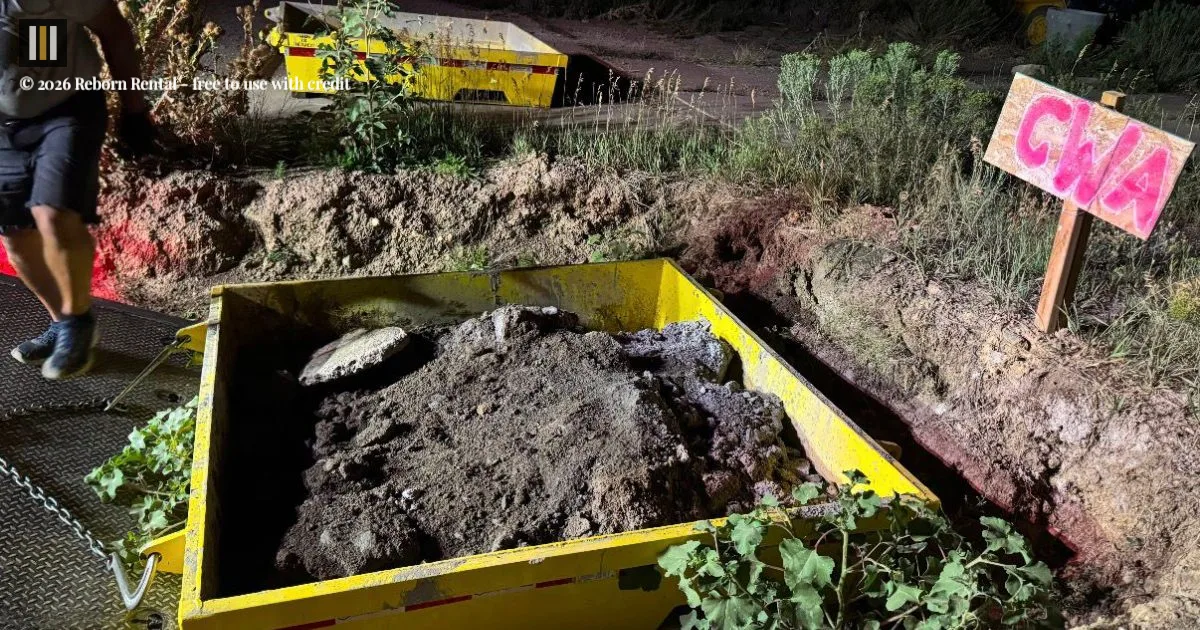
- The 310-Gallon Pan (Small): Measures 72″ × 72″ × 14″ deep. Rental rate: $26/day, $140/week, $532 per 4-week cycle. This low-profile pan is specifically engineered for a Boom Pump hopper, a Line Pump cleanout box, or low ready-mix chutes. The 14-inch side allows equipment to back directly over the lip or discharge flush without building ramps.
- The 441-Gallon Pan (Large): Measures 72″ × 72″ × 24″ deep. Rental rate: $29/day, $175/week, $588 per 4-week cycle. Designed for high-volume jobs where standard ready-mix trucks can drop chutes from a standard transit height. It handles more washes per container cycle, reducing swap frequency on bulk pours.
If you are coordinating specialty pump pours, downtown core shotcrete, or low-overhead parking structure decks, the 310-gallon Small washout pan is the primary container for your site. A 24-inch wall on the 441-gallon Large washout pan offers roughly 42% more liquid volume, but if your pump’s rear hopper dump gate sits 18 inches off the ground, that extra capacity is useless without space-consuming earthen or timber ramps. In tight urban spaces, simplicity beats extra depth every time.
Footprint Engineering: Fitting 72×72-Inch Containment in Alleys and Corridors
In downtown Denver, Boulder, or Colorado Springs, an alley pour often leaves less than 12 feet of total clearance between existing brick commercial facades and your shoring wall. If a pump truck takes up 8.5 feet of width, you have inches to spare. Every square foot of staging must be accounted for on your site logistics plan.
Both our 310-gallon and 441-gallon containers occupy an identical surface footprint: 72 inches wide by 72 inches long (exactly 36 square feet). Because the footprint does not change between capacities, your layout planning remains uniform regardless of project duration. Here is how that layout functions in tight staging zones:
- Direct In-Line Staging: Position the 72″ × 72″ pan directly behind the pump hopper along the centerline of the vehicle. This maintains walking clearance down both sides of the corridor and keeps discharge lines short.
- Lateral Staging: If the alley allows 14 to 16 feet of clear width, position the pan adjacent to the outrigger pads. Keep the pan outside the swing path of any material handlers or skid-steer loaders.
- Under-Boom Reach: When washing out line pumps, you do not need to drag lines across the public sidewalk. Position the pan within reach of your flexible hose bundle, wash the lines directly into the container, and cap the system cleanly.
When staging in narrow driveways or pedestrian corridors, maintain a minimum 3-foot perimeter around the pan to allow workers safe foot traffic without stepping onto the container rim. Never place your washout in a position where ready-mix agitator trucks have to negotiate tight multi-point turns around the container corners.
Zero-Dirt Infill: Protecting Hardscape and Preventing Illicit Discharge
On suburban greenfield sites, contractors frequently rely on a dug pit. On an urban infill site, there is no dirt. The ground is either asphalt, structural topping, concrete sidewalk, or a prepared Base Course. You cannot dig, and you cannot allow any alkaline water to contact the surface.
Concrete washout water has a pH level between 12 and 13, which is corrosive enough to cause chemical burns to skin and destroy aquatic habitats if it enters municipal drainage. Under Colorado Department of Public Health and Environment (CDPHE) stormwater permits, concrete wash entering a city storm gutter constitutes an Illicit Discharge. If slurry penetrates an Impervious Surface or washes across public sidewalks, local inspectors issue immediate stop-work orders and steep fines.
To stage watertight steel pans on hardscape without incurring penalties or property damage, apply these field standards:
- Timber Cribbing and Dunnage: Never set a 3,000-pound loaded steel pan directly onto finished asphalt or architectural concrete. Lay down three parallel 4×4 timber skids beneath the container. This distributes point loads, prevents the steel bottom from sticking to hot asphalt, and allows our winch cable and roll-off hooks to engage cleanly without scarring the pavement.
- Secondary Perimeter Containment: Place heavy-duty weighted sediment logs or rubber spill berms in a ring around the pan, leaving an 18-inch buffer. If an errant chute wash drops liquid outside the steel rim, the berm keeps it on your site and away from the gutter.
- Down-Gradient Storm Inlet Protection: Every urban infill project must maintain active Inlet Protection. Install drop-inlet silt sacks and gravel barriers on every street or alley storm drain within 50 feet of your washout area.
Our heavy-gauge steel pans are completely watertight, eliminating the continuous failure risk seen with poly-lined wooden boxes or corrugated kits that puncture on aggregate stones. When you rent concrete washout pans from Reborn Rental, you eliminate subgrade infiltration entirely.
Pump-Truck Cleanout Controls: Preventing Splash on Adjacent Structures
Cleaning out a concrete pump hopper involves pressurized water, high-velocity slurry, and the discharge of the system sponge ball. On a tight site where an adjacent historical building or curtain-wall window is only six feet away, an unshielded cleanout will splatter finished brick, glass, and public property.
Executing clean, controlled pump-line washouts in tight quarters requires strict crew discipline and physical blast deflection:
- Install a Blast Deflector: Stand a 4-foot by 6-foot sheet of 3/4-inch CDX plywood along the far rim of the washout pan, facing away from the pump. Secure it to the pan’s lifting lugs with wire or clamp it to a steel backer frame. When the pump line discharges the sponge ball or releases backpressure, slurry strikes the wood shield and falls straight into the container instead of misting onto adjacent walls.
- Catch the Blow-Out Ball Safely: Never fire a cleanout sponge ball freely into an open pan. Use a commercial catch-basket or chain tether attached to the line discharge to trap the ball immediately while directing the residual slurry downward.
- Control Water Volume: Operators often run hoses at maximum flow during chute rinsing. On tight sites, use an adjustable shut-off nozzle. Rinsing a pump hopper and chute requires roughly 20 to 35 gallons of water per truck when managed properly. Oversaturating the pan fills capacity unnecessarily and increases the risk of slosh when the pan is moved.
By controlling velocity at the discharge point and using the 14-inch lip of the Small pan, your pump operator cleans the hopper quickly without leaving a single drop of slurry on neighboring properties.
Front Range Logistics: Urban Staging, Swaps, and Site Turnaround
Urban jobsites cannot leave full containers sitting for weeks. When your pan fills to within four inches of the rim, continuing to wash out violates stormwater BMP (Best Management Practice) regulations. You need a dedicated partner who drops, hauls, and swaps containers cleanly without snarling downtown morning deliveries.
Reborn Rental handles container logistics across the entire Colorado Front Range. Our pricing is completely clear and published up front:
- Swap-and-Haul Fee: A flat $300 per pan anywhere inside the C-470 highway loop.
- Beyond C-470: $8.99 per mile per swap outside the loop. (Trips exceeding 200 miles are quoted via dedicated long-haul estimate).
- Rental Rates: Small 310-gallon pan at $26/day, $140/week, or $532 per 4-week billing period. Large 441-gallon pan at $29/day, $175/week, or $588 per 4-week billing period. No long-term contracts.
- After-Hours Flexibility: Standard operational support runs Monday through Friday from 9:00 AM to 6:00 PM Mountain Time. For night pours or weekend lane closures, self-service pickup and drop-off is available with advance notice for a straightforward $35 after-hours fee.
To order a swap, schedule your service online through our concrete washout swap and disposal service. We coordinate hook-truck access directly with your site superintendent to ensure we back into your alley during open delivery windows, winch up the full container, and leave an empty, watertight pan ready for your next pour. We accept all major credit cards, Klarna, Apple Pay, Google Pay, and ACH transfers (no cash).
For complex commercial jobs spanning multiple city blocks, check our full transparent schedule of fees and surcharges before pouring starts so your project accounting remains completely predictable.
Frequently Asked Questions
How much space does a concrete washout pan require on an urban build?
Both our 310-gallon and 441-gallon containers require a clear ground footprint of 72 inches by 72 inches (6 feet by 6 feet). On an urban build, allow an additional 3-foot perimeter buffer where possible so pump operators can work safely around the rim, along with clear overhead clearance for our delivery truck’s roll-off winch equipment.
Can a 14-inch pan be positioned in an alley or narrow driveway?
Yes. The 310-gallon pan has a low 14-inch wall height, making it ideal for narrow alleys, tight driveways, and parking structure entrances. Concrete pump truck hoppers and ready-mix discharge chutes can empty straight into the container without the need for ramps, elevated stands, or excavated ground pits.
How do you prevent slurry runoff on sites with zero dirt perimeter?
To prevent slurry runoff on hardscape, set the watertight steel pan on 4×4 timber dunnage to protect the pavement, surround the containment zone with weighted sediment berms, and install fabric inlet protection inserts into all nearby storm drain grates. Use a plywood blast board during pump blow-outs to stop overspray from leaving the footprint.
What is your cancellation policy?
Cancellations are completely free up to 5 business days before your scheduled delivery. Cancellations made after that window are charged 50% of the reservation total, excluding delivery charges.
How far do you deliver from Denver?
We deliver throughout the Denver metro area and the wider Colorado Front Range. Service inside the C-470 loop carries a flat $300 swap rate. Deliveries beyond the C-470 perimeter are billed at $8.99 per mile per swap. Deliveries over 200 miles are priced on a custom long-haul quote.
Can I self-pick-up or self-drop-off on a weekend or outside working hours?
Yes. You can self-pick-up or self-drop-off containers outside standard working hours with advance notice for a $35 after-hours fee. Our standard staffed yard hours are Monday through Friday, 9:00 AM to 6:00 PM Mountain Time.
How can I track my delivery?
Contact our support team with your assigned Order ID. We will check the live GPS location of our driver and provide you with an exact estimated arrival time for your jobsite.
What payment methods do you accept?
We accept all major credit cards, Klarna, Apple Pay, Google Pay, and direct ACH transfers. We do not accept cash payments.
Not sure which pan fits your setup? Call us at (720) 734-9337 — we’ll talk it through and quote you on the spot.