On a busy construction site, a handshake deal for a concrete washout pan can feel fast and efficient, until it isn't. A delayed delivery, a surprise surcharge for rough terrain, or a dispute over damage can stop work and waste time nobody has. Strong contract management isn't just paperwork, it's the control layer that protects your schedule, your budget, and your crew's sanity. These contract management best practices are built for the world, where rentals move fast, conditions change, and nobody has patience for vague terms.
1. Implement Clear Contract Terms and Scope of Work
A rental contract should say exactly what's being delivered, where it's going, how long it stays, and who owns each responsibility. On a construction site, vague language turns into argument fast. If a washout pan arrives and the crew expected a different size, capacity, or setup, the job site takes the hit.
For rental work, clarity means naming the equipment, the rental dates, the delivery point, and any setup conditions before the truck rolls. Reborn Rentals' catalog shows why that matters, since its washout options are listed with specific dimensions and capacity details, including a 72' x 72' x 24' unit at approximately 18.25 tons and about 441 gallons, and a 72' x 72' x 14' unit at about 310 gallons. That kind of specificity keeps the site team from guessing and gives the rental company a clean standard to deliver against.
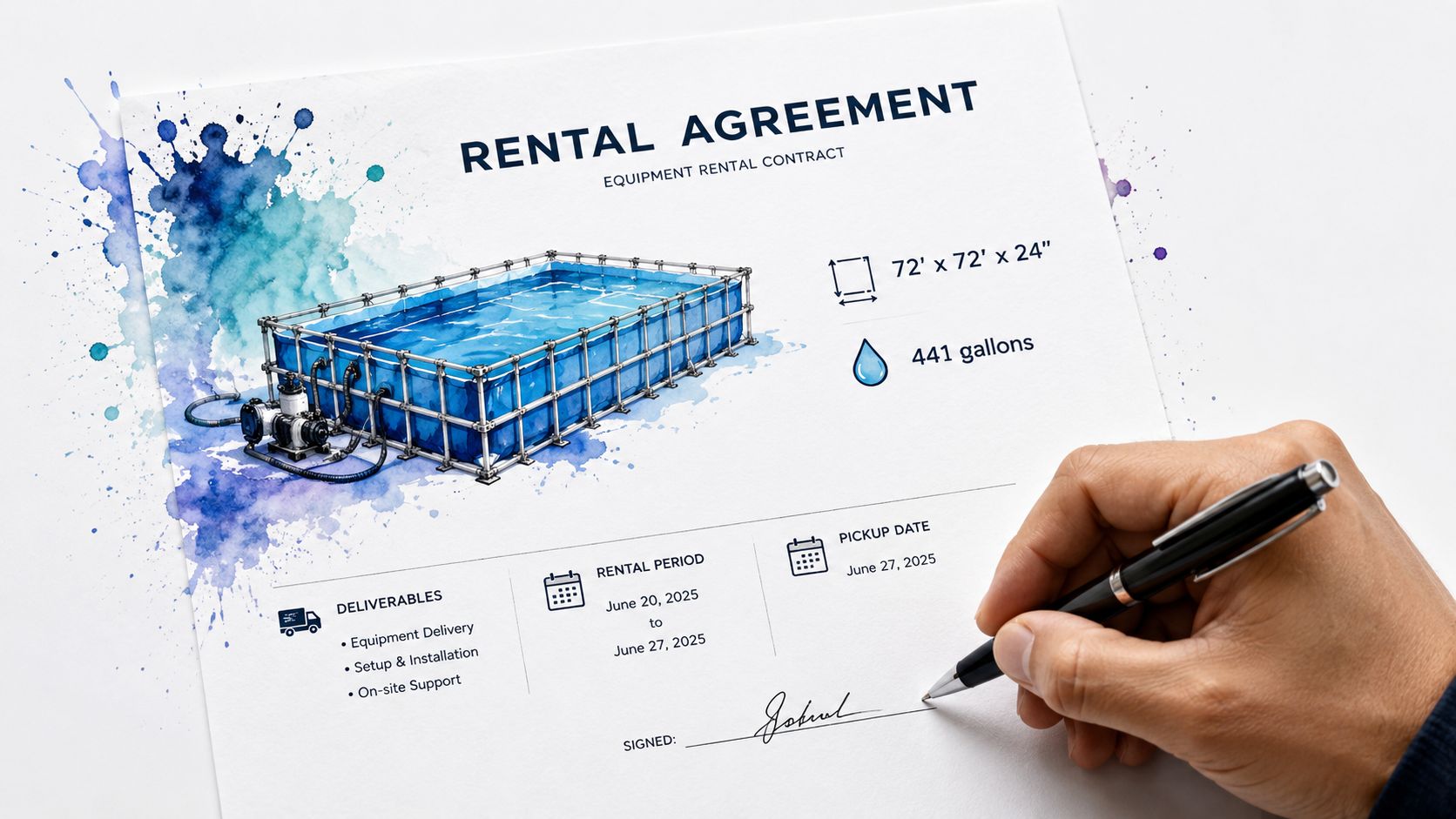
Use the contract as the single source of truth
Practical rule: if the scope isn't written down, it doesn't exist.
That applies to restrictions too. If rough terrain, express delivery, or special placement rules change the price or the timing, those terms need to be visible before the order is confirmed. Site crews don't want surprises, and office staff don't want to chase down what somebody “thought” was included.
A strong template should also leave room for job-specific notes, such as access restrictions, after-hours delivery, or a modified pickup plan. If the crew needs a different setup because another trade is already working in the area, document it before dispatch. That small discipline prevents the kind of misalignment that creates downtime, extra invoices, and avoidable friction.
2. Establish Transparent Pricing and Fee Structures
Construction crews can handle a lot, but they don't handle surprise charges well. If the base rental looks reasonable and the final invoice suddenly includes delivery changes, terrain surcharges, or rush handling fees, trust drops immediately. Transparent pricing makes the commercial side feel as clean as the job site should be.
Reborn Rentals makes this easier by showing daily pricing starting at $25/day and flagging possible added charges for delivery, rough terrain, and express orders. That's the right model for rental contracts because the customer can budget before committing instead of decoding the bill afterward. When pricing is hidden until the last step, you end up spending more time on disputes than on the actual rental.
Put every charge in writing before the order goes live
- Base rate: State the rental price and the billing unit clearly, such as daily or weekly.
- Delivery charges: Explain whether they're flat, distance-based, or tied to access conditions.
- Surcharges: Spell out when rough terrain, express timing, or special handling changes the cost.
- Extra time: Define what happens if the rental runs longer than planned.
- Damage or cleanup costs: Describe how those charges are assessed and documented.
The best practice is simple, give crews and office staff the same pricing picture. If a foreman can see the likely total on the first quote, the back office can approve faster and with fewer follow-up calls. If your billing language is muddy, every rental becomes a negotiation after the fact, and that's a bad way to run a site-facing business.
3. Use Standardized Contract Templates and Forms
High-volume rental work doesn't leave much room for reinventing the wheel every time. A good template gives your team a starting point that already protects the business, while still leaving room for the details that change from one site to the next. That's especially useful when the same kinds of rentals keep coming back, like concrete washout containment, short-term equipment holds, or repeat subcontractor work.
The point isn't to make the contract rigid. It's to make the repeat parts consistent, so your staff can focus on what changes. Legal review still matters, but the frontline team shouldn't be drafting from scratch when a project manager needs a washout unit turned around quickly.
Keep one clean version and train the team on when to use it
A standardized template should include editable fields for customer name, equipment type, dates, location, pricing, and special instructions. It should also carry version control so the crew isn't working from a stale form that misses an updated fee or liability clause. If you're using multiple templates, separate them by service type instead of stuffing every scenario into one oversized document.
Useful habit: if the template keeps getting edited in the field, the template isn't ready yet.
The value shows up on site. A foreman can confirm the rental terms in minutes, dispatch can verify the delivery note, and finance can bill from a clean record instead of chasing down handwritten changes. That's how standardized forms save time without cutting corners.
4. Maintain Comprehensive Contract Documentation and Organization
A contract that can't be found is almost as bad as a contract that was never signed. On active construction jobs, paperwork gets buried under daily noise, and that's where missed renewals, lost approvals, and avoidable disputes start. The fix is simple in concept, centralized storage, consistent naming, and access control by role.
This matters even more because contract-related data is often scattered across an average of 24 different systems, according to the WorldCC research cited in the provided materials. That kind of sprawl makes it hard to track pickup dates, renewal terms, and open obligations in one place. If a rental company, project manager, and finance team all keep their own version of the truth, someone is going to be wrong.
Make retrieval as easy as execution
A practical setup doesn't need to be fancy. It needs to be searchable, secure, and kept current. Use file names that tell staff what they're looking at, then add metadata for start date, end date, customer, equipment type, and renewal status. If your team is still digging through email threads to find the current agreement, the process is already too loose.
- Centralize storage: Keep signed agreements in one system instead of scattered folders.
- Control access: Let operations, sales, and finance see what they need, not everything.
- Set alerts: Flag pickup dates, renewal windows, and payment deadlines before they pass.
- Audit regularly: Remove duplicates, old drafts, and out-of-date versions.
A good document system doesn't just store files, it supports the next action. On a rental-heavy job, that means the right person can confirm the current agreement while the crew is still on site, and that saves real time.
5. Define Clear Performance Metrics and Service Level Agreements
On a construction site, “we'll get it there soon” isn't a service level. Crews need actual expectations for delivery, availability, condition, and response time, because they're planning around concrete pours, inspections, and subcontractor handoffs. If the contract doesn't define performance, every delay turns into a debate about what was promised.
For rental businesses, the most useful SLAs are the ones tied to visible outcomes. That means delivery windows, equipment condition at handoff, support response times, and what happens if the equipment arrives late or unusable. The more concrete the promise, the easier it is to manage both the job and the relationship.
Keep the promise tied to operations, not marketing
Set SLAs that your team can hit on a normal day. If dispatch can't support a short response window on a bad weather week, the promise needs to be adjusted before it becomes a problem. For equipment rentals, define what counts as a failure, who gets notified, and how replacements are handled.
A site manager doesn't care about polished language. They care about whether the pan arrives when the concrete crew needs it and whether someone picks up the phone when the order changes. That's why performance terms should be plain, measurable, and easy to check without a long argument.
Put the service promise in the same place as the delivery note and the billing record. If they don't match, someone will spend the afternoon sorting it out.
The strongest SLA is the one the crew can verify on the spot. If the unit arrives clean, ready, and on time, the contract has done its job. If it doesn't, the contract needs a clear path for correction, not a vague apology.
6. Implement Regular Contract Review, Renewal, and Compliance Audits
Contracts don't manage themselves after signature. On a rental program, somebody has to watch the dates, check the condition notes, and make sure the agreement still matches the job. If nobody owns that follow-up, the business ends up reacting to problems instead of preventing them.
The lifecycle view matters because contract management runs from request through renewal and closeout, not just signature day. That's the difference between an organized operation and a stack of old PDFs. Good teams review contracts before renewal, compare performance against expectations, and decide whether to extend, amend, or walk away.
Build review dates into the workflow
The practical move is to assign ownership. One person should know when a contract is coming due, what terms need checking, and whether the customer has any open issues. For repeat rental customers, renewal conversations should start early enough to discuss changes in scope, schedule, or equipment needs without a last-minute scramble.
A clean audit process should also check whether the returned gear matches the condition documented at delivery. That matters for washout containment and other site-sensitive rentals, where wear, contamination, or misuse can become a real cost. If the return doesn't match the handoff record, the issue should be documented immediately and handled through the contract, not through memory.
- Set reminders early: Give yourself time to review before expiration.
- Track obligations: Check whether both sides met the agreed terms.
- Document findings: Write down issues while the job is still fresh.
- Escalate clearly: Don't let serious non-compliance sit unresolved.
Regular review is how contracts stay useful instead of becoming archive clutter. On a working site, that's the difference between controlled turnover and chaos.
7. Establish Clear Liability, Insurance, and Risk Allocation Clauses
Renting equipment without clear risk language is asking for trouble. On a construction site, things get damaged, moved, contaminated, or used outside the original plan. If the contract doesn't say who carries that risk, the argument starts the minute something goes wrong.
This is especially important for washout containment, because environmental exposure and site cleanup issues can carry real consequences. The contract should say who is responsible for damage, loss, theft, misuse, third-party claims, and any environmental obligation tied to the rental. It should also say what happens if the renter's insurance lapses or the equipment is returned in worse condition than expected.
Make the insurance expectations explicit
If the renter needs general liability, equipment coverage, or pollution-related coverage, say so plainly before delivery. If you need proof of insurance or want to be named as additional insured, that should be part of the order process, not a surprise after the truck leaves. The same goes for definitions like normal wear and tear versus chargeable damage, because that line matters when a unit comes back from a rough job.
Practical rule: the liability clause should read like an on-site checklist, not a legal puzzle.
Use your broker as a sanity check so the contract language aligns with your actual coverage. A rental business can't afford to promise protection it doesn't carry, and a customer can't price the job properly if the risk is hidden. Clear allocation protects both sides and keeps the dispute from turning personal.
8. Create Change Order and Amendment Procedures
Construction work changes. Schedules slip, quantities shift, access changes, and a rental that looked simple on Monday can look different by Thursday. If the contract has no clean way to handle those changes, the team starts relying on verbal updates, and that's where scope creep gets expensive.
A good change order process keeps the original agreement intact while documenting the new request, the business reason, the cost impact, and the approval. That protects the rental company and gives the customer a clean record of what changed. It also keeps billing honest, which matters when a project needs a longer rental period, a different delivery location, or extra equipment.
Don't let field conversations become hidden commitments
Every approved change should be written down. Email is better than memory, and a formal amendment is better than a loose phone conversation that nobody can verify later. For larger contractors, it also helps to define who has authority to request changes, because site crews, coordinators, and project managers don't always have the same sign-off power.
- Reference the original agreement: Tie the change to the contract already in force.
- Describe the change clearly: Say what's different and why.
- State the impact: Show how timing, pricing, or scope changes.
- Get approval in writing: Don't rely on verbal consent.
Change control is where disciplined rental operators separate themselves from chaotic ones. If the crew needs another pan or an extended hold, the process should be fast, but it still needs to be written. Fast without documentation just creates a bigger mess later.
9. Implement Multi-Channel Contract Delivery and Signature Systems
If a site superintendent can approve a delivery by phone but can't sign the contract until they get back to the office, you're slowing the job down for no reason. Modern contract management needs to meet people where they are, whether that's a trailer office, a truck cab, or a laptop. Electronic signature systems remove a lot of friction, especially when the equipment needs to move quickly.
The challenge isn't just getting a signature. It's making sure the contract can be viewed, approved, signed, and stored without a pile of manual steps. When that process is clumsy, people start bypassing it, and that creates risk.
Keep the digital path simple and the fallback available
A strong setup should work on mobile devices, because construction approvals don't always happen at a desk. It should also support more than one delivery channel, such as email, portal links, or QR code access, so the customer can choose the fastest route. If someone still needs paper, keep a backup process ready, but don't make paper the default.
The win is speed with traceability. A signed contract should land in the right repository automatically so operations, finance, and dispatch can all see the same final version. That avoids the classic jobsite problem of one person working from an old PDF while another person is reacting to a newer email draft.
When the signature process is easy, the rest of the rental process gets easier too. Orders get confirmed faster, delivery teams get clearer instructions, and no one wastes half a morning chasing a missing signature.
10. Establish Payment Terms, Invoice, and Collections Procedures
Cash flow matters on every project, but on rental work it can get messy fast if the billing rules are weak. If the contract doesn't spell out payment timing, methods, and late-payment consequences, your office ends up doing detective work after the job is already done. That's a bad use of time and a bad way to manage customer relationships.
Reborn Rentals' model shows why this needs to be front-loaded, since the business pairs clear daily pricing with straightforward checkout. When the customer knows what's due and when, the handoff is cleaner and the invoice has fewer chances to turn into an argument. A strong contract should do the same thing for every rental, not just the easy ones.
Make the invoice match the job
State the payment terms in the contract and repeat them on the invoice. List the equipment, rental dates, pricing unit, and any surcharges so there's no confusion about what the customer is paying for. If you accept card, ACH, or check, make that visible early so the payment process doesn't stall after delivery.
A good collections process should be firm, but not sloppy. Send invoices promptly, track overdue balances, and define what happens if payment doesn't come through on time. For recurring or multi-day rentals, billing on a schedule can be cleaner than waiting until the very end, especially when the site is still active and the agreement is still changing.
Practical rule: billing problems get worse the longer you wait to name them.
The best payment procedure is the one customers can understand without a call to accounting. That cuts down disputes, speeds up collection, and keeps the rental side of the business moving.
10-Point Contract Management Best-Practices Comparison
| Item | Implementation complexity | Resource requirements | Expected outcomes | Ideal use cases | Key advantages |
|---|---|---|---|---|---|
| Implement Clear Contract Terms and Scope of Work | Low–Medium (requires careful drafting) | Legal input, product/spec data, time to draft | Fewer disputes; clearer deliverables and billing | Complex equipment rentals; long or high-value jobs | Reduces ambiguity; provides legal protection; sets expectations |
| Establish Transparent Pricing and Fee Structures | Low (policy and communication) | Pricing analysis, website/checkout updates, documentation | Fewer billing surprises; improved customer trust | Variable-cost services; consumer-facing rentals | Predictable costs; better customer confidence; simpler disputes |
| Use Standardized Contract Templates and Forms | Medium (initial legal setup) | Lawyer review, template library, version control | Faster execution; consistent terms across customers | High-volume transactions; repeat customers | Speeds contracting; reduces legal review costs; consistency |
| Maintain Comprehensive Contract Documentation and Organization | Medium–High (system implementation) | Document management/CLM, IT, naming conventions, training | Quick retrieval; better compliance and audit readiness | Multi-location operations; audit/regulatory environments | Improved visibility; reduced missed dates; audit trail |
| Define Clear Performance Metrics and SLAs | Medium–High (metric design & monitoring) | Monitoring/reporting tools, operations, defined KPIs | Measurable service levels; accountability | Time-sensitive deliveries; service-differentiated offerings | Objective performance measurement; dispute reduction |
| Implement Regular Contract Review, Renewal, and Compliance Audits | Medium (process & cadence) | Contract owners, calendar system, audit resources | Optimized terms; early issue identification | Long-term contracts; recurring clients | Prevents unwanted renewals; enables renegotiation |
| Establish Clear Liability, Insurance, and Risk Allocation Clauses | High (legal and insurance complexity) | Legal counsel, insurance broker, verification processes | Reduced exposure to claims; aligned insurance coverage | Hazardous equipment; environmental risk services | Risk mitigation; regulatory and financial protection |
| Create Change Order and Amendment Procedures | Low–Medium (process design) | Change-order templates, approval workflow, billing integration | Controlled scope changes; accurate billing | Projects with frequent scope adjustments | Prevents scope creep; maintains audit trail |
| Implement Multi-Channel Contract Delivery and Signature Systems | Medium (tech & compliance) | e-signature platform, integration, device testing, training | Faster execution; tamper-proof records; remote signing | Remote customers; jobsite approvals; rapid turnaround | Accelerates signing; improves convenience; legal audit trail |
| Establish Payment Terms, Invoice, and Collections Procedures | Medium (policy + systems) | Accounting system, payment gateways, collections workflow | Predictable cash flow; fewer late payments | Recurring rentals; B2B accounts | Ensures timely payments; reduces disputes; financial control |
Turn Your Contracts Into Project Assets
Effective contract management is more than a defensive habit, it's a practical way to keep jobs moving, protect margins, and reduce the kind of confusion that drains crews and office staff alike. In construction rental work, especially with concrete washout containment and other site-critical equipment, the contract should do more than satisfy legal requirements. It should tell everyone what's being delivered, what it costs, who's responsible, and what happens when the plan changes.
The biggest mistake is treating contracts like paperwork that gets filed and forgotten. The better approach is to use them as working tools. That means writing down the scope clearly, standardizing the repeat terms, documenting changes, tracking renewal dates, and handling payment before billing turns into a fight.
The same discipline also helps with site control. Crews know what's coming. Dispatch knows where it's going. Finance knows what should be billed. And management gets fewer surprises, which is the whole point.
The broader market is already moving in that direction. CLM use is common in major legal departments, and organizations continue to invest in contract software, but many still run hybrid workflows with manual steps and scattered documents, which is exactly where errors creep in (contract management software adoption data, Zoho's state of contract management survey). The opportunity isn't just buying software. It's using it to tighten the way your team works in the field.
Start with the biggest weak spot in your current process. If your scopes are fuzzy, fix that first. If your renewals slip, build a calendar. If your billing gets messy, tighten the payment terms. Small improvements in the right place will do more than a big redesign that nobody uses.
Reborn Rentals helps construction teams handle concrete washout containment with clear specs, upfront pricing, and a simple checkout flow that fits the pace of the jobsite. If you want rentals that are easier to contract, easier to track, and easier to bill, visit Reborn Rentals and see how their process can support cleaner, more reliable site operations.