You're standing on a job where the old slab is already busted out, the haul truck is waiting, and someone's asking the question that decides the next two weeks of work, do we stockpile the rubble, crush it, or send in virgin aggregate and move on. That's the moment where crushed concrete road base stops being a recycling idea and becomes a field decision about cost, drainage, compaction, and how much risk the superintendent wants under the pavement.
What Crushed Concrete Road Base Actually Is
The pile at the edge of the site looks like rubble until the processor gets done with it. After the slab comes out, the concrete gets sorted, stripped of obvious trash, crushed, and screened into a graded recycled concrete aggregate that can work as a base layer instead of random fill. That difference matters, because one load behaves like structure and the other behaves like a problem.
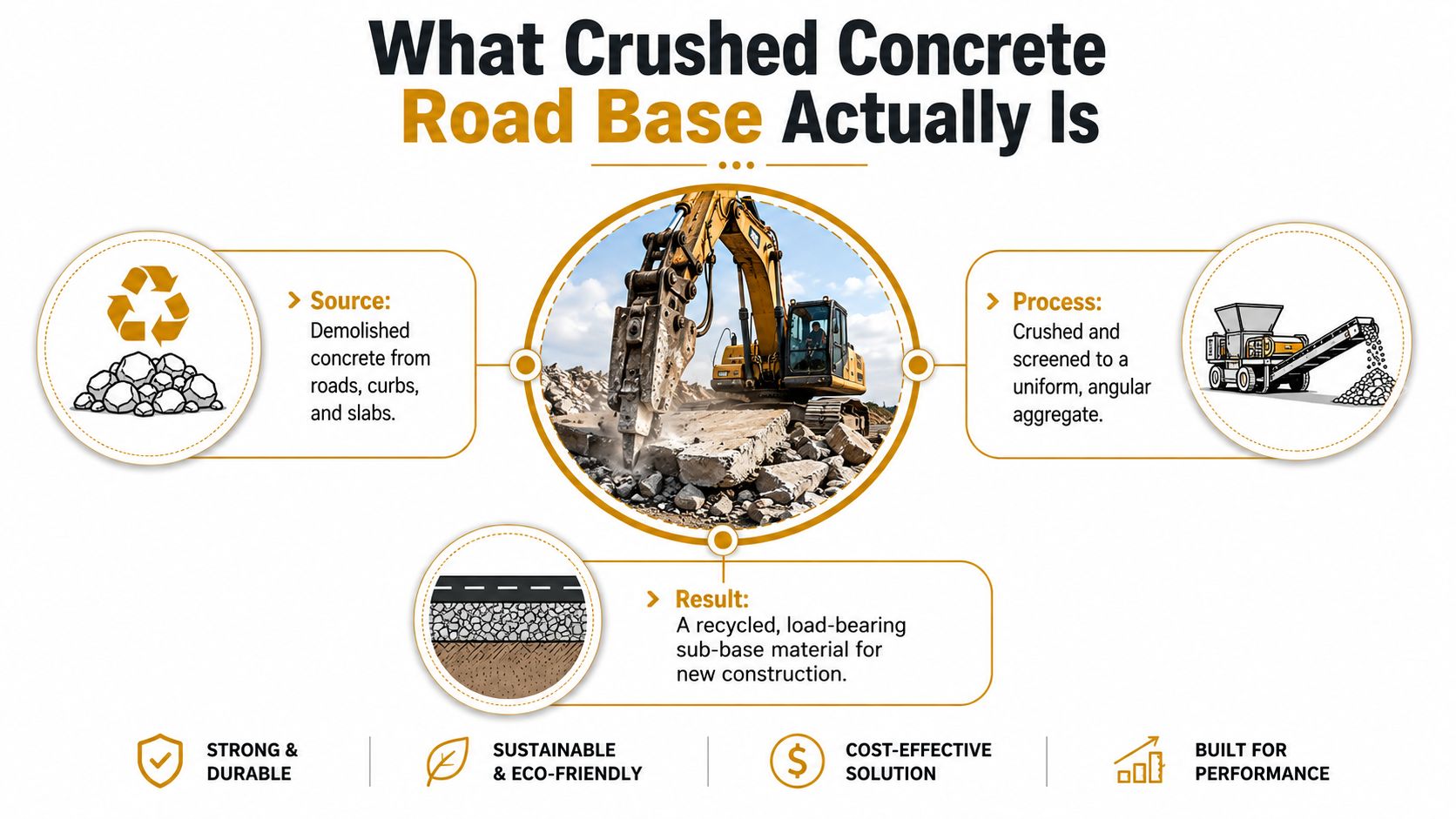
From demolition waste to a usable base
A good load starts with clean source material. Roads, curbs, and slabs get broken out, then the recycler removes obvious contaminants like wood, glass, and metal before the concrete runs through crushers and screens. The target isn't just “small pieces,” it's a well-graded angular aggregate that can lock together and compact into a stable layer.
Practical rule: if the ticket says crushed concrete road base but the pile looks like mixed demolition debris, treat it like suspect material until you verify the processing and contamination controls.
That processing step is why contractors who treat crushed concrete like spoil get soft, inconsistent bases. Contractors who treat it like aggregate get a structural layer with useful interlock and predictable placement.
What you should expect on a delivery ticket
For base work, a common profile is 1 1/2-inch-minus material, which means the material is screened so it passes a 1 1/2-inch sieve and includes the fines needed for compaction. A technical listing for this type of base notes compacted density around 120–135 lb/ft³, moisture content around 8%–12% for effective field compaction, and less than 1% deleterious material such as wood or glass (Gravel Shop technical profile).
That's the practical point. A clean, processed product behaves like a base course. Untouched rubble behaves like a liability.
Technical Specs and Gradation That Matter
On site, the argument usually comes down to whether the material will knit under a roller or cut under traffic. That depends on gradation, particle shape, fines content, and how much adhered mortar is still on the aggregate. If those pieces are out of balance, the base can look tight on top and still fail below.
What the lab sheet should tell you
Good crushed concrete road base is usually specified as angular, well-graded material with controlled moisture and a fines fraction that helps the mass lock together instead of turning it into soup. The angular shape matters because it creates interlock. The fines matter because they fill voids. Too many fines, though, and drainage suffers, with pumping risk going up.
FHWA guidance on reclaimed concrete material reports specific gravity of about 2.2 to 2.5, absorption of about 2% to 6%, pH often above 11, Los Angeles abrasion loss of roughly 20% to 45%, and CBR values of about 94 to 148 (FHWA reclaimed concrete material guidance). Those figures do not read like marketing copy. They read like a material that can perform well if you understand it before placement.
A high-absorption base is not a reason to reject the load by itself. It is a reason to control moisture, drainage, and lift thickness with more discipline. On a tight job, that usually matters more than chasing a perfect-looking pile.
How to read the spec in the field
If you are buying the load, the supplier should show a gradation curve, a plasticity check on the fines where local spec requires it, and evidence that the material is not loaded with concrete chunks so large they leave voids between passes. The particle shape should be visibly angular, not rounded like river gravel. That angularity is what gives shear resistance and keeps the base from rolling around under repetitive loads.
| Property | Typical Range | Why It Matters |
|---|---|---|
| Sieve sizing | 1 1/2-inch-minus | Helps the material lock together and compact |
| Compacted density | 120 to 135 lb/ft³ | Indicates a dense, workable base layer |
| Moisture content | 8% to 12% | Supports field compaction without pumping |
| Specific gravity | 2.2 to 2.5 | Signals adhered mortar and lower density than virgin rock |
| Absorption | 2% to 6% | Tells you the material will drink water and needs moisture control |
| pH | Often above 11 | Matters for environmental and drainage considerations |
A delivery that looks too dry, too wet, or too coarse to knit will not improve because the lab sheet looks good. The roller will show what the material can really do.
Where Crushed Concrete Road Base Works Best
Crushed concrete road base earns its keep where the project needs a firm working platform and the surface course is going to do the final work. It fits temporary haul roads, parking lots, industrial yards, and base layers under asphalt or concrete pavements. It is not a drop-in replacement for every aggregate class, but in the right place it gives you a practical base at a sensible cost.
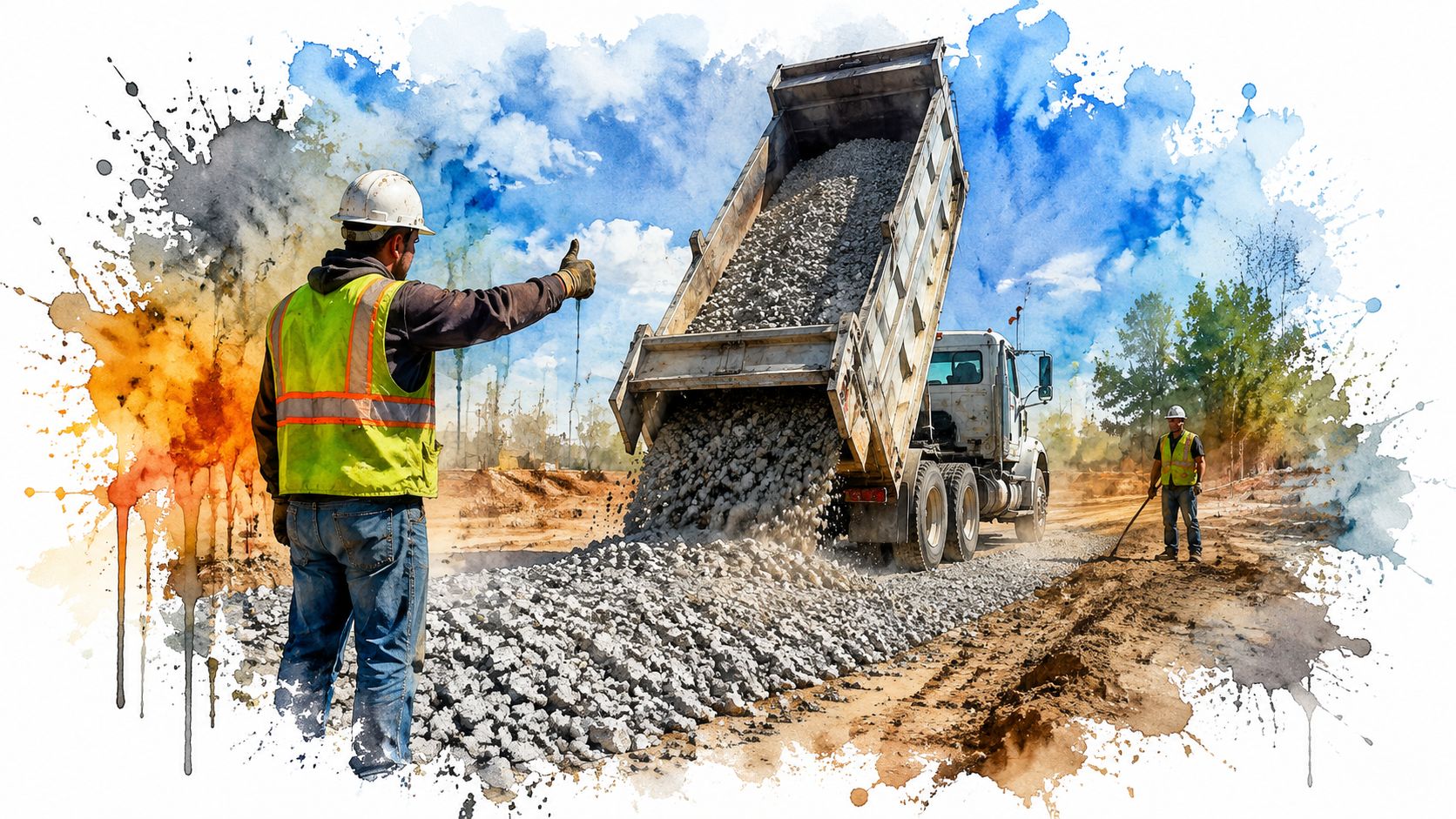
Best-fit jobs and where the trade-off pays
On industrial yards and access roads, the main advantage is stiffness with lower material cost. On parking lots, it gives the asphalt a stable platform so the top course is not trying to bridge weak support. On haul roads, its angular particles help it hold together under repeated truck traffic, provided the crew keeps water moving away from the section and does not overbuild soft subgrade.
That acceptance is not just field habit. The USGS circular noted that by 2004, 38 of 50 U.S. states were using crushed hydraulic cement concrete in base aggregate applications, which shows the material had moved into mainstream infrastructure practice. The same circular also reported that in 1997 about 95 million tons of crushed cement concrete were being substituted for construction aggregates, equal to roughly 4.8% of total aggregate consumption that year, with 85% of that material going into road base and others (USGS circular).
Where virgin aggregate still wins
Virgin aggregate still makes sense when the project has little tolerance for variable absorption, when the specification is strict, or when the owner wants the most predictable source material with the fewest acceptance questions. Cement-treated base and asphalt-treated base can outperform recycled concrete in some structural or moisture-sensitive situations, but those options usually bring more processing, more cost, and more mix-control risk.
Bottom line: use crushed concrete road base when the site can support normal recycling trade-offs and you want a strong base layer under a pavement system. Keep virgin aggregate in play when drainage, compliance, or uniformity matters more than initial savings.
For a simple subbase under a lot or local road, crushed concrete often pencils out well. On a structure with tight drainage tolerance or a weak outfall path, the cheaper material can become the expensive mistake.
Designing Thickness and Layer Configuration
A road base fails early when the section is built for the aggregate instead of the traffic and the subgrade. Thickness has to match the load path below it, and the layer build has to give the base room to compact without trapping weak pockets. A light-duty access lane can tolerate a leaner section than a truck corridor, but both still need enough depth to spread wheel loads and protect the soil underneath.
Matching the build to the job
For driveways and light parking areas, a thinner section can perform well if the subgrade is firm and the site drains properly. The key question is whether the soil will hold shape after repeated wetting and drying. If the subgrade pumps, the base thickness alone will not save the pavement.
For local roads and commercial lots, the section needs enough depth to resist rutting under repeated wheel loads. That usually means planning the base as a structural layer, not just a working platform. For haul roads and heavy industrial use, add subgrade preparation, more careful lift control, and enough thickness to avoid pushing stress straight into the soil.
The field record supports that approach. A Transportation Research Record summary described five projects totaling approximately 310,000 square yards of pavement built with recycled crushed concrete bases, and those pavements were reported as strong, stable, and economical, with performance equal to or better than standard granular base materials (Transportation Research Record summary). The same record reported an average CBR of 148, which points to a very strong base-course material and helps explain why the layer can work when the section above it is designed correctly.
Layering that keeps the section honest
A sound section goes in compacted lifts, not in one deep placement that looks good at first pass and stays soft underneath. Crews should place the material over an improved subgrade or separation layer where conditions call for it, then build the base in lifts the roller can densify. That keeps the section uniform, which matters more than speed when the subgrade is marginal.
- Light-duty areas: build enough base to support the surface without overworking the subgrade, then proof-roll before paving to confirm the section is carrying evenly.
- Medium-duty lots and local roads: use multiple compacted lifts so the roller reaches the full depth of the section and does not leave a dense crust over loose material.
- Heavy-duty haul routes: separate weak soils from the base, and avoid one oversized lift that becomes a hidden plane of weakness.
Layer configuration is where recycled concrete either earns its keep or gets blamed for a bad section. The material can be perfectly acceptable and still fail if the lift plan is sloppy, the subgrade is soft, or drainage is ignored. A cheap base that moves under the first wet season is not a cheap section.
Compaction and Installation Best Practices
A base can meet spec on paper and still fail in the field if placement is rushed. I have seen good material go soft because it was dumped too thick, left to dry out, or rolled before the moisture was right. The target is a dense, interlocked platform that carries load and sheds water, not a hard-looking crust over loose stone.
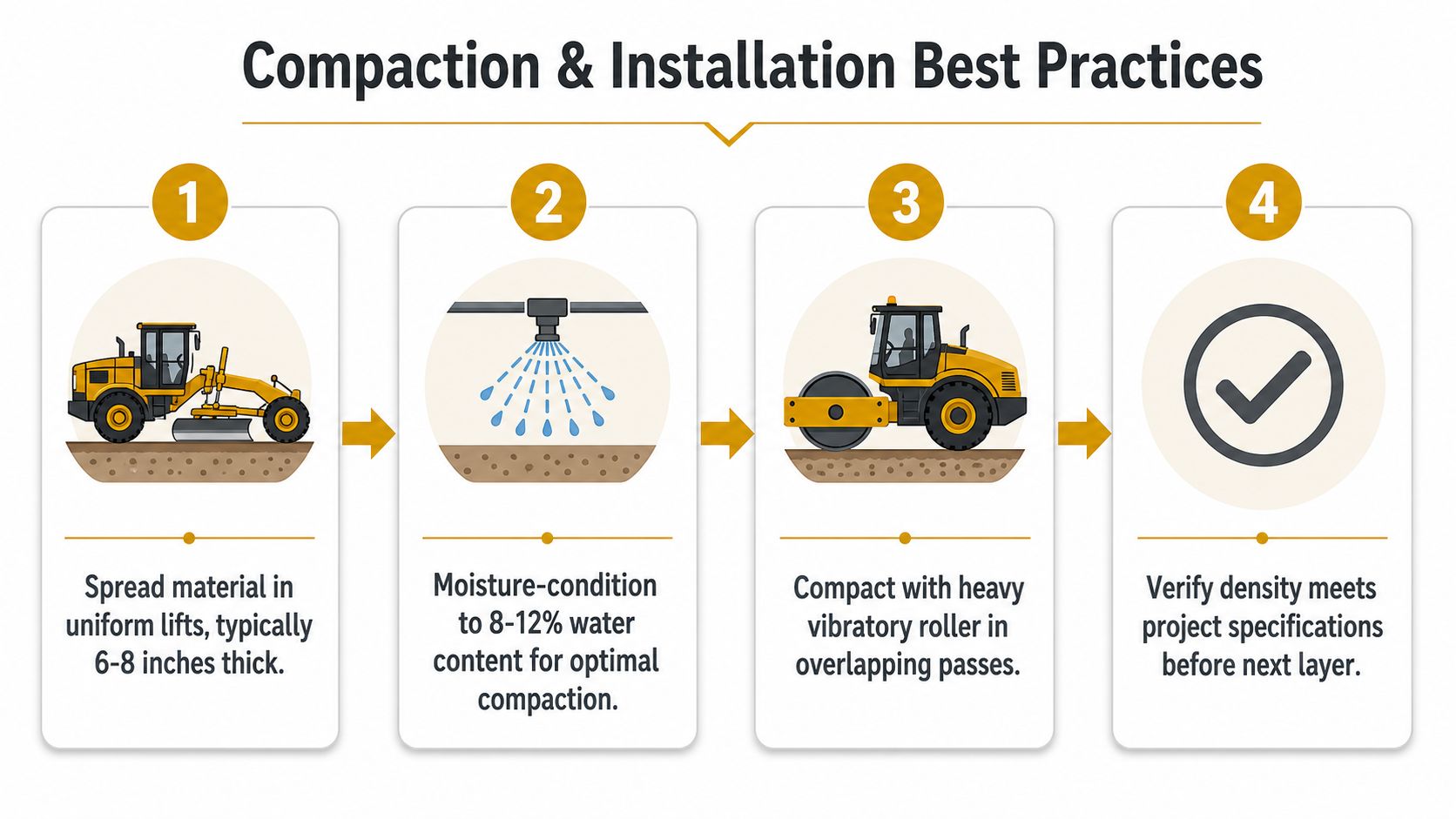
Keep the lift thickness under control
Spread the material in uniform lifts so the roller can work through the full depth. If the lift is too thick, the top tightens up while the bottom stays open. That hidden loose layer is where later settlement starts.
Field crews usually do better when they place the base in manageable compacted lifts and work from the bottom up. If the surface starts raveling or the roller leaves a wave instead of a firm mat, the lift is usually too dry, too thick, or both. The fix is on the placement side, not by adding more passes and hoping the section improves.
Moisture is a structural variable
Moisture control matters because crushed concrete does not behave exactly like virgin aggregate. It carries adhered mortar, so it can absorb and hold water differently from clean stone. FHWA notes absorption of about 2% to 6% for coarse reclaimed concrete material, and particle size affects mortar content and density (FHWA reclaimed concrete material guidance). On site, that means the material can pull water from itself and from the subgrade, so the grader operator and water truck have to stay in step.
- Too dry: the roller will not lock the particles together, and density comes up short.
- Too wet: the base pumps, fines migrate, and the section loses support.
- Just right: the layer tightens under vibration and stands up under proof rolling.
Field rule: if the first pass of the vibratory roller throws dust or leaves the surface loose, stop and correct moisture before chasing density with more passes.
Finish with proof-roll discipline
After compaction, proof-roll the section before the next layer or paving operation. The point is to catch soft spots, pumping, or deflection while access is still easy. A weak spot that gets paved over turns into a repair problem for someone else, and it usually shows up when the road is already carrying traffic.
Testing and Quality Assurance on the Job
The first bad truck should not become the first bad lane. QA on crushed concrete road base starts at the source, because a pile can look workable and still carry the wrong gradation, excess absorbed water, or debris that should have been screened out before it ever reached the grade.
The tests worth asking for
Start with gradation. If the particle size spread is wrong, the base may bridge in spots, stay open in others, or refuse to compact into a tight section. Add Atterberg limits when the fines content or project spec raises a plasticity question, because recycled concrete with too many active fines can behave differently under moisture. Ask for CBR when the project needs a structural benchmark, and check LA abrasion when you want a durability read on how the aggregate will stand up under traffic and handling.
For durability, use credible source data, not supplier assurances alone. The Transportation Research Record summary reports mean Los Angeles abrasion values of 36.5%, a standard deviation of 3.6%, and magnesium soundness averaging 3.75 with sample loss averaging 9.8% and ranging from 4.4% to 14.5%. Those figures do not guarantee field success, but they show why processing consistency and source control matter before material gets accepted.
A practical sampling routine
Do not wait until the stockpile is nearly gone before checking it. Pull samples from the first loads, then keep sampling as the source, crusher settings, or mix of incoming concrete changes. Keep split samples on hand so the field team and supplier can compare the same material if a question comes up later.
A clean paper trail saves time when a load looks off. Delivery tickets, lab results, source notes, and rejection records should stay together so the superintendent can trace a problem without guessing.
- Sample regularly: take material from the first loads and keep checking as the source changes.
- Reject visibly bad loads: wood, gypsum, metal, asphalt chunks, and obvious trash do not belong in base.
- Hold documentation: keep lab results, delivery tickets, and source notes together so problems can be traced quickly.
If the recycler cannot show recent test data and a clear processing spec, the contractor is carrying the quality risk instead of the supplier.
QA is not paperwork for its own sake. It is the check that keeps the owner from paying for material that never should have been compacted into the road in the first place.
Drainage, Environmental and Long-Term Performance
Recycled concrete gets oversold. It can make a good base, but it does not change the drainage problem or the way water moves through a section. Once a base stays wet too long, absorption, fines content, and chemistry start to matter more than the pitch from the supplier.
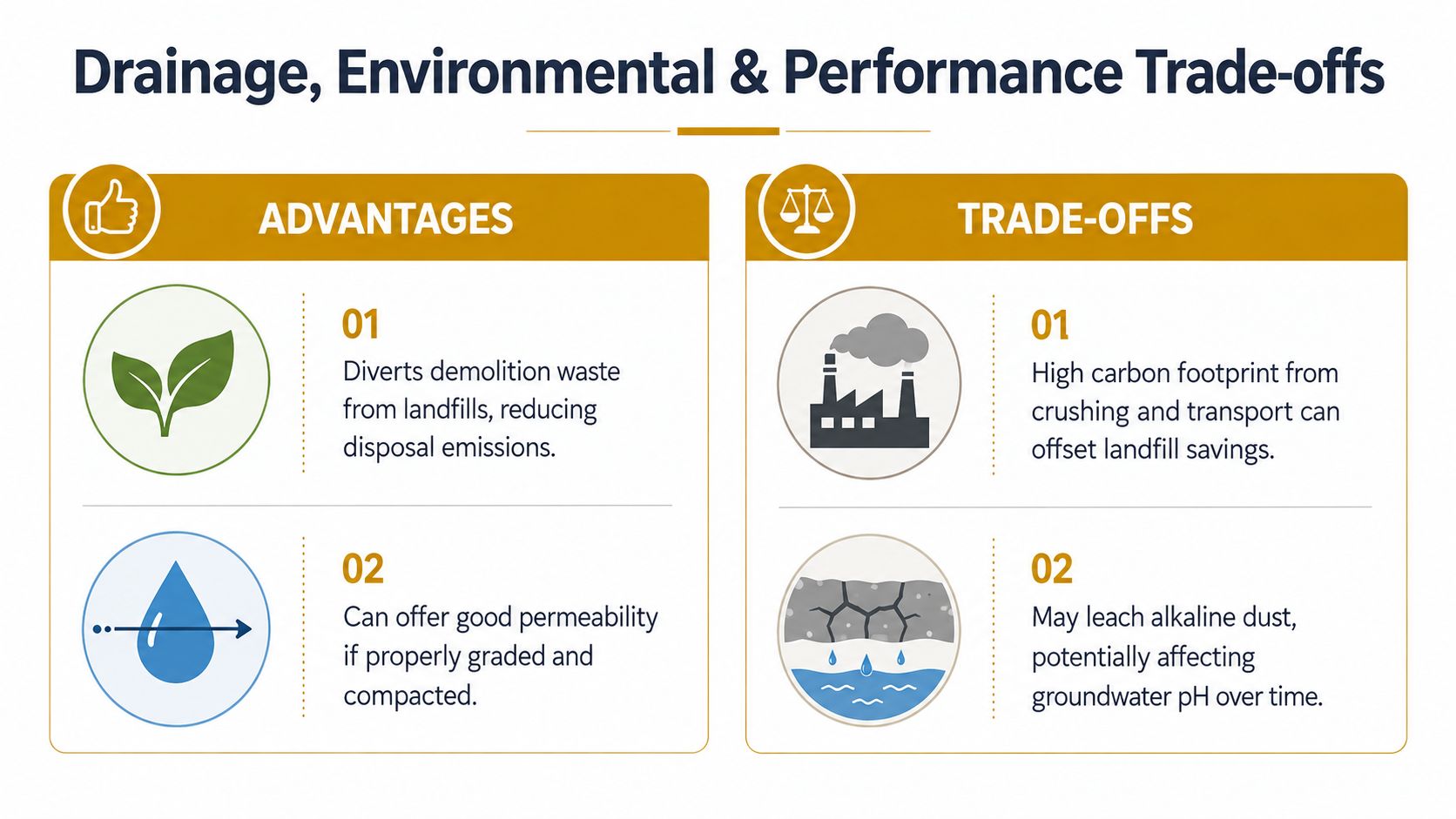
Drainage details that protect the section
A road base that traps water shortens its own life. Keep the crown and crossfall working the way the design intended, make sure edge drains stay open, and use separation geotextiles where finer soils could migrate into the base. Those details reduce pumping and help the section shed water instead of holding it.
The sustainability review from Frontiers notes that recycled concrete is used in base and subbase applications, while also pointing to the need to understand permeability, erosion control, and long-term behavior in right-of-way settings (Frontiers sustainability review). That is a field issue, not just a design note. Wet shoulders, saturation, and freeze-thaw cycles show weak drainage faster than a lab report can.
A base can look fine at placement and still fail in service if water has nowhere to go. That is why drainage detailing belongs in the same conversation as gradation and compaction, not as a separate cleanup item after the section is built.
Environmental trade-offs without the marketing gloss
Recycled concrete can keep demolition material out of disposal streams and reduce the need for fresh quarry extraction. It can also create alkaline dust and runoff concerns, because reclaimed concrete material is often strongly basic, with FHWA guidance noting high pH behavior in the material (FHWA reclaimed concrete material guidance). That does not rule it out. It means the drainage plan, discharge path, and permit conditions need to match the material.
If the site sits under a SWPPP, the crew should treat stockpiles, runoff paths, and exposed base as part of the environmental scope. That includes where water leaves the pad, where fines can wash, and where the material will sit before the next lift goes down. The long-term gain comes from pairing the recycled base with a section that moves water away instead of trapping it in the structure.
Sourcing, Cost and Maintenance in Practice
A good supplier saves time before the first truck rolls. Ask for a named spec, recent lab data, and a chance to inspect the stockpile before you commit. If the source is mixed, the processing is casual, or the documentation is thin, any price advantage can disappear fast.
What to ask before you buy
The right source should be able to tell you how the material was processed, what contaminants are controlled, and whether the product was screened to a specific base gradation. That matters more than a generic promise that “recycled concrete works.” Clean processing is what turns old pavement into a base that crews can build with.
Cost usually helps the bid when the plant is close and the quality is consistent. If haul distance stretches out or the material needs extra cleanup, the savings shrink. That's why the supplier check should happen before the estimate is locked.
What to watch after opening to traffic
The first wet season tells you whether the section was built right. Watch for rutting, edge breakdown, and raveling in the wheel paths. Keep drainage paths open and re-grade early if the surface starts to wander.
A base that stays dry and drains cleanly will forgive a lot. A base that holds water won't forgive much at all.
For the superintendent, the decision framework is simple. Specify crushed concrete road base when the source is clean, the gradation is controlled, and the drainage detail is real. Walk away when the supplier can't prove those things.
If you need to keep a concrete crew moving while you handle the messy parts of washout containment and site logistics, Reborn Rentals can help you stay organized and compliant without slowing down the job. Visit Reborn Rentals to see washout solutions that fit active construction sites, scheduled pours, and short-term project needs.