The truck is on time. The delivery still fails.
You've probably seen the version where the driver reaches the address, checks in at the gate, and then everything breaks down in the last few minutes. The laydown yard is full. The foreman thought the pan was going near the pump, but the pump moved. A trench cuts off the approach. The only forklift on site is busy unloading rebar. On the dispatch screen, it looked like a clean stop. On the jobsite, it was never workable.
That gap is where most delivery route planning falls apart for heavy equipment rentals. Consumer maps can get a driver to the street. They can't tell you whether the truck can swing into the active side of the site, whether the ground will support the offload, or whether the drop zone still exists when the truck arrives. For bulky equipment, the route is only half the job. The other half is staging, access, timing, and offload control.
Most route planning content still centers on distance and traffic. It misses non-driving time, even though for heavy equipment logistics that's often what decides whether a stop succeeds or burns half the day. As DispatchTrack's route planner best practices note, the best route isn't just about drive time. It also has to account for service time and detailed stop notes.
Beyond the Map A New Approach to Delivery Planning
A washout pan delivery can go wrong without a single bad turn.
We've seen trucks arrive exactly when promised and still sit idle because the site contact gave the office a billing address instead of the actual gate, or because nobody checked whether the drop area was reachable from the truck path. That's the kind of mistake that looks small in dispatch and turns expensive on site. The truck is there. The equipment is there. The crew is there. But the delivery isn't complete.
Heavy rental deliveries force a different standard for delivery route planning. You're not sending cartons to a loading dock with a fixed process. You're sending bulky equipment into a moving work zone where access roads change, concrete trucks stack up, and the right drop point at 7 a.m. may be the wrong one by 10 a.m.
The route that wins on a screen can lose on a slab.
That's why a workable plan starts with field reality, not software. Before dispatch touches stop sequence, someone has to verify where the truck enters, where it waits, how it turns, who receives the load, and what equipment is available to place it. If you skip those questions, the map will still give you an answer. It just won't give you the right one.
A better approach separates the job into four practical decisions:
- Can the site physically receive this load? Think access width, turning room, ground conditions, overheads, and active work zones.
- Is the assigned vehicle the right one? The load may fit on paper but still be wrong for the site approach or offload method.
- Does the schedule reflect site operations? A narrow delivery window means little if the signaler, forklift, or superintendent isn't available when the truck arrives.
- What happens when the site changes mid-day? Good planning expects disruption and gives dispatch options before the first call comes in.
When you run delivery route planning that way, you stop treating the stop as a pin on a map. You treat it as a field operation.
Pre-Delivery Site and Load Assessment
A driver can leave the yard on time and still lose the job in the last 50 feet.
That happens on construction sites every day. The truck gets in, then waits on a muddy access road because the gate changed, the forklift is tied up, or the crew points to a drop area that blocks traffic. For washout pans and other bulky rentals, the problem usually starts before dispatch builds the route. It starts with weak site and load information.

Read the load like an operator, not a catalog
A washout pan changes the plan because of how it handles on site, not because of how it looks on an order sheet. The footprint affects turning room. The weight affects truck choice, ground conditions, and offload method. The final placement affects whether the site can keep working after we leave.
That is the standard to use on every order review.
A good pre-delivery check covers four points:
- Footprint and height: Wide or tall units create problems at gates, around temporary fencing, near parked equipment, and beside stacked material.
- Empty handling weight: Even before the pan is used, the truck and the offload area need to support the load safely.
- Working position after placement: A pan set in the wrong spot creates a second move, and second moves cost time, labor, and patience on a busy site.
- Pickup condition later: If the unit will come back loaded with slurry and debris, plan retrieval access at drop-off. Do not leave future pickup to guesswork.
We learned long ago that “it fits on the truck” is only the first screen. The harder question is whether the truck can place it where the customer needs it without blocking a pump lane, crane path, material delivery, or crew access.
Run a real site check
A street address gets your driver near the project. It does not get the load set.
Site assessment for heavy rentals should answer the field questions the driver will ask at the gate and at the drop point. If those answers are missing, dispatch is building around assumptions.
Confirm these items before you lock the stop:
- Actual entry point: Gate number, approach side, and any approach restrictions for the assigned vehicle.
- Current site conditions: Stored material, closed lanes, concrete wash areas, active pours, or excavations that changed access since the last visit.
- Surface strength and condition: Gravel, mud, fresh subgrade, broken pavement, or steel plates all change where a truck can travel and stop.
- Overhead restrictions: Power lines, scaffolding, crane activity, and temporary structures can rule out an otherwise clear approach.
- Receiving contact: Name and phone number for the person who can direct the truck on arrival.
- Offload support: Forklift, lull, crane, signaler, or ground crew, plus confirmation that the equipment will be available during the delivery window.
- Exact set location: A marked drop zone, not a loose instruction like “back by the pour.”
One missing answer can turn a 20-minute stop into a 90-minute one. That extra time rarely shows up in route software, but it shows up on payroll, driver utilization, and customer complaints.
Practical rule: If your notes do not tell a new driver where to enter, where to stage, who to call, and where to place the load, the stop is not ready for dispatch.
A short field checklist that saves trouble
| Checkpoint | What to confirm | Why it matters |
|---|---|---|
| Access path | Gate, turn radius, internal road condition | Prevents arrivals where the truck reaches the address but cannot reach the working side of the site |
| Drop zone | Exact placement area, nearby obstructions | Reduces rehandling, disputes, and wasted site time |
| Offload support | Forklift, crane, signaler, or ground crew | Prevents truck waiting time and unsafe last-minute workarounds |
| Site timing | Receiving window and contact availability | Keeps the stop aligned with site activity, not just the route plan |
Small jobs need the same discipline. Alley access, tenant-occupied buildings, back-lot deliveries, and renovation work can be tighter than a large commercial project.
The point is simple. Distance is only part of delivery planning. For bulky equipment, staging and offloading usually decide whether the stop was profitable.
Mapping the Route and Defining the Schedule
A route can look efficient at 6:00 a.m. and fall apart by 8:30 if dispatch planned for drive time and ignored site time. We see that often with bulky deliveries. The truck is on the right road, but the stop still fails because the gate changed, the access lane is blocked, or the crew is not ready to receive a heavy item.
That is why route planning for construction work has to start with field reality, not just map logic. Trackroad's route optimization guidance lays out a sound sequence: clean and geocode the stop list, add service times and time windows, set vehicle and driver constraints, run the optimizer, then review exceptions before dispatch. That order matters. It forces dispatch to build routes around actual operating limits instead of hoping the field will absorb bad assumptions.
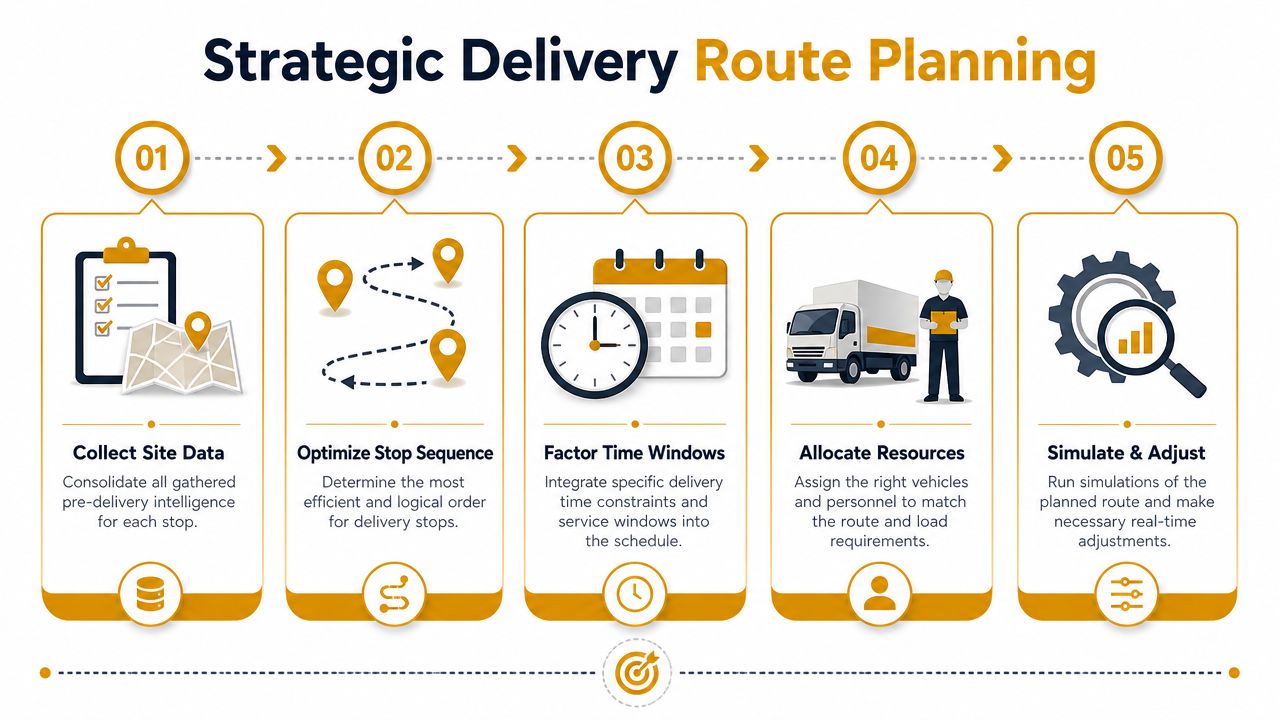
Geocode the receiving point, not just the address
For a construction stop, the street address is usually an administrative detail. The driver needs the approach that works for the assigned truck, the gate that is open that day, and the side of the site where the load can be set.
For washout pans, trench boxes, dumpsters, and other bulky rentals, we often store more than one location reference for the same job. Billing may use one address. The driver may need a different pin for the haul road entrance. The drop may happen at a third point inside the site. If those are not separated in dispatch, the route may be technically correct and operationally useless.
The common planning mistakes are predictable:
Routing to the office instead of the receiving entrance
The truck arrives on site property but still cannot reach the unload area.Using generic service time
The software treats a heavy delivery like a quick parcel stop and compresses the whole route.Assigning the wrong truck
The stop fits a smaller vehicle on paper, but the actual unit needs more turning room, firmer ground, or different unloading support.Stacking stops too tightly
One delayed check-in or blocked lane pushes the rest of the day off schedule.
Build the day around non-driving time
Dispatch teams usually know how long the drive should take. The harder part is pricing the minutes that happen after arrival. On construction work, those minutes decide whether the route holds together.
Use the schedule inputs that affect the stop, not just the road:
- Receiving window: Some sites only accept deliveries before trades crowd the access lanes or before a concrete operation starts.
- Check-in delay: Security, site orientation, and gate control can add time before the truck even moves toward the drop area.
- Offload readiness: If the forklift is tied up or the foreman is elsewhere, your driver waits.
- Street and neighborhood restrictions: Lane closures, school traffic, noise limits, and permit conditions can narrow the workable delivery window.
- Hours and equipment limits: Driver hours, trailer type, axle weight, and load order shape which stops belong on the same run.
Generic route software often falls short. It can calculate travel well enough. It does not know that one washout pan delivery may need ten minutes at the curb and another may need forty minutes because the crane path crosses the only placement area.
A route that works in the field
| Good map output | Field-ready plan |
|---|---|
| Uses the posted address | Uses the gate or approach point the truck can actually reach |
| Applies standard stop time | Includes check-in, staging, waiting, and offload time |
| Chooses the shortest drive | Chooses the sequence the truck and site can support |
| Promises narrow ETAs | Gives windows the driver and site contact can realistically meet |
One tool can improve the starting data. If you're scheduling a washout rental through Reborn Rentals, the checkout flow captures dates and locations early, which cuts down on the usual phone cleanup later. Dispatch still needs to review the stop with a jobsite mindset, but better intake makes the route easier to build correctly.
A workable route survives gate changes, delays, and site friction. If the plan only holds as long as every stop behaves like a clean pin on a map, it is not ready for dispatch.
Executing On-Site Staging and Offloading
The truck reaches the site. Now the route plan has to become a field operation.
This part is where experience shows. A driver who knows how to stage properly can save the stop even when the site is tight. A driver who rushes the last few minutes can turn a routine delivery into a site disruption.

The last 50 feet decide the stop
A smooth offload usually looks uneventful. That's the point.
The driver checks in, confirms the contact, pauses before entering the active work area, and verifies the drop zone with the person who controls that part of the site. Not the person who placed the order last week. Not the laborer waving from across the lot. The person responsible for where that equipment will sit today.
Then comes the staging choice. Sometimes the fastest way in creates the worst offload angle. Sometimes backing in takes a little longer but leaves the load in a safer, cleaner position. Good crews choose the setup that reduces rehandling and keeps site traffic moving.
A reliable offload rhythm
When the stop is heavy or awkward, we use a disciplined sequence:
- Pause at the edge of the work area: Confirm the path is still open and the drop zone still exists.
- Walk the final placement if needed: This catches soft spots, debris, and access conflicts before the truck commits.
- Coordinate hand signals and roles: One signaler. One decision-maker. No crowd instructions.
- Set the equipment where pickup will also be possible: A drop that works today but traps retrieval later creates a second problem.
- Photograph final placement: This protects both sides and confirms the equipment was delivered as directed.
If three people are giving placement instructions, nobody is in charge.
Common site problems and the right response
| Problem on arrival | Wrong move | Better move |
|---|---|---|
| Drop zone is blocked | Try to squeeze into a nearby spot without approval | Stop and get a revised placement from site control |
| Ground looks unstable | Push through to save time | Reassess approach and confirm safe offload area |
| Forklift is unavailable | Wait without updating dispatch | Notify dispatch and contact immediately, then decide whether to hold, resequence, or reschedule |
| Access lane is crowded | Force a tight maneuver in active traffic | Stage outside the lane until the site can receive safely |
A well-run stop also protects the next stop. If a driver burns too much time improvising on one jobsite, the remaining route starts to unravel. That's why clean staging and offloading aren't just driver skills. They're part of delivery route planning itself.
Mastering Communication and Contingency Plans
Communication isn't the soft side of logistics. It's one of the few tools that can prevent a route failure before it becomes expensive.
The route can be well built and the truck can be properly assigned, but if the site contact doesn't know the ETA, the gate team doesn't know the truck is coming, or dispatch waits too long to report a delay, the day gets harder fast. On active construction sites, silence creates idle time.
Industry guidance is moving toward continuous adjustment, not static planning. Descartes notes that route optimization is shifting from pre-day planning to adaptive adjustment using live data, which is essential for handling real-time disruptions and reducing unnecessary mileage while avoiding overtime. That applies directly to heavy jobsite deliveries, where a blocked access road or customer delay can force a quick resequencing decision.
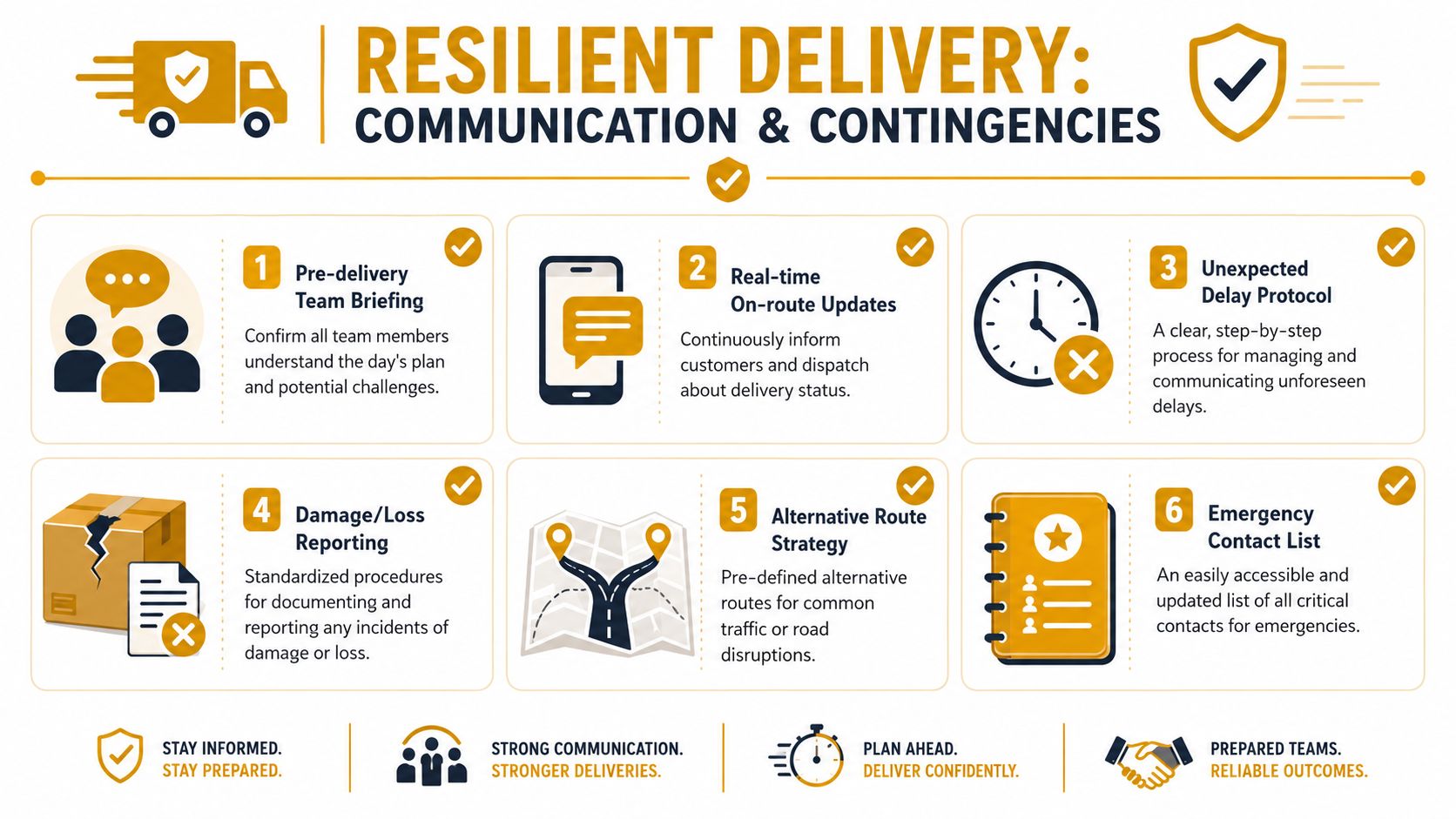
The messages that prevent confusion
You don't need polished marketing language. You need short, usable communication that answers the next field question.
Pre-delivery confirmation
Delivery scheduled for tomorrow. Please confirm gate, site contact, receiving window, and exact drop location. If access, staging, or on-site equipment has changed, send the update before dispatch.
Driver en route
Driver is on the way. Please keep the access path clear and have the receiving contact available on arrival.
Arrival issue
Driver is on site, but the planned drop area isn't accessible. We need site direction on revised placement before offloading.
Post-delivery confirmation
Equipment delivered and placed as directed. Placement photo recorded. Reply if site instructions for pickup will differ from delivery conditions.
These messages work because they reduce assumption. They also create a written trail, which matters when site conditions shift and memories get selective.
Build contingencies before the phone rings
A contingency plan should answer operational questions, not read like a policy memo.
Use a short pre-dispatch checklist:
- Alternative approach: If the main gate is blocked, what's the secondary access point?
- Resequence option: If this stop stalls, which later stop can move up without breaking driver hours or customer commitments?
- Escalation path: Who can approve a revised drop zone or same-day return?
- Proof standard: What photo, note, or customer acknowledgment does dispatch need if the stop changes in the field?
That's where adaptive delivery route planning earns its value. Not by producing a prettier route, but by giving dispatch and drivers a way to protect service when conditions change mid-day.
Calculating the True Cost of Your Deliveries
A lot of teams still judge delivery performance by whether the truck eventually got there. That's too loose.
A heavy equipment stop can be technically completed and still lose money through waiting time, overtime, poor staging, rehandling, or a failed first attempt. Last-mile delivery is already the most expensive and operationally complex part of shipping. One industry summary says its share of total shipping cost rose from 41% in 2018 to 53% in 2024, with first-attempt delivery failure rates of 8% to 20%, and address errors responsible for 45% of failed deliveries, according to SmartRoutes last-mile delivery statistics. That's exactly why stop accuracy and site-level detail matter so much.
Route planning has also become a major logistics technology category. The route optimization software market was estimated at USD 3,729 million and projected to reach USD 12,416 million by 2030, with a projected 11.56% CAGR from 2022 to 2030, based on the research summary cited in Upper's route optimization trends and statistics. The practical takeaway is simple. Businesses keep investing here because reducing mileage, improving dispatch accuracy, and increasing vehicle utilization affect the bottom line.
The KPIs that matter in the field
For day-to-day control, use metrics that connect directly to route quality and site execution. FarEye's route optimization KPI guide points to measures such as miles per route, drive time, stops per driver, on-time delivery rate, overtime hours, cost per stop, and failed-delivery or reattempt rate.
For heavy equipment rentals, those metrics become more useful when you read them together:
- Miles per route: This tells you whether dispatch is controlling travel efficiency.
- On-time delivery rate: This shows whether schedules reflect real field conditions, not just optimistic planning.
- Overtime hours: This often reveals hidden service-time problems faster than route maps do.
- Cost per stop: This exposes which jobsites create repeat friction and whether pricing or process needs to change.
- Failed-delivery or reattempt rate: This usually indicates weak site verification.
Visible cost versus hidden cost
| Cost type | What you see quickly | What many teams miss |
|---|---|---|
| Transportation | Fuel, driver wages, truck time | Time lost in staging, waiting, or rehandling |
| Schedule impact | Late arrival | Knock-on delays to later stops and pickups |
| Site coordination | Extra calls and dispatch effort | Crew downtime while waiting on equipment |
| Delivery failure | Return trip or reschedule | Loss of trust and future scheduling friction |
The hidden cost is often larger on construction work. A delayed washout pan can affect crew flow, placement timing, and site cleanliness expectations. Even when the rental itself is modest, the operational disruption around it may not be.
Track what the route consumed, not just whether the stop closed.
That's where disciplined delivery route planning changes from an admin task into a margin tool. Better site data lowers avoidable failures. Better service-time assumptions reduce overtime. Better communication lowers reattempts. Better offload discipline keeps one bad stop from wrecking the rest of the day.
If you want cleaner numbers, don't start with a dashboard. Start with better inputs and tighter field execution. The dashboard will improve after that.
If you're scheduling washout containment for an active project, Reborn Rentals gives crews a straightforward way to set dates, locations, and delivery details for concrete washout equipment. For contractors managing pours, renovations, or short-term site logistics, that can make it easier to align rental delivery with the actual conditions on the ground.