You buy a new piece of jobsite equipment, put it to work the same week, and the cash is already gone. That part is obvious. What's less obvious is how that cost should show up in your bids, your monthly financials, and your tax records over the years you use it.
That's where an equipment depreciation calculator stops being an accounting side task and starts becoming a management tool. If you run concrete work, earthwork, pumping, cleanup, or site services, depreciation tells you what that asset is costing your business over time. If you skip it, your books can look healthier than the field reality. Your bids can also come in too light.
Contractors usually care about three things here. First, what number belongs in job costing. Second, what method makes sense for taxes. Third, whether the machine or container still earns its keep. Depreciation sits in the middle of all three.
Depreciation Is More Than Just a Tax Term
A project manager usually feels depreciation long before the accountant closes the year. It shows up when a washout pan has been on enough pours that the steel is getting rough, cleanup takes longer, and someone has to decide whether to patch it, replace it, or keep running it one more quarter.
Depreciation puts a cost on that wear in a way the business can effectively use. In plain terms, it spreads the cost of an asset across the years or jobs that benefit from it, instead of letting the purchase invoice distort one period and disappear from the next. For a contractor, that is less about textbook accounting and more about knowing what the equipment is really costing the company while it is in service.
But field decisions happen daily, not just once a year.
What depreciation does for a contractor
For a construction business, depreciation helps answer practical questions that come up in estimating, operations, and ownership meetings:
- Job costing: Are your jobs carrying part of the equipment cost, or are you only billing labor, fuel, and repairs?
- Replacement planning: Is that washout pan still cheap to keep in rotation, or are repairs and downtime starting to beat the value you have left in it?
- Financial reporting: Do your books show a realistic remaining value for the gear you own?
- Tax planning: Does your depreciation method fit the tax treatment you want and the way the asset loses value?
Straight-line depreciation is the method many contractors recognize first. The formula is (Initial Value – Salvage Value) ÷ Useful Life = Annual Depreciation. It gives you the same depreciation expense each year, which makes it easy to budget and easy to explain to a PM who just wants a clean annual ownership number.
Practical rule: If a washout pan, skid steer, trailer, or pump will help produce revenue for several years, part of its cost belongs in the years that use it up.
Why project managers should care
Project managers do not need to run the tax return. They do need to know the difference between cash paid, book cost, and job cost.
Say a washout pan was bought last season and the check is long gone. The pan still carries cost every time it goes out to a job, gets hauled, cleaned, abused by crews, and comes back with less useful life than it had before. If the bid only includes visible operating costs, the job can look profitable on paper while the fleet loses value underneath it.
That is why depreciation belongs in equipment conversations outside the office too. It gives estimators, PMs, and owners a common number to work from when they price work, compare repair versus replacement, and plan purchases without guessing.
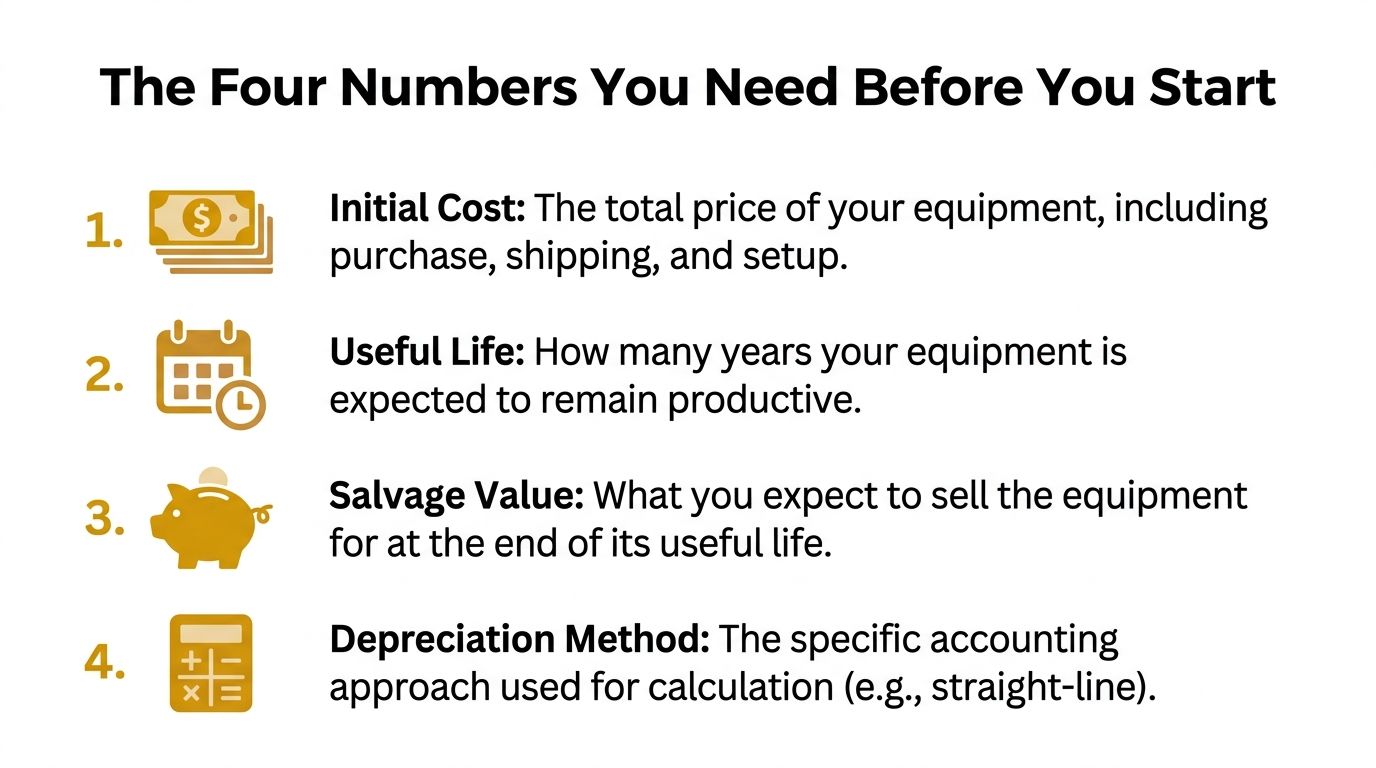
The Four Numbers You Need Before You Start
A depreciation calculator can only give you a usable number if the inputs match how the equipment is bought, used, and retired. On a construction job, that matters fast. If you understate ownership cost on something as simple as a washout pan, the bid looks tighter than it really is.
Before you run any formula, lock down four numbers and make sure the office and field are using the same assumptions.
Initial cost
Initial cost is the full amount it took to place the asset into service.
For a washout pan, that may include the purchase price, freight, and any prep needed before it can go to a site. If accounting books one pan at invoice price only, but another pan includes delivery and setup, your depreciation schedule stops being a clean comparison. The calculator is still doing the math right. The inputs are what broke consistency.
Use the invoice, not memory.
Salvage value
Salvage value is what you expect to recover when the asset is done earning its keep.
For contractors, this number needs discipline. A steel washout pan that has spent years getting dragged, loaded, dented, and patched is rarely worth the optimistic resale number someone throws out in a meeting. Set salvage too high and annual depreciation drops. That makes ownership cost look lighter than it is, which can carry through to job costing and replacement timing.
Base salvage on likely condition at exit, not best-case resale.
Useful life in years
Useful life in years is how long the asset stays productive for your company.
That is different from how long it can physically sit in the yard. A washout pan might last a long time in a strict technical sense, but if it becomes a maintenance headache, fails compliance expectations, or ties up crew time, its useful life to the business is shorter. Stretching the years too far lowers annual depreciation and pushes real cost into the background.
For book purposes, use the period that matches actual service in your operation.
Useful life in units
Some assets wear out by use more than by age. That is where a units-based measure matters.
With heavy equipment, the unit might be engine hours, haul cycles, rental days, or loads handled. For a washout pan, you might track rental turns, jobsite uses, or cleanout cycles if that reflects wear better than calendar years. This number is especially useful when one pan sits in the yard and another is on jobs every week. Treating them as if they aged the same can hide the actual cost of the harder-worked asset.
A quick field-tested check helps keep these inputs clean:
- Pull the actual invoice and any freight or setup charges.
- Set salvage from likely resale or scrap recovery, not optimism.
- Choose a useful life that matches your operation, replacement habits, and abuse level.
- Track usage the same way every time, whether that is days, hours, or cycles.
Get these four numbers right first. Then the depreciation method you choose has a fair shot at producing a number you can use for both bidding and taxes.
Choosing Your Depreciation Method
A contractor can buy the same washout pan, for the same price, and still get two different depreciation schedules depending on what the number needs to do. One schedule may be better for job costing. Another may fit tax reporting. The method changes the timing of the expense, and that timing matters when you are pricing work or planning equipment replacement.
For a construction business, four methods come up most often.
Straight-line
Straight-line is the cleanest option for book depreciation. You subtract salvage value from cost and spread the balance evenly over the asset's useful life.
Using the washout pan example from this article, a $3,500 pan with a $500 salvage value and a 10-year life gives you the same depreciation expense each year. That makes straight-line easy to budget, easy to explain, and easy to keep consistent across a fleet.
It also has a limitation. A pan that gets rented constantly, moved with forks every week, and cleaned out hard after every pour usually does not wear in a perfectly even pattern. Straight-line still works for financial statements, but it can understate the actual cost in heavy-use periods.
Declining balance
Declining balance pushes more depreciation into the early years and less into the later years. That fits assets that lose value faster when they are newer.
I would usually look at this method for higher-value equipment where early resale value drops fast, or where the first few years carry the hardest use and the highest maintenance risk. It is less common for a basic washout pan on internal books, but the logic is still useful to understand. If an asset takes its biggest value hit up front, declining balance shows that better than a flat annual charge.
The trade-off is simplicity. The math and the year-to-year tracking are less straightforward than straight-line, so some contractors reserve it for assets where the timing difference is large enough to matter.
Units of production
Units of production ties depreciation to actual use instead of the calendar. For contractors, this is often the most useful management method.
With a washout pan, the unit does not have to be engine hours. It could be rental days, jobsite uses, pours serviced, or cleanout cycles. If one pan sits in the yard for two months and another goes out on jobs every week, units of production captures that difference. Straight-line does not.
This method gives operations people a number they can use. If the pan costs more to use each time than your bid assumed, the problem shows up faster. The downside is recordkeeping. If crews are inconsistent about logging usage, the output is only as good as the field data.
MACRS for taxes
Tax depreciation is a separate decision. For U.S. federal taxes, many contractors depreciate equipment under MACRS, even if they use straight-line or units of production for internal reporting.
That split is normal. Internal books should help you price jobs, track ownership cost, and decide when to replace equipment. Tax depreciation follows tax rules, not the way your field team burns through an asset.
A practical setup is to keep one schedule for management and one for tax. That avoids forcing a tax rule into a job-costing decision where it does not belong.
Side-by-side comparison
| Method | Best For | What it does well | Main drawback |
|---|---|---|---|
| Straight-line | Financial reporting and simple book schedules | Same expense each year, easy to maintain | Ignores uneven usage |
| Declining balance | Assets that lose value faster early | Puts more cost in the early years | Harder to track and explain |
| Units of production | Job costing and usage-based equipment control | Matches depreciation to actual use | Requires reliable usage records |
| MACRS | U.S. tax reporting | Follows tax recovery rules | Often does not match field reality |
The best method depends on the decision in front of you. If you want a clean annual book number, use straight-line. If the asset's wear is tied to use, units of production usually gives the better management number. If you are closing the tax year, follow the tax schedule required for the return.
Walkthrough Calculating Depreciation for a Washout Pan
A project manager prices a small concrete job, includes labor, trucking, and disposal, then leaves out the washout pan because it was bought last season. That bid still carries the pan's cost. The only question is how you spread it.
Use one pan and one set of assumptions all the way through:
- Initial cost: $3,500
- Salvage value: $500
- Useful life: 10 years
- Usage life for a UoP view: 1,500 rental days
Straight-line calculation
Start with the basic book formula:
(Initial Value – Salvage Value) ÷ Useful Life = Annual Depreciation
With the washout pan:
($3,500 – $500) ÷ 10 = $300 annual depreciation
That gives you $300 per year on the books.
For internal planning, some contractors break that into monthly cost. Others leave it annual and roll it into overhead. Either approach can work. The practical point is simpler. The pan should not disappear from job cost just because the check cleared last year.
Straight-line works best if the pan sees fairly even use across the year and you want a clean, stable number for book reporting.
Units-of-production view
Now price the same pan the way the field uses it.
First, calculate the depreciable basis:
$3,500 – $500 = $3,000
Then divide by expected total rental days:
$3,000 ÷ 1,500 = $2 per rental day
Now you have a number an estimator can use. Every day the pan is assigned to a job consumes $2 of depreciation. If a slab crew needs it for 10 days, that job should carry $20 of depreciation from the pan.
For a washout pan, this is often the better management number. Steel containment pans do not wear out because the calendar changed on January 1. They wear out because they get hauled, loaded, scraped, and left on muddy sites job after job.
Where declining balance fits
Declining balance is usually not my first choice for a washout pan. It fits better when an asset loses more value in the early years, or when you want book value to drop faster up front.
The common double declining balance formula is:
2 x (1 ÷ Useful Life) x Current Book Value
Applied to this pan, the first-year rate would be 20% because the useful life is 10 years. First-year depreciation would be:
2 x (1 ÷ 10) x $3,500 = $700
That is a much faster write-down than straight-line. It can make sense for equipment that becomes outdated quickly or takes a hard resale hit early. A durable washout pan usually does not behave that way, which is why many contractors stick with straight-line for books or units of production for job costing.
Ultimately, the best equipment depreciation calculator is the one that matches how the asset loses value. For a washout pan, that usually means a simple annual number for the books, a per-day number for estimating, or both if you want cleaner management reporting.
How Depreciation Affects Your Bids and Taxes
A project manager prices a pour, covers labor, concrete, trucking, and disposal, then forgets the washout pan sitting on the site for two weeks. The bid looks fine on paper. The margin comes up short in the field.
That gap is often depreciation.
For a contractor, depreciation has two jobs. One helps recover equipment cost in the work you sell. The other helps claim the right deduction on your tax return. Use the same washout pan example for both, but do not expect one number to do both jobs well.
Bidding with the right unit cost
A washout pan does not earn its keep once a year. It earns it one job at a time. If your straight-line schedule says the pan costs $200 a year to depreciate, that is useful for the books, but it does not help much when an estimator needs to price a 12-day site setup.
The estimating number is the usage number.
If your pan depreciation works out to $2 per day and the job ties it up for 12 days, that bid should carry $24 for depreciation. On one job, that amount looks small. Across dozens of jobs, missing it means you are letting fleet cost leak out of your margins.
That is why many contractors convert annual depreciation into a daily, hourly, or per-use charge for estimating. BuildVision's explanation of equipment depreciation for bidding makes the same point and notes that contractors who skip a realistic usage-based equipment cost often underbid work by 15 to 20%.
A washout pan usually is not tracked by engine hours, but the logic is the same as it is for a skid steer or mini excavator. Match the bid cost to how the asset is used on the job.
Taxes and compliance
Tax depreciation follows tax rules, not field reality.
For many U.S. contractors, that means MACRS, possible Section 179 treatment, and bonus depreciation depending on the year, the asset, and how the company wants to handle deductions. That tax number can be faster than the wear you see in the field. It can also be slower. Either way, it is built for compliance and tax timing.
A washout pan is a good example. You may spread its cost one way for internal job costing, then depreciate it under a different tax schedule for the return your CPA files. That is normal.
Use each number for its job:
- For bids: assign depreciation by the day, week, or use period the job consumes.
- For taxes: follow the tax treatment that applies to the asset and your filing position.
- For replacement decisions: look at book value, repair history, condition, and how often the asset is still getting billed to work.
If you only use the tax number, bids can miss the actual cost of using the equipment. If you only use the field number, the tax return can be wrong. Contractors need both views.
Get Your Free Equipment Depreciation Spreadsheet
A spreadsheet is enough for this job if it matches how a contractor buys, uses, and replaces equipment.
For a washout pan, I would not stop at a single annual depreciation number and call it done. I want one sheet that shows the purchase price, expected salvage value, useful life, and the depreciation method used for financial reporting. I also want a second view that helps estimate what that pan costs per job, per month, or per rental cycle. That is the number a project manager can use when building a bid.
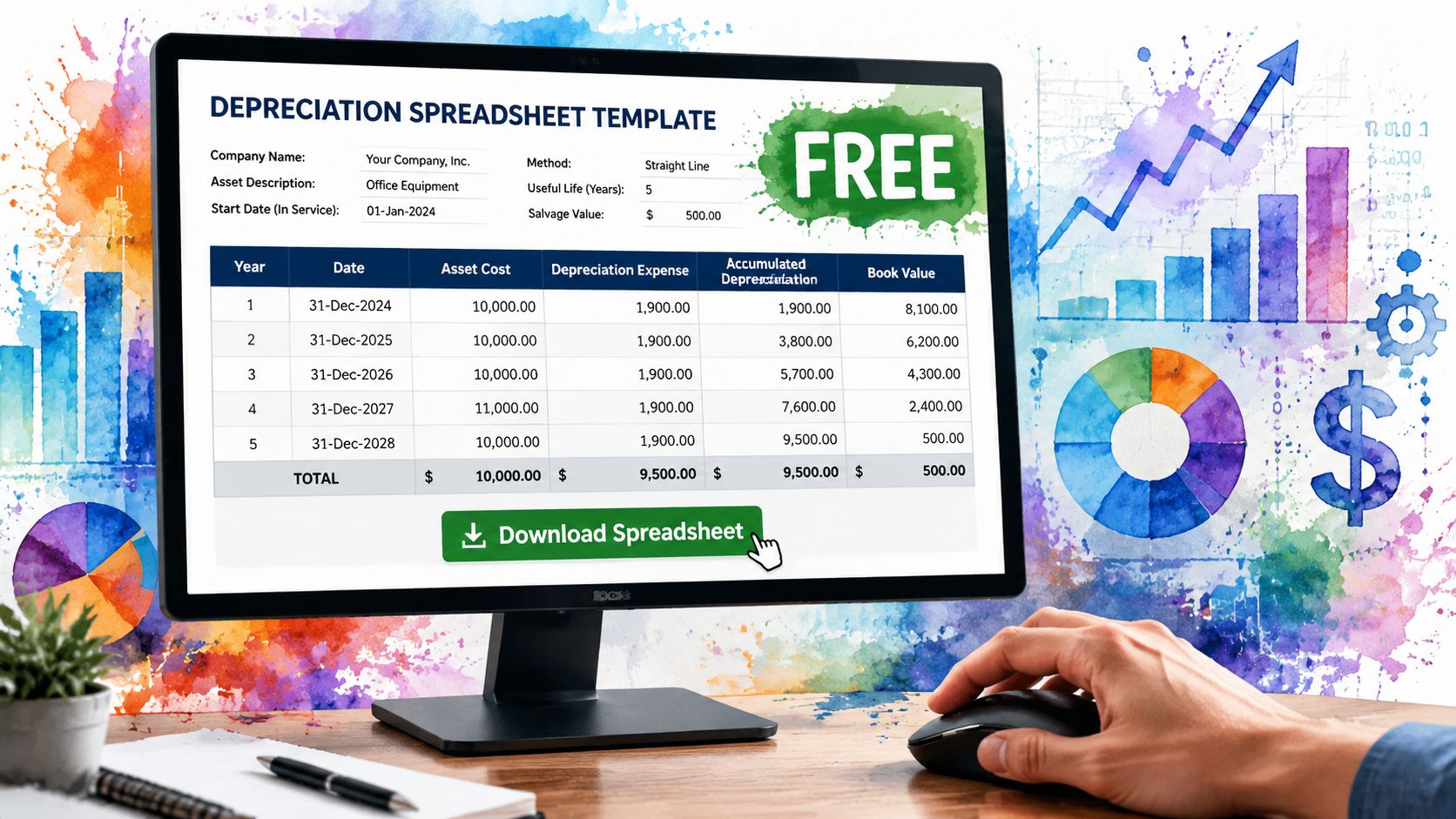
Keep the template simple enough that someone will update it after a long day in the field.
A useful spreadsheet should do four things well:
- List every asset in one place: Group washout pans, trailers, small tools, and machines so nothing gets missed at year-end or bid time.
- Show both accounting and job-cost views: Straight-line may be fine for the books. A use-based estimate is often more useful for pricing work.
- Record real field inputs: Purchase date, condition, repairs, days on rent, and downtime matter because they change replacement timing.
- Flag assumptions that need review: Salvage value and useful life should not sit untouched for years if the equipment is getting beat up on active jobsites.
The trade-off is simple. A basic spreadsheet takes discipline. Software can automate more, but many contractors do not need another subscription just to track depreciation on a washout pan and a few support assets. A clean file that gets updated every month is better than a polished system no one trusts.
If you need dependable concrete washout containment for your next project, Reborn Rentals makes it easy to reserve washout pans with clear pricing, delivery coordination, and fast checkout. Their team focuses on practical jobsite needs, so you can keep concrete cleanup compliant and organized without wasting time chasing equipment.