The pump is booked, the crew is standing by, and the concrete trucks are already on the road. Then the inspector calls to say the pre-pour check can't happen because an approval is still open. The washout area isn't ready, the rented containment pan hasn't arrived, and the finishing crew is waiting for a confirmed start time. A pour that looked secure on the schedule starts losing hours before anyone places concrete.
That situation isn't caused by one careless worker. It usually comes from small front-end and handoff failures that were never assigned, checked, or escalated. Learning how to reduce project delays in concrete work means managing those failure points before the pour window closes.
Why Concrete Projects Rarely Finish on Time
A concrete pour depends on more than the concrete itself. The subgrade must be ready, reinforcing steel must be placed correctly, forms must hold their dimensions, embeds must be confirmed, access must remain open, the pump must arrive, the batch plant must have capacity, the finishing crew must be ready, and the inspection must be complete. If one dependency slips, the crew either waits or starts working around an incomplete condition.
A widely cited construction research summary reports that about 75% of construction projects experience delays, while only 25% finish within 10% of their original deadline. The same construction delay research summary reports that large projects typically finish about 20% later than scheduled, while megaprojects are especially exposed, with around 98% ending up delayed or over budget.
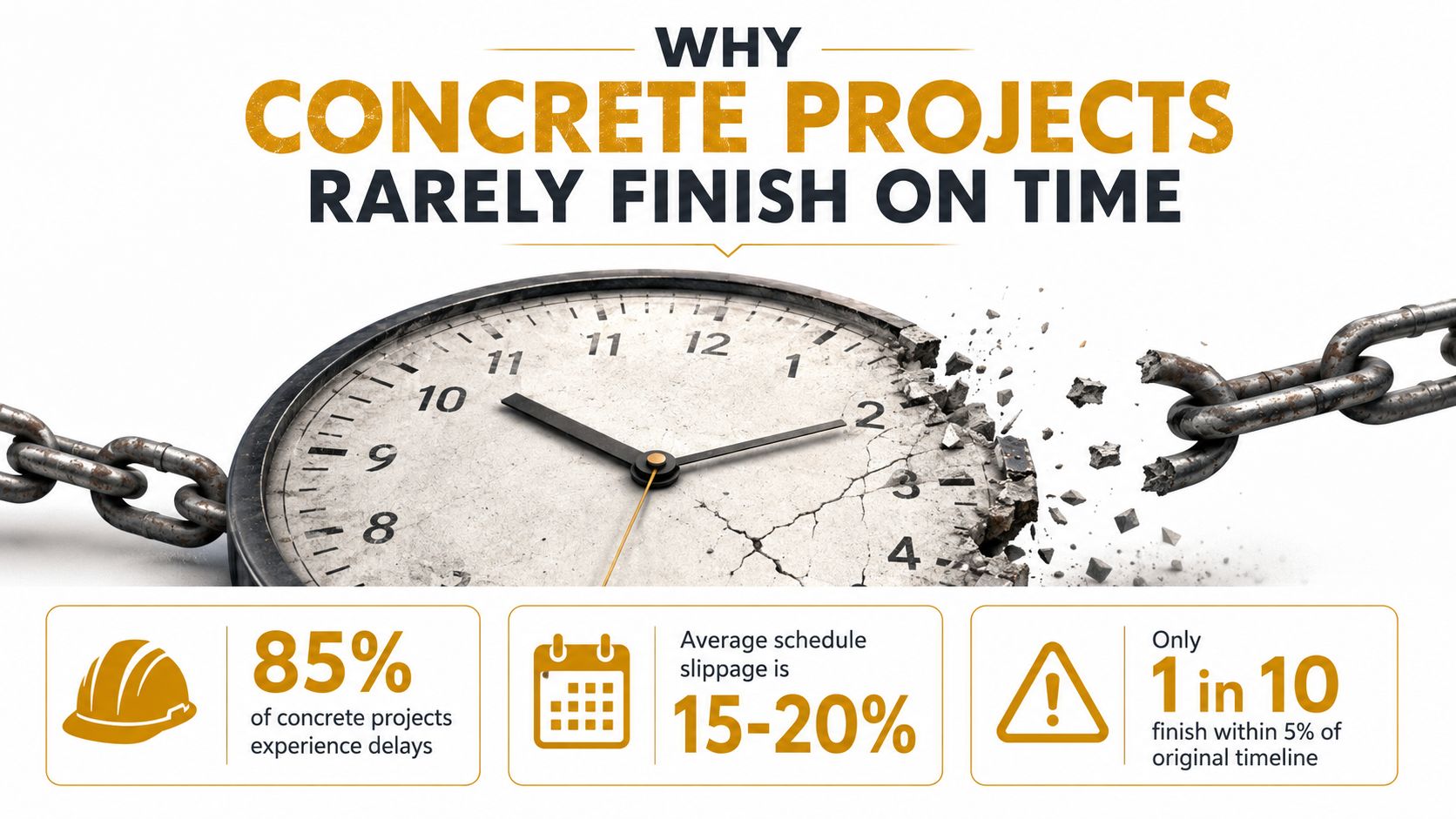
The numbers above aren't a reason to accept poor performance. They're a reason to stop treating the original baseline as a promise that will survive without active control. Concrete amplifies schedule risk because it ties several trades and decisions to a narrow working window. A missed inspection can push a placement into bad weather. A late delivery can leave the pump and crew unproductive. An unavailable rental can force a last-minute site change that creates compliance or access problems.
Build a schedule that expects friction
A reliable schedule distinguishes between planned production and readiness to produce. “Place slab concrete” is not ready because it appears on a Tuesday calendar. The work is ready when the preceding activities, materials, equipment, people, approvals, and site conditions have been verified.
Use milestone tracking for the events that can stop the pour:
- Subgrade and form readiness: Confirm elevations, dimensions, access, reinforcement, embeds, and protection.
- Inspection readiness: Assign who will request the inspection, who will attend, and what records must be available.
- Delivery readiness: Confirm the batch plant, truck sequence, pump, hose route, backup contact, and arrival window.
- Environmental readiness: Check the forecast, protection plan, curing approach, and any temperature or moisture constraints in the project specifications.
- Site-control readiness: Set the washout location, containment, traffic route, lighting, signage, and required personal protective equipment.
Practical rule: A schedule should show the work required to make a pour possible, not just the hour when the first truck is expected.
The point isn't to add paperwork for its own sake. It's to expose dependencies while there's still time to correct them. When schedule risk is treated as a default condition, the superintendent can protect the critical work without turning every field problem into an emergency.
The Real Root Causes Behind Most Schedule Slips
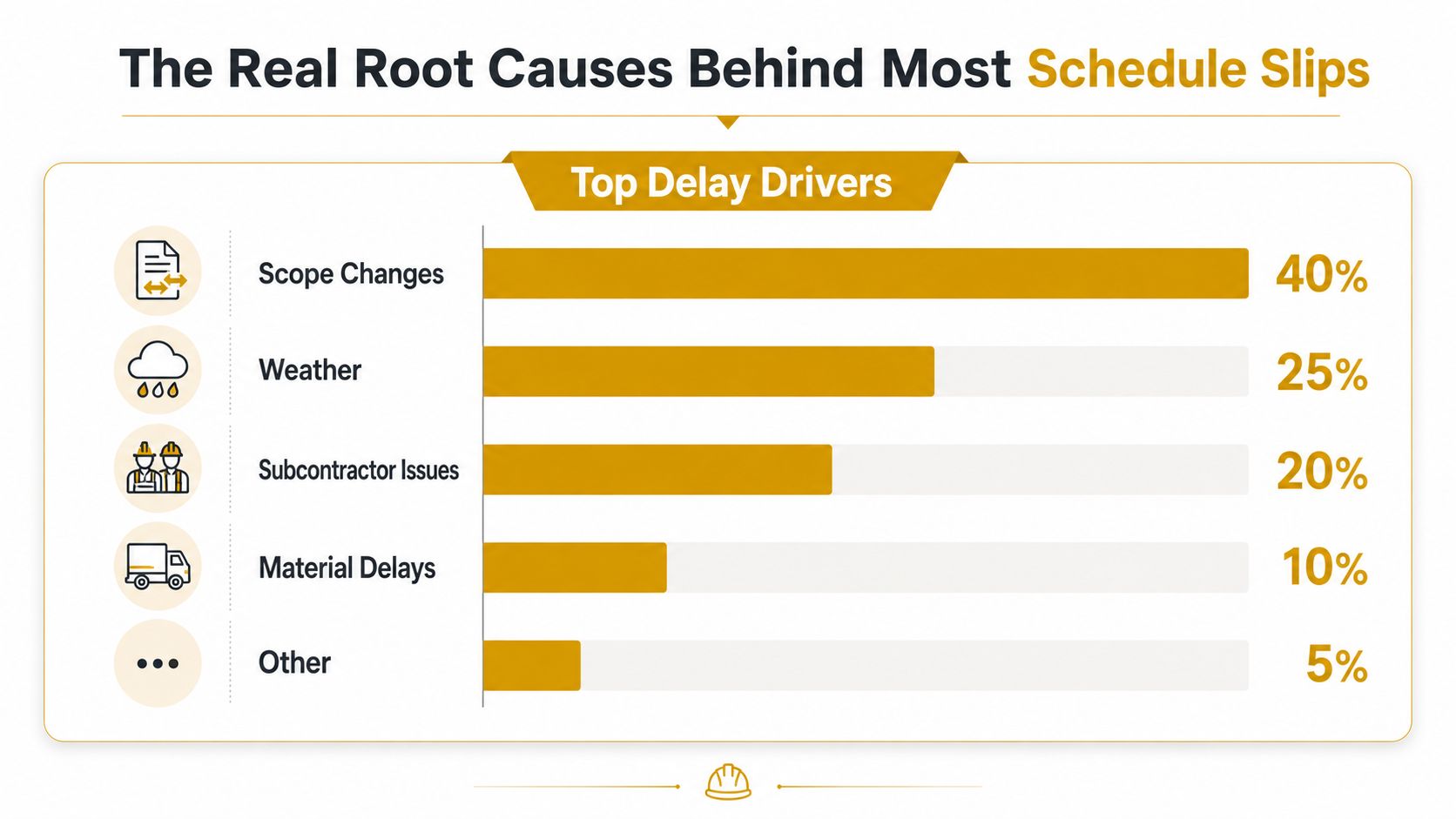
The fastest way to reduce delays is to stop treating every lost hour as an isolated event. Review recent schedule variance reports and classify each delay by its first controllable cause. A truck arriving late may look like a procurement issue, but the underlying problem could be an unconfirmed rental, an access conflict, a design change, or a handoff that never occurred.
One review found that contractor-related issues, design modifications, and site conditions accounted for more than 60% of delays across sampled projects. Contractor-related factors contributed 32% of total delay days, design changes contributed 18%, and regulatory approvals contributed 14%, according to the review of construction delay impacts on cost and schedule. The same literature summary reports average schedule extensions of 20% to 30% across projects.
Diagnose the first failure, not the final symptom
Five categories deserve close attention on concrete work:
| Delay category | What it looks like in the field | First control to examine |
|---|---|---|
| Contractor execution | Crews arrive without complete prerequisites, or production falls below the planned sequence | Work packaging, crew assignment, and readiness verification |
| Design modifications | Details change after forms, reinforcing, embeds, or access plans are already in progress | Design freeze, RFI tracking, and change-impact review |
| Site conditions | Access, ground, utilities, weather exposure, or existing structures disrupt the planned method | Constructability review and site investigation |
| Regulatory approvals | Inspections, permits, or agency decisions hold the next activity | Named approval owner and decision calendar |
| Handoff breakdowns | One trade believes work is complete while the next trade finds missing or defective prerequisites | Documented handoff criteria and signoff |
These causes compound. A design revision can trigger a new review, delay procurement, change the crew sequence, and create rework at the pour location. A poor handoff can leave a finishing crew mobilized before the pump route is clear. The schedule then loses time in several places even though the original mistake happened once.
Prioritize recurring losses
Don't launch a broad improvement program that asks every team to fix everything at once. Pull the last group of delayed activities, identify the repeated categories, and address the largest source first. A CURT study of factors affecting construction schedules cites more than 168,000 handoff-related issues, making coordination breakdowns a major source of delayed activities in the referenced industry dataset.
That finding matters because handoffs are often easier to improve than weather or market conditions. Define what “ready for concrete” means, name the person who confirms it, and require evidence before the next crew mobilizes. The best delay program doesn't make every task faster. It removes the preventable waiting, rework, and uncertainty that repeatedly interrupt critical work.
Front End Planning That Prevents Delays Before They Start
Most schedule recovery attempts begin too late. Once crews are mobilized, design gaps and approval bottlenecks become expensive because every correction competes with active production. Strong front-end planning moves those decisions into a controlled setting, before the first truck, pump, or finishing crew is committed.
An infrastructure review found that 60% of delay drivers originate in the preparation phase, including poor feasibility studies, unclear scope, and weak financial planning, according to the review of infrastructure delay drivers. For concrete contractors, that means the most valuable schedule work may happen before the site team begins daily production.
Define the work before pricing the sequence
Start with a scope review that includes the people who'll build the work. Drawings and specifications should be checked against actual access, crane or pump positioning, reinforcement congestion, form systems, placement limits, curing requirements, and inspection hold points. If the field team can't explain how the placement will happen, the schedule isn't ready.
Create a dependency map for every major pour. It should identify the prerequisite work, responsible party, required document, decision owner, and latest date for action. A simple decision calendar can list design responses, submittal reviews, permit needs, inspection requests, owner selections, and procurement releases.
Use readiness gates instead of optimistic dates
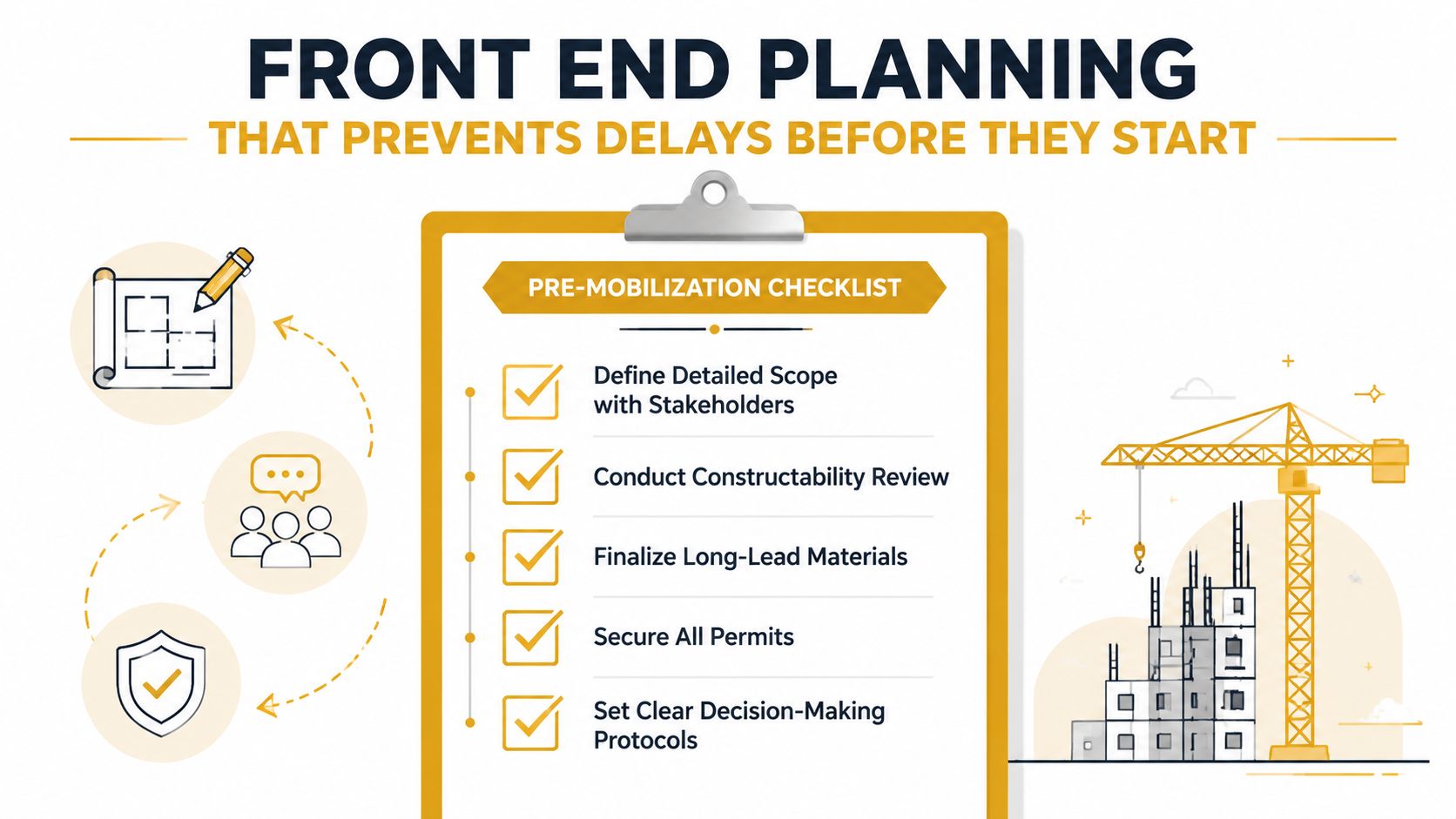
A useful pre-mobilization routine includes:
- Scope confirmation: Record what is included, what is excluded, and which assumptions affect sequence or production.
- Constructability review: Walk through the planned work with operations, safety, quality, and key subcontractors.
- Long-lead confirmation: Verify availability and release dates for reinforcing steel, embeds, forms, pumps, testing services, and containment equipment.
- Approval mapping: Assign an owner to each permit, inspection, RFI, submittal, and design decision.
- Look-ahead preparation: Build a short-range schedule that includes prerequisites, handoffs, access constraints, and contingency actions.
A milestone shouldn't turn green because someone believes it will be complete. It should turn green after the responsible person has verified the condition. This distinction protects the schedule from false confidence.
The field should be allowed to challenge a schedule before the schedule challenges the field.
Front-end planning also requires financial realism. If the budget doesn't account for required rentals, delivery restrictions, difficult terrain, inspection coordination, or contingency work, managers may delay decisions while they seek authorization. Clear cost assumptions support faster approvals and prevent the team from removing necessary controls to preserve an unrealistic baseline.
Keeping Procurement Rentals and Site Logistics on Schedule
Concrete logistics fail in predictable ways. The material is available, but the route is blocked. The pump is booked, but the setup area isn't prepared. The washout container is scheduled, but no one confirmed where it can sit without interfering with traffic, drainage, or environmental controls.
Treat each rental and delivery as a production dependency. Confirm the equipment type, capacity, dimensions, delivery window, placement method, site contact, access route, ground conditions, pickup expectation, and charges that may apply for difficult access or expedited service. A transparent daily rate is useful, but it won't protect the pour unless the operational details are confirmed with the supplier and the field team.
Reserve the complete logistics package
For a concrete placement, the logistics package may include:
- Containment equipment: Select a washout pan or container that matches the expected operation and available footprint.
- Access and placement: Verify that the delivery vehicle can reach the intended location and that the ground can support the setup.
- Traffic control: Keep truck movement separate from pedestrian routes and preserve emergency access.
- PPE and signage: Make the washout area visible, controlled, and consistent with the project's safety requirements.
- Pickup planning: Confirm how the equipment will be removed, what condition it must be in, and who authorizes pickup.
Washout compliance belongs on the pour checklist, not in the cleanup conversation after the last truck leaves. The containment area should be established before concrete arrives, with a route that doesn't require drivers or workers to improvise. If slurry reaches an unprotected surface or drainage path, the crew may face cleanup, reporting, corrective action, or a site hold that affects more than the concrete operation.
Confirm dates through more than one channel
A phone call can establish intent, but written confirmation gives the superintendent something to verify against the daily plan. Keep the reservation, delivery window, site address, contact name, equipment specification, and special access notes together. If the supplier offers messaging, email, scheduled callbacks, or another confirmation channel, use the method that creates a clear record and a fast escalation path.
Don't schedule a rental for the day it becomes critical unless the supplier and site have already confirmed the arrangement. Build the delivery into the look-ahead schedule, then recheck it during the pre-pour meeting. The trade-off is a small amount of administrative effort in exchange for avoiding a much larger disruption when the equipment or access plan fails.
Make site readiness visible
Mark the washout location on the site logistics plan. Photograph or inspect the setup before the pour, and assign a person to maintain it during placement. The same principle applies to pump pads, hose routes, truck staging, lighting, temporary power, and protection for finished work.
A clean site isn't just a safety or environmental objective. It's a schedule asset. Crews move with fewer interruptions when they know where equipment goes, where trucks travel, and who owns each correction.
Crew Coordination Weather and Inspection Tactics That Protect Your Timeline
A well-built schedule can still fail during the daily transition from one crew to another. The superintendent's job is to make that transition explicit. Every crew should know what was completed, what remains open, what could stop the next activity, and who has authority to resolve the issue.
A 2025 AGC workforce survey identifies worker shortages as the top cited cause of project delays, with 45% citing worker shortages. The same AGC workforce survey analysis reports that 34% cited a lack of government approvals or inspectors and 32% cited an owner directive to halt or redesign work. The operational lesson is direct: staffing matters, but decision latency and governance can be nearly as disruptive.
Run a short huddle around constraints
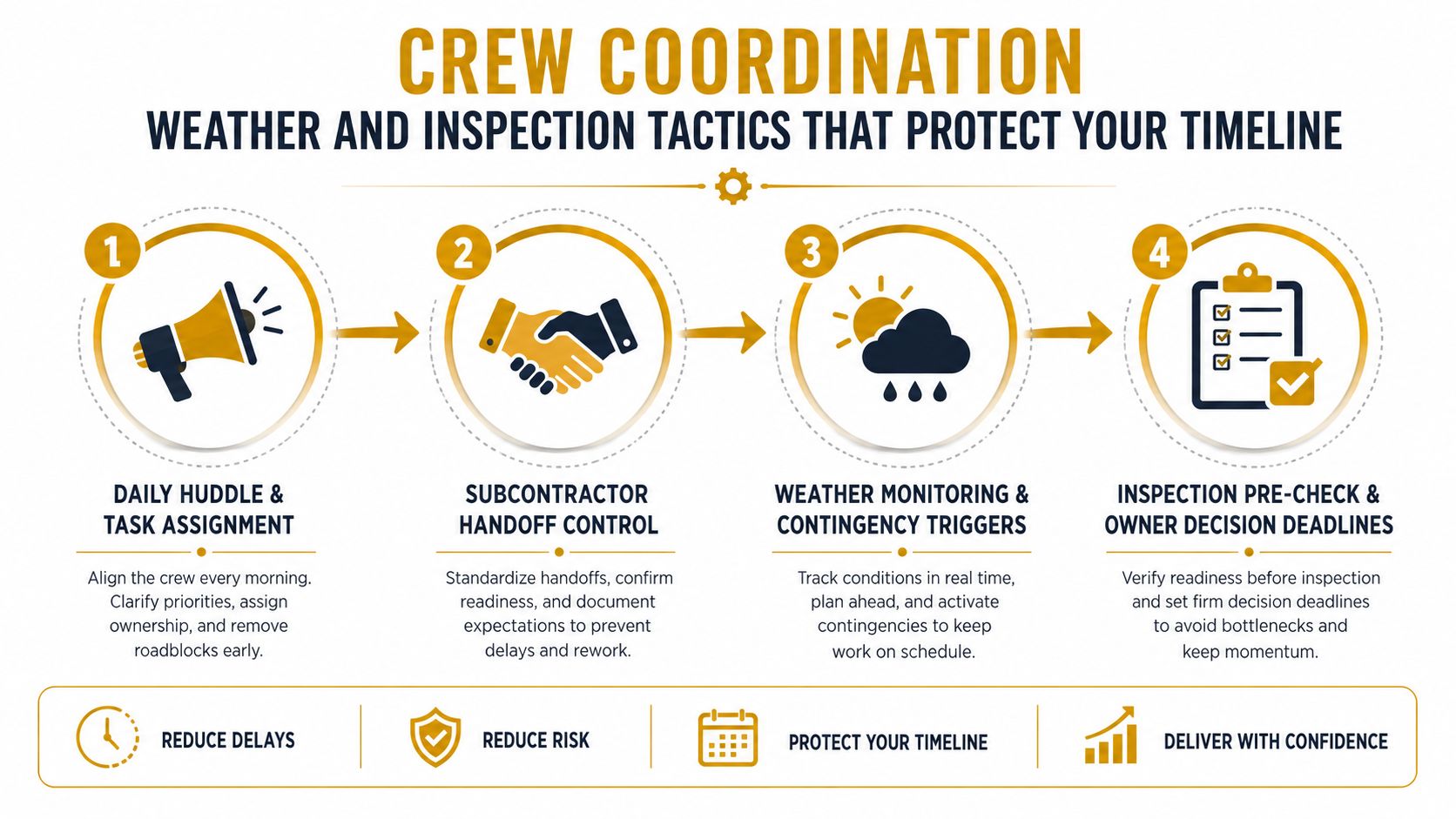
The daily huddle should assign work and surface blockers. Review the day's placements, crew availability, equipment status, inspection timing, weather window, safety controls, and handoffs. Don't let the meeting become a general status report. Ask what could stop production and require an owner and response time for each open item.
At each handoff, use a clear acceptance check. The receiving crew should confirm that the area, information, materials, and access are ready. If something is missing, record it immediately rather than allowing the crew to discover it after mobilization.
Treat weather as a decision trigger
Weather planning isn't about predicting conditions perfectly. It's about deciding in advance what conditions require a change in method, timing, protection, or sequence. Monitor the forecast, but also inspect the actual site. Wind, saturated access routes, heat exposure, standing water, and cold surfaces can affect operations even when the general forecast appears workable.
Cure protection and finishing requirements should appear in the work plan before placement starts. If the weather window closes, the team should know whether to resequence interior work, adjust delivery timing, add protection, or stop safely. A contingency only helps when someone has authority to activate it.
Make inspections part of production
Inspection readiness begins before the request. Confirm that the work matches the approved documents, required records are available, access is safe, and the responsible trade representative will be present. Track pending inspections visibly, with a named owner and a clear escalation route.
A delayed decision is still a schedule event. Track it like one.
Use the same discipline for owner decisions and design responses. Establish a deadline, identify the consequence of missing it, and decide when the team will resequence or protect resources. Continuous progress evaluation can strengthen this process. A BIM-based probabilistic progress evaluation method is designed to quantify delay risk continuously and flag slippage early enough for resequencing, resource reallocation, or contingency activation.
Your Practical Plan to Keep Every Pour on Track
Reducing project delays doesn't require a complicated control system. It requires a repeatable one. The superintendent, project manager, subcontractors, inspector, supplier, and owner need the same view of readiness, constraints, decisions, and next actions.
Use a weekly rhythm to protect the next pour:
- Review the look-ahead: Confirm prerequisites, access, inspections, deliveries, rentals, crew coverage, and weather exposure.
- Close decision gaps: Assign owners and deadlines for RFIs, design changes, approvals, and owner selections.
- Verify procurement: Reconfirm concrete supply, pump availability, testing support, containment equipment, and delivery instructions.
- Walk the work: Inspect forms, reinforcement, embeds, subgrade, access, washout containment, lighting, and safety controls.
- Set contingency triggers: Decide when to resequence, reassign labor, adjust deliveries, or activate protection measures.
Then use a short daily check before crews mobilize. Ask whether the work is ready, not whether the calendar says it should be ready. If a prerequisite is missing, make the delay visible while there's still time to protect the crew and equipment.
The most useful schedule metric is often reliability at the handoff. Did the area meet the agreed acceptance criteria? Did the decision arrive when promised? Did the rental and delivery arrive within the confirmed window? Did the inspection pass without preventable documentation or readiness issues? Those answers reveal whether the system is working better than a polished baseline alone.
Front-end definition prevents avoidable redesign. A locked look-ahead protects sequence. Procurement discipline keeps equipment and materials from becoming surprise constraints. Washout-compliant logistics prevent cleanup and environmental problems from interrupting production. Handoff controls, weather triggers, and inspection pre-checks give the field options before a small problem becomes a missed milestone.
Start with the next scheduled pour. Write down every prerequisite, assign one owner to each, confirm the delivery and inspection windows, and walk the site before the crew arrives. Then repeat the process until readiness becomes a habit rather than a last-minute rescue.
Reborn Rentals provides ready-to-deploy concrete washout containment equipment with clear daily pricing, delivery coordination, and support for access and site logistics. For your next pour, visit Reborn Rentals to confirm the right washout solution and keep containment from becoming a preventable schedule problem.