You're usually asking this question when the pour schedule is already moving. Maybe you've got a short foundation job, a tenant improvement with a few concrete placements, or a run of work where washout compliance keeps landing on your desk. The simple version is easy: renting looks cheaper because it avoids the purchase. Buying looks cheaper because you stop paying rental invoices.
The answer is less tidy. Is it cheaper to buy or rent a concrete washout pan? It depends on how often the pan is working, how far you have to move it, who's cleaning it, where it sits between jobs, and how much hassle your team is willing to absorb. On paper, daily rental rates can make one option look obvious. In the field, the hidden costs usually decide it.
Most contractors don't lose money on the pan itself. They lose money on the gaps around it. Idle equipment. Extra trucking. Yard clutter. Cleanup labor. Last-minute compliance scrambles. That's why the smart comparison isn't sticker price versus daily rate. It's total cost of ownership versus total cost of use.
The Clear Advantages of Renting a Washout Pan
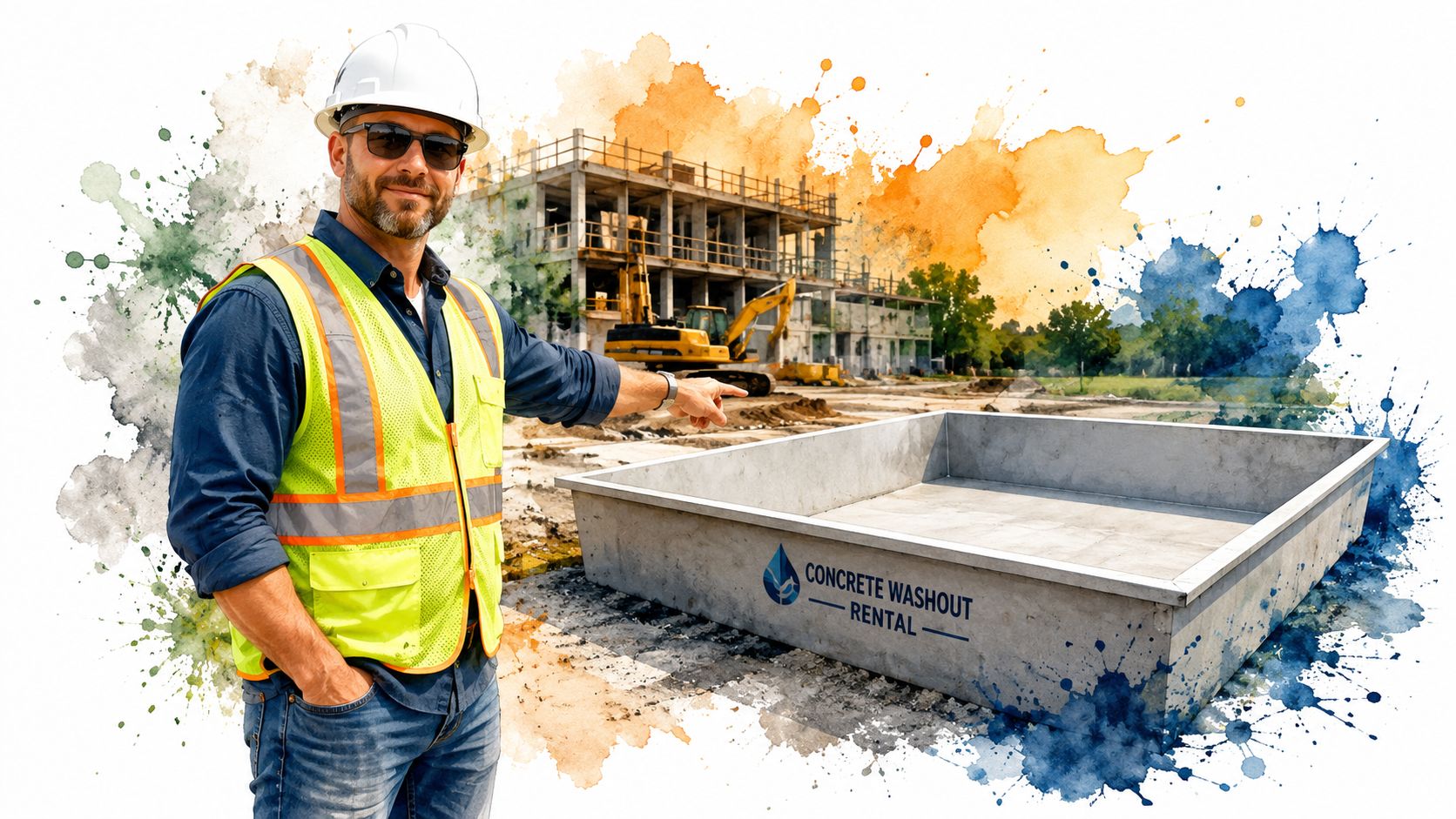
A crew wraps a small slab pour on Friday. By Monday, the washout pan is already a problem. Somebody has to haul it, clean it, stage it, or find room for it in the yard until the next job. If the next concrete scope is three weeks out, ownership starts costing money even while the pan does nothing.
That is why renting often wins on short runs, one-off pours, TI work, and projects with uneven concrete schedules. You are paying for use during the window you need it. You are not paying to own the downtime between jobs.
Industry guidance makes the same point. Renting avoids the upfront purchase and shifts storage, maintenance, and support to the provider, while giving contractors the option to choose a pan size that fits the job, as noted in Dumps Easy's washout pan guidance.
Renting cuts the costs that usually get missed
The rental rate is only part of the equation. The advantage is the list of ownership chores that drop off your plate.
With a rental, you usually reduce or avoid:
- Idle asset cost when the pan sits between pours or between projects
- Yard storage problems once the job is closed out
- Cleaning labor that pulls a worker or driver away from billable work
- Internal transport coordination to move the pan from site to site
- Repair surprises right before a scheduled placement
- Asset tracking headaches across multiple crews and jobs
Those costs are easy to ignore because they do not always show up on one invoice. They show up as wasted crew time, an extra truck move, a cluttered yard, or a superintendent chasing a compliance item that should have been handled already.
Renting fits jobs where timing changes
Concrete schedules slip. Inspections move. Weather pushes placements. Scope gets added late.
Renting gives you flexibility when the work is not steady enough to keep a pan busy week after week. If one project needs a smaller unit and the next needs something larger, you can match the container to the actual pour instead of forcing one owned pan into every situation. That matters on tight sites where placement and access are half the battle.
A rented pan also leaves you with a cleaner closeout. Once the concrete work is done, the container goes away. Your team is not stuck figuring out what to do with it next.
The biggest rental advantage is simpler total cost control
Contractors who rent are often buying less hassle, not just lower short-term price. That matters when you are modeling true cost by project duration.
On a brief job, ownership can lose the math fast. The purchase price gets spread over very few uses. Then you add delivery, pickup, cleaning, storage, and the risk that the pan sits untouched until the next pour. Rental keeps those costs tied closer to active work. It also reduces the chance that compliance-related equipment turns into one more yard asset nobody wants to manage.
For short-duration or irregular concrete work, that is usually the cleaner deal.
When Buying a Concrete Washout Pan Makes Sense
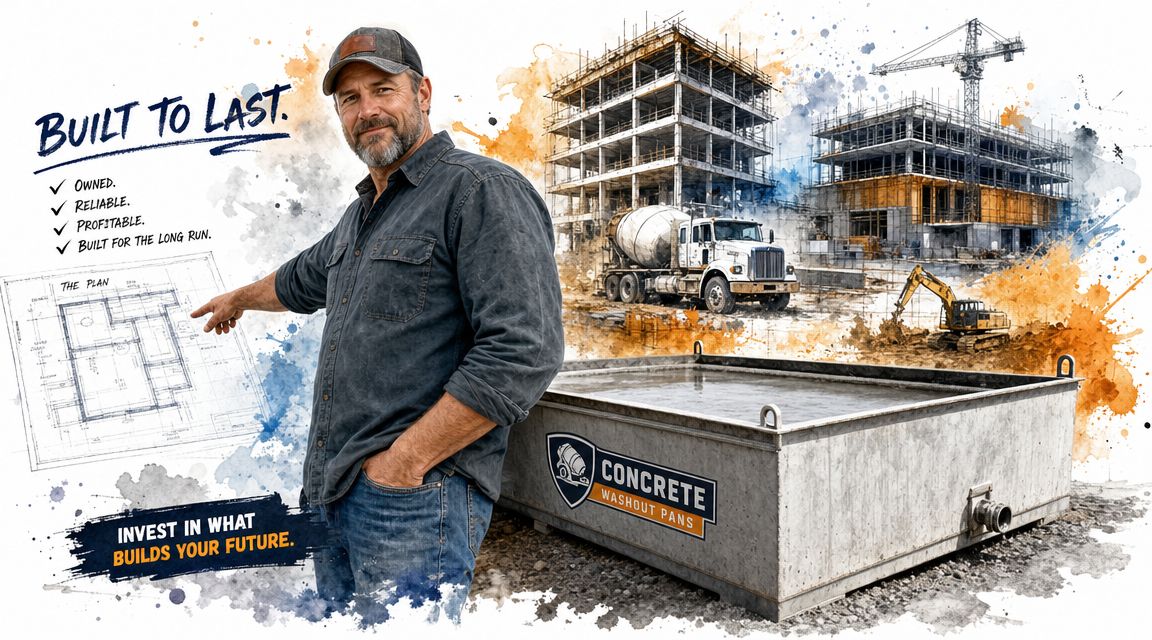
Buying starts to make sense when your usage is steady enough that the pan rarely sits still. If your crews are pouring all the time, moving from one concrete scope to the next, ownership can become the more controllable option. You're no longer paying for temporary access. You're putting an asset to work over and over.
Capacity matters here too. Concrete washout containers aren't tiny add-ons. One commercial source describes washouts as seven-yard containers, and another provider lists a small unit at 300 gallons for 10 to 15 mixer washouts and a large unit at 475 gallons for 20 to 30 mixer washouts, as shown in My Container Company's washout container details. If your company regularly handles pours at that scale, ownership becomes easier to justify.
Ownership works best with frequent utilization
A pan you own needs to stay busy. That means repeated pours, recurring field crews, and enough scheduling discipline to keep that asset moving from job to job instead of back to the yard.
Buying usually lines up with these business conditions:
- Consistent concrete work across the year, not occasional washout needs
- In-house transport capability so moving the pan doesn't require outside coordination every time
- Dedicated storage space where the pan can sit securely when it's off a job
- Internal maintenance discipline so someone is responsible for inspection, cleaning, and readiness
If you already run equipment this way, a washout pan can fit into the same system.
Control is the real advantage, not just cost
Ownership gives you immediate availability. You don't need to check vendor inventory or line up a rental window. For contractors with multiple active crews, that control can be valuable if washout planning tends to change fast.
A bought pan pays off only when your company uses it often enough to justify the transport, cleaning, storage, and management that come with it.
The contractors who benefit most from buying are usually the ones who already have a yard, trucking, operators, and a workflow for rotating gear between sites. If that infrastructure is already in place, adding pans is operationally simpler.
Buying does not work well when usage is uneven
Some firms encounter a predicament. They buy because they don't want to keep renting, then discover the pan is idle for stretches, or only useful on certain project types. That's when the math turns against ownership.
If your workload is intermittent, a bought pan can become one more item parked in the yard waiting for the next suitable job. At that point, the issue isn't whether ownership looked cheaper on day one. It's whether the pan earned its keep over time.
Calculating the True Lifetime Cost of Ownership
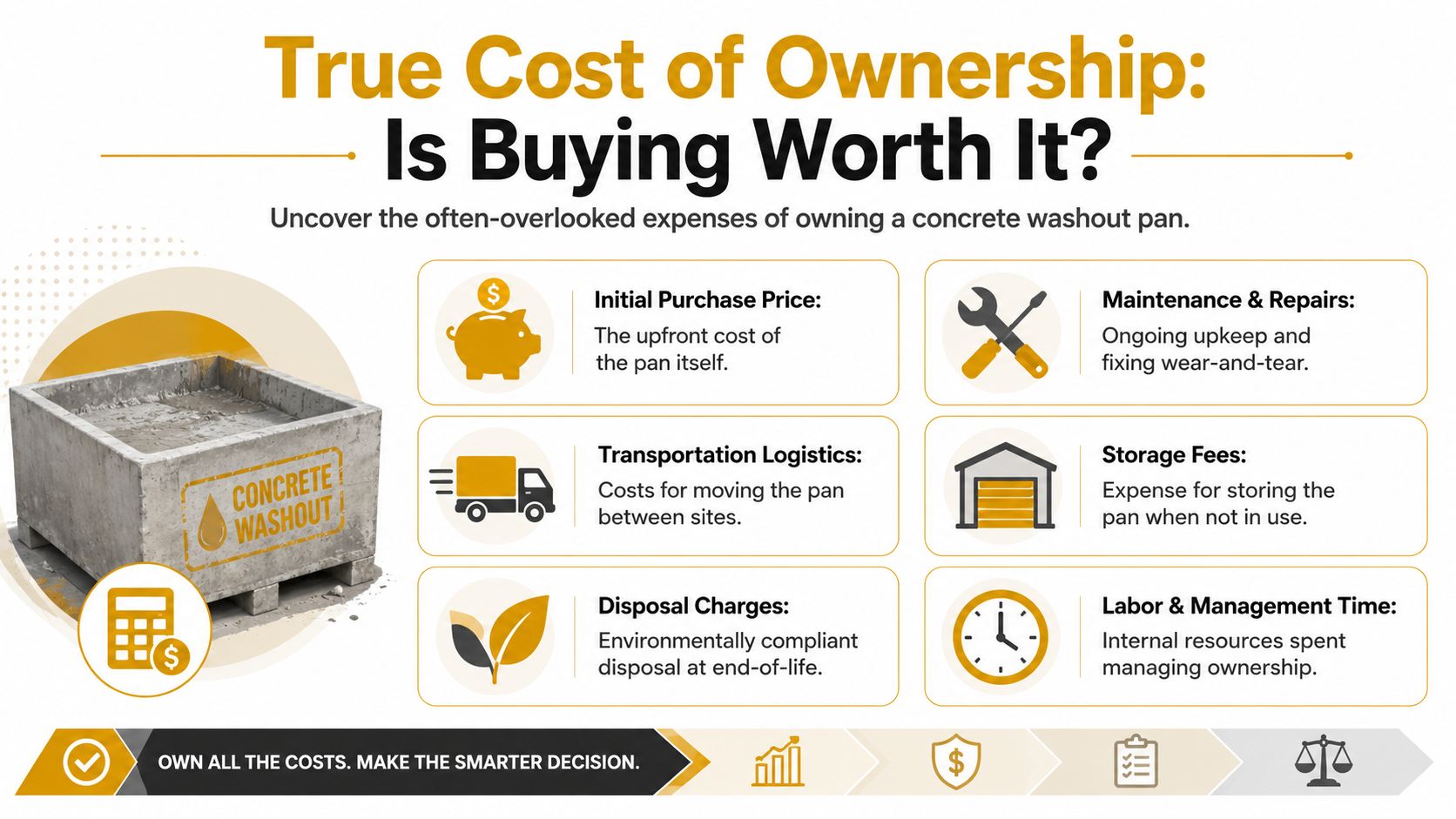
Most buy-versus-rent mistakes happen because the ownership side is undercounted. Teams remember the purchase price. They forget the truck, the yard, the cleanup, the labor to reposition it, and the admin time spent tracking where it is.
If you want a real answer, build your ownership number the same way you build an equipment cost code. Every touch counts.
Start with the full ownership checklist
Use a simple internal worksheet and price each item:
- Purchase cost for the pan itself
- Delivery to your yard or first site when you first acquire it
- Transport between projects every time you redeploy it
- Cleaning labor after use and before reuse
- Maintenance and repairs from normal wear, impact damage, or leaks
- Storage burden when it's not on a job
- End-of-life handling when the pan is no longer worth keeping
- Supervision and admin time to manage scheduling, movement, and condition
That last one gets missed all the time. Somebody in the company owns this task, even if it never lands on a dedicated spreadsheet.
Count labor the way the field feels it
A washout pan you own doesn't teleport. Someone has to load it, move it, place it, inspect it, and deal with it when the job wraps. If your foreman or laborer is handling that instead of pushing the project forward, that time has a cost even if it doesn't show up as a line item called “pan management.”
Ownership gets expensive. One extra move. One cleanup cycle. One job where the pan comes back in rough shape and needs attention before it can go back out. None of those issues feel huge by themselves. Together, they change the economics.
Treat every internal touch like a billable event. If your company spends time on it, the pan costs more than the purchase price.
Ask the three questions that usually decide the math
How often is it actually in service
Not how often you hope to use it. Not how often it could be used. How often it is on a site doing useful work. Idle time is what kills ownership value.
Who handles it between jobs
If you already have trucks, yard staff, and a clean dispatch process, ownership is easier to absorb. If moving the pan takes favors, last-minute calls, or rearranging other equipment, the actual cost is higher than it looks.
What happens when it's dirty, damaged, or in the way
A bought pan doesn't disappear when the job ends. It comes back to your system. That means cleanup, storage, and deciding when it's ready to send out again.
A practical ownership review usually looks like this:
| Ownership item | What to check internally |
|---|---|
| Pan utilization | How many jobs use it without long idle gaps |
| Transport effort | Who moves it and how often |
| Cleanup burden | Which crew handles washing and prep |
| Storage reality | Where it sits and what space it consumes |
| Readiness risk | Whether it's truly site-ready when needed |
If you can't answer those questions cleanly, you probably don't have a low-cost ownership model yet.
Financial Breakdown Buying vs Renting Modeled
The cleanest way to compare buying and renting is to stop chasing headline pricing and look at project duration plus utilization. A short job can still become an expensive rental if there's a minimum term and heavy transport charges. A long job can still favor rental if ownership would create constant movement, cleaning, and downtime.
One market example makes that point clearly. Some providers advertise $19 to $20 per day but also apply a 30-day minimum and $499 per delivery or pickup, which can change the economics fast, as shown on Durapan's nationwide washout pan rental pricing page.
Why daily rate shopping gives bad answers
A contractor sees a daily rental number and thinks, “That's cheap enough.” Then the quote comes in with a minimum rental period, transport, and site-specific fees. Suddenly a brief concrete operation is being billed like a much longer use case.
On the ownership side, the opposite mistake happens. The company focuses on not paying rental charges anymore, but doesn't build in the internal handling cost discussed earlier. The result is a comparison between a fully loaded rental quote and an undercounted ownership estimate.
Don't compare a headline rental rate to a bare purchase price. Compare fully loaded rental to fully loaded ownership.
Model the decision by job type, not by theory
This table gives a practical way to consider the topic:
| Cost Factor | Buying (Scenario) | Renting (Scenario) |
|---|---|---|
| Single-day pour | Usually weak value unless the pan is already in your fleet and nearby | Often makes more sense if you need compliant containment for a short window, but only after checking delivery, pickup, and minimum term |
| One-week project | Can still be hard to justify if the pan must be purchased mainly for this job | Often workable when the provider can deliver the right size and remove it promptly after use |
| Three-month build | Starts to make more sense if the same pan stays on site and your team can manage it efficiently | Can still pencil out if ownership would require extra transport, cleaning, or asset management |
| Full year of continuous use | Stronger case for ownership if the pan stays busy across repeated pours and multiple projects | Less attractive if you're repeatedly paying recurring rental periods and transport charges |
What usually works in the field
For one-off and short-duration work, rental tends to be the safer financial move because it limits commitment and pushes support tasks outside your team. It's especially practical when the pan is needed for compliance on a narrow schedule and then no longer needed.
For repeated, high-volume concrete work, ownership can take the lead if your crews use the pan often enough and your company already has the logistics to manage it without friction.
Use this quick screen before deciding:
- How long is the pan needed on this specific job?
- Will the same pan go directly to another project right after?
- Are delivery and pickup charges heavier than the daily rate suggests?
- Can your team move, clean, and store an owned pan without disrupting other work?
If you answer no to the last two ownership questions, renting is usually the cleaner answer even when the daily rate looks high.
Beyond Cost Compliance and Site Logistics
Cheaper on paper doesn't always mean better on site. Washout containment sits right at the intersection of environmental compliance, housekeeping, access, and crew coordination. If the pan setup is sloppy, the job feels sloppy.
Washout pans are used to capture slurry from mixer, pump, and tool cleaning to help prevent runoff and contamination. That means the decision isn't just financial. It's also about who carries the operational burden of doing that correctly every time.
Renting reduces moving parts on active jobs
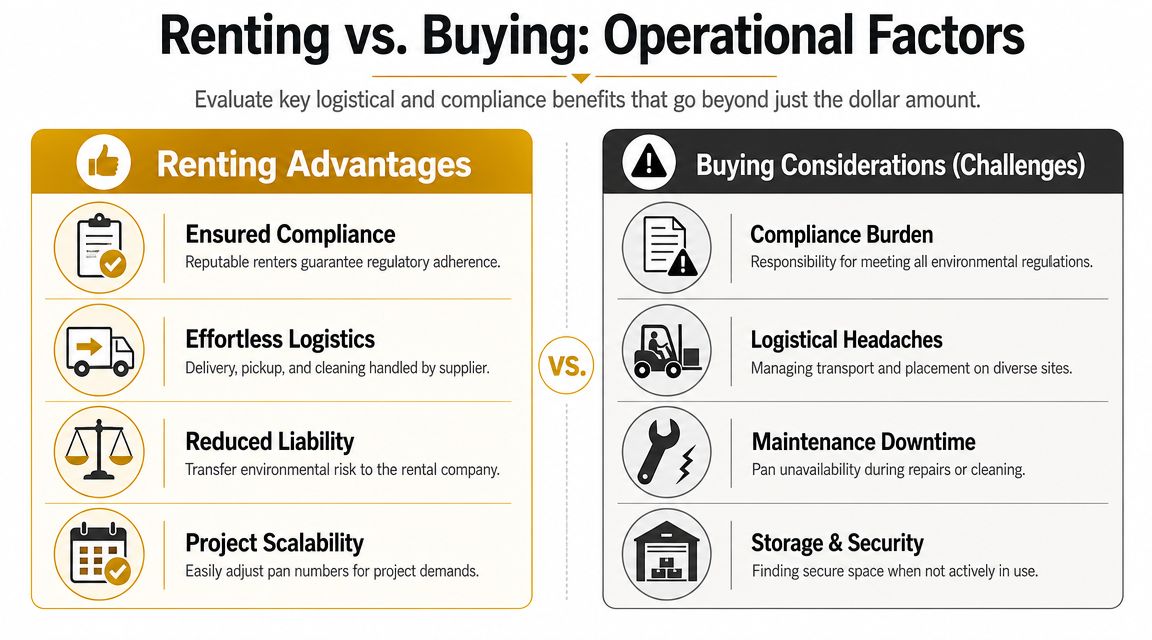
On a busy site, fewer moving parts usually means fewer mistakes. A rental arrangement can simplify delivery timing, pickup, and the condition of the pan when it arrives. That helps the superintendent or site manager avoid another coordination problem.
Operationally, renting often helps with:
- Cleaner site turnover because the pan leaves when the concrete scope is done
- Less yard congestion since you're not storing idle containment equipment
- Easier scaling when one project needs a different size or an extra unit
- Fewer internal handoffs because one vendor may handle multiple steps
Buying increases responsibility, whether you planned for it or not
Ownership gives control, but it also gives responsibility. Your team owns placement planning, movement, readiness, cleaning, storage, and any delay caused by the pan not being where it should be.
That can work well for disciplined operations. It works badly when everyone assumes someone else is handling it.
A pan is never just a pan. On site, it's a compliance item, a logistics item, and a housekeeping item all at once.
The practical question is who you want managing the problem
If your company wants direct control and has the systems to support it, buying can fit. If your company would rather keep crews focused on production and let a provider handle the containment asset itself, rental often creates a cleaner operation.
That's why the cheapest choice isn't always the lowest invoice. Sometimes it's the option that creates fewer opportunities for delay, confusion, and cleanup trouble.
Making the Right Call for Your Next Project
A lot of buy-versus-rent decisions get made too fast. The crew needs a washout pan, someone checks a daily rental rate against a purchase price, and the call gets made off the top line. That misses the fundamental question. Which option costs less after transport, cleaning, storage, pickup coordination, and the time your team spends dealing with it?
The right answer usually shows up once you model the full job cycle, not just the invoice.
If the pan is tied to one project, a short concrete phase, or an irregular schedule, rental usually keeps the total cost tighter. You get the equipment for the window you need, then it leaves the site instead of turning into another yard item your team has to move, clean, store, and track.
Buying starts to make sense when the pan will stay in rotation and your operation can support ownership. That means dependable utilization after this job, access to transport when the pan needs to move, space to keep it, and clear responsibility for maintenance and cleanup. Without those pieces, the lower long-term cost you expected can disappear into downtime, internal labor, and missed coordination.
A simple filter works:
- Rent if the job is short, one-off, or unpredictable, and you want the cost tied to the project instead of carried between jobs.
- Buy if you have steady concrete work and the internal systems to handle hauling, cleaning, storage, and redeployment without burning crew time.
- Price both ways if the project is long enough to make ownership look attractive but your post-job utilization is still uncertain.
That last point matters. A pan that sits behind the yard fence for months is not saving money. It is tying up cash and adding one more asset your team has to manage.
Good contractors make this call with a full cost picture. They count delivery. They count return haul. They count cleaning. They count admin time. They count the risk of a compliance problem if the pan is late, full, damaged, or not on site when inspectors or project owners expect proper containment.
If renting looks like the better fit for your next job, Reborn Rentals is one option to review for concrete washout pan scheduling, delivery coordination, and short-term containment needs. It gives you a way to line up site-ready washout equipment without taking on the long-tail ownership costs that only pencil out when the pan stays busy.