You're on a New Mexico job, the permit is moving, the pour is scheduled, and then the questions pile up fast. Which code controls the building. Which office controls runoff. Whether the city inspector cares about the same things as the SWPPP reviewer. And whether your concrete washout setup is just “good practice” or something that can stop work if it's wrong.
That confusion is common because New Mexico codes aren't one single book. They're a stack of statewide rules, adopted model codes, local amendments, and environmental obligations that hit the same job from different angles. A slab can pass structural review and still create a compliance problem if slurry leaves containment.
On active sites, the mistake I see most often isn't bad intent. It's treating building code and stormwater compliance as separate tracks. They aren't. If your crew places concrete, washes out chutes, pumps, buckets, or tools, your code decisions and your pollution-prevention decisions have to line up from day one.
Your Guide to Navigating New Mexico Codes
Most site managers don't need a law school lecture. They need to know which rules govern the work in front of them, who enforces them, and what has to be documented before the inspector or reviewer shows up.
That's the practical way to read New Mexico codes. Start with the statewide baseline. Then check the project type. Then verify whether the city or county has added local conditions. After that, look at operational risks that don't always show up on the first permit checklist, especially concrete washout, slurry containment, drainage protection, and SWPPP execution.
What trips crews up
The trouble usually starts when people assume one approval covers everything. It doesn't.
A building permit tells you the jurisdiction accepted the construction submittal under the applicable building rules. It doesn't erase separate duties tied to site housekeeping, runoff control, temporary equipment placement, or how your crew handles wash water and cementitious residue.
Common failure points look like this:
- State code assumed to be final: The crew builds to the statewide standard but misses local planning, grading, or site-access conditions.
- Temporary equipment treated casually: Washout pans, barriers, and access routes get decided in the field instead of during preconstruction.
- SWPPP disconnected from concrete operations: The erosion controls are installed, but nobody assigns responsibility for chute washout, pump cleanup, or slurry disposal.
- Modular or manufactured projects misclassified: Teams assume off-site fabrication changes site compliance duties, when site work still has to meet the governing code set.
Practical rule: If concrete touches the project, washout planning belongs in the same conversation as permitting, access, and inspection scheduling.
How to stay ahead of it
A workable approach is simple:
- Identify the governing code set for the structure.
- Confirm the local jurisdiction's amendments and permit conditions.
- Tie your concrete operations to the site's stormwater controls.
- Decide where washout happens before the first truck arrives.
- Keep one person responsible for documenting that the field setup matches the approved plan.
That approach prevents the most expensive kind of mistake, the one where the structure is moving but the site practices are out of compliance.
Understanding the New Mexico Code Framework
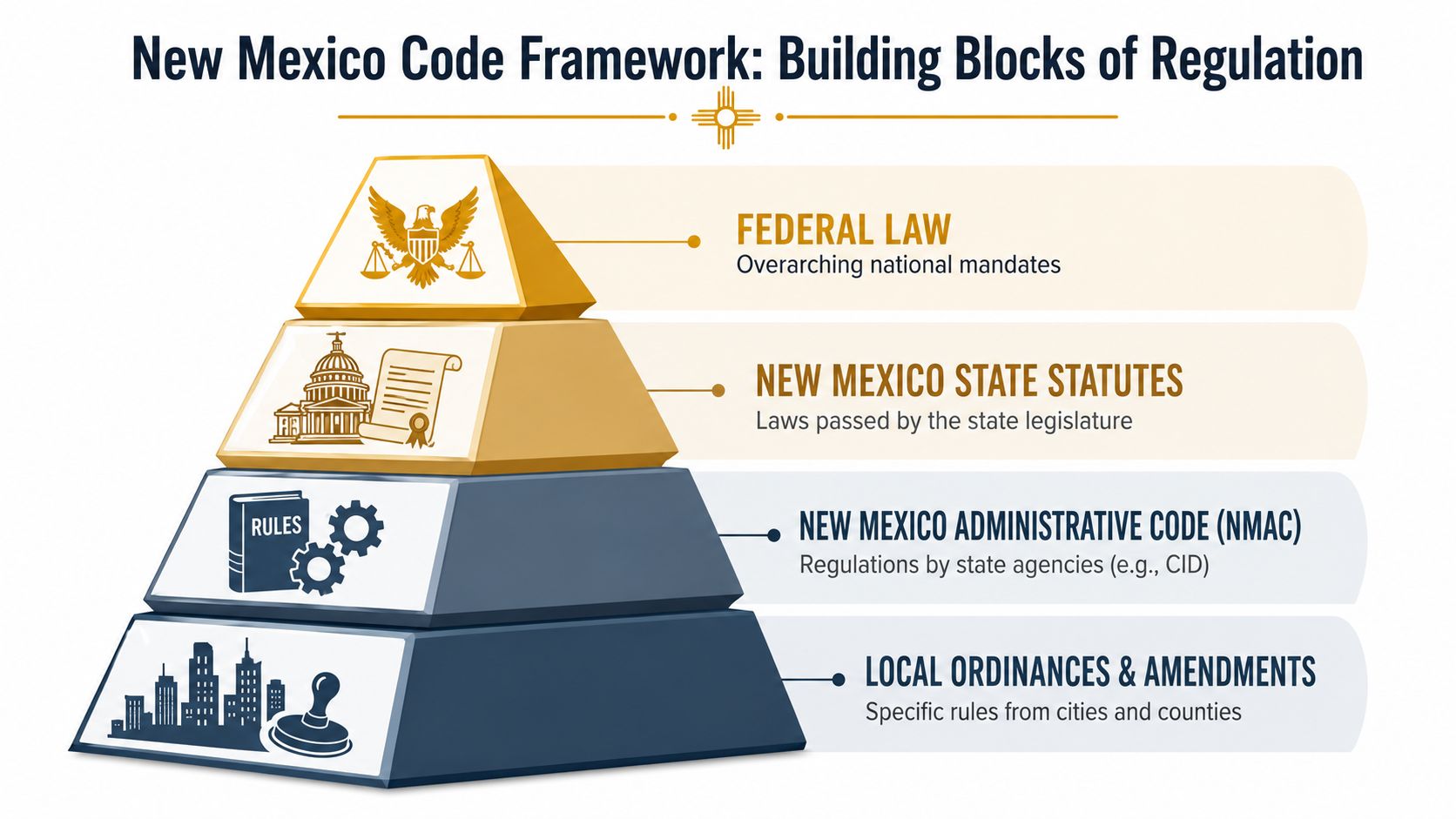
If you want to make sense of New Mexico codes, think of them as a pyramid. The higher levels create authority. The lower levels control day-to-day site decisions.
The top of the pyramid
At the broadest level, federal law can affect construction through environmental rules, workplace safety obligations, and permit-triggered requirements. For a New Mexico contractor, that matters most when federal stormwater obligations flow down into site controls and documentation.
Under that sits New Mexico's legal framework as a state. The modern system took shape when New Mexico entered the Union as the 47th state on January 6, 1912, ending a 61-year territorial period and replacing fragmented territorial rules with a state code system under a new constitution, as summarized in New Mexico statehood history.
That matters because contractors aren't working from a loose collection of customs. They're working within an organized state system that gives agencies authority to adopt and enforce detailed rules.
Where contractors actually work
The level most builders deal with is the New Mexico Administrative Code, usually called the NMAC. In the NMAC, agencies publish the specific rules that control building, electrical, plumbing, mechanical, manufactured housing, and related compliance topics.
For a site manager, the NMAC is the rulebook that turns broad legal authority into field requirements. It's what tells you which code edition applies, which agency has jurisdiction, and what standards your installations must meet.
A practical way to read the hierarchy is this:
| Level | What it does on a project |
|---|---|
| Federal law | Sets overarching mandates that can affect permits, stormwater, and environmental compliance |
| State statutes | Give New Mexico agencies authority to regulate |
| NMAC | Contains the enforceable agency rules contractors follow |
| Local ordinances and amendments | Add jurisdiction-specific requirements for the site |
Why this structure matters in disputes
When the field says one thing and the permit counter says another, this hierarchy helps you sort out who's right.
If a local jurisdiction has adopted stricter rules within its authority, you usually have to meet them. If a requirement comes from the state-adopted code, the local office can't ignore it just because it isn't convenient. And if the issue involves pollution prevention or stormwater, a building approval won't override those obligations.
The crews that handle New Mexico codes well don't memorize every section. They know where authority comes from and they verify the controlling layer before work starts.
That mindset keeps arguments short and corrections manageable.
The Core Building Codes Your Project Must Follow
Statewide construction compliance in New Mexico starts with adopted model codes. You don't build from scratch. You build to the state's adopted baseline, then check whether the local jurisdiction has tightened anything.
As of January 1, 2024, New Mexico adopted the 2021 International Building Code as the New Mexico Commercial Building Code and the 2023 National Electrical Code as the New Mexico Electrical Code, establishing a statewide minimum standard, according to New Mexico code adoption guidance.
Commercial, residential, and trade code scope
The first question on any job is simple. What kind of structure are you building.
If it's a commercial building or another project outside the detached one- and two-family residential category, the New Mexico Commercial Building Code is usually the main structural rule set. That drives plan review, occupancy issues, fire-resistance assemblies, egress, and broad construction standards.
If the project is a detached one- or two-family dwelling up to three stories high, the New Mexico Residential Code is the governing baseline for that structure type under the state's code system. That distinction matters because some crews incorrectly assume residential additions and small detached buildings can be handled under the same process as light commercial work.
For electrical work, the New Mexico Electrical Code applies statewide. If your project includes temporary power, service upgrades, equipment feeds, or final electrical installations, that trade work has to meet the adopted electrical code and any state amendments.
What this means on the ground
Here's how I'd sort common project types:
- Retail shell, office fit-out, warehouse work: Start with the commercial building code, then pull in electrical, plumbing, and mechanical rules as applicable.
- Single-family home, duplex, townhouse-style residential work within the covered category: Start with the residential code.
- Mixed-scope jobs: Don't guess. Some sites have residential-style components plus commercial utility or common-area work. Split the scopes correctly.
- Concrete-heavy projects: Structural code compliance is only part of the answer. Your slab, foundation, or flatwork work still has to fit the site's environmental controls.
Manufactured and modular work isn't exempt
A common misconception is that modular or manufactured housing avoids the same field requirements because much of the unit arrives prebuilt. That's the wrong read.
New Mexico's rules explicitly cover Manufactured Housing Requirements and Modular Structures, and those structures must conform to the same structural, safety, and environmental code framework as traditional construction. For crews doing foundations, utility tie-ins, pads, access, and related concrete work, that means the site still has to be run like a compliant construction site.
If your scope includes a foundation, pad, utility trench, stoop, driveway, or washout area, don't let the delivery method fool you. The site work still has code consequences.
A short decision check
Before mobilization, verify these points:
- Which code governs the building type
- Whether the work is residential, commercial, modular, or manufactured
- Which trade permits are needed
- Whether temporary concrete operations create separate SWPPP duties
- Whether local amendments add access, grading, drainage, or placement conditions
What works is making that call early, on paper, with the permit package. What doesn't work is trying to classify the project after inspections are already scheduled.
Concrete Washout and Stormwater Pollution Rules
The slab passes inspection. The rebar, forms, and finish are right. Then a storm hits that night, wash water leaves the washout area, and the job suddenly has an environmental problem on top of a building permit file.
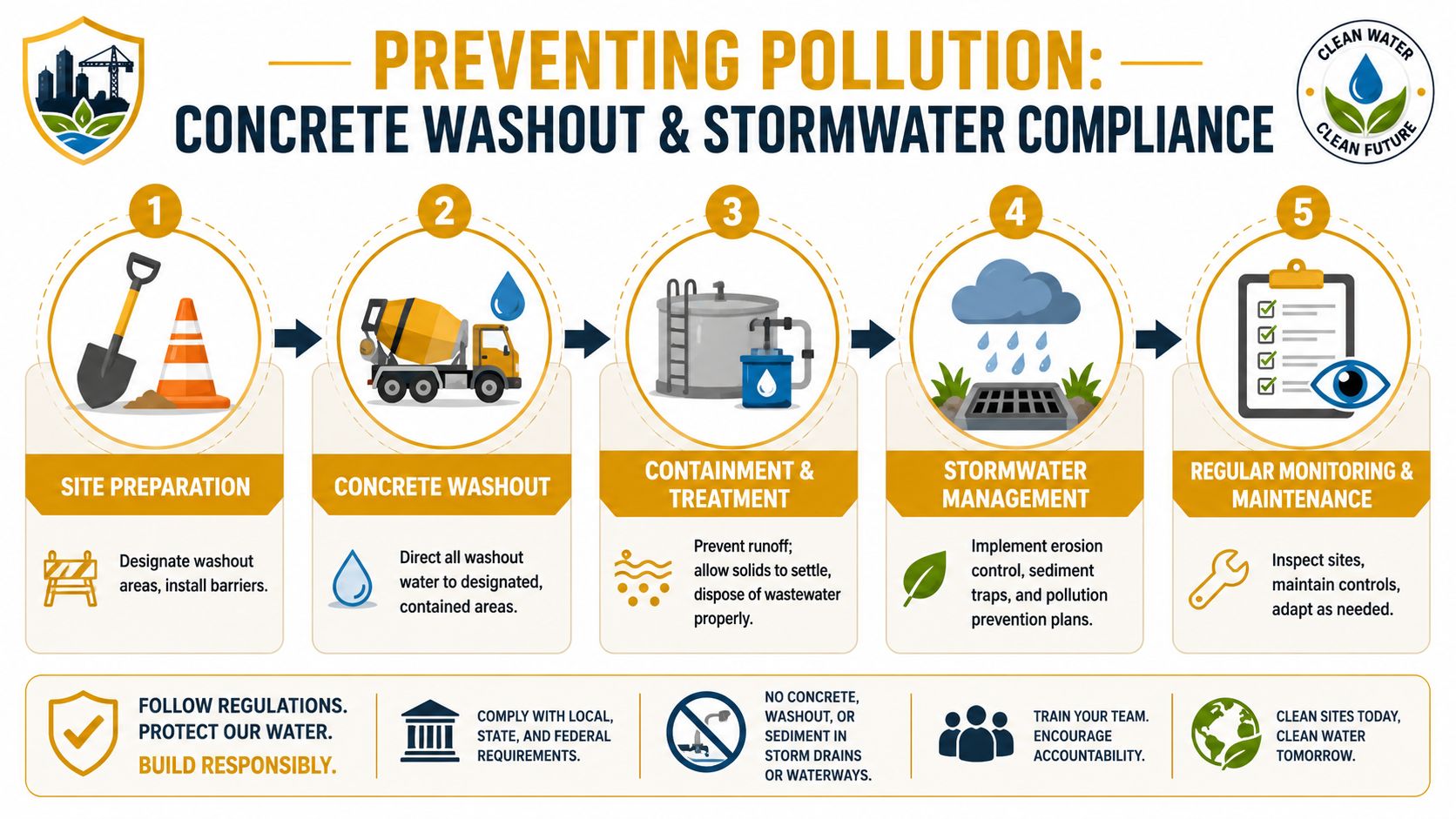
That happens more often than crews expect because concrete washout sits between two systems that are usually handled separately. One is the building code and permit process. The other is stormwater compliance under the project SWPPP.
Why washout gets flagged
Concrete wash water is not ordinary muddy runoff. It carries cement fines and high-pH material that can damage soil and water quality if it leaves containment. On New Mexico sites, the risk often gets underestimated because conditions stay dry until they do not. A single rain event, a poorly placed hose, or a washout area set in the wrong drainage path can turn routine cleanup into a reportable problem.
For site managers, the lesson is simple. If the SWPPP covers perimeter controls and stabilized entrances but says little about concrete washout, the field plan is not finished.
Code compliance does not cover this by itself
A project can be fully aligned with the adopted building code and still fail on stormwater control. Inspectors and regulators do not treat those as the same issue, and neither should the superintendent.
For concrete operations, keep these questions separate:
| Question | What it affects |
|---|---|
| Is the structure built under the correct code set and permit | Building inspection and permit compliance |
| Is there a designated, contained washout area | SWPPP implementation |
| Can runoff carry slurry or wash water off-site | Environmental exposure and enforcement risk |
| Is the washout setup close enough and large enough for the actual pour | Crew compliance, production, and cleanup |
That distinction matters on real jobs. I have seen crews do quality concrete work and still create avoidable violations because the washout plan lived on paper instead of in the field.
What a workable washout setup looks like
A good setup is obvious the moment you walk the site. Drivers can reach it. Pump crews do not have to improvise. The containment has enough capacity for the pour sequence, and it is placed where runoff will not overtop it or carry residue downhill.
The exact equipment can vary. Prefabricated containers, lined bermed areas, and slurry pans can all work if they are stable, accessible, and sized for the operation. The trade-off is practical. Small containment is easier to place but fills fast. Remote containment protects traffic flow but invites illegal dumping closer to the pour. The right answer is the one crews will use all day without overfilling it.
What works:
- A dedicated location close to truck and pump access
- Physical containment that holds wash water and solids under expected use
- Enough capacity for the planned pour, not just a light cleanup load
- Assigned responsibility for inspection, maintenance, and pump-out or removal
- Placement that fits the SWPPP and avoids drainage swales, low spots, and runoff routes
What fails in the field:
- Makeshift pits or loose plastic lining that tears, leaks, or collapses
- Washout areas placed too far away from where trucks and crews work
- Containment set on slope or rough ground where liquid can escape
- No maintenance plan after solids reduce usable volume
If the washout area is inconvenient, undersized, or badly placed, crews will work around it. Inspectors see that quickly.
How to tie washout into the SWPPP
Concrete washout should be written into the SWPPP the same way you would document any other site control. Identify the location, describe the containment method, assign who checks it, and state what happens when capacity is reached. Then match that paperwork to the site layout before the first truck arrives.
Use this field check before each pour sequence:
- Show the location on the site plan and review it at the pre-pour meeting
- Verify drainage so rain or wash water cannot bypass the control
- Match containment size to the volume of work scheduled that day
- Keep access open for ready-mix trucks, pump operators, and cleanup labor
- Inspect after use for overflow risk, liner damage, and solids buildup
- Remove or service full containment promptly so the next crew does not dump outside the system
The practical point is often missed in general code summaries. New Mexico code compliance for the structure and New Mexico environmental compliance for washout are connected on the same job site, but they are enforced through different duties. If you manage both together, you protect the permit, the schedule, and the site.
Local Amendments and Navigating City Permits
You can have an approved structural design, a ready crew, and concrete on the schedule, then lose a day because the city wants a revised site logistics plan. That happens all the time on New Mexico jobs. The problem usually is not the footing detail or wall section. It is where trucks enter, where temporary controls sit, how runoff is managed, and whether those field conditions match local permit expectations.

State code sets the baseline. Local jurisdictions add the site-specific rules that affect how you build. For a site manager, that means permit compliance is not just a plan review issue. It is a staging, access, drainage, and sequencing issue.
What changes at the local level
Local amendments and permit conditions often reach beyond the building itself. They can affect:
- Zoning and land use
- Setbacks and placement
- Drainage and grading review
- Historic or design review
- Temporary equipment location
- Access routes for deliveries and site services
That last group gets missed too often. A city reviewer may not call it "concrete washout compliance," but they will care if your proposed setup creates tracking, blocks access, conflicts with drainage, or puts slurry control in the wrong place. That is where building code coordination and SWPPP execution meet on the same site.
Santa Fe and Albuquerque show the difference clearly. Santa Fe often applies closer review to visual standards, neighborhood fit, and sensitive site conditions. Albuquerque often puts more weight on zoning process, utilities, and the mechanics of city plan review. Same state. Different local pressure points.
Rural sites create different permit problems
Outside the larger cities, the issues change but they do not get easier. Slope, unstable shoulders, limited staging area, and long truck approaches can all affect permit approval and field compliance.
A significant number of rural projects run into delays because temporary equipment access was never fully worked out during preconstruction. I see it most often with washout containment, pump setup, and truck turning movements. A containment plan that works on a flat subdivision pad can fail fast on a narrow mountain lot or a soft shoulder after rain.
The lesson is practical. If the washout container cannot be reached safely, kept level, and protected from runoff, crews will improvise. Once that happens, you have both a permit problem and an environmental problem.
Review the permit set like a field supervisor
Use this comparison before submittal:
| Issue | Statewide baseline | Local permit reality |
|---|---|---|
| Building code | Sets minimum construction standards | Often paired with local comments tied to site conditions |
| Site access | Usually handled as means and methods | May be reviewed through traffic, grading, fire access, or permit conditions |
| Drainage and runoff | Connected to environmental duties | Commonly reviewed by local planning or engineering staff |
| Temporary equipment | Rarely described in general code summaries | Can trigger corrections if placement affects access, drainage, or neighboring property |
| Historic or neighborhood context | Applies only where relevant | Can control exterior work, staging limits, and review timing in some jurisdictions |
A permit package moves faster when it answers field questions before the reviewer has to raise them.
How to reduce permit friction
These steps save time on real jobs:
- Call the local building or planning office before you lock the site logistics plan.
- Ask how the jurisdiction wants temporary controls shown on the permit set, especially washout, stabilized access, and material staging.
- Put constrained-site logistics on the drawings if access, slope, or drainage will be tight.
- Check whether grading, drainage, or fire access review will affect where concrete trucks and pump equipment can operate.
- Treat rural sites seriously. Less staff oversight does not mean fewer consequences after a complaint, inspection, or storm event.
- Review the SWPPP and city permit together so the washout location works for both.
The crews that stay out of trouble usually solve these issues before mobilization. The ones that struggle send in a clean building set, then try to figure out washout placement, truck access, and runoff control after the permit comments arrive.
Enforcement Fines and Staying Compliant
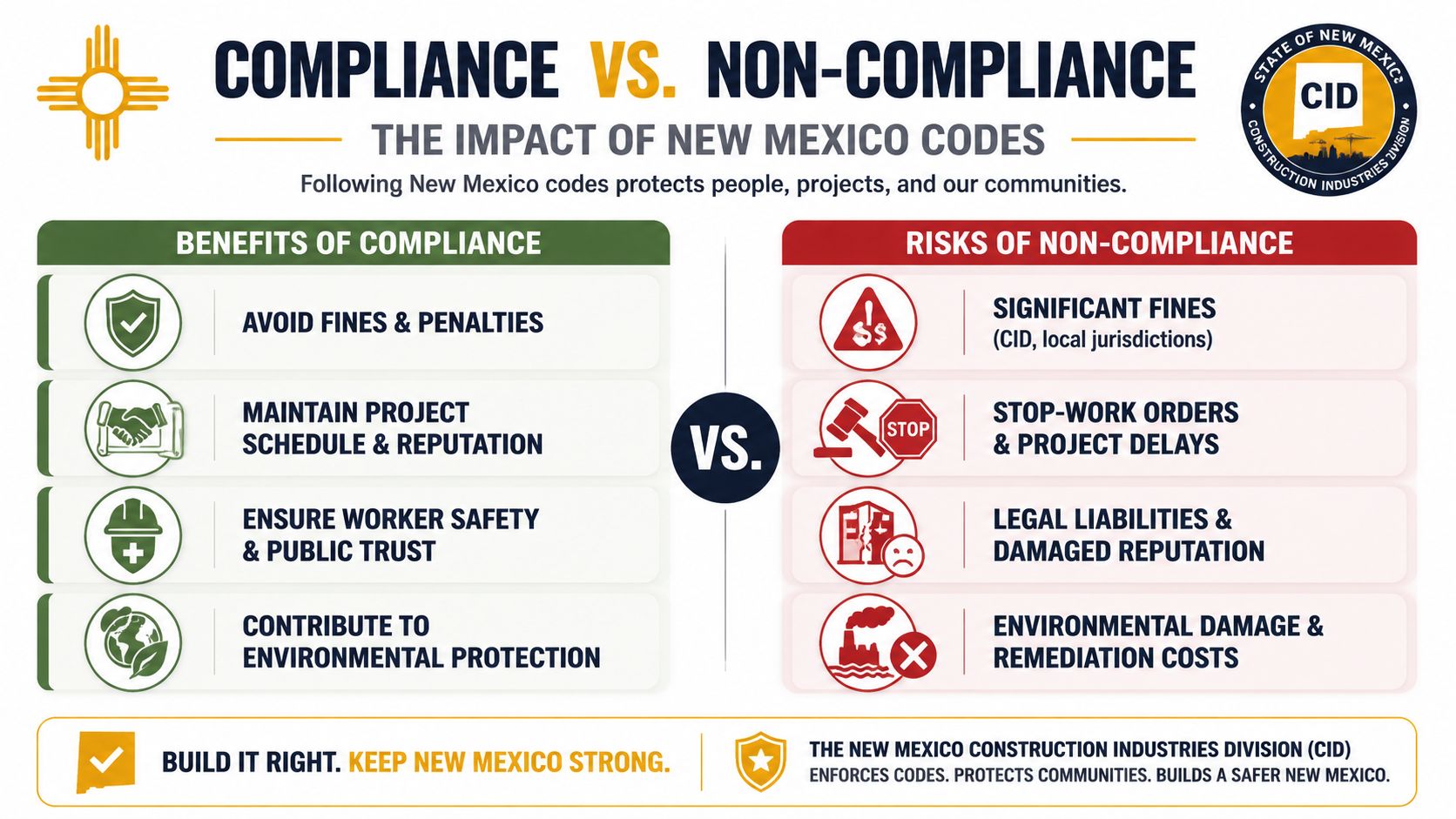
Most compliance failures don't start with a dramatic shutdown. They start small. An overlooked correction. A washout area that drifts from the approved plan. A temporary setup that nobody documented. Then the project accumulates risk until one inspection, one complaint, or one storm turns it into a formal problem.
That's why compliance should be treated as risk control, not paperwork.
How enforcement usually unfolds
On New Mexico jobs, enforcement can come from more than one direction. The Construction Industries Division has authority over adopted building and related codes. Local building departments enforce permit conditions and local requirements. Environmental obligations can trigger separate consequences when runoff, slurry, or site discharges aren't controlled.
The sequence is usually predictable:
- A reviewer or inspector finds a deficiency.
- The contractor gets notice to correct.
- If the issue affects safety, environmental protection, or permit compliance, the pressure escalates fast.
- Delays follow because corrective action has to happen before work can move normally again.
For a site manager, the biggest cost usually isn't the label attached to the violation. It's lost time, crew disruption, resequencing, and damaged trust with the owner or municipality.
Why cutting corners backfires
Crews sometimes shortcut compliance because the job is under schedule pressure. That rarely helps. If the concrete operation isn't aligned with the approved site controls, every pour becomes a chance to create a bigger issue.
A non-compliant washout setup can lead to cleanup, re-inspection, and documentation headaches even before formal penalties enter the picture. If runoff leaves the site, the problem expands beyond housekeeping. Now you're dealing with environmental exposure and possible remediation obligations too.
The cheapest washout plan is the one that doesn't have to be rebuilt in the middle of the project.
The habits that protect the schedule
The jobs that stay clean usually do a few things consistently:
- One owner for compliance: Someone on site checks that the field condition still matches the plan.
- Pre-pour review: The washout location, access path, and containment status get confirmed before the trucks arrive.
- Daily housekeeping: Small spills and bad habits are corrected immediately.
- Fast response to notices: If an inspector flags something, fix it and document it before it becomes a pattern.
A good superintendent doesn't wait for enforcement to define the standard. The site runs to the standard every day. That's how you protect the budget, preserve the schedule, and keep New Mexico codes from turning into a project problem.
FAQ and Key New Mexico Agency Contacts
The questions below usually surface after plans are approved and the work is already moving. A pour is scheduled, trucks are on the way, and someone realizes the washout area was never clearly shown, never installed, or no longer matches the site conditions. That is how a routine concrete operation turns into both a code problem and a stormwater problem.
FAQ
Do I need a separate permit just for concrete washout containment
Usually, no separate washout permit is issued by itself. Rather, the question is whether your washout area is accounted for under the site's approved erosion and sediment controls, grading documents, SWPPP requirements, and any local permit conditions.
For the field team, that means one thing. Decide the washout location before the first pour, show it in the project documents where required, and make sure it is usable by the trucks. A compliant washout plan on paper does not help if the driver cannot reach it without crossing unstabilized ground or tracking slurry toward a drain.
If I'm doing modular or manufactured housing work, do site rules change
The approval path can change. The ground rules on site do not.
Manufactured and modular housing work still has to meet the applicable state requirements for setup, utility connections, safety, and site-related controls. If you are placing concrete for foundations, flatwork, piers, skirting supports, or utility pads, the same runoff and washout concerns still apply. The unit type does not excuse a bad washout setup or discharge off site. For code and regulatory references tied to that housing sector, the New Mexico Manufactured Housing Association codes and regulations page is a useful starting point.
What should I do first if I get a correction notice
Treat it like a field directive, not a paperwork exercise.
Read the notice closely. Figure out whether the issue is building code, permit administration, stormwater compliance, or a combination of those. Then assign one person to own the response. On problem jobs, corrections stall because the superintendent thinks the concrete sub is handling it, the concrete sub thinks the civil contractor is handling it, and nobody closes the loop.
Take date-stamped photos, fix the condition, update any required logs or plans, and ask the issuing agency what proof they want before they will clear it.
Who should answer my question when the issue overlaps building code and SWPPP
Start with the agency that has direct authority over the condition you can see on the ground. If the issue involves a footing, slab, wall, or trade installation, start with the building side. If the issue involves runoff, discharge potential, sediment controls, or washout management, bring in the environmental side at the same time.
That overlap matters in New Mexico. A concrete washout problem is often treated like housekeeping by crews, but inspectors may view it as pollutant control, plan compliance, and site management all at once.
New Mexico agency and municipal contacts
| Agency / Department | Area of Responsibility | Website / Contact |
|---|---|---|
| New Mexico Construction Industries Division | State building code enforcement, adopted codes, trade regulation | Construction Industries Division, as noted earlier in this guide |
| New Mexico Environment Department | Environmental compliance and state environmental oversight | New Mexico Environment Department |
| City of Albuquerque Planning Department | Local planning, zoning, and development review | City of Albuquerque Planning |
| City of Santa Fe Land Use Department | Local land use, permits, planning review | City of Santa Fe Land Use |
| City of Rio Rancho Building Safety and Planning | Local building and development coordination | City of Rio Rancho development services |
| Angel Fire Planning and Zoning | Local planning context and community development information | Angel Fire Planning and Zoning, as noted earlier in this guide |
The jobs that stay out of trouble usually handle this early. One person owns code and SWPPP coordination, the washout area is set before the pour, and local comments get pushed to the field before they become inspection failures.
If your project needs a practical concrete washout solution that fits real site conditions, Reborn Rentals offers specialized containment rentals for construction teams that need dependable equipment, clear pricing, and fast coordination for delivery, scheduling, and site logistics.