You're probably dealing with the same pressure every project manager hits sooner or later. The schedule is tight, subs are asking for answers now, ownership wants progress photos, and the field team is trying to keep work moving without getting buried in paperwork. That's when quality starts to slip, not because people don't care, but because the job starts running on momentum instead of control.
In construction, bad quality rarely shows up all at once. It starts small. A crew installs from an outdated detail. A delivery gets accepted before anyone checks the submittal. A concrete washout area gets treated like housekeeping instead of compliance. By the time someone catches it, the mistake is built in, covered up, or spread across three trades.
That's why quality assurance construction has to be more than inspection forms at the end of the week. It has to be part of how the job is planned, briefed, documented, and verified every day. If the structure depends on a sound footing, the project depends on a sound QA process. Build that foundation early, and the rest of the job stands straighter.
Why Quality Assurance Is Your Best Insurance Policy
A project can look fine right up to the moment it doesn't.
One common example is a concrete pour that goes in without one last check of embeds, rebar spacing, form dimensions, or approved mix documentation. The placement happens, the finish looks clean, everyone moves on, and then the questions start. Was the right bar installed? Was the approved mix delivered? Did anyone verify the hold points before placement? At that stage, you're not fixing a typo. You're cutting into structure, delaying follow-on trades, and trying to explain why a preventable issue got past the team.
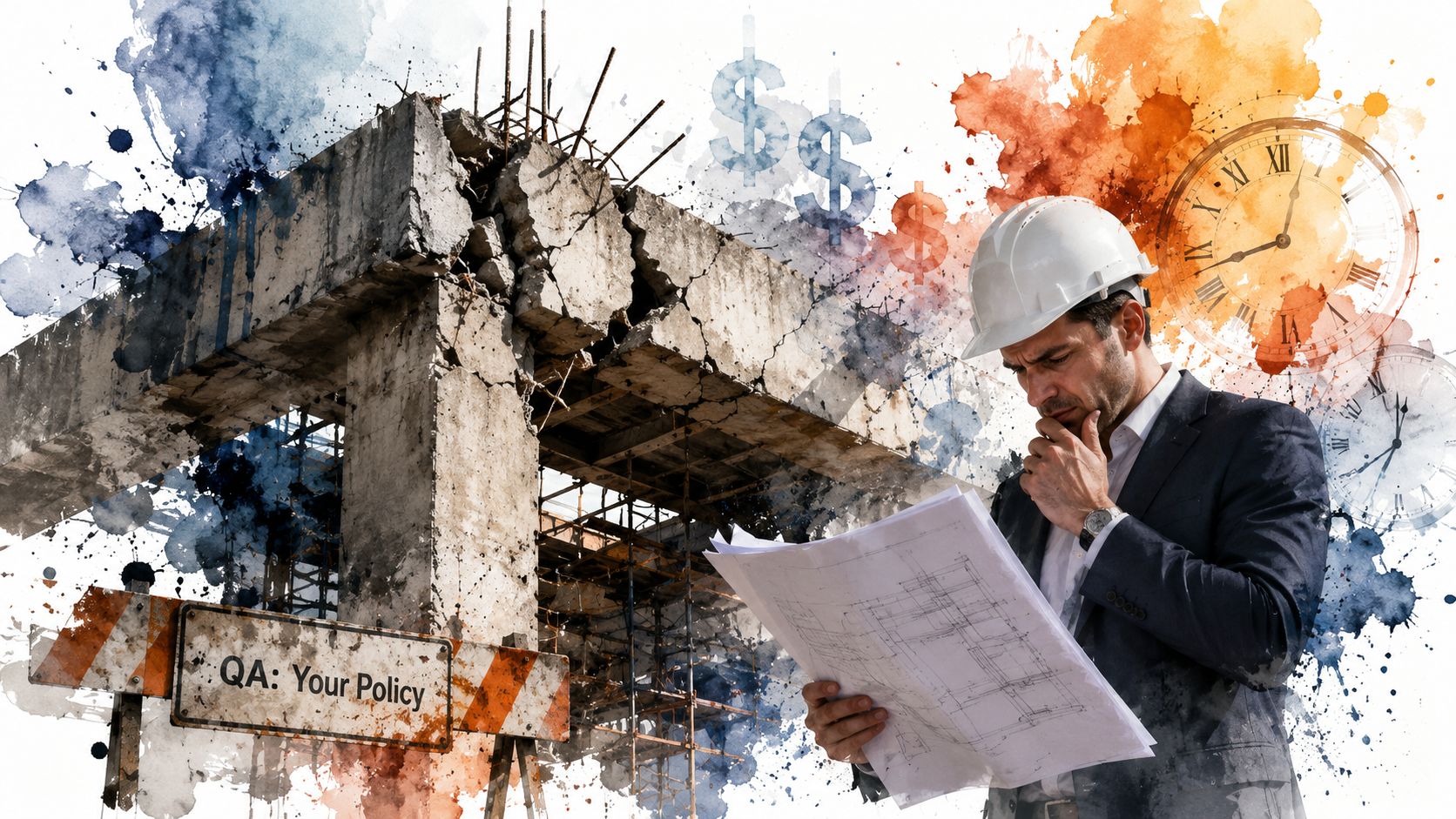
That's what quality assurance is supposed to stop. It isn't paperwork for its own sake. It's the system that keeps the wrong material, wrong method, or wrong sequence from getting built into the job.
What QA looks like in the real world
On a healthy project, QA starts before tools hit the slab. The drawings are coordinated. Submittals are reviewed against the spec. The superintendent and foremen know what the acceptance criteria are before the work starts, not after the inspector shows up. Hold points are clear. Documentation is ready. The crew knows what “done right” looks like.
That's the difference between hoping for a good result and setting the job up to produce one.
Practical rule: If the first time you verify quality is after installation, you're already late.
A lot of new managers confuse QA with “checking work.” That's only part of the picture. Real QA is process control. It answers basic questions before they become expensive ones:
- Are we building from the current documents? Old sheets and stale details create clean-looking mistakes.
- Are approved materials on site? If receiving doesn't tie back to submittals, the wrong product can slip through.
- Does the crew understand the sequence? Even good trades can fail when the handoff between activities is sloppy.
- Are compliance items built into the work plan? Environmental controls, testing requirements, and inspections can't be treated as side tasks.
Why it protects more than the finish product
When QA is working, the job runs calmer. Fewer surprises. Fewer arguments over who knew what. Fewer rushed corrections right before turnover.
It also protects things people don't always file under “quality,” but should:
- Profitability: Rework eats labor and schedule.
- Reputation: Owners remember how many problems had to be chased.
- Safety: Crews working around rework and confusion take more risks.
- Compliance: A project that misses permit or environmental requirements isn't a quality success.
A good QA program is like proper shoring. Nobody gets excited about it when it's in place, but when it's missing, the whole job feels unstable.
QA vs QC Understanding the Critical Difference
The terms are often used interchangeably. That causes trouble fast.
Quality assurance is the process that prevents defects. Quality control is the process that finds defects. They work together, but they are not the same job.
Think of it like building and measuring
If you want a simple way to explain it to a new assistant superintendent, use this: QA is the blueprint and the method. QC is the tape measure in the field.
QA says, “Here's the approved drawing, here's the submittal, here's the pre-install meeting, here's the checklist, and here's who signs off before we proceed.”
QC says, “Let's verify this anchor bolt layout, check the weld, test the line, and document any deficiency.”
One is prevention. One is verification.
A crew can pass QC on a small area and still fail the project if the underlying QA process is weak.
Why teams mix them up
They mix them up because QC is visible. You can see an inspection, a punch walk, or a failed test report. QA is quieter. It lives in planning meetings, controlled documents, submittal logs, checklists, and hold points. Done right, it prevents the headline problem, so people forget it was doing the work all along.
That's like crediting the paint for a straight wall and ignoring the framing layout.
Quality Assurance QA vs Quality Control QC
| Aspect | Quality Assurance (QA) | Quality Control (QC) |
|---|---|---|
| Primary purpose | Prevent defects before they get built in | Identify defects in installed or in-progress work |
| Timing | Before and during the work through planning and process control | During and after the work through checks and testing |
| Main focus | Systems, procedures, communication, approvals, training | Inspection, measurement, testing, punch items |
| Typical owner | Project managers, superintendents, discipline leads, trade partners | Inspectors, testing agencies, QC staff, field engineers |
| Typical tools | Pre-task plans, submittal tracking, method statements, checklists, approved drawings | Test reports, inspections, field measurements, deficiency logs |
| Best question | “How do we keep this from going wrong?” | “Did this installation meet the requirement?” |
| Failure mode | Crews build the wrong thing correctly | Crews discover the wrong thing after labor and material are spent |
What works on actual jobs
The strongest teams don't argue about whether QA or QC matters more. They connect them.
A pre-install meeting without field verification is incomplete. An inspection without a defined standard is just opinion. If you want fewer callbacks and cleaner turnover, pair the two deliberately:
- Use QA to define acceptance before work starts
- Use QC to verify the field matches that acceptance
- Feed QC findings back into QA so the process improves
- Stop treating punch lists as the main quality strategy
Punch lists have their place. But if your quality program starts at punch, you're running a repair business inside a construction project.
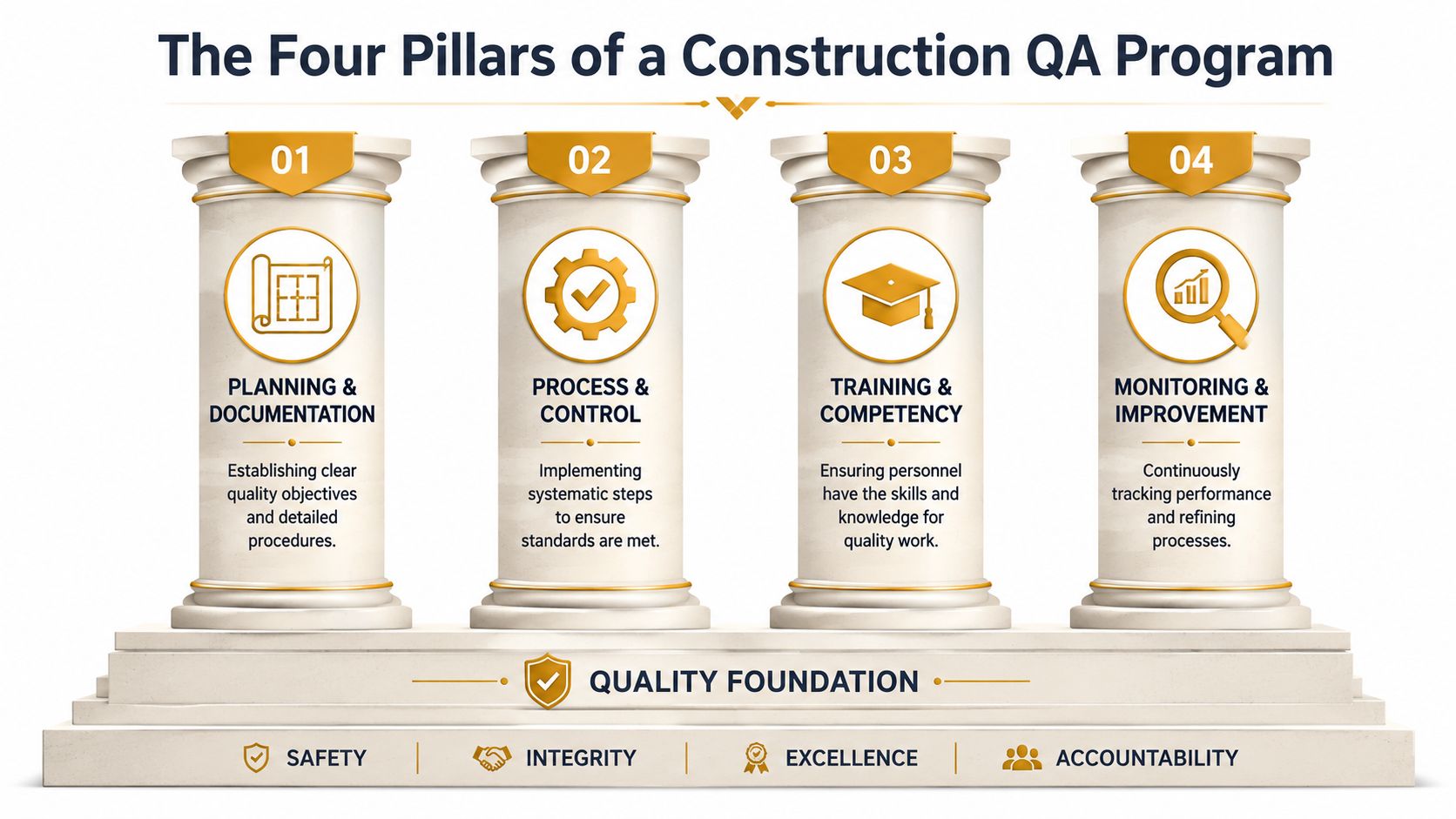
The Four Pillars of a Construction QA Program
A dependable QA program isn't complicated because it has a lot of forms. It's dependable because it covers the right ground every time. I'd break it into four pillars: planning, standards, verification, and documentation. If one pillar is weak, the rest of the system leans.
Quality planning
At this stage, the project either gets organized or gets lucky.
The core document is usually a Project Quality Plan, whether you call it that formally or not. It should identify responsibilities, hold points, required submittals, inspection paths, document control, and how nonconforming work gets handled. It also needs to line up with the schedule. A QA plan that sits outside the schedule will be ignored the first time the job gets busy.
Key activities here include:
- Pre-installation meetings: Get the superintendent, trade foreman, and relevant consultants aligned before critical work starts.
- Task-specific checklists: Build them around actual risk points, not generic language copied from another job.
- Responsibility mapping: Decide who reviews, who verifies, and who has authority to stop or reject work.
A weak plan usually shows itself in one sentence from the field: “I thought someone else had that.”
Defined standards
You can't assure quality if nobody knows what standard applies.
This pillar means more than keeping a spec book in the trailer. The team needs to know which drawings are current, which submittals are approved, which tolerances matter, and what mock-up or sample governs the finished look. For architectural work especially, mock-ups settle arguments before they become change disputes.
Useful control points include:
| Control item | Why it matters |
|---|---|
| Current drawing set | Prevents crews from building from outdated information |
| Approved submittals | Confirms the product on site matches what was accepted |
| Mock-ups and samples | Establishes the quality benchmark in visible form |
| Code and permit requirements | Keeps the work compliant, not just functional |
If the foreman has to guess whether something is acceptable, the QA system already failed him.
Audits and inspections
This pillar catches drift. Even a well-planned job starts to slip if nobody checks whether the process is being followed.
Internal audits matter because they test the system, not just the installed work. Are submittals being filed where the field can access them? Are hold points being honored? Are receiving inspections happening? Are corrective actions being closed out? Third-party inspections matter too, especially when structural, geotechnical, envelope, fire protection, or jurisdictional requirements are involved.
A practical audit rhythm usually includes:
- Routine field walks: Focus on upcoming work as much as completed work.
- Hold-point verification: No pour, close-in, or cover-up until the signoffs are complete.
- Corrective action tracking: Every deficiency needs an owner and a closeout path.
Rigorous documentation
Documentation isn't admin clutter. It's the project memory.
When disputes come up, memory loses to records every time. The jobs that stay under control have organized RFIs, approved submittals, delivery tickets, inspection forms, test reports, nonconformance logs, and dated photos tied to locations. You don't need a fancy system if the team is disciplined, but you do need a reliable one.
The documents that carry the most weight are usually these:
- RFIs and responses: They show how ambiguity was resolved.
- Submittal records: They prove what was approved before purchase and installation.
- Inspection and test reports: They establish what was verified and when.
- Photo documentation: They capture concealed conditions before they disappear behind finishes.
A slab needs reinforcement in the right places. A QA program does too. These four pillars are that reinforcement.
Common QA Checkpoints from Foundation to Finish
QA makes the most sense when you follow a job in sequence. Every phase has a few moments where a short check prevents a long problem.
Preconstruction and early mobilization
Before excavation starts, the project team should already be reviewing the geotechnical report, permit conditions, approved drawings, and the scope gaps between trades. This is also when subcontractor qualifications matter. A low number on a bid tab doesn't help if the trade partner can't document procedures, manage submittals, or hold their own quality line in the field.
Early site logistics also belong in QA. Staging, access, material storage, stormwater controls, and utility protection all affect whether later work gets built cleanly or under pressure.
A few early checkpoints worth enforcing:
- Document control setup: Make sure the field is pulling from one current source of truth.
- Submittal release planning: Long-lead materials should be approved before they become schedule excuses.
- Site compliance setup: Erosion control, protection measures, and designated waste areas should be ready before production ramps up.
Foundations and structure
At this stage, hidden mistakes become permanent.
Before a footing or slab pour, the team should verify excavation depth, bearing conditions, rebar size and spacing, form dimensions, embeds, sleeves, and access for placement. If a testing agency is required, their role and timing need to be set before the truck queue starts forming. Once concrete is in the air, the window for thoughtful correction closes quickly.
For structural steel or raised decks, QA checkpoints shift to member identification, connection details, bolt installation procedures, weld requirements, deck fastening, and survey control. These aren't items to “look at later.” They govern whether the building goes up true and whether follow-on trades inherit a workable frame.
The cheapest time to fix a defect is before the truck backs in or the lift starts swinging steel.
MEP rough-in and close-in work
MEP QA often breaks down at interfaces. The duct is right, but it blocks access. The plumbing line is installed, but it conflicts with framing. The conduit is run, but the wall assembly won't pass inspection once it's sealed.
That's why pre-close-in checks matter so much. Before walls and ceilings are covered, verify pressure tests, supports, clearances, device locations, firestopping requirements, equipment access, and ceiling coordination. Phone photos help here more than people admit. Once the board is up, “I'm pretty sure it was right” has no value.
Finishes and handover
Finishes expose all the sloppiness that came before them.
Floor flatness, substrate prep, moisture conditions, paint surface quality, sealant joints, hardware function, and fixture alignment all need defined acceptance criteria. The best finishing crews still struggle if they inherit damaged substrates and rushed predecessor work.
Handover QA should also include document turnover, training records, attic stock or spare materials where required, and closeout verification that matches contract obligations. A polished lobby doesn't mean the job is complete if the paperwork and operating information are a mess.
Environmental Compliance as a Core QA Component
A project isn't high quality if it fails environmental compliance. That's not a side issue anymore. It's part of the work.
Too many jobs still treat environmental controls like a separate binder for the consultant or a box to check before an inspection visit. In the field, that mindset creates preventable failures. Crews protect finishes, protect survey control, protect structural tolerances, but leave washout, runoff, and material containment to chance. That's a QA failure, not just an environmental one.
Why environmental compliance belongs inside QA
If your quality program defines how work gets executed correctly, then it has to include permit conditions, site controls, and regulated waste handling. Otherwise, you're saying the project can be “quality work” even while violating requirements tied to the same contract and site.
That doesn't hold up in practice. Poor environmental control creates the same project consequences as poor structural or finish control:
- Work disruption: Inspectors and owners respond fast when a site looks uncontrolled.
- Rework: Contaminated areas and damaged surfaces still need cleanup and correction.
- Documentation exposure: If there's no record of planning, containment, and inspection, the team has little defense.
- Reputation damage: A sloppy site signals sloppy management.
Concrete washout is the test case most teams underestimate
Concrete washout management is where this issue becomes obvious. Fresh slurry and wash water don't belong in random low spots, behind the trailer, or along the curb because the pump operator needed a quick place to clean out. Yet that's exactly how many sites drift into trouble.
Concrete operations need a designated, contained washout area before the first pour starts. Not later. Not after someone asks. Before the work begins.
That means the QA plan should identify:
| Washout QA item | What the field team should confirm |
|---|---|
| Location | Accessible to pump, truck, and finishing crews without encouraging shortcuts |
| Containment method | Sized and placed for expected use, stable, and clearly designated |
| Crew briefing | Operators and laborers know exactly where washout is allowed |
| Inspection routine | Someone checks condition, capacity, and housekeeping during active concrete work |
| Closeout process | Removal, disposal, and site restoration are assigned, not assumed |
A clean washout setup does more than keep the site tidy. It proves the job was planned.
What works and what fails
What works is simple and boring. Put containment in place early. Mark it clearly. Include it in pre-pour planning. Assign responsibility for inspection and service. Photograph it like any other compliance control. Treat it as a required condition for concrete work, not as optional support.
What fails is the usual mix of last-minute thinking and divided responsibility. The superintendent assumes the concrete sub has it covered. The concrete sub assumes the site team has designated an area. The trucks arrive, and people improvise. Improvisation is where compliance problems start.
Modern quality assurance construction has to absorb this lesson. Environmental compliance isn't peripheral. It's embedded in whether the work was properly planned, properly executed, and properly documented.
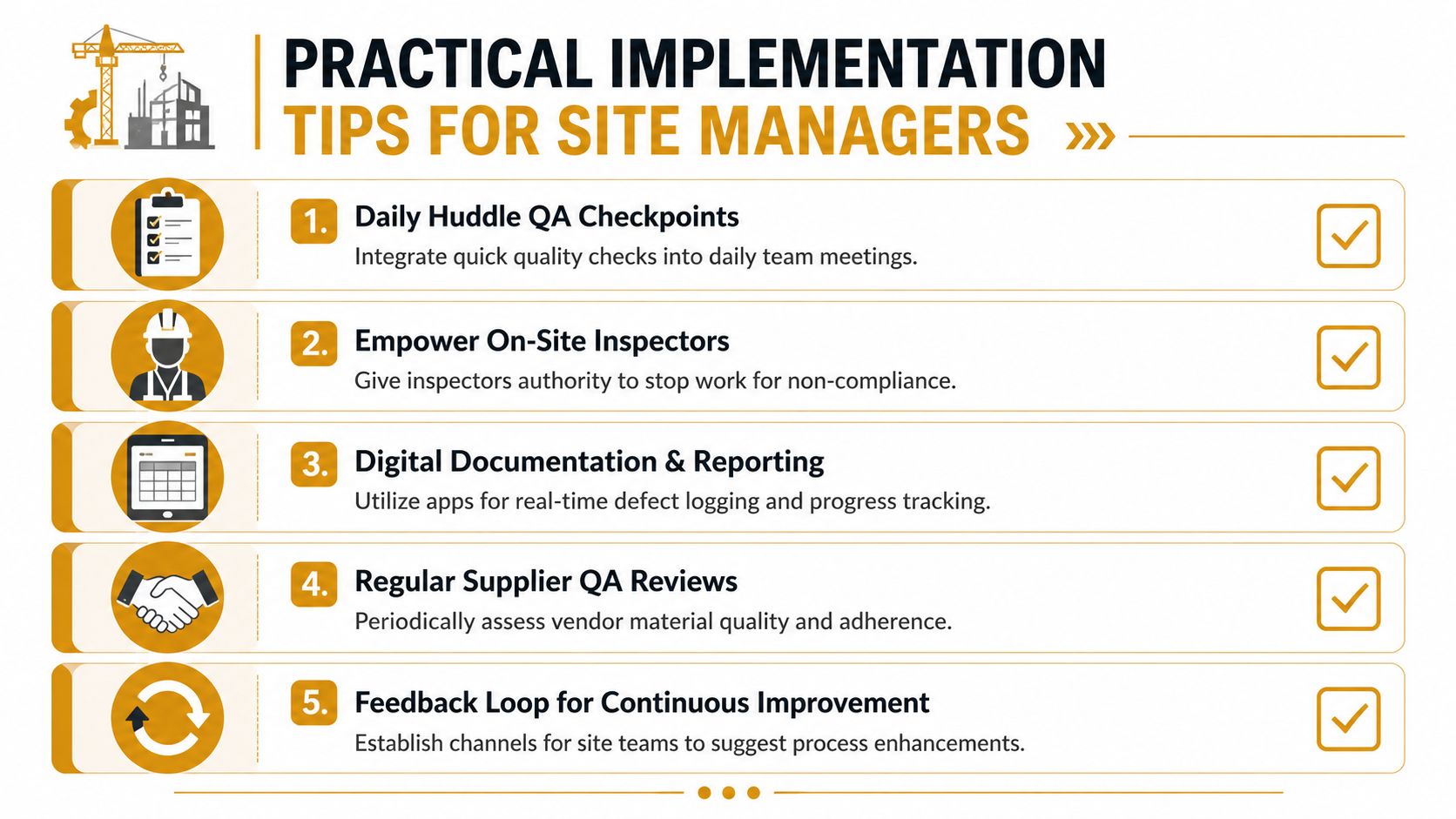
Practical Implementation Tips for Site Managers
Most jobs don't need a grand quality overhaul. They need a few habits done consistently.
Start with the critical work, not every possible task
Don't try to create a perfect QA system for the entire project in one pass. Start with the activities that can bury you if they go wrong: concrete placements, waterproofing, structural connections, MEP pressure tests, envelope transitions, and close-in inspections.
Build short checklists for those first. A good field checklist isn't a policy manual. It's a one-page control tool that tells the team what must be verified before work proceeds.
Use daily communication to drive quality
The daily huddle is one of the cheapest QA tools on site. If the superintendent or foreman uses it well, crews know the day's risk points before the first lift or delivery.
Focus the conversation on what can go wrong today, what must be checked before cover-up, what document controls the work, and who has to sign off. That keeps quality tied to production instead of making it feel like an interruption.
A few practical habits make a big difference:
- Pre-task briefings: Review the drawing, spec requirement, sequence, and hold points with the crew doing the work.
- Authority to stop work: Field leaders need clear backing to pause nonconforming work before it spreads.
- Photo records: Use phone cameras for pre-cover, in-progress, and completed conditions tied to location and date.
- Vendor and delivery checks: Verify material labels, condition, and approval status before unloading into production.
- Issue closure: Don't just log deficiencies. Confirm the correction and note who accepted it.
Build a culture where quality isn't someone else's department
If laborers, operators, foremen, and assistant supers think quality belongs only to inspectors, the job will stay reactive. The better approach is simple: every person who installs work is responsible for checking the condition they inherit and the condition they leave behind.
That sounds basic, but it changes behavior. Drywall crews start asking whether the MEP rough-in is signed off. Concrete crews ask where washout is located before placement. Finish trades reject damaged substrates instead of covering them up and arguing later.
Good sites don't just inspect quality. They hand it off from crew to crew without dropping it.
You don't need expensive software to start. A shared folder, current drawings, clear checklists, disciplined photos, and a superintendent who enforces hold points will outperform a fancy platform that nobody uses.
Frequently Asked Questions about Construction QA
What software is used for construction QA
Teams use a mix of tools, not one magic platform. Common setups include project management software for submittals and RFIs, field inspection apps for checklists and deficiency tracking, cloud storage for controlled drawings, and photo documentation tools tied to locations. The best software is the one the field will use consistently. If the app is too slow or too complicated, crews will fall back to calls, texts, and memory.
How should a small contractor handle QA
A small residential or light commercial contractor doesn't need a giant manual. They need simple controls that are used every time. Start with current drawings, approved material selections, pre-task checklists for critical work, photo records before concealment, and a clean closeout process. Small teams usually win with simplicity and discipline, not volume of forms.
What roles and career paths are tied to QA
QA work shows up under several titles. You'll see project engineers, field engineers, superintendents, QC managers, commissioning staff, special inspectors, and compliance coordinators carrying parts of it. The strongest quality leaders usually understand both field production and documentation. They know how work gets built in practice, not just how forms get filled out.
How do you convince ownership to invest in QA
Don't sell QA as overhead. Sell it as risk control. Owners understand schedule certainty, cleaner turnover, fewer disputes, and better documentation. Show them where the project can fail if approvals, inspections, and compliance controls are loose. Speak in terms of avoided disruption, not abstract “quality culture.”
How does environmental compliance fit into construction QA
It fits the same way material verification and inspection hold points fit. If the project requires compliant execution, then environmental controls belong in the quality process. That includes planning, designated containment areas, inspection routines, photo documentation, and assigned responsibility. Concrete washout is a clear example. If that process is unmanaged, the project is not under quality control in any meaningful sense.
If your team needs a reliable way to handle concrete washout as part of a stronger QA and compliance program, Reborn Rentals is worth a close look. Their rental options are built around practical site needs, with straightforward scheduling, delivery coordination, and washout containment solutions that help crews keep sites clean, organized, and ready for inspection.