You usually find out whether roll off truck dimensions matter at the worst possible moment. The truck is on site. The driver has already committed time to the stop. Your crew is waiting. Then the access problem shows up all at once: the gate is tighter than it looked on the plan, the approach angle is ugly, the tree canopy sits too low, or the drop zone doesn't give the truck enough room to line up and slide the container off cleanly.
That's the expensive part of bad site prep. The container itself may fit the footprint you picked, but the truck still has to enter, turn, stage, lift, and exit. Those are different questions, and they're the ones that decide whether delivery happens on the first trip.
Most guides stop at dumpster size. That's useful, but it's incomplete. What saves a jobsite is translating spec-sheet numbers into a working site plan. If you're trying to answer, “Will this fit, and what do I need to prepare?” that's the right way to look at roll off truck dimensions.
The Most Expensive Mistake in Site Management
A failed delivery usually starts with a reasonable assumption. Someone sees open ground and assumes the truck can work. Then the driver arrives and sees what the site team missed: the truck can't square up to the placement area, the overhead isn't clean, or the turn into the site leaves no recovery room.
I've seen this happen most often on active builds where the layout changed after the original access plan. A temporary fence gets moved. Pallets get staged near the gate. A pump truck parks where the roll-off needs to swing. Nobody changed the delivery instructions, so the truck shows up to a site that no longer matches the plan.
The cost isn't just a delayed drop. It ripples through the day.
- Crew time burns first: Labor stands around waiting for a container or washout setup that should already be in place.
- Concrete work gets squeezed: If the washout container can't get placed where the crew needs it, cleanup becomes harder and compliance gets riskier.
- Rescheduling gets messy: Once a truck misses a clean delivery window, the next opening may not line up with your pour, demo, or haul-off sequence.
- Site congestion gets worse: Other trades keep moving, which narrows access even more.
Practical rule: If the driver has to “figure it out” at the gate, site planning started too late.
The fix is straightforward. Stop treating the order as a container-only decision. Treat it as a vehicle access and placement problem. The right question isn't just “What size box do I need?” It's “What truck is bringing it, what space does that truck need to work, and what's in the way?”
Roll Off Dimensions Quick Reference Tables
A 20-yard box can fit on paper and still fail at the gate. The miss usually is not the container footprint. It is the truck's working room to enter, straighten out, raise the hoist, and set the box down without clipping a fence, tree limb, scaffold, or parked equipment.
Use the tables below as a field planning sheet, not a catalog. The goal is simple: confirm what size box you are ordering, then check whether the truck has enough room to place it safely.
Common roll off container sizes
Across the U.S., roll-off containers are commonly sold by volume in 10, 15, 20, 30, and 40 cubic yards, with metric equivalents of about 7.65 m³, 11.47 m³, 15.29 m³, 22.94 m³, and 30.58 m³ according to the roll-off container reference on Wikipedia).
| Container size | Approximate metric volume | Field planning note |
|---|---|---|
| 10 cubic yards | 7.65 m³ | Good for dense material and short cleanouts. Verify wall height if you are loading by skid steer. |
| 15 cubic yards | 11.47 m³ | Common middle-ground option where a 20-yard box feels long for the pad. |
| 20 cubic yards | 15.29 m³ | A common 20-yard box is typically about 22 feet long, 8 feet wide, and 4.5 feet high, according to the same Wikipedia reference. |
| 30 cubic yards | 22.94 m³ | Better for bulky debris, but the higher sidewalls affect hand loading and sightlines around the box. |
| 40 cubic yards | 30.58 m³ | A common 40-yard box is typically about 22 feet long, 8 feet wide, and 8 feet high, according to the same Wikipedia reference. |
Two jobsite realities matter here:
- Length stays fairly consistent at the large end. Capacity often changes more by wall height than by footprint.
- The box footprint is only the starting number. You still need approach room, overhead clearance, and space in front of the placement area for the truck to work.
Roll off truck and service geometry reference
These are the numbers I check before I approve a drop into a tight site.
| Item | Dimension or limit | What to verify on site |
|---|---|---|
| Compatible container length | 18 to 22 feet per Custom Truck's 60,000-lb cable tri-axle roll-off truck specification | Confirm your container falls within the truck's service range. If it does not, the hoist setup is wrong for the box. |
| Hoist length | 279 7/16 inches from that same truck specification | This affects how the body and container line up during loading and set-down. |
| Height above truck frame | 162 3/8 inches from the same truck specification | Use this as a reminder to check vertical working space, not just travel height. |
| Service envelope | 35 feet in a municipal fleet spec from Seattle Public Utilities solid waste truck specifications | Measure the full working zone. The truck needs room to place the container, not just arrive beside it. |
| Overhead clearance | 14 feet for low-profile compactors or 16 feet otherwise in that same Seattle specification | Check wires, tree canopies, roof edges, temporary lighting, and pump lines before dispatch. |
Fast site-read checklist
Before the truck rolls, confirm these items:
- Straight approach path: The driver needs room to line up with the drop spot.
- Clear overhead path: Check the travel route and the placement zone.
- Ground support: Soft shoulders, fresh backfill, and broken asphalt can stop a delivery even when dimensions work.
- Front working room: Leave open space ahead of the placement pad so the truck can extend and set the box down cleanly.
- Recovery room: If the first approach is blocked, the driver needs enough space to reposition without backing through active traffic or stored material.
That last point gets missed a lot. A site can technically fit the box and still be a bad delivery if the truck has no room to correct its angle.
Understanding Core Roll Off Truck Dimensions
A crew clears a gate, measures the pad, and still loses the delivery. The truck gets on site, but it cannot line up, raise the hoist under the overheads, or roll the box off without cutting across soft ground. That failure usually traces back to one mistake. The site checked the container size, not the truck's working dimensions.
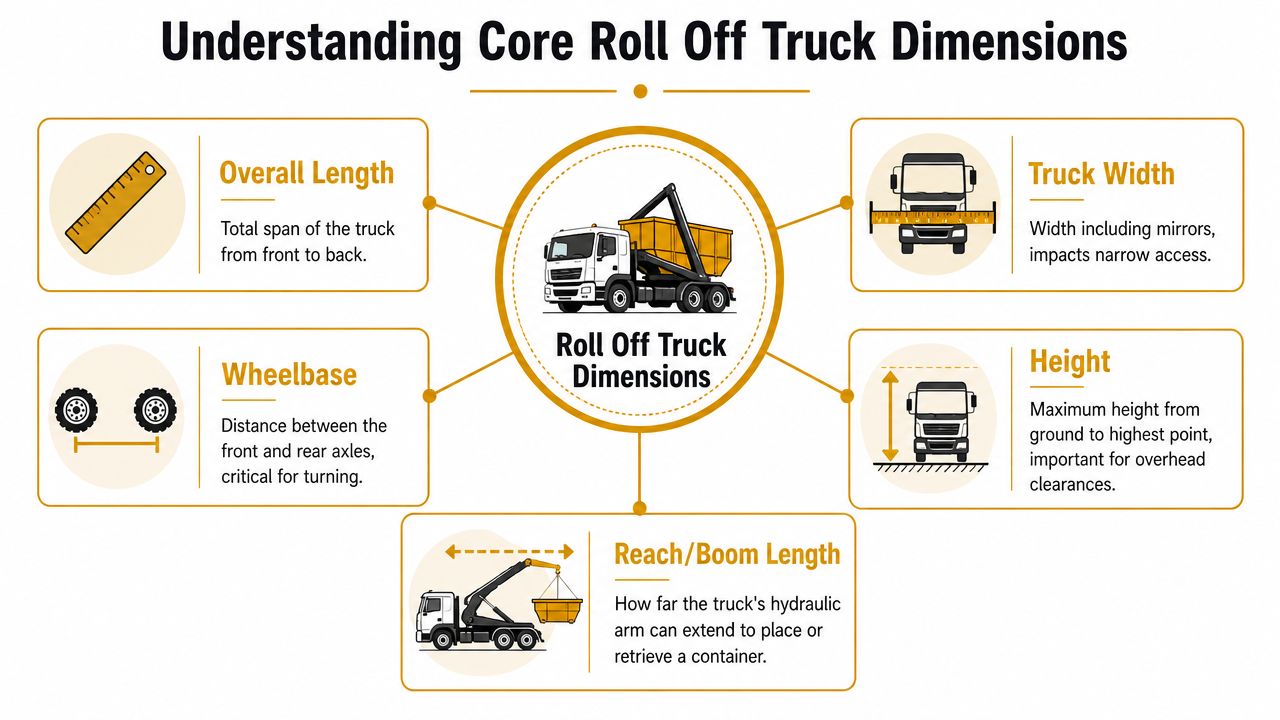
The dimensions that decide whether the truck can actually work
For site planning, the useful numbers are the truck's operating dimensions, not just its parked footprint. As noted in the Custom Truck specification mentioned earlier, a common tri-axle cable roll-off setup is built around containers in the 18-foot to 22-foot range, with a 60,000-pound hoist and a raised hoist height of 162 3/8 inches above the truck frame.
Those numbers answer practical questions:
| Truck spec | What it means on site |
|---|---|
| Container service range: 18 to 22 feet | The truck and box have to match. A yardage label alone does not confirm fit. |
| Hoist rating: 60,000 pounds | Pickup capacity depends on truck setup, box weight, and legal road weight, not just what the container can hold. |
| Raised hoist height: 162 3/8 inches above frame | The truck needs vertical working room during placement and pickup, not just travel clearance. |
A roll-off truck places a container through a fixed arc and slide path. If the box is outside the hoist's intended range, the driver may not be able to engage it correctly or set it down square. If the truck has overhead obstructions above the placement zone, the hoist can stop mid-cycle even though the truck cleared the entrance.
Core truck dimensions, translated into field checks
Spec sheets list several dimensions. Site teams should read each one as a clearance check.
Overall length affects staging and queue space. It tells you whether the truck can wait, straighten, and pull ahead after the box is on the ground.
Wheelbase and axle spacing affect turning and load transfer. Longer trucks track wider through gates and need more room to correct their angle before the driver starts the roll-off sequence.
Truck width is the easy one to underestimate. Mirrors, gate posts, jersey barriers, and parked equipment tighten the approach long before the body of the truck becomes the problem.
Frame height and ground clearance matter at transitions. A crowned driveway, broken curb cut, or temporary steel plate can change the truck's angle enough to slow or stop the approach.
Hoist geometry decides whether the job finishes. The truck needs room to raise, tilt, and let the container roll back on line.
Use this quick read before you approve the drop spot
| Dimension | Ask this on site | Common failure point |
|---|---|---|
| Length | Is there enough straight run to approach and pull out? | Truck enters but cannot straighten for placement |
| Turning space | Can a tri-axle make the gate and recover its line? | Driver has to back repeatedly or abort |
| Width | Do mirrors and fenders clear fences, pallets, and parked gear? | Tight access pinches the approach |
| Vertical working height | Is the airspace clear where the hoist rises? | Wires, limbs, pump lines, and canopies block the lift |
| Ground transition | Will the truck stay stable over the entrance and pad? | Soft edge or steep breakover shifts the truck off line |
I tell crews to separate three checks. Can the truck enter? Can it line up? Can it complete the set-down cycle? Jobs get missed on the second and third check more than the first.
That is why “truck length” by itself is rarely enough. Roll off truck dimensions only become useful when you turn them into a site plan that accounts for turning radius, overhead lift path, and the ground-level room the driver needs to place the box cleanly.
Deciphering Roll Off Container Specifications
A 20-yard box can still be the wrong order.
Two containers with the same yardage can have different wall heights, different floor lengths, and different pickup hardware. On site, those differences decide whether the driver can load, set, and retrieve the container without a second trip.
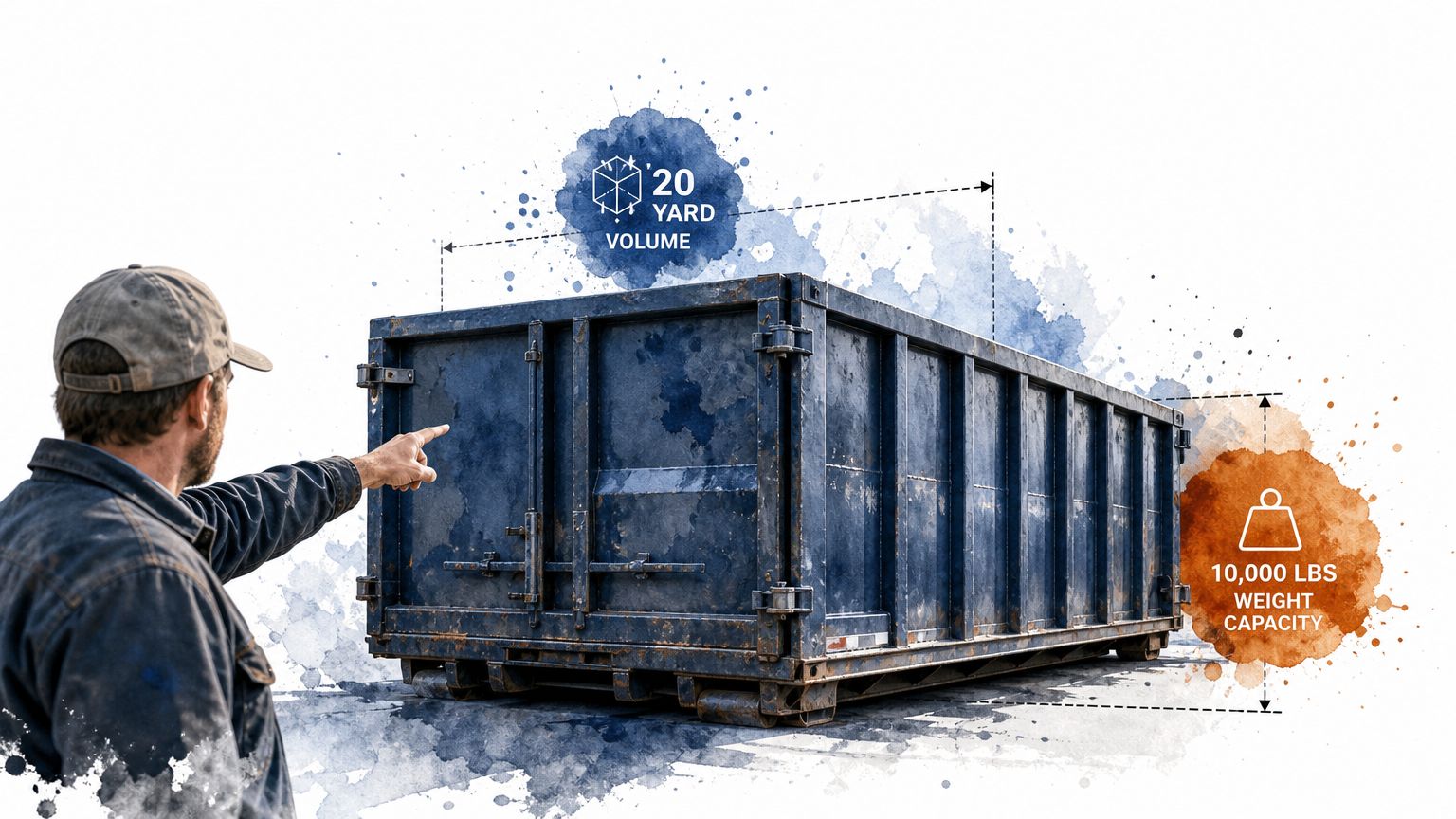
Yardage tells you capacity. Specs tell you whether the box will work.
Common commercial sizes run from 10 to 40 cubic yards. That number only describes internal volume. It does not tell you how much ground space the container needs, how high crews must lift material over the side, or how quickly a dense load will hit the truck's legal weight limit.
For light demo, packaging, and mixed renovation debris, volume usually controls the order. For dirt, concrete, block, roofing, and wet spoil, weight controls it. Crews learn this when a half-full box is already at its hauling limit and pickup has to be rescheduled or reworked.
Use this rule on the front end:
| Spec on the quote | What it answers in the field |
|---|---|
| Yardage | How much loose material the box can hold |
| Outside length | Whether the box fits the pad you marked out |
| Sidewall height | How easy it is to load by hand or with a skid steer |
| Container type | Whether the dispatched truck can service it |
| Material type | Whether weight will cap the load before the box looks full |
A tall 20-yard can save footprint on a tight site, but it is harder to hand-load. A longer, lower box is easier for concrete or palletized debris, but it needs more straight placement room. That is the trade-off crews should review before dispatch, not after the truck arrives.
The truck and container have to match at the pickup points
Compatibility problems usually happen at the interface, not at the volume label. A box can fit the material and still be unusable if the truck is built for a different hoist setup.
A hoist specification from Super Products shows the kind of dimensions dispatch checks before assigning equipment. It lists an 18' to 22' container length range and notes common hooklift bail heights such as 36", 54", and 62". If the bail height, stop location, or pickup style does not match the truck, the driver cannot safely load the container.
Check these points before you confirm the order:
| Container question | Why dispatch asks it |
|---|---|
| Cable roll-off or hooklift? | Each truck is built around a specific pickup method |
| Exact container length? | Hoist and frame geometry only allow a certain range |
| Bail height or pin setup? | Wrong pickup point stops the load cycle |
| What material is going in the box? | Heavy debris changes how much the truck can legally haul |
The practical order sequence is simple. Confirm the service method first. Confirm the container dimensions second. Confirm the material third. Yardage comes after that.
That order prevents a common failure. The box fits the site pad, but the truck cannot engage it, or the load reaches weight before the container is ready for pickup.
Planning Your Site Clearance and Maneuvering Zone
A site can have plenty of room for the container and still fail the delivery. The usual problem is truck movement, not box size. If the driver cannot get straight, clear the overhead path, and roll the container off on stable ground, the stop turns into a delay, a redelivery charge, or a relocation request.
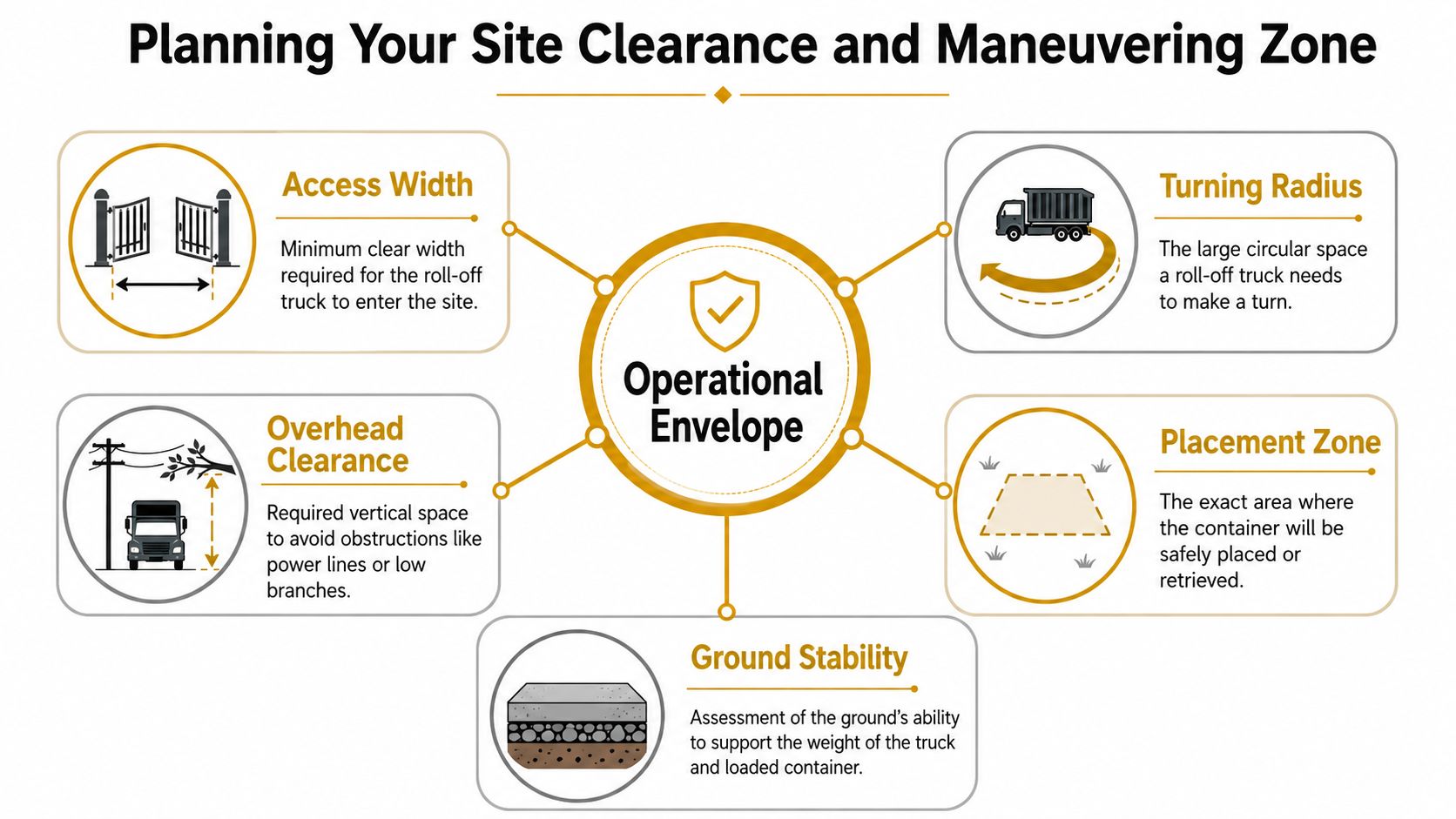
What actually decides whether the truck fits
Crews often measure the pad and stop there. That misses the part that causes trouble: approach geometry.
A roll-off delivery needs four things to work at the same time:
| Site factor | What to check on site | Why it matters to the driver |
|---|---|---|
| Entry access | Clear gate opening, fence posts, parked vehicles, barriers | The truck has to enter without clipping mirrors, fenders, or the container rails |
| Straight setup room | A clear run-up to the drop point | The driver needs to line up with the container path before rolling the box off |
| Overhead clearance | Wires, tree limbs, scaffold, roof edges, temporary power | The bed raises during placement and pickup, so low overhead obstructions can stop the job |
| Ground support | Pavement condition, compacted stone, slope, soft shoulder | Concentrated truck and container weight can crack asphalt or sink into wet subgrade |
That is the part many site plans leave out. The placement area is only one piece of the working zone.
Mark the full operating envelope, not just the container footprint
Before booking delivery, walk the route the truck will use from the street to the final spot. Then mark the working area in the field with cones, paint, stakes, or pallets.
Set out these zones:
- Entry path: the actual route through the gate and past any parked equipment or stored material.
- Alignment lane: the straight section where the truck can square up before unloading.
- Drop zone: the container location, plus side and front clearance for the roll-off motion.
- Exit path: the route out after placement, assuming other trades have already filled the site with lifts, pickups, and pallets.
On tight jobs, I tell crews to stand where the truck has to turn, then trace the move from cab height, not from a plan sheet. Bird's-eye layouts hide fence returns, blind corners, and low branches.
Common site conditions that cause failed placements
These are the repeat offenders:
- Swing gates that do not open fully
- Cars or forklifts parked in the alignment lane
- Soft gravel at the drop point
- Temporary power lines crossing the approach
- Curbs or shoulders that force the truck off level
- A pad that fits the container but leaves no room to roll it off
A cramped site usually fails in the turn or during bed raise. The final resting spot is rarely the only issue.
Fast field check before you confirm delivery
Use this checklist with the superintendent or yard lead:
- Measure the actual clear opening at the narrowest point.
- Check for a straight approach, not just an open pad.
- Look up along the entire truck path, including the raise point.
- Confirm the surface is firm and level enough for truck tires and container rollers.
- Clear a path that will still be open when the truck arrives, not just during the morning walk.
- Identify where the driver can stop if the first placement attempt does not work.
If any one of those items is questionable, get the driver a photo and a simple sketch before dispatch sends the truck. That step saves more failed trips than arguing over container size ever will.
Calculating Load Limits and Legal Weight
A full container that cannot be hauled is one of the easiest ways to lose a day on site.
Weight failures usually happen on jobs where the box still looks manageable from the top. Concrete chunks, wet dirt, block, roofing tear-off, and slurry-heavy debris can hit the truck's haul limit long before the container is near the rim. Light mixed trash behaves the opposite way. It fills the box before it challenges legal road weight.
Weight controls the job on dense material
For heavy debris, plan the load by material type first and container size second. That is the trade-off crews miss.
Use this rule in the field:
| Material type | What usually limits the load | Planning note |
|---|---|---|
| Concrete, brick, block, dirt | Weight | Use smaller boxes or partial fills |
| Asphalt roofing, plaster, tile | Weight | Watch moisture. Rain changes the haul plan |
| Mixed C&D debris | Either one | Heavy fractions decide faster than crews expect |
| Wood, packaging, insulation | Volume | Box size matters more than haul weight |
| Cardboard and light trash | Volume | Overfill and loose material become the bigger issue |
If the debris is dense, stop asking, "How much space is left?" Ask, "How much does this load weigh now?"
What legal weight means in practice
Drivers do not make this call based on schedule pressure or how badly the site wants the pickup. They have to leave with a load the truck can carry, the hoist can handle, and the route can take legally.
That affects more than the container itself:
- Pickup can be refused until the box is lightened
- Trucks may need to stay on stronger pavement instead of crossing soft or unfinished areas
- Axle loading and braking distance change with a heavy can
- Retrieval gets harder if the truck has limited room to straighten and pull out cleanly
The relevance of spec-sheet numbers becomes apparent in site planning. A heavy container raises the risk on every tight move. Soft gravel, patched asphalt, steep transitions, and sharp exit angles matter more when the truck is hauling near its working limit.
Fast load-planning guide
Use this before calling for pickup:
- Concrete or masonry: keep the load low and spread evenly
- Dirt: expect weight trouble early, especially if the material is wet
- Roof tear-off: check for water weight in saturated layers
- Mixed remodel debris: separate dense material if you see tile, mud bed, plaster, or countertop chunks building up in one end
- Slurry or washout waste: confirm the acceptable fill level before loading the container
Uneven loading causes its own problems. A box that is technically under the limit can still be a bad pickup if one end is packed heavy and the truck cannot hoist it cleanly.
Field call: If the crew is debating whether the box is too heavy, split the load before the truck is dispatched.
That call usually costs less than a dry run, a refused pickup, or a reload by hand.
Site Planning Examples from Real Projects
Specs make more sense when you run them against actual job conditions. These are the kinds of planning calls that decide whether a delivery goes smoothly or turns into a gate-side debate.
Tight urban renovation with alley access
The job is a renovation behind an occupied building. Access is through a rear alley with fencing on one side, parked cars on the other, overhead utility conflicts, and a sidewalk crossing at the entrance. The crew wants the container close to the rear demo area to cut hand-carry time.
The first mistake would be focusing only on the box footprint. The better approach is to test the truck's path in sequence:
- Can the truck enter without clipping fixed obstacles?
- Can it complete the alley turn without using space that won't be available on delivery day?
- Is there clean overhead through the full approach and lift path?
- Can it straighten enough to place the container squarely?
- Is there room to retrieve it later when debris has built up around the area?
On a site like this, the turn is usually the deciding factor. If the truck has to crab through the alley and the driver can't straighten before the drop, placement becomes unreliable. Even if the driver gets it in, pickup may be worse once neighboring trades stack material around the box.
The right answer on this kind of site is often one of these:
- Use a different drop location closer to the entrance.
- Clear the alley fully for a dedicated delivery window.
- Use a smaller compatible setup if your hauler has one for the route.
- Stage material differently so the container doesn't need to sit at the deepest point of the site.
The go or no-go decision comes down to one question: Can the truck repeat the move safely on pickup day, not just on delivery day? If the answer is uncertain, the original drop plan isn't good enough.
New suburban home build with wide frontage
A suburban new build usually has the opposite problem. There's more room, but crews still make avoidable mistakes by dropping the container in the most convenient spot instead of the most workable one.
Typical issues include soft subgrade after rain, newly poured driveway sections, site prep, and trade stacking near the garage apron. Nobody is fighting alley geometry, but the truck still needs a stable line in and out.
On this kind of site, I'd look for a placement zone that does three things well:
| Site factor | Better choice | Bad choice |
|---|---|---|
| Ground support | Firm, established access path | Soft dirt or recently disturbed fill |
| Workflow | Near the debris or washout activity without blocking trades | Directly in front of garage, material laydown, or pump setup |
| Pickup reliability | Straight retrieval path | Spot that works only if the site stays unusually clean |
One useful habit is to plan around the pickup, not the drop. Delivery day often has open space. A week later, the site has pallets, mud, pipe bundles, and parked equipment. If the truck can't pull straight back into the container or retrieve it with enough working room, the original placement was wrong.
The best drop point is rarely the closest point. It's the point the truck can service twice without drama.
That's especially true for washout containment and short-duration rentals. Efficiency on the ground matters, but retrieval matters just as much.
Arranging Your Reborn Rentals Washout Container Delivery
The expensive miss on washout delivery is not choosing the wrong container. It is booking the right container for a spot the truck cannot service cleanly.
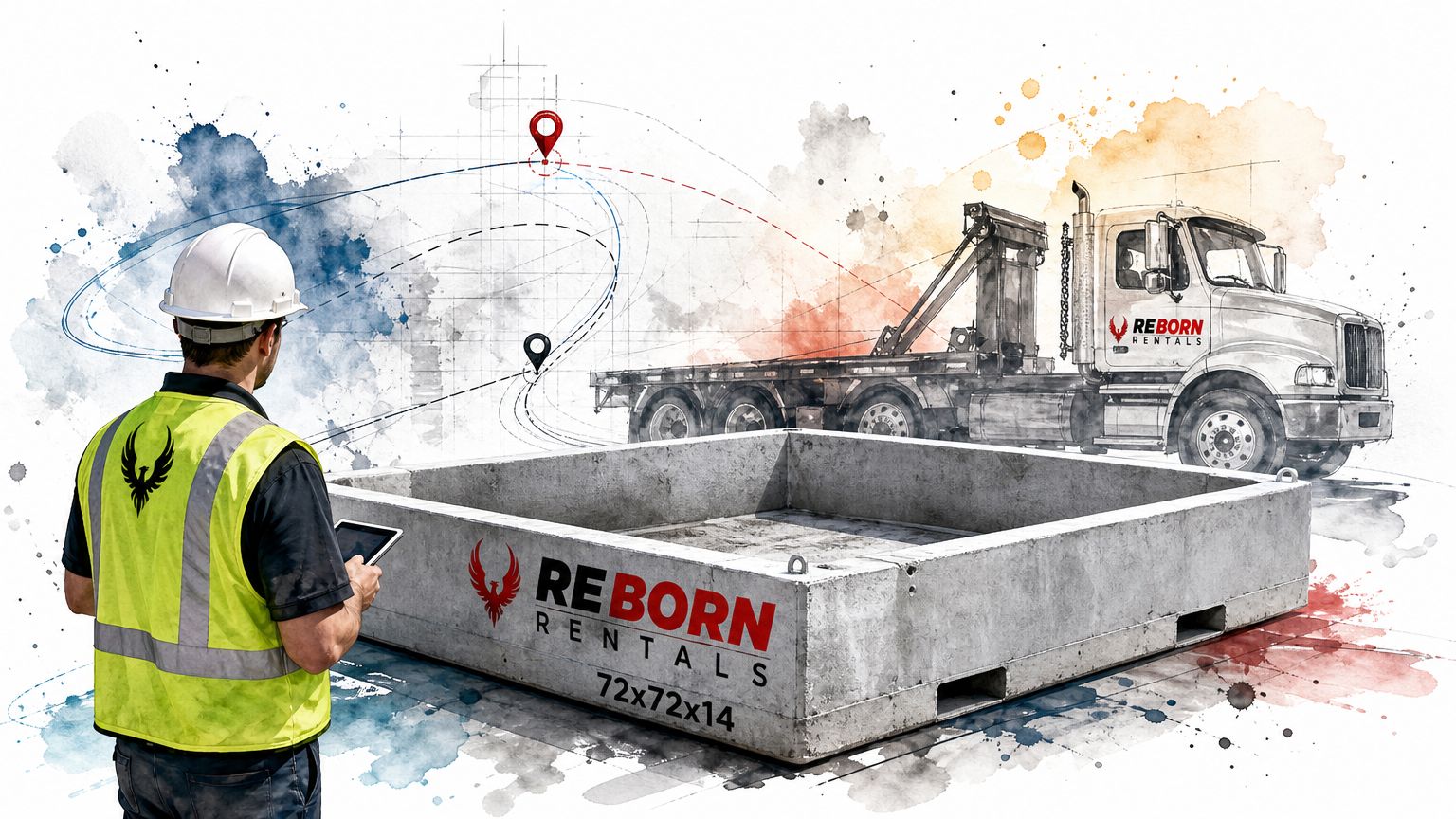
Washout boxes are smaller than full roll offs, but drivers still need the same three things: a clear approach, enough swing room to line up, and ground that will hold the truck while it sets down and picks up. On concrete jobs, the failure point is usually not the container size on paper. It is the actual site condition at the gate, under the boom path, or at the set-down area.
Before booking, send the details that affect placement.
What the dispatcher needs before delivery is scheduled
| What to send | Why it matters in the field |
|---|---|
| Entrance photos | Shows gate width, curb approach, parked vehicles, and whether the truck can square up before backing |
| Drop-zone photos | Helps confirm wall clearance, hose paths, crew access, and pickup room |
| Overhead conditions | Flags power lines, tree limbs, scaffold, balconies, and temporary protection that can block hoist travel |
| Ground surface description | Tells the driver whether the truck is rolling on pavement, gravel, compacted base, or soft subgrade |
| Access restrictions | Prevents failed trips caused by school-zone timing, lane closures, locked gates, or building rules |
| Site contact name and phone | Gives the driver one person who can approve the exact spot and clear last-minute obstructions |
A marked drop zone saves time. Paint, cones, or a quick site sketch is enough if it shows the front edge of the container and the truck's approach line.
Practical checks before the truck is dispatched
Use this short field checklist:
- Access path is open. No stacked material, parked lifts, or trade vehicles blocking the line in.
- Overhead is clear. Check the full truck path, not just the final set-down point.
- Ground is firm. Fresh fill, wet soil, and green concrete are common trouble spots.
- Pickup path also works. Plan for the site after rebar, formwork, pallets, and spoil piles show up.
- A site contact will answer. If the driver cannot get direction on arrival, placement slows down fast.
That last point matters more than many crews expect. Delivery day and pickup day rarely look the same, especially on active concrete pours.
Details that prevent rework on washout jobs
Washout placement has a trade-off. The box needs to sit close enough that crews will use it, but far enough out of circulation that it does not block pumps, foot traffic, or material staging. A spot that works for the finisher can still fail for the truck if there is no straight approach or no room to retrieve the container later.
I usually ask crews to review four questions before confirming the order:
- Will the truck need to back in from the street, alley, or drive aisle?
- Can the driver turn and straighten out before the hoist starts?
- Is there enough overhead clearance for the truck during loading and unloading?
- Will this same spot still be serviceable after the pour, cleanup, and follow-on trades?
If those answers are clear, delivery usually goes smoothly.
If you need a concrete washout container and want a straightforward booking path, Reborn Rentals lets you arrange dates, location, and delivery details through its online checkout. For tight-access sites, send entrance photos, overhead notes, and ground conditions up front so dispatch can plan around actual field constraints.