The pour always looks finished before the washout problem starts.
The truck is backing out. The finisher is closing up the surface. The pump crew wants to rinse down and move. Then somebody asks the question that tells you whether the site is being run well or not: Where is the washout going?
That question matters because concrete slurry is not harmless rinse water. It is caustic, messy, and expensive to deal with after it escapes. If you let crews improvise, you usually get the same result. A muddy corner of the site, a stained curb line, and a superintendent explaining to the inspector why alkaline waste got too close to drainage.
The right answer is not “use a washout pan.” The right answer is: use the right kind of washout containment for the job you are running. High-rise work, residential flatwork, pump jobs, interior retrofits, and heavy civil pours do not all need the same setup. That is where most generic advice falls apart.
Contractors usually compare washout options by purchase price or rental rate first. On a real job, that is too narrow. You need to think about access, crane or forklift availability, how often the washout area needs to move, daily volume, cleanup labor, and what your stormwater plan will allow.
The useful way to think about types of concrete washout pans and their uses is simple. Match the container to the pour pattern, the site layout, and the disposal method. When you do that, crews stay faster, the site stays cleaner, and compliance becomes routine instead of reactive.
The End of the Pour Is Just the Beginning
A lot of washout mistakes happen in the last hour of the day.
Crews are tired. The concrete is down. Everyone wants to clean tools, rinse chutes, wash the hopper, and get off site. If the washout area is too far away, too small, blocked by materials, or not clearly assigned, people start making bad decisions fast.
What usually goes wrong on site
The common failures are predictable.
One crew washes out beside a curb because the pan is full. Another rinses into a dirt area because the lined pit tore and nobody replaced it. A pump operator tries to make do with a bag that is too small for the amount of residue coming off the line. None of this starts as a big environmental event. It starts as convenience.
That is why washout containment should be treated like any other production tool. It is not just a compliance box to check. It is part of the pour plan.
Tip: Put the washout location in the same pre-pour conversation as truck access, pump placement, and cleanup responsibility. If it is not assigned before the first load arrives, it will become a problem later.
Why the right container matters
Concrete washout systems do three jobs at once.
They contain slurry, keep crews efficient, and protect the rest of the site from cleanup work that should never have been created in the first place. A clean washout setup also signals discipline. Inspectors notice it. Owners notice it. Subs notice it too.
The wrong setup costs time in ways people underestimate:
- Extra walking and repositioning: Crews waste motion when the washout point is not where the work is happening.
- Messy secondary cleanup: Once slurry hits soil, pavement, or drainage paths, the cleanup gets harder.
- Disposal headaches: A bad container choice creates overflow, torn liners, or hardened waste in the wrong place.
- Coordination problems: The pump crew, finishers, and laborers all assume someone else is handling it.
A foreman does not need the fanciest washout system on every site. He needs one that matches the job. That is the difference between a site that stays under control and one that keeps solving the same preventable problem.
Your Primary Concrete Washout Options
Most washout setups fall into three working categories. If you keep those categories straight, choosing the right one gets much easier.
Portable rigid pans
These are the most familiar options on active commercial sites. They include steel pans and heavy-duty plastic pans.
Both are self-contained, easy to identify, and straightforward to place near where trucks, pumps, and finish crews need them. Portable rigid pans work best when you want a defined washout point that can be relocated as the project changes.
Use them when:
- The washout zone needs to move as phases shift across the site.
- You want cleaner housekeeping than a site-built pit usually provides.
- Crews need a simple target that is visible and hard to misuse.
Steel is usually the heavy-duty choice. Plastic fits lighter work and tighter access.
Site-built or disposable containment
This group includes lined pits and washout bags.
A lined pit is usually the practical choice when you have one stable washout location, room to build it, and enough volume to justify a larger static area. A washout bag is the opposite. It works when portability matters more than long service life.
These options make sense when:
- The site is temporary or constrained
- Heavy placement equipment is limited
- You need low-setup containment for short-duration work
They are not inferior by default. They are specialized. A bag can solve a tight urban access problem better than a steel pan. A lined pit can handle a large, repetitive washout area better than a small portable unit.
High-capacity systems
Roll-off containers, corrugated systems, and other larger engineered washout solutions constitute high-capacity systems.
These options belong on projects where standard pans are too small, too slow to service, or too difficult to manage across sustained concrete operations. Heavy civil work, infrastructure pours, and industrial sites often land here.
A simple way to think about the categories is this:
| Category | Best fit | Main trade-off |
|---|---|---|
| Portable rigid pans | Moving crews and repeated pours | Need servicing and planned placement |
| Site-built or disposable | Static zones and short-term tasks | Less flexible once in use |
| High-capacity systems | Large-volume or continuous pours | More logistics and site planning required |
When people struggle with washout, it is usually because they chose from the wrong category first, then tried to force that tool onto a job it was never meant to serve.
Comparing Steel and Plastic Washout Pans
If you only compare reusable options, the primary decision is usually steel versus plastic.
That sounds simple until you put the pan on a real project. Then the differences show up fast in transport, access, daily abuse, and how much confidence you have when crews are washing out in a hurry.
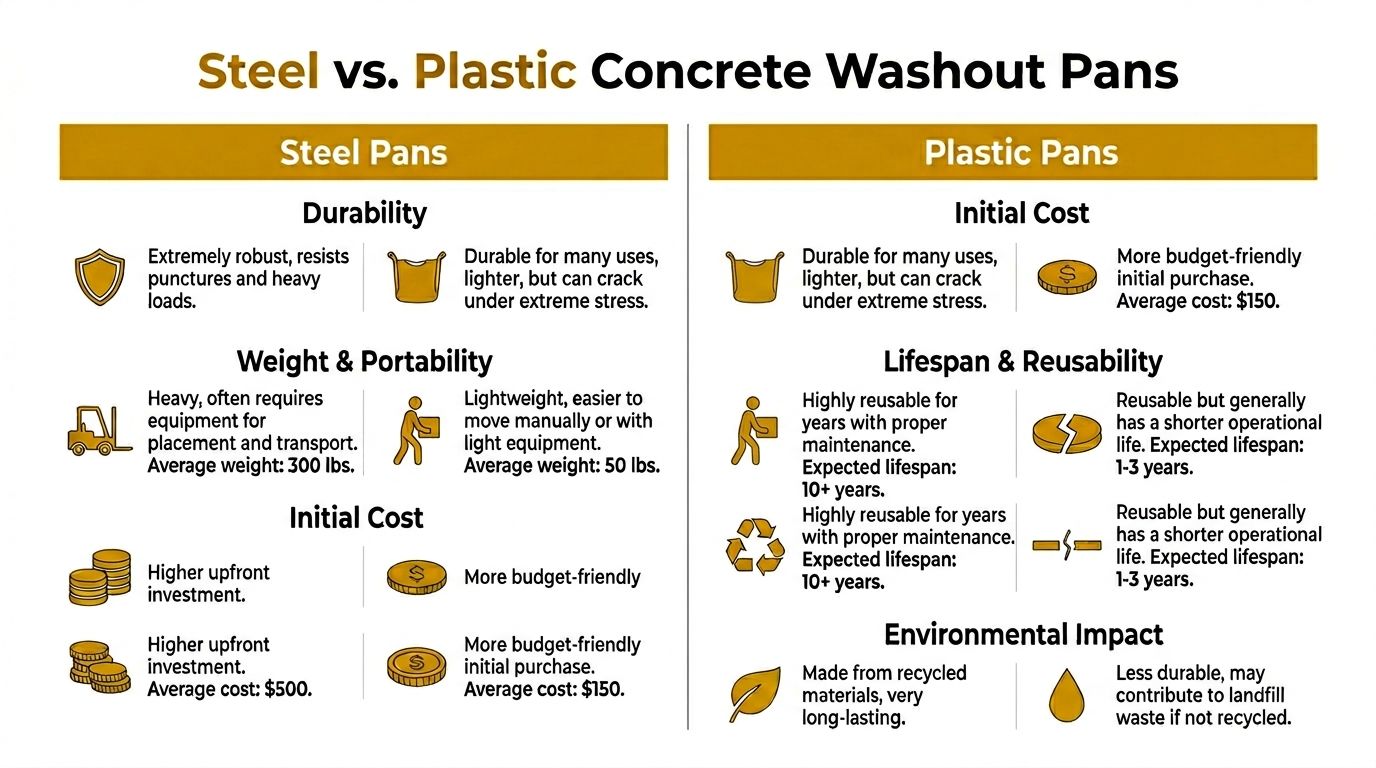
A visual comparison helps before getting into site conditions.
Where steel pans earn their keep
Steel pans are the workhorse option for commercial concrete.
They are common because they tolerate abuse, handle heavier washout loads, and fit the way larger sites already move material. The better units are built from heavy-gauge steel and are designed to be moved by crane or forklift. Typical examples include 72″x72″x14″ pans weighing 274kg with 4 lifting eyes, and 72″x72″x24″ pans that can hold approximately 3 cubic yards of concrete waste, equal to about 18.25 tons of slurry and 441 gallons of liquid, as described in Bear Iron’s overview of concrete washout solutions.
That capacity matters on active sites running regular pours from pump trucks and mixers. It gives crews room to wash out without immediately creating an overflow risk.
Steel is also the right answer when the washout point needs to move vertically or across a busy footprint. Crane-rated pans with lifting points fit high-rise and heavy civil work far better than lighter disposable options. On those projects, durability is not a bonus. It is the requirement.
Where plastic pans make more sense
Plastic pans solve a different problem.
They are easier to handle, easier to stage in confined areas, and easier to use on jobs where bringing in lifting equipment for the pan itself would be overkill. A plastic pan weighing 60 pounds is a practical tool for narrow access, smaller pours, trailer pumps, mixer truck cleanup, and renovation work where crews need portability more than maximum ruggedness.
That makes plastic useful for:
- Residential or light commercial pours
- Interior or courtyard access
- Short-duration work with limited equipment
- Subcontractors who need fast deployment
Plastic also helps when site conditions change quickly and the washout point needs to follow the work without much effort.
The trade-off is straightforward. Plastic is lighter and more convenient, but it is not what you want for repeated heavy loading, rough handling, or a project where the pan will be dragged through months of hard use.
Here is the practical view:
| Factor | Steel pan | Plastic pan |
|---|---|---|
| Best job type | Commercial, pump, high-rise, civil | Small jobs, renovations, tight sites |
| Handling | Usually equipment-assisted | Often manual or light equipment |
| Durability | Built for repeated hard use | Better for lighter-duty service |
| Mobility | Strong once rigged | Easy to reposition quickly |
Later in the job, movement matters as much as capacity. This field example shows why operators like portable containment close to the work area.
Key takeaway: Choose steel when the pan is part of a production system. Choose plastic when the pan is part of an access solution.
Exploring Lined Pits and Washout Bags
Not every site needs a rigid reusable pan.
Some sites are better served by a lined pit or a washout bag, especially when the job is temporary, access is awkward, or there is no reason to bring in a heavier container.
When a lined pit is the right call
A lined pit works best when the washout location can stay put.
This is common on larger sites with a stable laydown area, predictable truck routes, and enough room to isolate a dedicated washout zone. If the crew can build it correctly and protect it from damage, it gives you a practical communal spot for repeated washout activity.
The compliance part is where people get sloppy. Regulations often prohibit unlined washout pits within 100 feet of storm drains or water bodies and require a minimum 10-mil polyethylene liner to ensure impermeability, according to Jewinner’s 2024 washout container buying guide.
That means a DIY dirt hole is not a washout plan. It is a risk.
A lined pit makes sense when:
- The site has room for a fixed washout area
- Several crews will share one location
- The expected washout volume is steady
- You can protect the liner from puncture and traffic
What does not work is placing a lined pit where trucks cut across it, where runoff can enter it, or where nobody owns maintenance.
Where bags fit better
Washout bags are the opposite of pits. They are about convenience, portability, and quick setup.
They are useful for subcontractors, short pours, punch-list concrete work, urban infill, or any site where carrying in a lightweight containment option is easier than staging a pan. They also help on jobs where a full-size washout point would interfere with pedestrian routes, interior logistics, or limited exterior access.
Bags are a good fit when:
- You need to move fast
- The washout volume is modest
- Forklift handling or hand placement is more realistic than crane work
- The setup is temporary
The weakness is service life. Bags wear faster, they are easier to misuse, and they are less forgiving when crews exceed what the bag was intended to handle.
Tip: Bags work well when the pour is small and the disposal path is already planned. They fail when crews treat them like a permanent washout station.
For many foremen, the mistake is thinking pits and bags are bargain substitutes for pans. They are not. They are targeted tools. On the right site, they are the cleanest option available. On the wrong site, they turn into one more thing to repair, replace, or explain.
Specialized Solutions for High Volume and Complex Sites
Some projects outgrow standard pans quickly.
A small commercial slab can live with a single portable container. A heavy civil job, a long-duration industrial pour, or a site running continuous concrete traffic often cannot. At that point, you need a system that is designed for throughput, not just containment.
Roll-offs and other large-scale options
Roll-off washout containers are the practical answer when the site is producing large volumes and needs outside servicing.
They work well on infrastructure work, industrial plants, and major commercial builds where truck traffic, pump washout, and repeated cleanup would overwhelm smaller pans. The advantage is simple. You are not asking the field crew to keep nursing a too-small container through a high-volume operation.
This approach also helps when the washout area is part of a broader waste-handling plan with haul-off already coordinated.
Corrugated and multi-chamber systems
Engineered systems solve a different set of problems.
Corrugated washout units improve rigidity without relying on the same mass as traditional heavy steel boxes. Eco-Pan’s large corrugated pan is listed at 7'x7'x28" with a 5-ton capacity and 475 gallons, and its multi-chamber design can reduce effluent solids by 70%, which supports water reuse for tasks like chute washing, according to Eco-Pan’s large pan specifications.
That matters on sites trying to reduce mess and separate solids earlier in the process. It also matters for risk management, because the same source notes that environmental fines for alkaline discharge violations can reach up to $50,000 per incident.
For complex sites, these systems are useful when:
- You need more capacity than a standard pan provides
- The site benefits from staged solids separation
- Reuse of wash water adds operational value
- Access or below-grade placement makes standard tubs awkward
Matching advanced systems to field conditions
Use the more specialized option when the ordinary one creates repeated work.
If the crew is stopping production to swap containers, if service intervals are too frequent, or if the washout point is causing traffic conflicts, you have probably outgrown the basic setup. Advanced systems cost more effort to coordinate, but on the right project they reduce disruption and tighten site control.
How to Choose the Right Concrete Washout System
The right choice usually becomes obvious once you stop asking, “What is the cheapest container?” and start asking better site questions.
Start with volume and frequency
How much washout will the crew generate in a normal day?
That first question rules out a lot of bad choices. If the job involves repeated pump work or daily mixer washout, you need capacity and durability. If the work is a short residential pour or a small renovation, portability may matter more than maximum volume.
A useful rule in practice is this:
- Frequent washout and regular pours: Lean toward steel or a larger managed system.
- Occasional washout and tight access: Plastic or bags may be the better fit.
- Sustained high-volume work: Consider roll-offs or specialized engineered systems.
Check how the site can move the container
A pan that fits the pour but does not fit the logistics is still the wrong pan.
Ask whether the site has crane access, forklift access, or neither. Ask whether the washout point stays in one place or must move as work climbs, shifts, or sequences across the property.
The lifecycle side matters too. Steel pans offer high reusability, more than 10x that of bags, and crane-rated steel can reduce downtime on high-volume pours by an estimated 20-30%, as noted by Steve Boyd Company’s discussion of concrete washout pans.
That is why steel keeps showing up on pump truck applications and high-rise jobs. It is not just stronger. It works better with the way those jobs operate.
Use this field checklist
Before assigning a washout system, answer these questions:
How much washout is expected each day?
A small bag for a heavy pump day is asking for trouble.Will the washout area move?
A fixed lined pit is fine for a static site. It is frustrating on a phased build.What equipment is available to place and remove it?
Crane-rated steel is wasted on a site with no practical way to move it.What is the disposal path?
Plan where hardened waste, residual liquid, and container servicing will go before the first pour.How disciplined is the crew flow?
The more rushed and crowded the operation, the more you benefit from a rugged, obvious, easy-to-use container.
Key takeaway: Good washout decisions are operational decisions. Pick the system that reduces field friction while staying compliant.
The best choice is usually the one that crews will use correctly when the day gets busy.
A Quick Guide to Setup and Compliant Disposal
Even the right container fails if it is set up poorly.
Placement comes first. Put the washout on level ground, keep it accessible to the equipment using it, and keep it away from drains, inlets, and traffic paths that can damage the containment or spread residue.
Setup that works in the field
Use a simple sequence:
- Choose the location early: Mark the area before trucks arrive so nobody improvises.
- Protect access: Keep the route open for mixers, pump cleanup, forklift service, or crane pickup.
- Control overflow risk: Do not let crews treat the container like an unlimited dump point.
- Inspect during the pour: Check liners, edges, lifting points, and surrounding ground before the day gets away from you.
Disposal without creating a second mess
Once washout material is in the container, the goal is controlled drying, solidification, and proper removal.
Let solids harden as intended, separate handling responsibilities clearly, and make sure the final disposal method matches local requirements and the project SWPPP. If the system supports solids separation or recycling, use that process consistently rather than mixing clean and contaminated waste streams.
For reusable pans, cleaning should happen as part of servicing, not as an unplanned field chore beside active work. For bags and lined pits, closeout matters. Remove the waste completely, check the surrounding area, and leave no residue that can be tracked or washed off later.
A compliant washout area should be easy to inspect upon completion of daily work. If it looks chaotic, it probably is.
Frequently Asked Questions About Concrete Washout
| Question | Answer |
|---|---|
| Can I just dig a hole and use that as washout? | Not if it is unlined and treated as a casual dump area. Concrete slurry is highly alkaline, and uncontained washout can create stormwater and soil contamination problems. |
| Why is concrete washout treated so seriously? | Concrete slurry often exceeds pH 12, which makes it caustic. If it reaches stormwater, it can disrupt pH balance and harm aquatic life, as explained in GAR-BRO’s standard washout pan information. |
| What makes a steel pan safer on a busy site? | Better steel pans use fully welded 4.8mm to 6.35mm plates and certified lifting lugs compliant with ASME B30.20, which helps prevent seepage and supports safe handling on site. |
| Are washout bags a bad option? | No. They are useful for small pours, short-duration work, and tight access. They become a bad option when crews overload them or try to use them as a long-term station. |
| When should I step up to a roll-off or large managed system? | When standard pans fill too fast, disrupt production, or require too much servicing during sustained concrete operations. |
| Can hardened concrete waste be recycled? | On some sites, crews separate solids and manage them for reuse or compliant disposal. Whether that makes sense depends on the system in use and local disposal practices. |
| What is the biggest mistake foremen make with washout? | They focus on container price and ignore logistics. The wrong washout setup usually costs more in labor, delays, and cleanup than it saves up front. |
If you need a washout setup that matches the way your project runs, Reborn Rentals offers ready-to-deploy concrete washout containment with clear daily pricing starting at $25/day, practical capacity options including 72' x 72' x 24' and 72' x 72' x 14' units, and direct support for delivery scheduling, site logistics, and rental coordination. For contractors who want a clean site, straightforward ordering, and dependable containment for pours large or small, it is a practical place to start.