A concrete pour is underway, the pump is moving steadily, and the washout crew has one job before the trucks leave: keep alkaline slurry out of the storm system. A pan placed too close to a catch basin, an unprotected liner, or a container filled beyond its working capacity can turn routine cleanup into a discharge problem. Once cement-laden water reaches a storm drain, the site has lost the opportunity to control the waste at its source.
That same principle drives municipal wastewater treatment processes. Operators separate solids, use biological activity to reduce dissolved pollutants, polish the remaining effluent, and manage the sludge created along the way. A construction site usually doesn't need a miniature treatment plant, but it does need the same disciplined thinking: identify the contaminant, keep it contained, treat it only when required, and document where the residual material goes.
Why Wastewater Treatment Matters on Every Job Site
A washout pan is the first treatment barrier on a concrete site. It captures cement paste, aggregate fines, rinse water, and residual material before they can migrate through soil or enter a drainage pathway. The pan isn't performing secondary biological treatment, but it is doing the most important initial job, physical containment.
The field failure is usually predictable. A truck driver rinses the chute outside the designated area, the crew assumes the storm drain is protected by distance, or rain fills an uncovered pan until slurry spills over the edge. Alkaline concrete wash water can affect receiving water and soil conditions, while settled solids can clog drainage infrastructure. The cleanup may look minor, but the compliance exposure can extend beyond the pour itself.
The connection to municipal treatment
Municipal plants receive wastewater through a controlled collection system. Construction sites often generate short, irregular wastewater streams without that collection infrastructure. That difference matters. A treatment plant has tanks, pumps, operators, sampling points, and an approved discharge route. A job site has moving equipment, changing grades, subcontractors, weather, and a schedule that can compress cleanup into a few minutes.
Worldwide, 42% of household wastewater was not safely treated before discharge in 2022, representing about 113 billion cubic metres released with inadequate or no treatment, according to the UN-Water 2024 wastewater treatment update. Construction washout is only one small stream within the global picture, but the operating lesson is direct: uncontrolled wastewater becomes an environmental problem when the source, pathway, and final destination aren't managed.
What the site manager must control
A SWPPP, or stormwater pollution prevention plan, should translate regulatory requirements into visible field controls. The plan needs a designated washout location, access instructions, inspection responsibility, overflow response, and a method for handling hardened residue. Federal stormwater requirements are implemented through permits and local conditions, so the controlling requirements can vary by jurisdiction and project.
Field rule: If a worker can't identify the washout location without asking a supervisor, the control isn't ready for a pour.
Treat containment as part of the treatment chain. Keep washout away from storm drains and surface waters, place it on stable ground, inspect the liner before use, and stop the activity if the container is damaged or approaching capacity. A superintendent who understands treatment stages can make better decisions because the question changes from “Where can the truck rinse?” to “How will this waste be captured, separated, stored, and removed?”
The Three Stages of Wastewater Treatment Explained
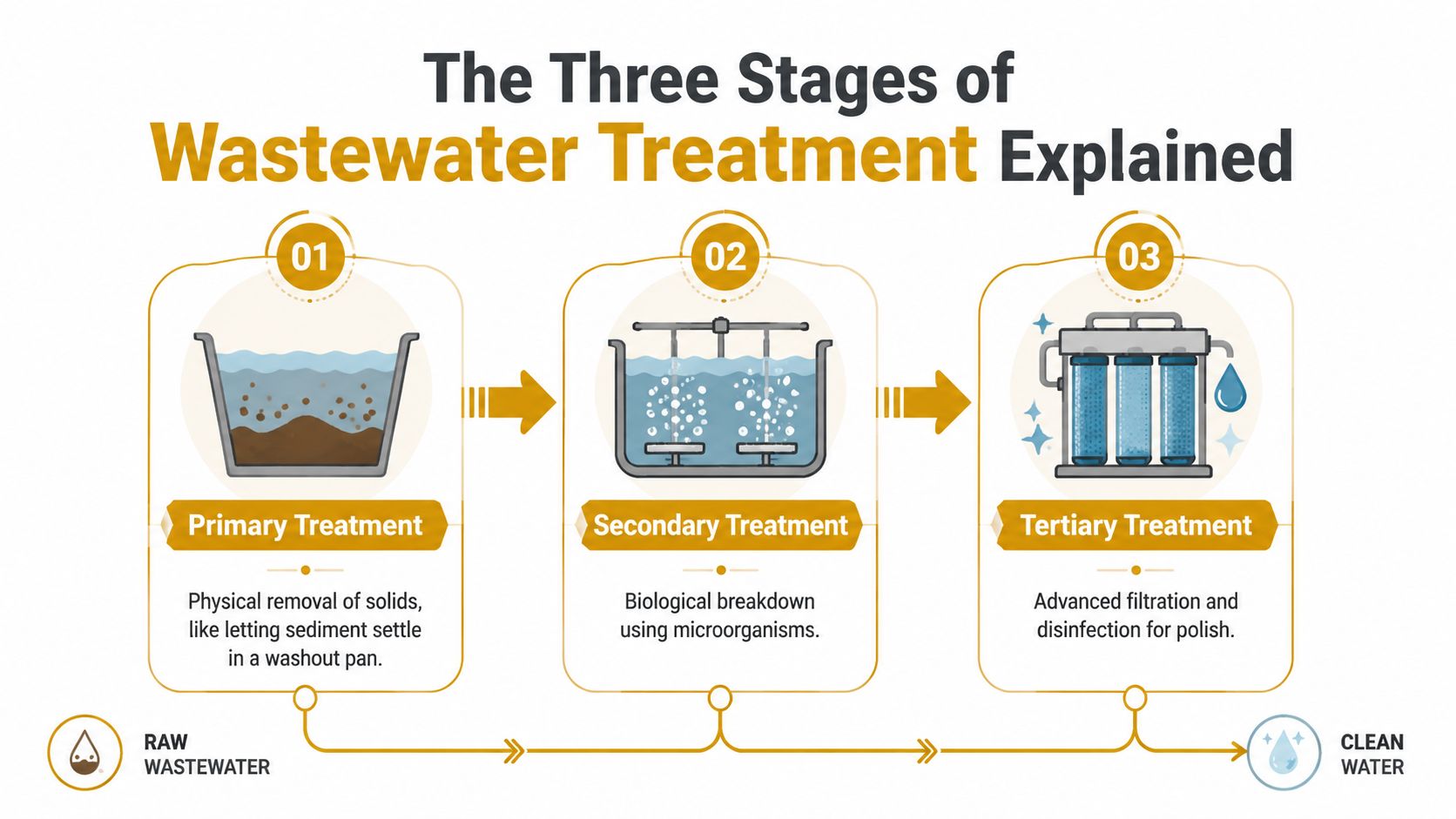
Wastewater treatment is a sequence of barriers, not a single machine. Each stage targets a different class of pollutant, and skipping one usually forces the next stage to work harder. On a construction site, the same logic appears in simpler form: capture solids first, control the water chemistry, then decide whether further filtration or treatment is necessary.
Primary treatment removes what can settle or be screened
Primary treatment is physical separation. Screens remove larger debris, grit systems capture dense mineral particles, and settling tanks allow suspended solids to drop out of the flow. The liquid continues forward while heavier material becomes primary sludge.
A washout pan uses the same basic idea. Aggregate, cement particles, and hardened fragments settle when the flow is left undisturbed. The pan doesn't remove dissolved contaminants, and it won't correct pH by itself, but it prevents a large solids load from spreading across the site.
Sedimentation works only when the system has enough retention and isn't being constantly disturbed. A pan placed where trucks drive through it, or one that receives more water than it can hold, loses that advantage. Good placement and capacity are process controls, not housekeeping details.
Secondary treatment uses biology to reduce dissolved organics
Secondary treatment relies on microorganisms. In activated sludge systems, operators maintain a microbial population in an aeration basin. The organisms consume biodegradable organic matter, and a clarifier separates the biological solids from the treated liquid. Trickling filters use attached growth on a media surface rather than suspended organisms in a basin.
This stage has no direct equivalent in ordinary concrete washout. Cement slurry is primarily a high-pH, solids-rich waste stream, not a municipal organic wastewater stream designed for biological treatment. Sending it into a biological system without understanding the chemistry can disrupt the organisms that make that system work.
Tertiary treatment polishes the effluent
Tertiary treatment provides targeted polishing. Filtration can remove remaining suspended particles, disinfection can reduce pathogens, and nutrient-removal processes can address nitrogen or phosphorus where permit limits require it. Advanced systems may also use membranes, adsorption, or oxidation, but every added barrier brings equipment, energy, maintenance, and monitoring requirements.
On a job site, polishing might involve cartridge filtration, settling followed by filtration, or pH adjustment before controlled discharge, subject to the applicable permit and approval. It isn't automatically better than containment. If the project has no permitted discharge route, active treatment doesn't give the crew permission to release water.
The treatment train should match the waste stream and the receiving requirement. A pan may be the right answer for a normal pour with off-site disposal of captured material. A treatment unit may be justified where the volume is large, reuse is planned, or discharge limits demand more than physical capture.
Unit Operations and Unit Processes That Drive Performance
Treatment operators distinguish unit operations from unit processes to identify whether equipment is separating material or controlling a chemical or biological reaction. Screening, sedimentation, and filtration are unit operations. Coagulation, nitrification, denitrification, and disinfection are unit processes because chemicals or microorganisms change the wastewater.
That vocabulary gives contractors a clearer way to coordinate with plant operators, engineers, and SWPPP consultants. Visible clarity does not guarantee safe discharge. Dissolved pollutants, unacceptable pH, nutrients, and other contaminants may remain and require laboratory testing.
Physical operations and chemical or biological processes
| Operation or Process | Type | Primary Function | Typical Application |
|---|---|---|---|
| Screening | Unit operation | Removes large debris | Headworks and preliminary treatment |
| Grit removal | Unit operation | Separates dense mineral particles | Municipal influent and industrial solids control |
| Sedimentation | Unit operation | Settles suspended solids | Primary clarifiers, secondary clarifiers, and washout containment |
| Filtration | Unit operation | Captures remaining suspended material | Tertiary polishing and reuse preparation |
| Coagulation and flocculation | Unit process | Aggregates fine particles for separation | Difficult-to-settle solids and industrial wastewater |
| Nitrification | Biological unit process | Oxidizes ammonia through microbial activity | Nitrogen control in biological treatment |
| Denitrification | Biological unit process | Converts nitrate under anoxic conditions | Advanced nitrogen removal |
| Disinfection | Chemical or physical unit process | Reduces pathogens before discharge or reuse | Chlorination, ultraviolet treatment, or comparable barriers |
Nitrogen control demonstrates why the treatment train must match the permit. Conventional activated sludge generally produces effluent total nitrogen of 15 to 35 mg/L, while advanced biological nitrification-denitrification can reduce total nitrogen to 2 to 10 mg/L, based on the U.S. EPA process design reference. Achieving that range requires controlled oxygen conditions, recycle flows, adequate biomass, instrumentation, and operators who can respond to changing loads. A contractor planning washout containment should recognize the same principle: the required result determines whether passive capture, treatment, or a permitted discharge system is appropriate.
Chemistry can set the operating limit
Nitrification consumes approximately 4.6 mg of oxygen per mg of ammonia nitrogen oxidized and 7.1 mg of CaCO3 alkalinity per mg of nitrogen oxidized, as documented in the EPA wastewater treatment reference. Low-alkalinity influent can therefore constrain the process unless operators supplement alkalinity.
Every treatment step has a limiting condition. Filters blind under heavy solids loading. Coagulants underperform when mixing or dosage is wrong. Biological systems can suffer when toxic or extreme-pH flows enter without equalization. On an active pour site, cement-rich washout can create a chemistry problem before any discharge decision is made. The treatment train performs only when each unit protects the next one.
Sludge Management From Thickening to Final Disposal
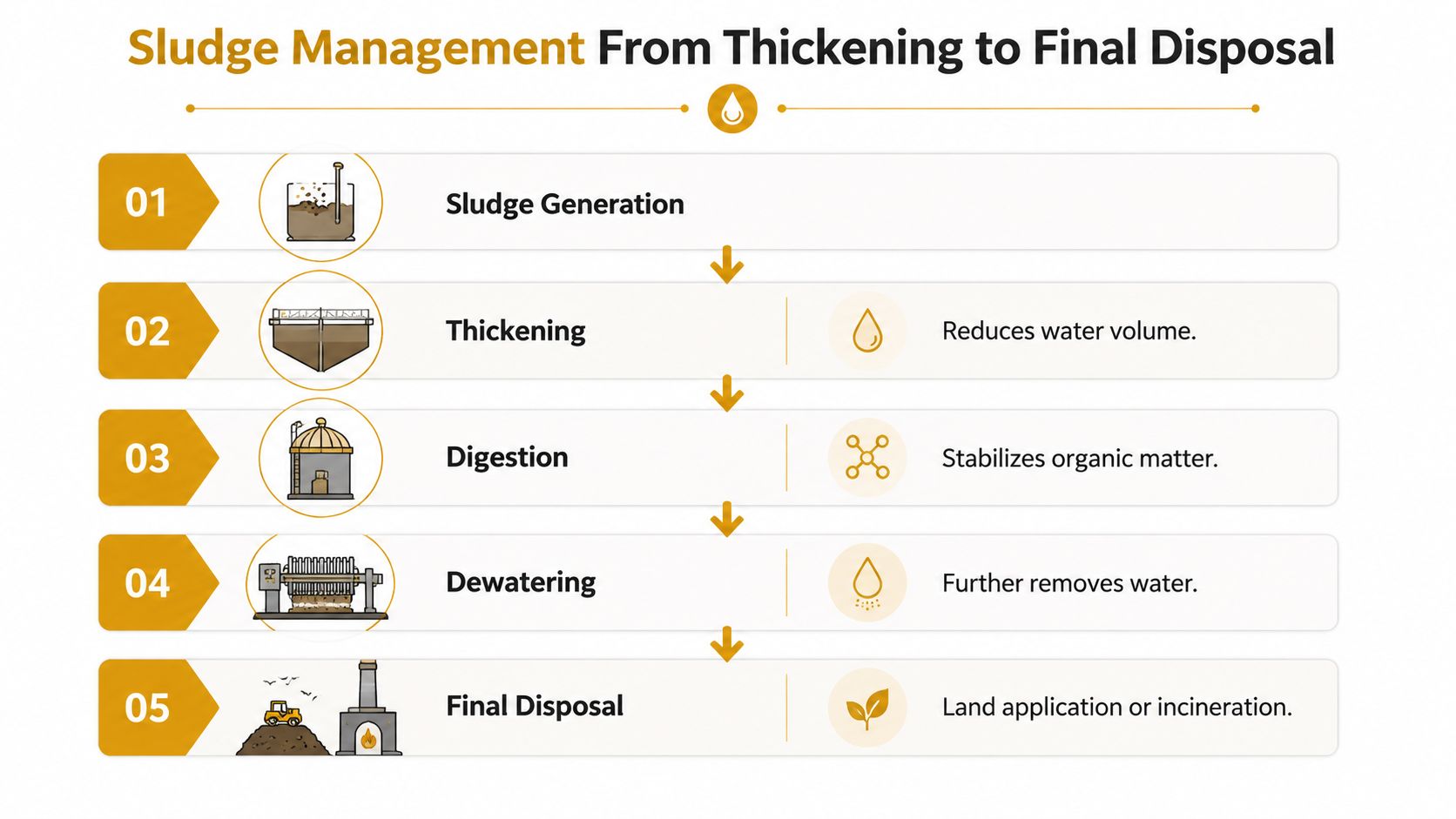
Every treatment system creates a residual stream. At a municipal plant, that stream is sludge. On a concrete site, it may be settled cement solids and hardened washout residue. Removing the liquid does not remove the handling obligation.
The sequence is simple on paper, but each stage affects labor, hauling, equipment, and compliance.
Concentrate the solids before moving them
Thickening reduces water volume. Gravity thickeners, dissolved air flotation, and similar systems raise solids concentration before stabilization and dewatering. The aim is to reduce the material that must be stored, treated, hauled, and accepted for disposal.
A washout pan provides passive settling, but crews still must manage both layers. Water remains above the settled solids, while cement-rich material collects below. Agitating the pan before removal can turn a settled layer back into a difficult slurry. Where the permit and site procedure allow solids to set, leaving the material undisturbed usually makes removal easier.
Stabilize and dewater the residual
Stabilization controls biological activity and odors. Anaerobic digestion reduces biodegradable material without oxygen, while lime stabilization uses chemical treatment. The appropriate method depends on sludge characteristics, available infrastructure, staffing, and local requirements.
Dewatering removes more water through belt presses, centrifuges, filter presses, or drying beds. A belt press can fit a plant with continuous staffing and established polymer handling. A centrifuge uses less floor space, but it requires careful operation and maintenance. Drying beds are mechanically simple, yet they need land, suitable weather, and time.
Practical observation: Hauling water is an avoidable cost, but maximum dryness is not automatically the best target. Extra dryness can consume more energy, chemicals, labor, and maintenance capacity. Set the endpoint around the approved disposal route and the equipment the crew can operate reliably.
Disposal is part of treatment design
Final management may include a permitted landfill, land application, incineration, or beneficial reuse when the residual meets applicable requirements. Classification, testing, hauling records, and receiving-site acceptance determine whether a route is lawful. Hardened concrete residue, municipal biosolids, and industrial sludge should not be assumed to share one disposal path.
That decision belongs in the design before construction starts. A low-cost liquid process can produce a difficult solids stream, increasing project costs through extra storage, handling, testing, or hauling. A simpler system with predictable solids handling may cost less over its service life.
For contractors, the same logic applies to washout containment. Settling is only one step. The plan must identify the water above the solids, the residue below them, the approved removal method, and the receiving facility. Every captured solid needs a destination before the first batch of wastewater enters the equipment.
On-Site Containment Versus Full Treatment for Construction Washout
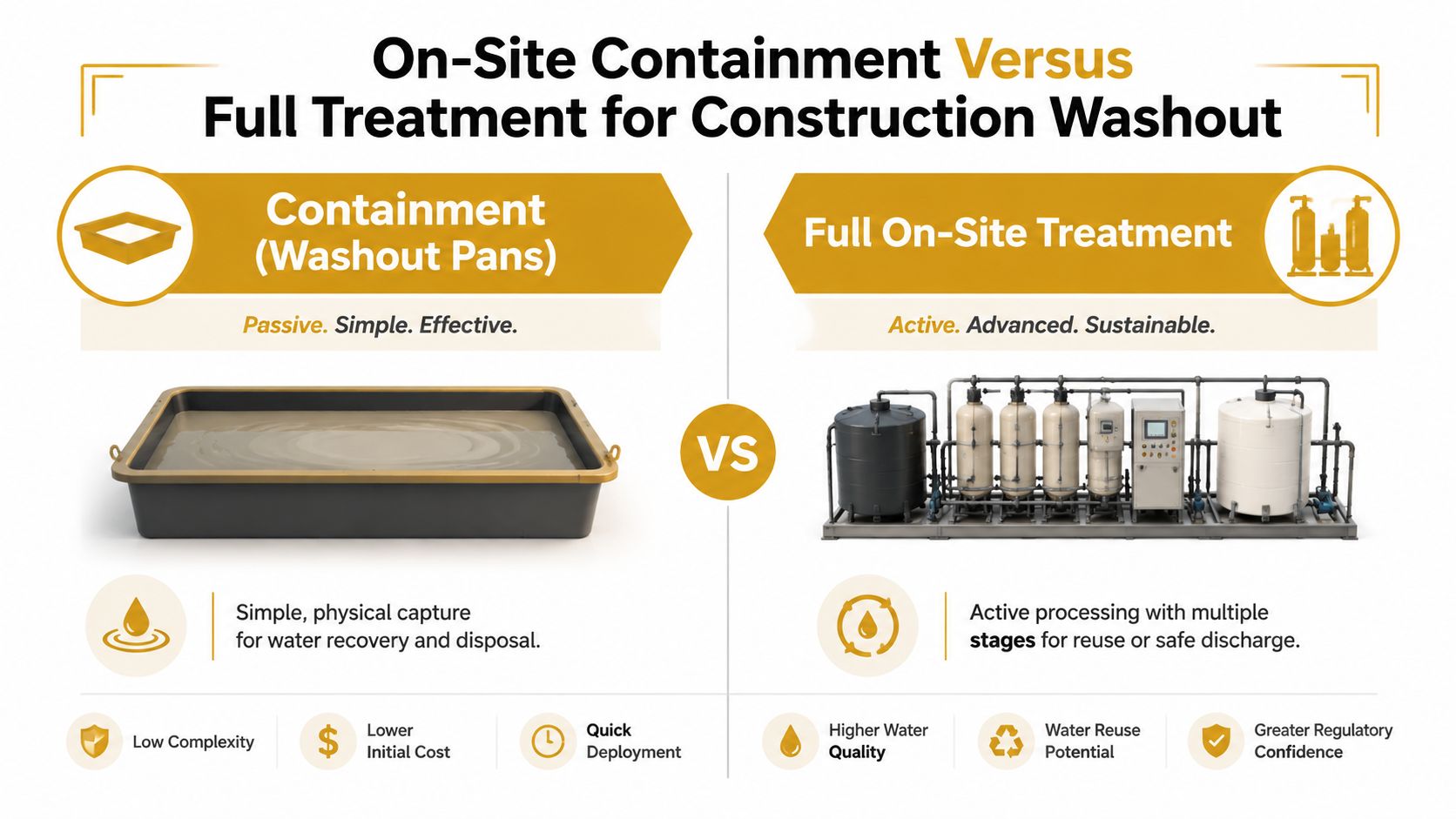
On an active pour, the right washout control depends on the approved endpoint, the site conditions, and what the crew can operate consistently. A pan may suit a contained pour with no discharge. A large project near sensitive water may require filtration, pH adjustment, monitoring, or off-site management.
Start with the permit and the waste route. Confirm where captured water and solids will go before selecting equipment.
Containment works when capture is the approved endpoint
A washout pan is often the practical choice when the project can keep rinse water and solids inside a durable, inspected container, then arrange lawful removal or disposal. Setup is limited, process controls are unnecessary, and operator training focuses on correct use. The trade-off is finite capacity. Rain can reduce available volume, and the crew must inspect the container during the pour.
Containment means capture, secure storage, and management through an approved route. It does not authorize later dumping. If the pan fills, the crew needs a contingency plan, not a hose aimed at the nearest drain.
Active treatment adds capability and responsibility
An on-site treatment train may combine settling, filtration, coagulation, pH neutralization, or other process steps. It can support water reuse or controlled discharge when the project has the required authorization. The system also brings pumps, power, consumables, sampling, maintenance, calibration, and residuals that someone must manage.
| Project condition | More defensible starting point | Main caution |
|---|---|---|
| Routine pour with no permitted discharge | Containment and off-site management | Prevent overflow and unauthorized release |
| Repeated pours over several workdays | Containment sized for the schedule, with backup capacity | Inspect after rain and before each pour |
| Large-volume washout stream | Engineering review of containment and active treatment | Confirm actual flow and solids loading |
| Sensitive receiving water nearby | Conservative containment or approved treatment train | Follow site-specific permit conditions |
| Planned water reuse | Treatment matched to the reuse quality requirement | Verify quality before reuse |
| Remote site without sewer access | Containment, hauling, or modular treatment | Confirm logistics before mobilization |
Treatment selection also affects field supervision. A larger system may consume budget, power, chemicals, and operator time without addressing a real discharge requirement. Undersized containment can overflow during rain and create a release that is more difficult and costly to explain than the original equipment decision.
For a superintendent, the decision is straightforward: match the control to the permitted endpoint and the crew's actual work sequence.
Decision test: If nobody has identified the approved destination for the treated water and settled solids, the system isn't ready for operation.
Compliance Best Practices and When to Rent Containment Solutions
Compliance controls work best when they are installed before the concrete trucks arrive. The washout location should be designated in the SWPPP, visible to drivers, reachable without crossing unstable ground, and separated from storm drains, waterways, and areas where runoff concentrates. The crew should know who checks the container, who handles a damaged liner, and who calls for removal.
Capacity planning must reflect the actual work sequence. Consider the pour duration, number of trucks, chute and pump cleaning practices, expected rainfall, and how often the container can be serviced. A container that fits the first pour may not fit a multi-day placement with no pickup access.
Controls that prevent common failures
- Choose the location early: Place containment where trucks can reach it without tracking slurry across the site.
- Protect the container: Use a stable base, inspect seams and liners, and keep sharp debris away from the containment surface.
- Control rainwater: Cover the pan when practical, or provide a documented plan for keeping stormwater from consuming the available capacity.
- Assign inspections: Record condition, approximate fill level, weather exposure, and corrective action.
- Plan removal: Confirm pickup timing and the receiving route before the container becomes full.
Rental containment can make sense for a short project, a remote work area, a multi-day pour, or a site that doesn't want to purchase, store, and maintain specialized equipment between jobs. Available products may include a 72 by 72 by 24 inch option listed at approximately 18.25 tons and about 441 gallons, along with a 72 by 72 by 14 inch option listed at about 310 gallons, according to the supplied publisher information. Verify dimensions, working capacity, access, and local requirements before ordering.
Documentation protects the project
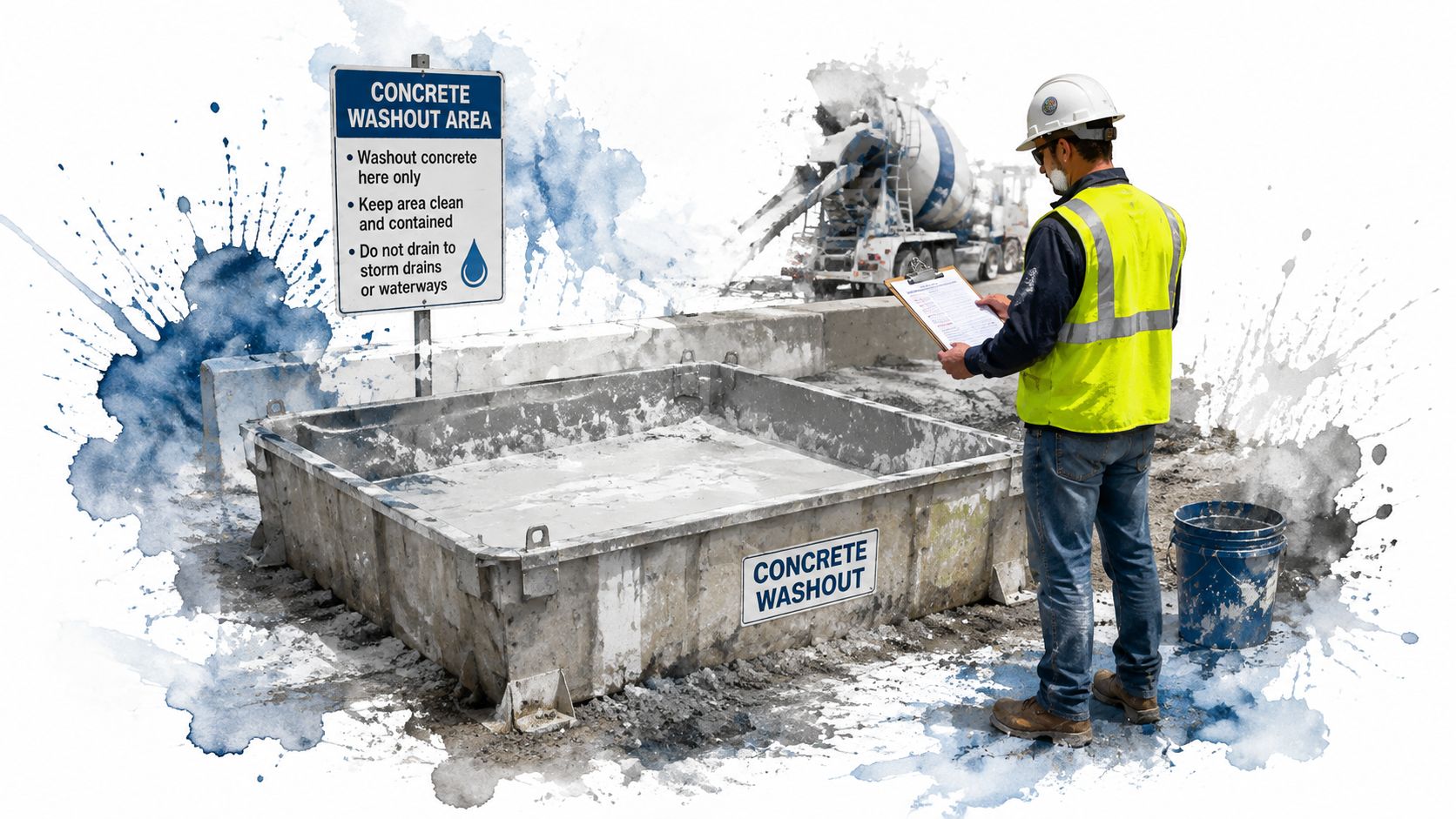
Photograph the installed washout, note its location on the site plan, and retain delivery, inspection, service, and pickup records. During an inspection, organized documentation shows that the contractor designed a control, assigned responsibility, and responded when conditions changed.
Don't wait until an inspector finds a full pan. The best time to adjust capacity is before the pour, when the change is logistical rather than corrective.
Building Your Wastewater Management Strategy for the Next Pour
Before the next pour, walk the site as if you're tracing every drop of water. Identify the pour area, truck route, storm drains, low points, slopes, nearby receiving waters, and the place where captured solids will ultimately be managed.
Use this decision sequence:
- Read the controlling documents. Check the SWPPP, permit conditions, municipal requirements, and any project-specific environmental restrictions.
- Define the waste stream. Separate concrete washout from sanitary wastewater, fuel-contaminated water, excavation water, and other streams that may require different handling.
- Select the control. Use containment when capture and approved disposal meet the requirement. Obtain engineering and regulatory direction before adding active treatment or planning discharge.
- Size for the work pattern. Account for trucks, pump cleaning, rain exposure, access, and service timing rather than choosing equipment by footprint alone.
- Assign ownership. Name the person responsible for inspections, overflow response, records, pickup, and subcontractor instruction.
- Prepare a failure response. Keep spare protective materials available, stop washout if capacity is threatened, and report or correct releases according to the project requirements.
The most economical wastewater treatment strategy isn't automatically the one with the fewest components. It is the one that controls the pollutant, satisfies the discharge or disposal requirement, and remains operable when the site is busy, wet, and short on time.
Reborn Rentals provides ready-to-deploy concrete washout pans and containment solutions for projects ranging from small renovations to major pours, with delivery coordination and clear rental options. Visit Reborn Rentals to review available equipment and arrange containment before your next pour.