A crew has concrete on the way, inspectors can show up any time, and the washout plan has to work the first time. Then the rental arrives late, the container is in rough shape, or nobody can answer a basic delivery question. At that point, “customer satisfaction” stops sounding like office language and starts sounding like schedule risk.
That's why customer satisfaction metrics matter in equipment rentals. On a job site, the customer's opinion shows up in very practical ways. They call back for the next pour. They stop calling. They warn another superintendent. They escalate a billing dispute because the delivery window slipped and the crew stood around waiting.
For rental operations, especially in concrete work, good service isn't about charm. It's about timing, condition, communication, and follow-through. If you measure those poorly, you'll keep finding out about problems after the truck has already missed the gate.
Why Bother with Metrics on a Job Site
A contractor rarely complains because they enjoy giving feedback. They complain because something got in the way of production. Maybe the washout pan showed up later than promised and the crew had to improvise. Maybe the unit was usable, but not clean enough for a site that's already under scrutiny. Maybe dispatch said one thing, the driver said another, and the field team burned time sorting it out.
That kind of friction doesn't stay isolated. It spreads into labor efficiency, compliance exposure, and trust.
Satisfaction is really a risk signal
In equipment rental, customer satisfaction metrics aren't vanity numbers. They're early warning lights. A low score after delivery often points to a process gap long before the account is lost. The customer may still finish the job with your equipment, but they're already deciding whether to use you again.
On construction projects, that decision happens fast. Field teams remember vendors who make the day easier, and they remember the ones who create extra calls, extra waiting, and extra paperwork.
Practical rule: If a service issue can delay placement, cleanup, pickup, or compliance, it belongs in your satisfaction tracking.
A lot of operators make the mistake of treating feedback as a complaint folder. That's too late. By then, the cost has already landed on the site. A useful measurement system does something else. It tells you where customers are losing confidence before the relationship gets brittle.
What the score is really telling you
In rental operations, a weak satisfaction signal usually maps back to one of these realities:
- Delivery reliability: The equipment didn't arrive when the field team expected it.
- Equipment readiness: The unit showed up, but condition or fit wasn't right for the job.
- Communication quality: The customer had to chase updates instead of getting clear answers.
- Administrative friction: Booking, changes, paperwork, or pickup took too much effort.
- Trust for the next job: The customer used you once, but doesn't want to risk a repeat.
Those aren't abstract brand issues. They affect whether a superintendent keeps your number, whether accounting challenges the invoice, and whether your company gets considered on the next mobilization.
The Core Three Customer Satisfaction Metrics
On a rental job, three questions matter more than the rest. Was the last interaction good? Was it easy to work with us? Would this customer trust us on the next job or recommend us to another contractor? Those questions map to CSAT, CES, and NPS.
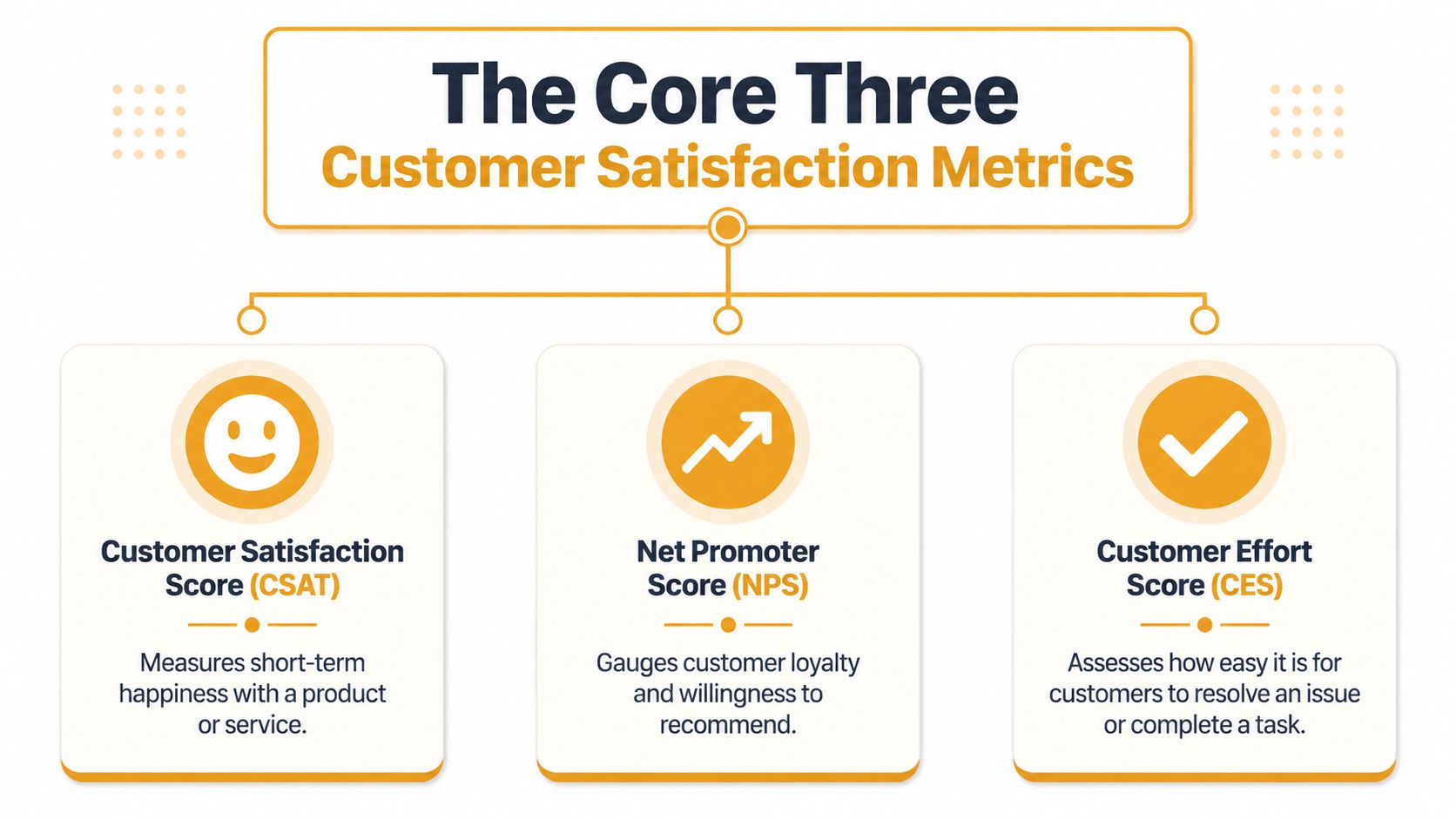
These metrics show up in plenty of SaaS and retail guides, but rental operations need a stricter reading. A decent score is not just about brand sentiment. It affects whether the concrete crew waits on a delivery, whether the foreman accepts the replacement unit, and whether the contractor gives your dispatcher another chance next month.
CSAT measures the last touchpoint
Customer Satisfaction Score, or CSAT, captures how the customer felt about a specific interaction. It is usually calculated as the share of satisfied responses out of total responses, multiplied by 100. Rating scales vary, and this overview of customer satisfaction KPIs and CSAT calculation lays out the common formats.
For equipment rental, CSAT works best right after a moment that can help or hurt the day's schedule. Delivery, swap-out, pickup, off-rent processing, and invoice resolution are all good candidates.
Use CSAT to answer narrow operational questions:
- Did the unit arrive when the site expected it?
- Was the equipment clean, ready, and correct for the task?
- Did pickup happen without extra calls or confusion?
- Did billing match what the customer thought they ordered?
CSAT is immediate. That makes it useful, but also limited. A contractor can be satisfied with one pickup and still have low confidence in your company overall.
NPS measures account-level trust
Net Promoter Score, or NPS, asks whether the customer would recommend your company. The standard calculation subtracts the percentage of detractors from the percentage of promoters.
In rental terms, this is less about marketing and more about reputation on active jobs. If a superintendent recommends your company to another PM, they are attaching their own credibility to your delivery time, equipment condition, paperwork, and follow-through.
That is why NPS belongs at the relationship level, not after every routine transaction. Use it to gauge whether the account sees your branch as dependable enough for the next phase, the next site, or the next bid.
NPS has a trade-off. It is broad, so it can signal trust problems before revenue drops. It is also too general to tell dispatch or service exactly what failed. If your NPS slips, someone still needs to trace it back to the handoffs that created the doubt.
CES measures friction
Customer Effort Score, or CES, measures how hard the customer had to work to get something done. Surveys use different scales, but the point is consistent. High effort creates frustration, even when the job eventually gets done.
This metric matters more in rental than many operators expect. Contractors deal with enough moving parts already. If they have to call twice to confirm delivery, chase a revised contract, or explain the same issue to sales and dispatch, the process starts costing them time they do not have.
Good CES questions fit moments like these:
- Rescheduling a delivery after a site delay
- Requesting a pickup or off-rent change
- Resolving a service problem in the field
- Getting COIs, tickets, or billing documents corrected
A customer will often forgive one mechanical issue. They are less likely to forgive a process that burns an hour across the trailer, the field, and the office.
Use each metric for the job it fits
The mistake I see most often is overloading one score and expecting it to explain the whole account. It will not. Each metric answers a different operational question.
| Metric | What it answers on a job site | Best use |
|---|---|---|
| CSAT | Was this specific rental interaction satisfactory? | Delivery, pickup, equipment condition, billing touchpoints |
| NPS | Does this customer trust us enough to recommend us? | Account health, reputation, long-term loyalty |
| CES | How much work did we create for the customer? | Scheduling, support, changes, issue resolution |
If a customer praises your equipment but complains that every schedule change takes four calls, NPS may stay flat for a while and CSAT may look acceptable on isolated transactions. CES will catch the drag sooner. That is why the three metrics work best together. They show whether the job went well, whether the process was painful, and whether the customer trusts you enough to come back.
Operational Metrics That Measure Real Happiness
Survey scores matter, but they're only half the picture. In equipment rental, some of the clearest signs of customer satisfaction come from behavior and operations. Customers tell you what they think in a survey. They tell you what they really think in their next order, their cancellation, and the way they respond when dispatch calls.

Watch what customers do next
The strongest practical indicators in a rental business are usually operational.
- Repeat rental rate: If the same contractor books again, that's trust in action.
- Customer churn rate: If an account goes quiet after one or two rentals, something likely broke in the experience.
- Delivery timeliness: If the equipment arrives when promised, the site can plan around it.
- Damage or incident patterns: If condition issues keep surfacing, customers may not complain every time, but they notice.
These metrics matter because they connect service quality to field reality. A contractor may give a polite score and still stop calling. Another may complain loudly after one rough delivery but remain a strong account because the issue was handled well.
Sentiment without behavior can mislead you
Many guides for rental operations miss the mark. A nice-looking score doesn't always translate into repeat business. Simon-Kucher notes that a high NPS score doesn't guarantee customers will keep buying, and a low CSAT score doesn't always mean they'll leave, which highlights the gap between sentiment metrics and financial outcomes in its analysis of how customer satisfaction metrics relate to revenue.
That's a very familiar pattern in construction. Some customers score generously because they've known your team for years. Then procurement shifts, a few delivery misses pile up, and the work goes elsewhere. Other customers score hard because the job was under pressure, but they keep renting because your operation still solves their problem better than the alternatives.
Field test: If your survey scores look healthy but repeat orders are thinning out, trust the booking data first and investigate the gap.
Operational metrics make survey data useful
The practical move is to line up sentiment with proof.
Consider this simple comparison:
| Signal | What it suggests | What to check next |
|---|---|---|
| High CSAT, weak repeat business | Customers liked the transaction but didn't build loyalty | Pricing clarity, account coverage, scheduling consistency |
| Low CSAT, strong repeat business | Customers still need the service but friction exists | Delivery windows, unit condition, communication handoffs |
| Low CES, more support calls | Customers are working too hard to do basic tasks | Booking flow, dispatch updates, one-call resolution |
| Late deliveries and more complaints | Operational failure is driving dissatisfaction | Routing, staffing, staging, site access confirmation |
Rental businesses gain an advantage over generic customer experience programs. You don't have to guess what matters. The site tells you. If the unit is late, dirty, mis-sized, or hard to schedule, satisfaction drops for reasons you can fix.
How to Collect and Calculate These Key Metrics
A contractor does not fill out a long survey while a crew is waiting on a lift. Collection has to fit the rental process you already run. If it takes extra manual effort from dispatch, yard, or inside sales, it slips the first time the day gets busy.

The cleanest approach is to tie each question to a real service event. That gives you feedback with context, which matters far more than a generic monthly pulse.
Use the trigger that matches the touchpoint:
- After delivery: Ask whether the unit arrived on time, was placed correctly, and was ready to work.
- After pickup: Ask whether scheduling was clear, the driver communication was solid, and the closeout process made sense.
- After a service call: Ask how hard it was to get the problem handled.
- After the full rental is closed: Ask whether the customer would recommend your company.
SMS usually gets better response from field contacts because superintendents and foremen are rarely sitting at a desk. Email fits project coordinators, purchasing, and office staff better, especially for questions about paperwork, rates, or invoicing. Timing matters. Send the request while the delivery, breakdown, or pickup is still fresh.
Keep the survey short. One scored question and one comment box is enough for most events.
These prompts work well in rental operations:
- CSAT question: “How satisfied were you with this rental experience?”
- NPS question: “How likely are you to recommend our rental service to another contractor?”
- CES question: “How easy was it to book, schedule, or resolve your request?”
The open comment field does a lot of the heavy lifting. A low score tells you there is a problem. The comment usually tells you whether it came from a late truck, the wrong attachment, poor site access communication, or a billing mismatch.
Calculation should stay simple and consistent. A spreadsheet is enough if everyone uses the same definitions every time. If one branch counts a 3 out of 5 as satisfied and another does not, the score becomes useless.
Use these formulas:
- CSAT = (Number of satisfied responses / Total number of responses) × 100
- NPS = % of promoters – % of detractors
- CES = Sum of all individual effort scores / Number of respondents
- Customer retention rate = [(Customers at end of period – New customers during period) / Customers at start of period] × 100
For CSAT, define in advance what counts as satisfied. On a 5-point scale, many teams count 4 and 5 as positive. The important part is not the exact threshold. The important part is using the same threshold across every branch, rep, and reporting period.
For NPS, sort responses into the standard groups before you do the math. Promoters score 9 or 10. Passives score 7 or 8. Detractors score 0 through 6. Then subtract the percentage of detractors from the percentage of promoters.
For CES, decide whether you are tracking average effort across all responses or the share of customers who selected the easiest ratings. Either method can work. Just do not switch methods quarter to quarter and expect a clean trend line.
Rental operators should also calculate a few operational measures from internal records, because survey scores alone miss a lot:
- Repeat rental rate: Count how many accounts placed another order within your normal rental cycle.
- Delivery timeliness: Compare promised delivery windows with actual arrival times from dispatch records.
- Equipment-ready rate: Track how often units arrive clean, fueled or charged, inspected, and ready to go.
- Churn pattern: Review accounts that used to rent regularly and then stopped booking.
Those measures tie customer sentiment to job-site reality. If NPS drops in one branch and on-time delivery also slips, you have a lead to work. If CSAT stays high but repeat rentals fall, the service may be acceptable while pricing, coverage, or account management is losing the next order.
Build the collection step into the handoff so it happens without reminders:
- The event closes in your rental system.
- An automatic SMS or email sends the right question for that event.
- Responses feed into a shared log or dashboard for operations, customer service, and branch managers.
- Low scores create follow-up tasks for the team that can fix the issue.
The follow-up owner matters. Feedback about late delivery should go to dispatch leadership. Feedback about dirty or faulty equipment should go to the yard or service manager. Feedback about confusing charges should go to billing. If comments only land in a marketing inbox, nothing changes on the ground.
Setting Benchmarks and Interpreting Your Scores
A branch can post an 86 percent CSAT and still lose a concrete crew's next order because the telehandler showed up late on a pour day. That is the benchmark problem in rental. A decent-looking score can hide the kind of failure a superintendent remembers when the next project starts.
General customer satisfaction ranges are useful for orientation, but they are a weak operating target for equipment rental. Contractors are not grading a mobile app or a retail checkout line. They are judging whether your team protected the schedule, sent equipment that was ready to work, and solved issues without creating more calls, delays, or change-order headaches.
That shifts how benchmarks should be set.
Start with your own history before you compare yourself to broad market averages. A branch that has held steady for six months and then drops across two or three measures needs attention, even if the headline score still looks acceptable on paper. In practice, the better benchmark is your recent baseline by branch, customer type, and rental event.
A national account running infrastructure jobs will score differently than a local contractor renting a skid steer twice a month. Emergency replacement deliveries also produce different feedback than planned weekly rentals. If all of that gets blended into one company average, weak spots stay hidden until revenue moves.
Use benchmarks at three levels:
- Company level: Shows whether the overall service model is getting better or worse.
- Branch level: Exposes local execution problems in dispatch, yard prep, staffing, or communication.
- Touchpoint level: Shows where the friction sits, such as delivery, equipment condition, off-rent pickup, or invoicing.
The most useful question is not, “Is this score good?” It is, “Is this score good enough to keep the next rental?”
That is why score interpretation needs context around the work. A single low response after a storm-delayed delivery may not mean much if communication was clear and recovery was fast. A pattern of average scores paired with comments about dirty machines, missing attachments, or no pickup updates points to a process problem that will hit repeat business.
This read on the numbers works well in rental operations:
| Score pattern | What it usually means in rental |
|---|---|
| Stable scores and steady repeat business | Customers are getting what they were promised, with few surprises |
| Scores slipping across branches | A broader operating issue is developing, often staffing, fleet availability, or dispatch discipline |
| Strong averages with a few severe complaints | The process works most of the time, but failures are expensive when they happen |
| One weak touchpoint, others holding steady | The problem is probably contained to one handoff, such as billing, pickup coordination, or yard release |
Interpret NPS carefully in this industry. A contractor may recommend your company while still being frustrated by a few preventable misses, because local options are limited or your fleet coverage is strong. The reverse is also true. A customer may give a modest recommendation score even while continuing to rent because your branch solves problems faster than competitors. NPS has value, but in rental it works best as a relationship signal, not a standalone operating grade.
CSAT and CES usually give clearer direction at the branch level because they tie more closely to specific events. If post-delivery CSAT drops while invoice satisfaction stays flat, the operation knows where to look first. If effort scores worsen for off-rent requests, the issue may be handoffs between the counter, dispatch, and drivers rather than customer sentiment in general.
Retention matters more than trophy scores. A customer who renews rentals, expands to additional categories, and stops price-shopping every order is telling you more than a polished monthly average ever will. Set benchmarks that connect to those outcomes, then judge each score by one standard: did this part of the rental experience make the customer's job easier or harder?
Actionable Steps for Improving Your Rental Service
Metrics only earn their keep when they change how the operation runs. If a score drops and nothing changes in dispatch, yard prep, driver communication, or billing, the measurement program becomes theater.
The fastest way to improve customer satisfaction metrics is to tie each signal to a specific corrective action.
If this metric moves, do this next
If CSAT drops after delivery, inspect the handoff first. Don't start with a generic customer service retraining session. Check whether the promised window was realistic, whether the driver had complete site information, and whether the equipment arrived in the condition the site expected.
If CES gets worse, simplify the process before you script better apologies. Customers usually report high effort because they had to repeat details, wait for callbacks, or coordinate through too many people.
If NPS softens, don't assume your reputation problem is branding. In rental operations, weak recommendation intent often starts with repeated operational friction.
A practical response map looks like this:
- Low delivery-related feedback: Tighten dispatch confirmation, verify gate and placement instructions earlier, and update customers before they have to ask.
- Condition complaints: Add a stricter yard-release checklist. Customers notice readiness long before they mention it formally.
- High-effort feedback: Reduce handoffs. One contact who can confirm date, location, and pickup beats three separate updates from three different people.
- Weak repeat activity from a previously steady account: Review the full account history, not just the last survey score. Look for service inconsistency, invoice surprises, or missed follow-up after an issue.
Don't confuse approval with loyalty
This is the trap many teams fall into. They see a decent NPS and assume the account is safe. Simon-Kucher's analysis makes the opposite point clearly: a high NPS score doesn't guarantee customers will keep buying, and a low CSAT score doesn't always mean they'll leave, as noted earlier in the linked discussion of the disconnect between satisfaction metrics and financial outcomes.
That means every improvement effort should answer two questions at once:
- Did the customer report a better experience?
- Did behavior improve after that?
Manager's shortcut: Pair every sentiment metric with one operational metric. CSAT with on-time delivery. CES with support follow-ups. NPS with repeat rentals.
Fix root causes close to the work
The best improvements usually aren't glamorous. They're operational.
Examples that tend to move the needle in rental businesses:
- Cleaner order intake: Require site address, contact name, access notes, and placement details before dispatch locks the run.
- Better pre-delivery communication: Confirm the window and any access constraints before the truck leaves the yard.
- Clearer fees and exceptions: Avoid surprise charges that turn a completed job into an account dispute.
- Tighter pickup coordination: Don't make the customer chase removal on a busy site.
Customers rarely ask for innovation in a rental transaction. They ask for predictability. If you deliver what was promised, when it was promised, with less effort on their side, the scores usually follow.
Building a Simple Customer Satisfaction Dashboard
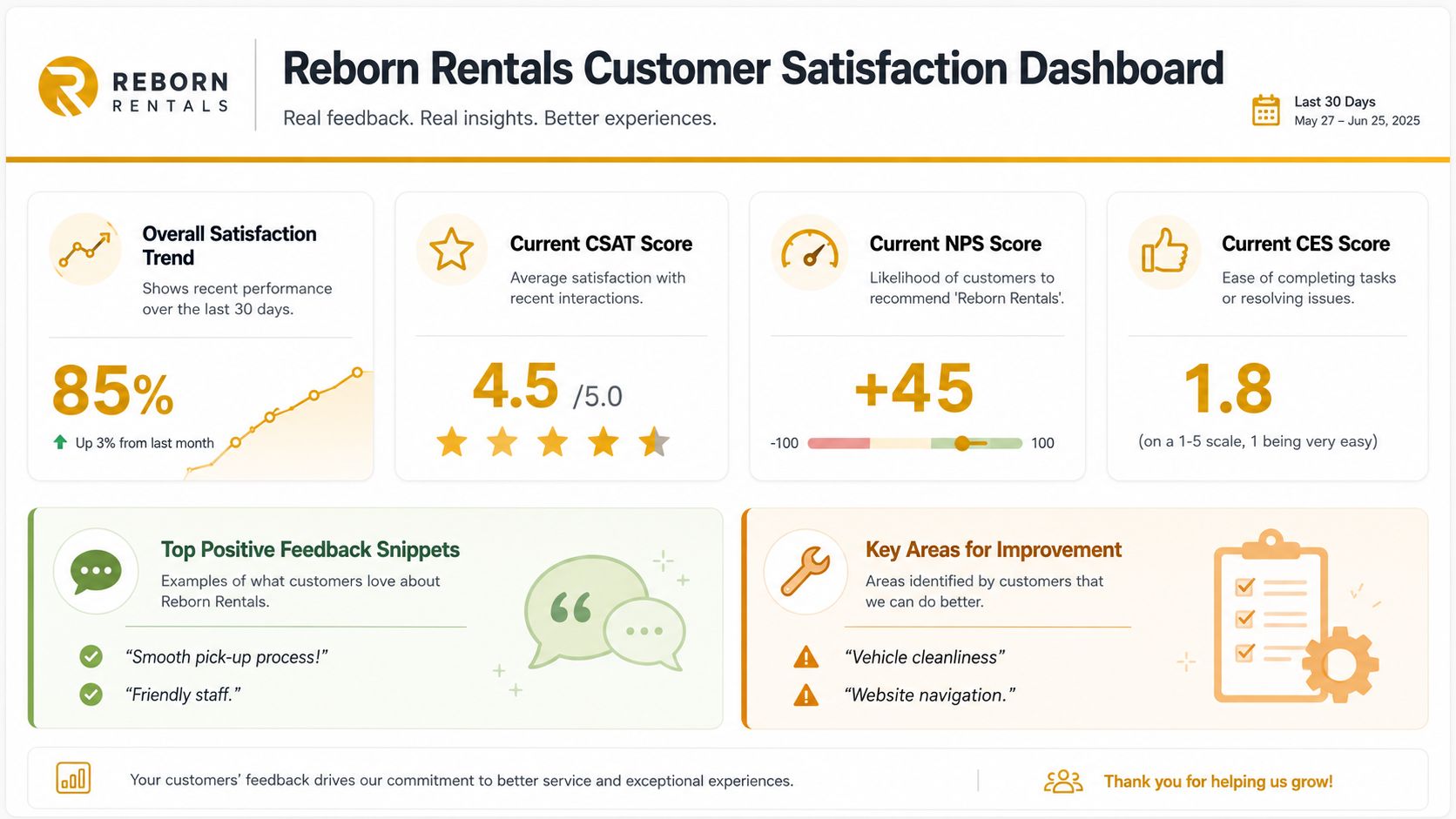
A useful dashboard for rental operations should answer one question quickly: are customers getting an experience they trust enough to repeat?
It doesn't need to be a complicated business intelligence project. It needs to help an operations manager spot service risk before it spreads across active accounts.
What to put on the screen
Keep the view tight. A dashboard should typically include these elements:
- CSAT trend: A short time-series view that shows whether recent rental interactions are improving or slipping.
- NPS trend: A broader relationship signal that helps management watch reputation and referral strength.
- CES snapshot: A friction indicator for booking, coordination, and support.
- Repeat rental activity: A practical check on whether customers are coming back.
- Delivery timeliness metric: A service reliability signal tied directly to field expectations.
- Comment highlights: A small feed of recent feedback phrases that gives context to the numbers.
How to make it useful in real operations
The dashboard should help a manager scan for exceptions, not admire averages. If CSAT is steady but comments mention late arrivals, the comments deserve attention. If NPS is fine but repeat orders dip, operations should treat that as a real warning.
A clean layout usually works better than a crowded one:
| Dashboard block | Why it matters |
|---|---|
| Top-line sentiment | Gives a fast read on how recent interactions felt to customers |
| Operational proof | Confirms whether good scores match customer behavior |
| Touchpoint breakdown | Shows where delivery, support, or billing is creating drag |
| Recent comments | Adds job-site detail that metrics alone can't show |
One review rhythm works especially well. Operations looks at the dashboard daily for urgent issues. Management reviews trends weekly for process changes. Monthly review is where you decide whether a recurring problem needs staffing, routing, training, or pricing clarity.
A good dashboard doesn't replace conversations with customers or crews. It makes those conversations sharper. Instead of saying, “We've had some complaints,” you can say, “Delivery satisfaction is slipping, repeat business from a few accounts is softening, and the comments point to scheduling confusion.” That's actionable.
If your team needs dependable washout containment with clear pricing, straightforward scheduling, and communication channels that fit the way job sites operate, Reborn Rentals is worth a look. Their rental process is built for contractors who need compliant equipment delivered and picked up without adding more friction to the day.